eBook - ePub
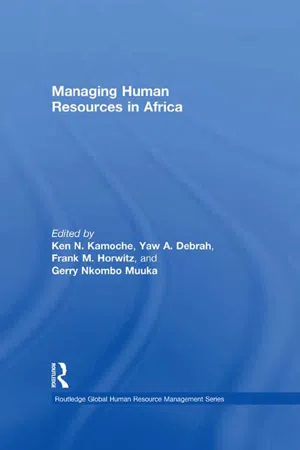
Managing Human Resources in Africa
- 224 pages
- English
- ePUB (mobile friendly)
- Available on iOS & Android
eBook - ePub
Managing Human Resources in Africa
About this book
As rival economies mature, attention shifts to new frontiers - such as Africa. Yet academic debate often neglects the complexities of this diverse continent, and the challenges faced by both multinational companies and domestic companies; particularly those in the Human Resource (HR) field.This is a refreshing new book that boldly tackles the HR ch
| 1 | HRM in South Africa |
Introduction
Any discussion of human resource management in South Africa (SA) must consider both global and local context. Much work has occurred on the promulgation of labor legislation to redress historical workplace discrimination in SA. Whilst local institutional context in labor relations and particularism in HRM practices remain important, the influence of convergent forces such as globalization, information technology, and increased competition have become much more prominent in post-apartheid SA. We explore the complex context influencing the management of human resources in SA and its impact on human resource practices in organizations.
South Africa has a total population of 45.31 million and a GDP per head of R21,889 (US$2,230) (Statistics SA, 2002). Its GDP is R243.22 billion (US$23.65 billion). GDP growth for the past three years has been around 3 percent, slightly above the global average. Inflation has been below 10 percent for the past six years, but moved above this in 2002–2003 (11.6 percent). Formal sector employment is approximately 15 million. Over 500,000 jobs have, however, been lost in this sector due to retrenchments following organizational restructuring and downsizing since 1994. There is a rapidly growing informal and casual worker sector. Historically, the economy was dependent on the mining industry, including gold, coal, and other minerals. Over the past decade the GDP contribution of these sectors declined to under 35 percent as industrial and export strategies in the auto assembly, manufacturing, and agriculture sectors were aggressively pursued. Although SA has made a relatively successful transition from a resource-based economy to a manufacturing and export oriented model, it has not created significant formal employment (Fraser, 2002), although the post-apartheid open economy saw significant growth in the tourism and hospitality industries. Whilst the economic fundamentals of macro-economic policy appear sound, high unemployment persists, estimated at 29 percent (Statistics SA, 2002). Crime and an HIV/AIDS epidemic are pressing social problems for policy choices. Estimated shrinkage from year 2002 to 2015 of real GDP owing to AIDS ranges from 2.8 to 9.6 percent (ABSA Bank and ING Barings, 2002).
South Africa is an ethnically diverse society. English, Xhosa, Zulu, Sotho, and Afrikaans are the most widely spoken languages. Black people (Africans, colored people, and Indians) comprise over 75 per cent of the population. Since its establishment as a trading post by the Dutch East India Company in 1652, SA had colonial governments from Britain and the Dutch (Afrikaaner) settlers. Racial discrimination and wars for control over territories and land were a feature of SA's history for over two centuries. Apartheid was formally instituted as a political system by the Nationalist Party in 1948, and abandoned in 1994 with the country's first democratic election, after decades of a continuing political struggle by the African majority and its representative parties such as the African National Congress. The latter and other opposition groups had been banned from the 1960s until the release from prison of Nelson Mandela and other political prisoners in 1990.
The industrialization of SA began with the discovery of gold and diamonds at the end of the nineteenth century. Preference for skilled and managerial work was given to white workers, who were given trade union and collective bargaining rights by the Industrial Conciliation Act (1924). African workers were excluded from these rights until 1980. Access to training and skilled work was denied to Africans. The legacy of institutionalized workplace discrimination has meant that organizations in the “new South Africa” now have to develop a skilled and productive workforce, which was previously under-utilized, poorly trained, and alienated from performance improvement and competitiveness goals. This is a vital challenge for human resource management today.
Major stakeholders in HRM and labor relations are represented in the tripartite National Economic Development and Labor Council (NEDLAC). Employers may belong to employer organizations represented nationally by bodies such as the SA Chamber of Business. Trade unions belong to union federations such as the Congress of South African Trade Unions (COSATU), with some 3 million members in its affiliates. NEDLAC is an important statutory body aiming to foster a social partnership amongst organized business, labor, and the State, through joint consensus seeking on national labor market policy issues and proposed labor legislation such as skills development, employment equity, and labor relations laws. NEDLAC also has a chamber where small business can be represented as an interest group.
Many human resource practitioners are members of a professional association, the Institute for People Management (IPM), which, together with the SA Board for Personnel Practice (SABPP), seeks to enhance the professional standing of the HR profession by providing professional accreditation and standards of ethical and professional conduct. The IPM provides an educational function, running seminars, diploma and advanced programs, and disseminating relevant information through newsletters to members. The SABPP is accredited with the national skills and qualification authority and has played a key role in the formation of this body. The IPM has its own HR magazine, People Dynamics, aimed at practitioners. It hosts a large annual conference, with local and international experts as speakers. Many industrial relations specialists belong to the Industrial Relations Association of SA (IRASA), an affiliate of the International Industrial Relations Association (IIRA) based at the ILO in Geneva.
Strategic human resource imperatives
Two imperatives reflect the critical relevance of a strategic approach to HR in SA. First, to address the discriminatory legacy of apartheid in removing unfair discrimination in the workplace and enhancing organizational representation of Africans, colored people, Indians, and women. Apartheid education and skills legislation created a relatively unique basis for skills and earnings inequalities. African access to trades and skilled work was legislatively prohibited by job reservation in favor of white employees in the then Industrial Conciliation Act (1956) and the Mines and Works Act. These were repealed in 1980—some twenty years ago, yet African progress into skilled and managerial work has been slow. A new culture of learning and integration rather than reliance only on “access and legitimacy and discrimination and fairness” perspectives has become necessary to ensure cohesive and productive work group relations in diverse settings (Ely and Thomas, 2001).
The second strategic imperative is formulating HR strategies at both national and organizational levels to enhance competitiveness and performance improvement. South Africa's re-entry into competitive global markets in the 1990s created new managerial challenges. Human resource practitioners in SA see the most important workplace challenges as performance improvement, employment equity, training and development, and managing trade union expectations (Templer and Hofmeyr, 1989). It is essential that South African organizations spend between 0.5 to 1.5 percent of the payroll on training compared to 5 percent in Europe and the USA and 8 percent in Japan. The apartheid legacy in SA created a racial segmentation of the labor market in respect of access to higher level technological skills (Barker, 1999; Isaacs, 1997; Standing et al., 1996). Training and development are seen by both managers and frontline employees in the services industry in SA as vital in addressing the skills gap and developing the capacity to meet competitive demands (Browning, 2000). Although not yet viewed by a majority of South African firms as a strategic issue, the rate of HIV/AIDS in the labor force is viewed by some as having the potential to erode productivity gains made through skill development efforts. According to the Medical Research Council of South Africa, about 12–15 percent of the population is HIV-infected. AIDS has become the single biggest cause of death (Dorrington et al., 2001). Firms in the mining industry are expected to be hit particularly hard because of the legacy of migrant labor. Some large firms, like AngloGold, have responded by offering employees access to HIV drugs. As the impact of the disease becomes more evident, firms may have no choice but to address it has a strategic human resource management challenge.
Templer et al. (1997: 551–558) found a preference for developing an African model of management, with less reliance on American and Japanese approaches. A comparative study found agreement between human resource practitioners in Canada, SA, and Zimbabwe on the need for flexible work practices and cost effectiveness, but significant differences in priorities. South African practices under apartheid focused on personnel administration and industrial relations. This has shifted to emphasizing employment equity, performance management, and organizational restructuring, often resulting in downsizing and retrenchments. The twin challenges of redressing labor market inequalities created by apartheid and simultaneously and rapidly creating competitive capabilities are daunting, often competing, but unavoidable HRM challenges. The magnitude of these challenges is best understood within their historical and stakeholder context. African economic empowerment has become a priority for the new government as a strategy to break through the social closure created by past discriminatory policies.
A feature of macro-economic policy is to attract foreign direct investment and multinational firms, often in joint ventures with local empowerment companies. An important question arises whether the influence/power of multinational corporations (MNCs) is so extensive and penetrative as to override local implementation factors such as the regulatory environment, including legislated employment standards and collective bargaining, and cultural factors. Effective diffusion and integration of HR practices will therefore depend on the relative importance of these factors. The stakeholder perspective is relatively well accepted in SA's new democracy. The historical exclusion of key stakeholders under apartheid has been replaced by a new emphasis on consultation and involvement of key groups and individuals, for example in NEDLAC. It includes organized business, labor and government departments in formulating industry, and labor market policies. Arguably, the stronger the stakeholder and pluralist perspectives are institutionalized in a society, the more likely that “crossvergent” or hybrid models of HRM will develop.
The labor market and institutional environment—
emergent trends
A structural inequality in the skill profile exists: a shortage of occupationally and managerially skilled employees is contrasted with an oversupply of unskilled labor, ill equipped for a modernizing economy with increasing knowledge and service sector priorities. South Africa has a rapidly growing and large youth population, which is predominantly African, poor, and lacking in education and skills. This presents a huge challenge to the state, public institutions, and private sector. The labor market absorption rate for young entrants, given modest economic growth of 2 to 3.5 percent over the past six years, has been low. Given the lack of relevant skills in market demand fields, coupled with shrinking formal core employment, youth unemployment is high. Socio-economic and labor market issues remain pressing managerial and business challenges in the post-apartheid transitional economy. The government has relaxed legislative provisions on basic conditions of employment to allow greater flexibility for small firms and is encouraging better education and occupationally relevant skills through the Skills Development Act (1998). It aims at encouraging the provision of opportunities for new labor market entrants to develop skills and gain experience for better employment prospects.
Human resource development priorities and policy challenges in achieving organisational change and capacity building in the labor market are critical to enhancing SA's international competitiveness. In SA, a developing economy, skilled jobs are growing and unskilled jobs are declining. Professional, managerial and transport occupations account for an increase of around 2 million jobs since 1970. More skilled employees have been absorbed into service industries, due to a structural shift from the primary sector to growth in services, accompanied by rising capital to labor ratios. Greatest demand is expected for skills in IT and finance (Bhorat, 1999). The labor absorption capacity into higher skill and managerial jobs is being nudged by supply-side measures such as employment equity legislation. Table 1.1 shows that employed Africans, both men and women, tend to be concentrated in lower income levels.
Although changing, with use of unfair discrimination legal action, a “glass ceiling” still remains for designated groups. Research by the University of Cape Town's Breakwater Monitor Project shows that the percentage of Africans in managerial positions increased from 1997 to 2001. White employees still held over 60 percent of management positions and still constituted the majority of managerial promotions (Bowmaker-Falconer 2000). This research also found that 25 percent of managerial promotions were women, with only 6 percent African women. Deloitte and Touche
Table of contents
- Cover
- Half Title
- Routledge Global Human Resource Management Series
- Full Title
- Copyright
- Dedication
- Contents
- List of illustrations
- List of contributors
- Foreword
- Preface
- 1 HRM in South Africa
- 2 HRM in Botswana
- 3 HRM in Zambia
- 4 HRM in Mauritius
- 5 HRM in Tanzania
- 6 HRM in Kenya
- 7 HRM in Ethiopia
- 8 HRM in Ghana
- 9 HRM in Ivory Coast
- 10 HRM in Tunisia
- 11 HRM in Libya
- 12 Conclusions: toward a research agenda
- Index
Trusted by 375,005 students
Access to over 1.5 million titles for a fair monthly price.
Study more efficiently using our study tools.
Frequently asked questions
Yes, you can cancel anytime from the Subscription tab in your account settings on the Perlego website. Your subscription will stay active until the end of your current billing period. Learn how to cancel your subscription
No, books cannot be downloaded as external files, such as PDFs, for use outside of Perlego. However, you can download books within the Perlego app for offline reading on mobile or tablet. Learn how to download books offline
Perlego offers two plans: Essential and Complete
- Essential is ideal for learners and professionals who enjoy exploring a wide range of subjects. Access the Essential Library with 800,000+ trusted titles and best-sellers across business, personal growth, and the humanities. Includes unlimited reading time and Standard Read Aloud voice.
- Complete: Perfect for advanced learners and researchers needing full, unrestricted access. Unlock 1.5M+ books across hundreds of subjects, including academic and specialized titles. The Complete Plan also includes advanced features like Premium Read Aloud and Research Assistant.
We are an online textbook subscription service, where you can get access to an entire online library for less than the price of a single book per month. With over 1.5 million books across 990+ topics, we’ve got you covered! Learn about our mission
Look out for the read-aloud symbol on your next book to see if you can listen to it. The read-aloud tool reads text aloud for you, highlighting the text as it is being read. You can pause it, speed it up and slow it down. Learn more about Read Aloud
Yes! You can use the Perlego app on both iOS and Android devices to read anytime, anywhere — even offline. Perfect for commutes or when you’re on the go.
Please note we cannot support devices running on iOS 13 and Android 7 or earlier. Learn more about using the app
Please note we cannot support devices running on iOS 13 and Android 7 or earlier. Learn more about using the app
Yes, you can access Managing Human Resources in Africa by Ken Kamoche, Yaw Debrah, Frank Horwitz, Gerry Nkombo Muuka, Ken Kamoche,Yaw Debrah,Frank Horwitz,Gerry Nkombo Muuka in PDF and/or ePUB format, as well as other popular books in Business & Business General. We have over 1.5 million books available in our catalogue for you to explore.