eBook - ePub
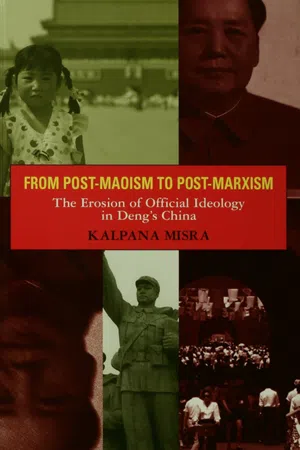
From Post-Maoism to Post-Marxism
The Erosion of Official Ideology in Deng's China
- 224 pages
- English
- ePUB (mobile friendly)
- Available on iOS & Android
eBook - ePub
About this book
This text chronicles Deng Xiaoping's institution of far-reaching and practical economic reforms that seem at odds with Communist theory and its emphasis on ideology. In fact, while Deng often turned to Mao for ideological justification of his reforms, those very reforms seemed to wear away to official ideology. Ultimately, even though the post-Mao
Information
One
The Criterion of Truth
The death of Mao and the purge of the Gang of Four removed the most strident voices of Chinese radicalism. Hua Guofeng's political decline, along with that of other beneficiaries of the Cultural Revolution, further undercut the predominance of ideological rhetoric in Chinese politics. Deng Xiaoping's return to politics in 1977 marked a new stage in intra-elite conflict and policy debate. Back in Beijing, Deng lost little time in launching an offensive to (a) assure a dominant place for himself in the policy-making process, (b) eliminate any residual opposition to the single-minded pursuit of the "four modernizations," and (c) thoroughly and systematically repudiate the ultraleft radicalism that constituted the Maoist legacy to Chinese politics.
The campaign on "practice is the sole criterion of truth" played a crucial role in legitimizing flexibility and the reorientation of ideology to the demands of economic construction.1 However, the scope of the discussions also revealed that neutralization of Maoist and neo-Maoist forces did not usher in a unanimous consensus on theoretical issues. On the question of dealing with the Marxist-Leninist-Maoist legacy, in particular, significant divergence continued to exist within the bureaucratic and intellectual elite.
The Political Background
The debate on epistemology that unfolded in the spring of 1978 was no mere exercise in esoterics. In July—August, while the Chinese Academy of Sciences held discussions on the criterion of truth, Zhou Yang underlined the importance of the debate as one that "affects our party's and our country's future.2 In his speech at the closing session of the Central Work Conference of November, Deng Xiaoping reiterated
. . . the current debate about whether practice is the sole criterion for testing truth is . . . highly important and necessary. When everything has to be done by the book, when thinking turns rigid and blind faith is the fashion, it is impossible for a party or a nation to make progress. Its life will cease and that party or nation will perish. . . . Only if we emancipate our minds, seek truth from facts, procecd from reality in everything and integrate theory with practice, can we carry out our socialist modernization programs smoothly, and only then can our Party further develop Marxism-Leninism and Mao Zedong Thought. In this sense the debate about the criterion for testing truth is really a debate about ideological line, about politics, about the future and the destiny of our Party and nation.3
In broad terms, the object of the campaign on seeking truth from facts and stressing practice as the sole criterion for testing truth, was to provide a theoretical basis for the change in course which was being maneuvered by the new rehabilitees, Chen Yun and Deng Xiaoping. Specifically, it was directed against the attitude reflected in a joint Renmin ribao RMRB, (HQ) Hongqi, and Jiefang ribao JFRB editorial published on 7 February 1977, which stressed: "We must adhere to whatever policies were set by Chairman Mao and implement whatever instructions were given by him."4
The proponents of this "whateverist" approach at the higher levels5 opposed the rehabilitation of Deng Xiaoping, the reversal of verdict on the 1976 Tiananmen Incident, and criticism of the radical leftist position on bourgeois right, proletarian dictatorship, continuous revolution, and the theory of productive forces, on the grounds that such initiatives violated Mao's words and actions. Although these individuals had disassociated themselves from the extreme left group around Jiang Qing and participated actively in the persecution of the so-called Gang of Four, they refrained from criticism of leftism as a deviant phenomenon.6 They understood full well that a direct attack on the real ideological orientation of Jiang and her cohorts, and any reassessment of past events or policies would logically extend to a criticism of Mao himself. Such a development would be catastrophic for a leadership group that owed its political advance to the Cultural Revolution and based its legitimacy on being Mao's chosen successors.
Thus, advocates of reform realized quickly enough that even though, as demonstrated by Tiananmen, the masses may not be averse to debunking "whatever" the Chairman had said and done for the last decade or so, entrenched vested interests, especially in the bureaucracy, would not countenance too rapid and/or drastic a move away from Maoist orthodoxy, Such change needed to be justifiable within that tradition. By reminding their audience that seeking truth from facts and stressing practice as the sole criterion of truth were key Maoist slogans Deng Xiaoping and Chen Yun displayed their political acumen by skillfully employing selective Maoist tenets to discredit other ones. According to the RMRB editor, Hu Jiwei, the principle of taking "practice as the sole criterion for testing truth" was first singled out by the Central Party School in the winter of 1976, when it began to "expose and criticize Lin Biao and the Gang of Four.7 By September 1977, Chen Yun and Nie Rongzhen began openly criticizing dogmatism and extolling the party style of seeking truth from facts, just as the ideological reorientation movement led by Hu Yaobang started to gather momentum,8 Termed the "third campaign to criticize the Gang of Four" this reorientation attempted to broaden the focus of earlier attacks on what Hu and his followers considered the "erroneous and pernicious" theoretical influences of radical leftism.9 The spearhead of attack was the journal Lilun dongtai, edited by Ruan Ming and and published by the Central Party School, which carried a series of articles aimed at refuting the "two whatevers." Having circumvented the censorship of Wang Dongxing and the Propaganda Department by this device, these were subsequently reprinted in GMRB, RMRB, and JFRB, as Special Commentator contributions indicating a considerable measure of support within high-level journalistic and theoretical circles.10
In March, RMRB published an article entitled "There Is Only One Criterion for Testing Truth."11 On n May GMRB published "Practice Is the Sole Criterion for Testing Truth" under the title of Special Commentator.12 This article, which was to spark off the nationwide campaign on "practice," was privately submitted to the paper by Hu Fuming, a philosophy professor at Nanjing University, and passed on by Editor in chief Yang Xiguang to Sun Changjiang and Wu Jiang in the Theory Research Office who modified it and arranged for its publication in Lilun dongtai on 10 May.13 The reprinting of the article in GMRB on the following day (and in RMRB, JFRB, and through the New China News Analysis (NCNA) on 12 May) was authorized by Hu Yaobang himself.
The publication of the practice-criterion article caused a stir even among some of Deng's reform-minded colleagues. Hu Qiaomu tried to persuade Hu Yaobang to suspend the debate and discontinue the publication of controversial articles in Lilun dongtai.14 However, the "antidogrnatism" message of the article was reiterated on 2 June by Deng Xiaoping in his speech at the All-Army Political Work Conference, thus sanctioning his support of the movement to combat ideological rigidity.15 Deng exhorted his audience to "restore and unfold the good tradition of seeking truth from facts," and his call was soon picked up by the media sources supportive of his political position. On 24 June JFRB and RMRB carried a Speciai Commentator article entitled "One of the Fundamental Principles of Marxism."16 With this article (written by Wu Jiang, then section head at the Central Party School, and endorsed after modifications by Luo Ruiqing, secretary-general of the Military Commission) the dictum that " 'practice is the sole criterion of truth' is the quintessence of Mao Zedong Thought" became a constant theme of these two newspapers and scholarly journals under the influence of Hu Yaobang and his associates. By August—September, the propaganda barrage against what was now coming to be recognized as the "whatever faction" had intensified. At this time, the practice campaign reached national proportions as, one by one, the provincial leaderships began to endorse Deng's line and convene conferences to publicize it.
Meanwhile, Wang Dongxing, Zhang Pinghua (the Central Propaganda Bureau Chief), Wu Lengxi (the former editor of RMRB), Xiong Fu (the general editor of Hongqi), and Hu Sheng (the assistant general editor of Hongqi) maneuvered behind scenes to resist what they perceived as a concealed revisionist onslaught against Mao's radical theoretical innova tions.17 Their opposition to the reformist campaign underway18 and the factional conflict brewing within leadership circles was illustrated by Hongqi's refusal to publish articles on the practice criterion and by the Zhongguo qingnian episode. On 6 September, RMRB had carried a report about the announcement of the publication of Zhongguo qingnian after a gap of 12 years. The first issue scheduled for distribution in mid-September was, however, abruptly confiscated ostensibly on the orders of Wang Dongxing. The reason for confiscation, although not stated publicly, was its positive portrayal of the Tiananmen incident. The journal also carried an important article entitled "Smash Superstition, Master Science" signed by a staff Special Commentator, and written by Hu Yaobang himself.19 The article accused Lin Biao and the Gang for creating a decade of "modern superstition," i.e., the cult of Mao, and could therefore be interpreted as one of the first indirect attacks on the Cultural Revolution in an official publication. The confiscated issue was ultimately released a few weeks later indicating that the "whateverists" had lost another round.20
The support rendered to Deng by military commanders and most provincial party secretaries and the gradually improving position of what the Hong Kong press referred to as the "practice faction" was demonstrated around the same time by the replacement of Beijing party chief Wu De with Lin Hujia. Wu De's dismissal was directly linked to the Tiananmen issue. Since the first anniversary of Zhou Enlai's death in January 1977, wall posters in Beijing had incessantly called for criticism and dismissal of Wu De for his involvement in the quelling of the 1976 riots and his earlier long-standing identification with the Cultural Revolutionary group.21 The demands at this time of the Democracy Wall activists coincided with Deng's own political needs: the dismissal of Wu De and the "reversal of the verdict" on the Tiananmen incident, which not only eliminated one more leftist, but also represented another instance of an erroneous decision of Mao that needed to be rectified. Such developments could not fail to throw doubt on Mao's capacity for sound judgment and thus undermined Hua Guofeng's legitimacy which was based on the Maoist injunction, "with you in charge I am at ease."
Furthermore, the wide publicity given by the Democracy movement to the problems of the Maoist period—arbitrary rule, social and political repression, and economic stagnation —strengthened Deng's case for a sharp breach with the past and demonstrated widespread popular support for his policies of political reform and economic liberalization.
The cumulative effect of the developments in the summer and autumn of 1978 was a great surge in the political fortunes of the Dengist camp. A Central Work Conference that convened in Beijing from 10 November to 13 December prepared the groundwork for the more famous Central Committee Third Plenum by frank discussion of hitherto politically sensitive questions (the 1976 Tiananmen Incident, the role of Mao, and the Cultural Revolution), and by tabling important policy changes related to agriculture and industry. The reversal of verdict on the Tiananmen incident, decided by the Work Conference was officially announced by the newly constituted Beijing Party Committee on 15 November.22 The Conference also proclaimed the end of "the era of turbulent mass struggles" (thus reversing Hua's emphasis on "taking class struggle as the key link") and proposed the termination of disruptive political campaigns and a shift in emphasis to economic modernization.
At a more concrete level, the delegates rejected the Dazhai agricultural model in favor of a policy stressing t...
Table of contents
- Cover
- Title
- Copyright
- Contents
- Timeline
- Acknowledgments
- Introduction
- 1. The Criterion of Truth
- 2. Revolutionary Practice and Economic Determinism
- 3. Stages of Socialism
- 4. The Problem of Class in Socialist Society
- 5. Refuting the Theory of a Bureaucrat Class and Affirming Socialist Democracy
- 6. Conclusion
- Glossary of Names
- Bibliography
- Index
Trusted by 375,005 students
Access to over 1.5 million titles for a fair monthly price.
Study more efficiently using our study tools.
Frequently asked questions
Yes, you can cancel anytime from the Subscription tab in your account settings on the Perlego website. Your subscription will stay active until the end of your current billing period. Learn how to cancel your subscription
No, books cannot be downloaded as external files, such as PDFs, for use outside of Perlego. However, you can download books within the Perlego app for offline reading on mobile or tablet. Learn how to download books offline
Perlego offers two plans: Essential and Complete
- Essential is ideal for learners and professionals who enjoy exploring a wide range of subjects. Access the Essential Library with 800,000+ trusted titles and best-sellers across business, personal growth, and the humanities. Includes unlimited reading time and Standard Read Aloud voice.
- Complete: Perfect for advanced learners and researchers needing full, unrestricted access. Unlock 1.5M+ books across hundreds of subjects, including academic and specialized titles. The Complete Plan also includes advanced features like Premium Read Aloud and Research Assistant.
We are an online textbook subscription service, where you can get access to an entire online library for less than the price of a single book per month. With over 1.5 million books across 990+ topics, we’ve got you covered! Learn about our mission
Look out for the read-aloud symbol on your next book to see if you can listen to it. The read-aloud tool reads text aloud for you, highlighting the text as it is being read. You can pause it, speed it up and slow it down. Learn more about Read Aloud
Yes! You can use the Perlego app on both iOS and Android devices to read anytime, anywhere — even offline. Perfect for commutes or when you’re on the go.
Please note we cannot support devices running on iOS 13 and Android 7 or earlier. Learn more about using the app
Please note we cannot support devices running on iOS 13 and Android 7 or earlier. Learn more about using the app
Yes, you can access From Post-Maoism to Post-Marxism by Kalpana Misra in PDF and/or ePUB format, as well as other popular books in Politics & International Relations & Chinese History. We have over 1.5 million books available in our catalogue for you to explore.