As the pace of change increases and new business structures evolve, finding and harnessing people's talent is becoming ever more important. From Talent Management to Talent Liberation presents a thoughtful and practical approach to talent. It provides compelling evidence for the limitations of talent management practice and offers talent liberation as an alternative approach.
Talent Liberation is positioned through five premises that draw on the agile movement to provide a fundamental reappraisal of the talent agenda. These premises are then applied through a range of strategic and tactical tools such as the Talent Compass. By combining academic research, thought leadership and practical experience, this book will stimulate fresh thinking.
Readers will be inspired to take action, using the simple tools to liberate more of the talent in their organisation and their teams. Leaders, HR professionals and individuals will benefit from the relevant insights shared here.
There have been numerous warnings about the impact of a forthcoming talent crisis. For example, the recently published Korn Ferry paper (‘The Global Talent Crunch’) described a 2030 scenario with a global talent shortage of 85.2 million people, impacting global revenue by a staggering $8.45 trillion. The availability of key skills remains a top-five concern for CEOs1 – only just behind over-regulation, terrorism, geopolitical uncertainty and cyberthreats. Millennials, as relatively new entrants to the workforce, often find themselves overqualified, underemployed, unsatisfied and inclined to move on or quit.2 It is these issues that talent management is positioned as helping us with. Since the mid-1990s the idea has been that by looking at resourcing needs across the employee life cycle we can potentially mitigate the risks of the talent crisis.
What do we mean by talent?
It’s very easy to use the word talent, but what do we actually mean by it?
Key questions to consider
Does everyone have talent or just a select few?
Is it innate, or can it be developed?
Is it about being better than others or the best you can be?
How does talent relate to performance and potential?
Is talent a general quality or specific to a job or organisation?
Is it possible to measure someone’s talent?
Does individual motivation influence how talented we are perceived to be?
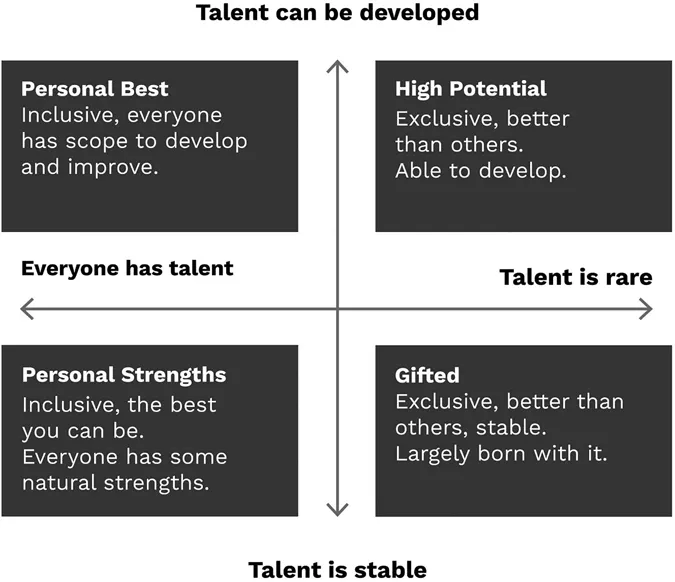
So what is talent? Is it innate, or can it be developed? Can talent be hired? Is it something that a ‘talented’ individual can replicate in different settings? We have reviewed the academic and leadership literature and found numerous interpretations of talent and many apparent contradictions.3 Interestingly, some writers draw on the same examples to make opposite points. For example, Mozart is cited as an example of both the innate and developed elements of talent.4 Cultural differences in the way the word is used have also been observed. For example, in the West there is a tendency to view talent as largely innate, whereas in Japan, there is a dominant view that talent is developed as a result of intense and disciplined training.5 To make sense of these different views of talent, we have found it helpful to consider them initially in terms of two questions: first, how rare is talent? (from everyone having talent to just the select few); second, to what extent (are you born with talent, or is it developed?) We have presented this as a 2 × 2 matrix (Figure 1.1), which presents four potential descriptions of talent.6 We refer to this as the Talent Quadrants, and the labels attached to each quadrant are used throughout the book.
Figure 1.1 Talent quadrants
Those who consider talent as rare and exclusive often refer to the ‘A’ players, or in Tomas Chamorro-Premuzic’s language, ‘the vital few’.7 This is typically positioned as the top 10–20% of people in particular roles (either already performing in this way or with the potential to perform in this way). It is argued that it is important to be clear who these people are so they receive greater investment. This investment may come in the form of attraction, development and retention strategies, justified on the basis that these people are strategically important and make a particularly strong contribution to the success of the business. Thus, for advocates of this view, talent management is equated to a decision science of how and where to invest.8 Within this exclusive view of talent, those who see it as largely stable are likely to focus on assessing personality, cognitive strengths and motivations and to use past performance in order to establish who is ‘gifted’ in a particular field. Those who see talent as developable will be keen to establish the high potential someone has so that this can be developed and deployed.
On the other hand, the inclusive approach represents a commitment to get the best possible contribution from everyone in the organisation. As such, this positions talent management with a similar ethos to HR management, finding ways to improve the attraction, selection, recruitment, deployment, development and engagement of all employees in order to support the strategic aims of the organisation. Those who see inclusive talent as largely stable are likely to engage with activities to uncover personal strengths and to look for the attitudes and behaviours that come naturally. Once these strengths are understood, individuals can be deployed in roles that will be intrinsically motivating for them.9 Those who adopt an inclusive and developable view of talent look to encourage everyone in the organisation to become exceptional performers. This is achieved through ongoing development and supporting a ‘growth mindset’10 whereby people actively invest in and promote their own learning.
The definition or philosophy chosen – inclusive or exclusive, developable or stable – will shape the talent management processes which are adopted and how they are implemented. This will influence the way they are received by employees, which in turn has been found to influence the impact such processes have.11 Proponents of each of the four philosophies outlined earlier claim benefits and competitive advantage. However, each definition can also be associated with shortcomings and implementation challenges.
What of our other questions regarding talent? Analysing the talent quadrants enables the following insights:
Is talent about being better than others or about being your Personal Best?
If talent is viewed as exclusive (High Potential or Gifted), it follows that the evidence for talent is being in some way ‘better’ than others (interpersonal). If, however, an inclusive view is taken, then talent is about being the best you can be (intrapersonal).
How does talent relate to performance and potential?
Those who equate talent with being Gifted are likely to view performance as the key indicator of talent. Those who take a High Potential view will attempt to find ways to spot potential, seeing this as the key indicator of talent. They will then aim to invest in development activities in order to translate the latent potential into superior performance. Some people may have already made this transition and be considered as ‘ready now’ talent. For those with a Strengths view, potential is released into superior performance when someone has an opportunity to use their natural strengths in their work. For the Personal Best proponents, development potential is especially important and is the gap between where someone is currently performing and how things would be if they were at their own peak performance.
Is talent a general quality or specific to a job or organisation?
Talent is normally specific to different domains of human functioning, so talent in one setting may not indicate talent in another area. These domains can be defined by different levels of specificity. You may have two talented musicians. However, it may be difficult to compare their talent as they are each talented in their own domain (say one as a pianist and the other as a singer). In the work context, two talented leaders can have very different skills. Someone good at rescuing a failing operation in America may not be well suited to starting a new office in the APAC region. The skills required for each task are valuable but likely to be different.
Is it possible to measure talent?
There are lots of ways of measuring talent, but the choice of measures will depend on what you mean by talent. One is more likely to find reliable measures if talent is seen as a fairly stable quality (taking either a Strengths or a Gifted perspective). This leads to the use of psychometric measures of cognitive ability, personality, motivations and core strengths. However, those who see talent as developable (Personal Best or High Potential) are also keen to find measures of people’s potential. In spite of this complexity, it has been suggested12 that potential can be assessed by reference to three dimensions: foundations (the more stable aspects such as cognitive abilities and personality); growth (the ways in which someone can adapt, learn and grow); and career (skills and motivations which indicate suitability to certain career areas).
Does motivation influence talent?
In the talent context, people’s motivation has been described as ‘activities they like, find important and in which they want to invest energy in’.13 This seems likely to be an important part of talent whichever description is adopted. For example, someone could be Gifted in a particular area, but without motivation to apply their gift, it is unlikely that excellent performance will be achieved. For the Strengths approach, motivation is a key element, with people being more intrinsically motivated when they are free to use their strengths in their work. For Personal Best and High Potential views of talent, motivation is a critical element of someone’s desire to grow and develop to translate their potential into talent.
These different interpretations of talent are not of themselves right or wrong. Nor are they mutually exclusive; indeed it is possible to combine the different definitions, depending on organisational needs. However, many organisations do not define what they mean by talent, using it in a vague way.14 It is assumed that people know what is meant and that they all mean the same thing, but this tends not to be explored or made explicit. This creates difficulties in selecting the most appropriate purpose, approach and tools of talent management.
Sport has invested considerable time and research in working out the best ways to identify and develop talent. ‘The Talent Lab’15 provides a fascinating account of the approach taken by the British Olympic team to prepare for the 2012 (and subsequent) Olympics. They were very clear on the physical attributes that needed to already be there (the innate traits), such as fast muscle twitch for sprinters and aerial awareness for divers. They were also clear on the skills that could be learned – broadening their sources of potential talent. They were also focused on the motivational aspects, including the capacity to learn, and exploring what ‘headroom’ the person had to grow.
This programme has been credited with huge success, including taking people such as Lizzy Yarnold (skeleton gold at Sochi, 2014) and Helen Glover (rowing gold in the coxless pairs, London, 2012) to gold medals within a few years of starting new sports.
What is talent management, and what has it contributed?
The term ‘talent management’ emerged in the 1990s. Initially talent management activities were targeted to ensure a secure and sustainable succession plan of people to the most important positions in an organisation (typically the most senior roles but also including some highly technical and hard-to-recruit-for roles). Gradually the scope increased to include longer-term people planning and existing programmes (such as graduate schemes and middle management development). Research has indicated four core approaches to talent management, based o...
Table of contents
Cover
Half Title
Title
Copyright
Dedication
Contents
List of figures and tables
Preface
Acknowledgements
PART I The context for talent liberation
PART II The practice of talent liberation
PART III – APPENDIX Toolkit and resources
Index
Trusted by 375,005 students
Access to over 1.5 million titles for a fair monthly price.
Study more efficiently using our study tools.
Frequently asked questions
Yes, you can cancel anytime from the Subscription tab in your account settings on the Perlego website. Your subscription will stay active until the end of your current billing period. Learn how to cancel your subscription
No, books cannot be downloaded as external files, such as PDFs, for use outside of Perlego. However, you can download books within the Perlego app for offline reading on mobile or tablet. Learn how to download books offline
Perlego offers two plans: Essential and Complete
Essential is ideal for learners and professionals who enjoy exploring a wide range of subjects. Access the Essential Library with 800,000+ trusted titles and best-sellers across business, personal growth, and the humanities. Includes unlimited reading time and Standard Read Aloud voice.
Complete: Perfect for advanced learners and researchers needing full, unrestricted access. Unlock 1.5M+ books across hundreds of subjects, including academic and specialized titles. The Complete Plan also includes advanced features like Premium Read Aloud and Research Assistant.
Both plans are available with monthly, semester, or annual billing cycles.
We are an online textbook subscription service, where you can get access to an entire online library for less than the price of a single book per month. With over 1.5 million books across 990+ topics, we’ve got you covered! Learn about our mission
Look out for the read-aloud symbol on your next book to see if you can listen to it. The read-aloud tool reads text aloud for you, highlighting the text as it is being read. You can pause it, speed it up and slow it down. Learn more about Read Aloud
Yes! You can use the Perlego app on both iOS and Android devices to read anytime, anywhere — even offline. Perfect for commutes or when you’re on the go. Please note we cannot support devices running on iOS 13 and Android 7 or earlier. Learn more about using the app
Yes, you can access From Talent Management to Talent Liberation by Maggi Evans,John Arnold,Andrew Rothwell in PDF and/or ePUB format, as well as other popular books in Business & Human Resource Management. We have over 1.5 million books available in our catalogue for you to explore.