Culturally Relevant Teaching in the English Language Arts Classroom
eBook - ePub

Culturally Relevant Teaching in the English Language Arts Classroom

A Guide for Teachers

  1. 156 pages
  2. English
  3. ePUB (mobile friendly)
  4. Available on iOS & Android
eBook - ePub

Culturally Relevant Teaching in the English Language Arts Classroom

A Guide for Teachers

About this book

This book is a practical, research-based, classroom-ready resource for English language arts teachers interested in learning how to incorporate culturally relevant pedagogy into all aspects of their instruction, including writing, reading, and vocabulary lessons. It also provides suggestions for building an inclusive classroom environment in which all students' backgrounds are valued.

Topics covered:

  • Writing strategies and diverse texts

  • Dialect and student writing

  • Applying reading strategies to texts that represent diverse backgrounds

  • Using reading strategies in out-of-school contexts

  • Considering students' funds of knowledge and language awareness

  • Connecting linguistic diversity to word-root instruction

  • Building an inclusive classroom environment

The appendix features several useful tools, including a study guide, a comprehensive list of suggested texts, recommendations for parent communication, and reproducible tools for the classroom. The study guide and reproducibles are available for free download from our website at www.routledge.com/9781138393318.

Frequently asked questions

Yes, you can cancel anytime from the Subscription tab in your account settings on the Perlego website. Your subscription will stay active until the end of your current billing period. Learn how to cancel your subscription.
No, books cannot be downloaded as external files, such as PDFs, for use outside of Perlego. However, you can download books within the Perlego app for offline reading on mobile or tablet. Learn more here.
Perlego offers two plans: Essential and Complete
  • Essential is ideal for learners and professionals who enjoy exploring a wide range of subjects. Access the Essential Library with 800,000+ trusted titles and best-sellers across business, personal growth, and the humanities. Includes unlimited reading time and Standard Read Aloud voice.
  • Complete: Perfect for advanced learners and researchers needing full, unrestricted access. Unlock 1.4M+ books across hundreds of subjects, including academic and specialized titles. The Complete Plan also includes advanced features like Premium Read Aloud and Research Assistant.
Both plans are available with monthly, semester, or annual billing cycles.
We are an online textbook subscription service, where you can get access to an entire online library for less than the price of a single book per month. With over 1 million books across 1000+ topics, we’ve got you covered! Learn more here.
Look out for the read-aloud symbol on your next book to see if you can listen to it. The read-aloud tool reads text aloud for you, highlighting the text as it is being read. You can pause it, speed it up and slow it down. Learn more here.
Yes! You can use the Perlego app on both iOS or Android devices to read anytime, anywhere — even offline. Perfect for commutes or when you’re on the go.
Please note we cannot support devices running on iOS 13 and Android 7 or earlier. Learn more about using the app.
Yes, you can access Culturally Relevant Teaching in the English Language Arts Classroom by Sean Ruday in PDF and/or ePUB format, as well as other popular books in Education & Classroom Management. We have over one million books available in our catalogue for you to explore.

Information

Publisher
Routledge
Year
2018
eBook ISBN
9780429687020
Edition
1

Section 1
Culturally Relevant Writing Instruction

1
Writing Strategies and Diverse Texts

In this chapter, we’ll explore the culturally relevant instructional practice of identifying and analyzing writing strategies in a wide range of texts—especially those related to students’ cultural backgrounds and out-of-school lives. First, we’ll consider it means to help students connect the study of writing strategies to a diverse range of texts, highlighting the main features of this instructional approach. Next, we’ll explore the benefits of this instructional practice, addressing ways it can enhances students’ academic and personal development. After that, I’ll discuss ways this practice can look in action in ELA classes of varying grade levels by presenting three different assignments (designed for elementary, middle, and high school, respectively) that can help students connect writing strategies and diverse texts. Finally, I’ll present key points to consider when putting the idea discussed in this chapter into action in your classes.

What Is It?

In this instructional practice, teachers help students understand the wide range of texts to which standards-based and academically rigorous writing strategies can be applied. The tools of effective writing—such as using incorporating sensory details, establishing a clear focus, using specific nouns and strong verbs to communicate information in clear and direct ways, and employing connotation-rich language—aren’t limited to the types of writing students traditionally read and create in school; instead, these writing strategies are used in a variety of texts, such as songs, films, and social media posts, sports broadcasts, recipes, and family stories. There are four main components to the process I use when helping students understand how writing strategies can be applied to diverse texts. First, I introduce a strategy with a mini-lesson that illustrates its fundamental components. Next, I talk with students about the impact of that strategy on effective communication, using an example of its use in literature to convey its significance and facilitate a conversation on how it enhances the text in which it’s used. Next, I ask students to do some “investigative work” by looking for, identifying, and analyzing relevant examples of the writing strategy they encounter in their out-of-school lives and communities. After that, I schedule time for students to share the culturally relevant examples of the writing strategies they identified and analyzed. Finally, I ask for students to incorporate the strategy in their own writing and reflect on its impact. The specific ways you integrate these components can vary based on the grade level you’re teaching and the writing strategy you’re addressing; we’ll explore grade and strategy-specific lesson ideas and instructional practices later in the chapter.

How Can It Help Students?

This instructional practice can benefit students in a variety of ways: it can give students additional opportunities to apply their understandings of writing strategies; it can help students build confidence in their knowledge of writing strategies through the use of familiar texts, and it can show students that their cultural backgrounds and out-of-school lives belong in school. Let’s look at each of these benefits individually.

It Can Give Students Additional Opportunities to Apply Their Understandings

When we encourage our students to look for examples of writing strategies in texts they encounter outside of school, we give them additional opportunities to apply their knowledge: this instructional practice significantly increases the number of possible texts to which students can identify the writing strategies they learn in school. While it’s important and beneficial for students to find and analyze examples of writing strategies in published texts they typically encounter in school, encouraging students to identify the uses of key writing strategies in texts they wouldn’t typically see in school provides them with more chances to use their skills.

It Can Help Students Build Confidence in Their Knowledge of Writing Strategies

This instructional practice can also use students’ familiarity with culturally relevant texts to help them develop confidence in their knowledge writing strategies. By giving students opportunities to look for examples of the writing strategies in texts that represent their out-of-school lives and cultural backgrounds, we create a learning environment that utilizes students’ background knowledge to help them understand academic material. I believe that incorporating students’ background knowledge in any academic context can enhance their learning by showing them what they already know and developing their confidence to understand a topic even more. For example, after I asked a group of middle-school students to identify prepositional phrases in texts they encountered outside of school, one explained that the practice made an intimidating topic seem manageable: “I looked for prepositional phrases in the lyrics of songs my siblings and I listen to. When we first started talking about [prepositional phrases] in class, I was stressed because I’m not usually good with grammar and writing, but when I looked for examples in songs I know and like, I didn’t feel stressed. I was using songs I’m familiar with it, and that made me feel like I could do it. I was sure of myself.”

It Can Show Students That Their Cultural Backgrounds and Out-of-School Lives Belong in School

Giving students opportunities to identify examples of writing strategies in culturally relevant texts sends the message that their in-school learning and out-of-school lives can be intertwined. When students are able to apply material that they learn in school to their own lives, they learn to see academic content as relevant to real-world issues and able to help them make sense of their own lives (Duncan-Andrade & Morrell, 2005). I recently prepared a group of middle-school students to look for examples of writing strategies in out-of-school texts by emphasizing the connection between the strategies we studied and their home lives: “The strategies we’ve been talking about that add detail to writing, like prepositional phrases and relative clauses, aren’t just related to school. They can be present in all kinds of texts you find—songs you hear, stories your family members tell, and signs and advertisements you find in your neighborhood. There are so many ways you can find these strategies we learn about here in school in out-of-school situations.”
Traditional educational practices sometimes convey to students that they should think one way while they’re in school and another while they’re out of school (Duncan-Andrade & Morrell, 2005); culturally relevant teaching practices (like students identifying examples of writing strategies in their home lives and communities) communicate that students’ out-of-school lives have a place in their in-school learning.

How Can It Look in Action?

In this section, we’ll look at three activities that you can use to help your students identify and analyze examples of writing strategies in diverse texts that represent their home cultures and out-of-school lives. These activities are organized by grade level: the first is designed for upper-elementary-school students, the second for middle schoolers, and the third for high-school students. Each activity description provides grade-level-oriented text and content suggestions (although you should feel free to adapt some of the components to meet the particular needs and interests of the specific students with whom you work).

Elementary School: Strong Verbs and Specific Nouns in Community Conversations

In this activity, elementary-school students look for examples of strong verbs and specific nouns in language they hear in conversations in their homes, communities, and activities. The writing strategy of using specific nouns and strong verbs aligns with the Common Core State Standards for elementary school (Common Core Standard L.4.3 calls for students to master this concept), as well as many state standards; this tactic is important to effective writing because of the way it allows for students to express their ideas in clear and concise ways. For example, the strong verb “whisper” clearly conveys how a character made a statement; in contrast, the weaker, or less clear verb “said” does not illustrate the character’s action as clearly. An author could add a modifier to the word “said,” such as “said quietly,” but this usage would be both wordier and less clear than its strong verb replacement. Now, let’s look at a step-by-step process for helping elementary-school students understand this concept and apply it in culturally relevant ways.

Step 1: Introduce the Strategy

To begin this activity, conduct a mini-lesson that describes the writing strategies of specific nouns and strong verbs: this will ensure that all students enter the instructional sequence with common understandings of these writing strategies. When I introduce specific nouns and strong verbs to students, I explain what makes a specific noun specific and strong verb strong. After discussing these fundamental features, I like to show students grade-appropriate published examples of each one so that they can see how published authors use these concepts in their works.

Step 2: Explain its Impact

After you’ve discussed the key features of this strategy and shown students examples, the next step is to talk with the students about its importance. To help students grasp the significance of specific nouns and strong verbs, I suggest taking the published examples you showed them in the previous step, replacing these concepts with vague versions, and talking with students about the differences. For example, in the book Fantastic Mr. Fox, author Roald Dahl (1970) uses the strong verb “clutching” in the sentence “Mr. Fox and Badger and the Smallest Fox ran across the cellar clutching a gallon jar each” (p. 71) to clearly convey how an action is performed; if Dahl instead used a weaker, more generic verb like “holding,” readers wouldn’t have such a clear understanding of how the characters in the book performed the action. In addition, Dahl utilizes specific nouns to make the information in this book as clear as possible; in the sentence “At six o’clock in the evening, Bean switched off the motor of his tractor and climbed down from the driver’s seat” (p. 29), the specific noun “tractor” provides the clarity and conciseness that a more general noun could not. For example, a general noun like “vehicle” would not provide the reader with concrete information; even a noun phrase like “farming vehicle” would still lack the clear and direct information that “tractor” provides.
Similarly, Kwame Alexander’s (2014) novel The Crossover uses strong verbs and specific nouns to clearly convey actions and objects it describes. For example, Alexander utilizes these concepts in the following line, which describes protagonist Josh Bell’s basketball skills: “He dribbles, fakes, then takes the rock to the glass.” (p.10). This concise line is an excellent example of the impact of these writing strategies: it uses strong verbs such “dribbles” and “fakes” and specific nouns like “rock” and “glass” to clearly and directly convey information about Josh playing basketball. Without these specific nouns and strong verbs, the piece would be wordier, less clear, and lack some of the tone and personality of the original text: an altered version that doesn’t employ these strategies might read, “He makes one basketball move, then makes another, then takes the ball toward the hoop
” This new sentence is longer than the original text and doesn’t contain the same clarity and expression.

Step 3: Engage Students in Investigative Work

Once students understand the attributes and importance of specific nouns and strong verbs, they’ll be positioned to apply their knowledge of this concept to culturally relevant communication. The guideline sheet depicted in Figure 1.1 illustrates the suggestions I give students to help them connect their understanding of this strategy to communication they encounter in their out-of-school lives. (This figure is also available in reproducible form in Appendix B.)
Before the students begin their investigations and analyses, I like to provide examples of the investigative work I ask them to do in the activity. For example, I recently discussed the impact of specific nouns to the effectiveness of an exercise class in which I participated, explaining that the names of specific pieces of exercise equipment such as “kettlebell” and “medicine ball” were essential to everyone involved in the class having clear understandings of what materials they would be using at particular times. “Without these specific nouns,” I explained, “it would have been a lot harder for the instructor to clearly communicate with the participants. This is just one of the many examples of this strategy being used for effective communication outside of a school environment.”

Step 4: Create Opportunities for Students to Share

This step is designed to give students the chance to share the findings of the investigative work they did in the previous component of the
Figure 1.1 Guideline Sheet for Strong Verbs and Specific Nouns in Community Conversations
instructional process; this opportunity to share allows for students to integrate their home lives into the ELA classroom in academically relevant ways. I recently listened to fifth-grade students who had completed this activity share what specific nouns and strong verbs they noticed in community conversations; one explained that she heard many examples of these concepts in a discussion about cooking: “I was helping my sister make ox tail soup—my family has that a lot,” she explained, “and I noticed that she said a ton of these [strong verbs and specific nouns]. She said a lot of strong verbs like “dice” and “sautĂ©â€ to explain exactly how to cook something, and a lot of specific nouns—the names of specific ingredients—to show exactly what goes in the soup.”

Step 5: Ask Students to Incorporate Strong Verbs and Specific Nouns in their Own Works and Reflect on their Impact

I recommend concluding this instructional process by asking students to apply this writing strategy to their own works and considering its importance. When I ask students to do this, I tell them that they can apply the writing tools of specific nouns and strong verbs to any genre of writing: “As you’ve seen in our discussions and activities,” I recently told a fifth-grade class, “these writing strategies are used in—and are important to—all kinds of writing and communication. I’d like you to focus on using a specific noun and a strong verb in a piece of writing that you create. It can be something you’re alread...
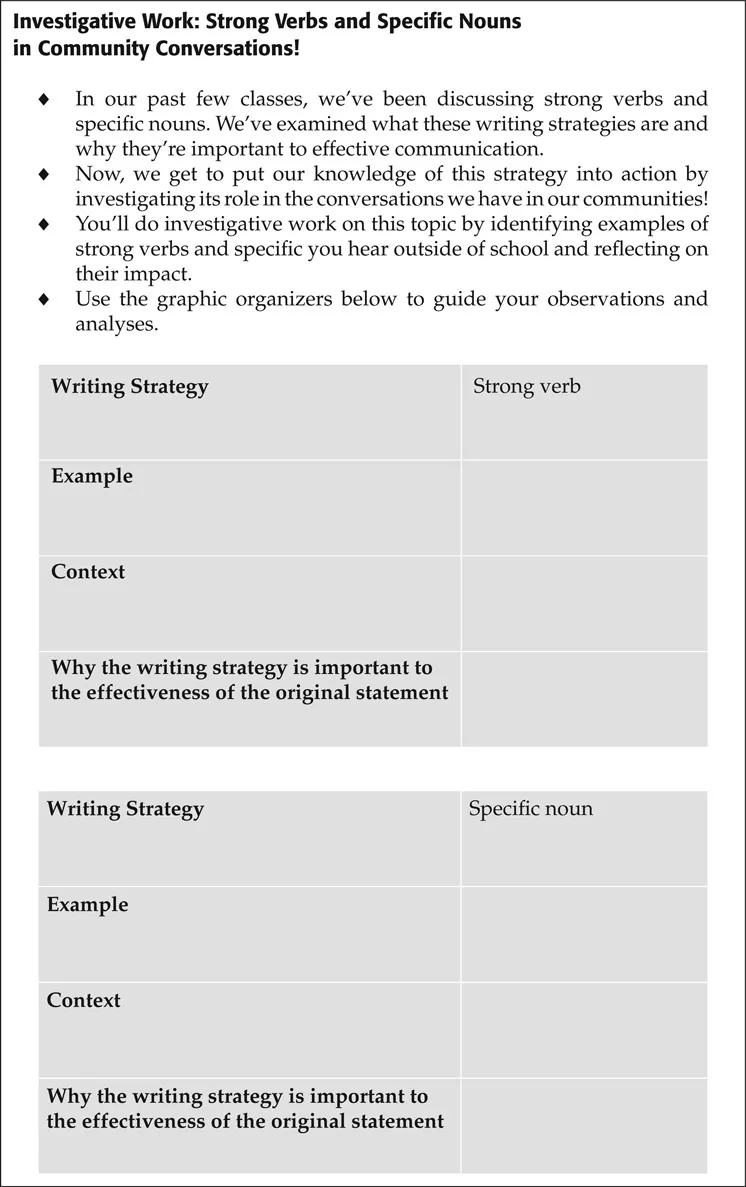
Table of contents

  1. Cover
  2. Half Title
  3. Series Page
  4. Title
  5. Copyright
  6. Contents
  7. Meet the Author
  8. Acknowledgements
  9. eResources
  10. Introduction: What is Culturally Relevant Teaching and Why is it Important?
  11. Section 1: Culturally Relevant Writing Instruction
  12. Section 2: Culturally Relevant Reading Instruction
  13. Section 3: Culturally Relevant Language Study
  14. Section 4: Putting It All Together
  15. Section 5: Resources
  16. References