- 192 pages
- English
- ePUB (mobile friendly)
- Available on iOS & Android
eBook - ePub
Physical Therapy and Massage for the Dog
About this book
Interest in canine massage and physical therapy has grown as greater emphasis is placed on the general fitness and agility of dogs, as pets and as sporting animals.In this book the authors are concerned with the prevention, management and treatment of movement and allied disorders. It encompasses detailed assessments, treatment programmes that invo
Information
1
Introduction to Physical Therapy and Massage
Julia Robertson and Andy Mead
• Introduction
• A brief history of massage
• Current practice
Introduction
Physical therapy is concerned with the prevention, management, and treatment of movement and allied disorders. It encompasses detailed assessments and treatment programmes that involve hands-on therapy, along with dynamic remedial and strengthening techniques using exercise plans. As far as dogs are concerned, this is an evolving therapy (1), but one that has been used for centuries. It was expounded by a famous Greek practitioner, Arrian, who wrote about how massage would help horses and dogs, asserting that it would ‘strengthen the limbs, render the hair soft and glossy, and cleanse the skin’.
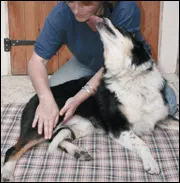
1 Physical therapy in the dog. (Courtesy of Henry Robertson.)
Medical breakthroughs by many famous historical figures have been documented over the centuries; Hippocrates, who is known as the ‘father of medicine’ and who was the originator of the Hippocratic Oath, was a documented practitioner of massage and physical therapy, developing their use through his teachings. Centuries later, Claudius Galenus of Pergamon (circa AD 129) further developed Hippocrates’ anatomical knowledge and surgical skills, and continued the incorporation of massage in his work at the school for gladiators, to aid healing and pain control. He is thought to be the first sports therapist.
A brief history of massage
Massage is one of the oldest forms of therapy. Egyptian tomb paintings show people being massaged. In Eastern cultures, massage has been practised continually since ancient times. A Chinese book from 2700 BC, The Yellow Emperor’s Classic of Internal Medicine, recommends ‘breathing exercises, massage of skin and flesh, and exercises of hands and feet’ as the appropriate treatment for complete paralysis, chills, and fever. In India, the traditional healing system of Ayurvedic medicine also prescribes massage for a variety of medical conditions. Physicians of ancient Greece and Rome also utilized massage as one of the primary methods to treat pain.
In Europe, doctors such as Ambroise Pare, a 16th century physician to the French court, praised massage as a treatment for various ailments. Swedish massage, the method most familiar to Westerners, was developed in the 19th century by a Swedish doctor named Per Henrik Ling. His system was based on a study of gymnastics and physiology, and on techniques borrowed from China, Egypt, Greece, and Rome.
With the foundation in 1894 of the Society of Trained Masseurs, World War I patients suffering from nerve injury or shell shock were treated with massage. By 1900, the Society had acquired the legal and public status of a professional organization, and became the Incorporated Society of Trained Masseuses. In 1920, the Society was granted a Royal Charter. It amalgamated with the Institute of Massage and Remedial Gymnastics, forming the Chartered Society of Physiotherapy. St Thomas’ Hospital, London, had a department of massage until 1934. However, later breakthroughs in medical technology and pharmacology eclipsed massage as physiotherapists began increasingly to favour electrical instruments over manual methods of stimulating the tissues.
Current practice
Recently, some physical therapies used in humans have been extended to horses, yet the transfer to dogs has not been explored as fully. Therefore, little research has been conducted into muscle dysfunction in the dog. Only recently have the canine health benefits of physical therapy and massage been identified, as the popularity of sports such as ‘agility’, increases.
There are a few modern practitioners and teachers of the art of canine massage who have been responsible for quietly projecting the therapy to many through high-quality professional teaching. One who stands out is Patricia Whalen-Shaw, who practises and teaches in Columbus, Ohio in the USA. For many years, she has been developing the art and transferring her skills to many, not only in the USA, but in all corners of the globe. Many of the techniques shown in Chapter 6 have been adapted from, or taken from her book Canine Massage – the Workbook.
With canine sports growing, it is a travesty that most of the people competing with their dogs, and their trainers, are ignorant of the basic indicators of a compromised muscular system. Due to a dog’s fundamental instinct to protect itself and maintain the security of the pack, it will not overtly inform us of a problem until suffering from obvious physical dysfunction. Thus we will often have to ‘second guess’ muscular and myofascial disorders, as the dogs, more often than not, do not show any obvious signs.
Following an injury or strain, the body will become altered by its efforts to compensate, which then means that biomechanical changes will occur. If these are allowed to remain untreated, the somatic appearance will also alter as the body adapts to the stress; sometimes pathological changes will also become evident, and can be traced back to the initial injury. Such changes usually end up being treated in isolation rather than together; sometimes, therefore, the effects are being treated instead of the cause.
The canine body, like any living body, requires balance, or homeostasis, to thrive; without this, systems can suffer. To maintain balance, all the body’s systems have to work together. For example, pain in the muscular system can affect behaviour patterns (as any form of pain will affect behaviour), the digestive system (stress from pain can have an effect on digestion), and compromise the peripheral neurological system.
The repeated postural and traumatic insults of a lifetime, combined with the tensions of emotional and psychological origin, often lead to a confusing pattern of tense and contracted fibrous tissue. This may appear to the uninformed handler, for example, as an obvious lameness. This complexity of initial trauma mixed with compensatory factors can present an extremely misleading set of symptoms. It seems that, sometimes, the dog is shouting to us for an appropriate response to its crisis, and we seem to be unable to listen. Sara Wyche, in her book entitled The Horse’s Muscles in Motion puts it very well: ‘If it’s the body that speaks the language, then it is the muscles that supply the words’.
Mutual grooming and touch therapy is an important component of animal pack and herd behaviour. Unlike humans, who have been conditioned to condemn touch for many reasons, many animals are aware of the power of physical manipulation to ease the soreness of muscles. This is evident when treating dogs, as they are more in touch with their bodily requirements than we are, and know what they need to ease a problem. It is, therefore, the duty of handlers to be more aware of their dog’s overall health, including awareness of its muscular system. This will, then, improve the relationship between man and dog.
The purpose of this book is to provide an insight into this subject, and to demonstrate that damage of one part of the body, no matter how small, will affect the whole. Even a small repetitive injury can have the same long-term effects as a massive acute injury. Recognition of this concept can help to prevent injury, enable the handler to know when to seek professional assistance and treatment, and give the dog the opportunity to have a long and pain-free life.
Dew of the morning,
Meet the warmth of the early sun;
The colours mix as milk and honey in a bowl,
They nourish and heal;
When poured, they fall as ice,
When they touch the earth, they become water,
Cleansing where they pool.
Meet the warmth of the early sun;
The colours mix as milk and honey in a bowl,
They nourish and heal;
When poured, they fall as ice,
When they touch the earth, they become water,
Cleansing where they pool.
Anon (2007)
(A handler’s poem describing her experience of her dog’s treatment and subsequent return to health.)
(A handler’s poem describing her experience of her dog’s treatment and subsequent return to health.)
2
Anatomy and Physiology
Julia Robertson and Andy Mead
• Introduction
• Skeletal system
• Muscular system
• Fascia
• Nervous system
• Other systems
• Comparative human and canine anatomy
Introduction
A balance is required in the body on a cellular level, as it is in every part of nature. The basic requirement of every cell must be met in order for it to survive, in the same way that soil must be correctly balanced in order for a plant to grow well. If one part of a system is not working properly, it will have an effect on another part of the system and the overall performance will be compromised. This chapter will aim to show how the body works in this holistic way and how each system interacts with another. In order to understand how massage and physical therapy affect the body, it is important to understand the systems within the body, how they function, and, most importantly, how they inter-relate.
Skeletal system
The skeleton can be defined as the stiff hardened tissues that form the supporting framework of an animal’s body. The skeleton is often divided into three distinct portions: the axial, the appendicular, and the visceral skeletons (2).
• The axial skeleton comprises the bones of the skull, the hyoid apparatus (larynx), the vertebral column, and the ribcage. It principally performs a protective role.
• The appendicular skeleton comprises the bones of the limbs and the bones that connect the limbs to the axial skeleton, e.g. the pelvis joining onto the sacrum.
• The visceral skeleton comprises the bones that develop in soft tissue structures. In dogs, this includes only one bone, the os penis.
It is not the intention to describe the anatomy of the canine skeleton in great detail here, as there are many other texts on the subject. Instead, an overview is presented.
Bones are a vital part of the skeletal system. They provide support and give shape to the body, as well as protecting vital organs including the heart and the brain. Above all, bones enable movement.
Bones comprise semi-rigid connective tissue and a mineral component, hydroxyapatite. The connective tissue is formed of type 1 collagen, the most common protein of connective tissue, which is made up of three polypeptide strands interlinked by hydrogen bonds into a left-handed helix. This provides an essentially brittle matrix of bone; what little capacity it has to withstand compressive and tensile forces is provided by weak hydrogen bonds between strands.
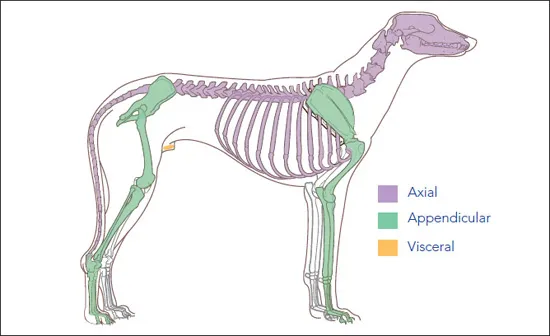
2 Major divisions of the canine skeleton.
Hydroxyapatite is essentially calcium and phosphorus (Ca10[PO4]6[OH]2) and constitutes approximately 70% of bone. It usually crystallizes in a very organized hexagonal pattern, providing rigidity to the structure of bone, as well as giving bone its smooth, white appearance. Bone also contains many different types of cells supported within the matrix, which allow the structure to grow, repair, and, perhaps more importantly, provide a scaffold for the performance of vital functions, such as red and white blood cell production.
Bone is the body’s mineral store, providing a reservoir of, for example, calcium and phosphorus, which can be mobilized for the purposes of:
• Maintaining calcium homeostasis.
• Detoxifying heavy metals.
• Producing blood cells within the marrow.
• Transferring sound though the bones of the ear.
The structure of bone can be categorized into two types, compact and trabecular.
Compact bone
This forms the hard outer layer of bone, which is both smooth and well-ordered. There are minimal gaps here between collagen fibres and the mineral matrix. Compact bone is often referred to as cortical bone (3).
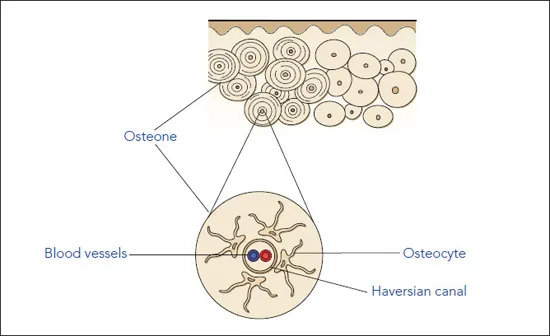
3 Diagram of cortical bone showing osteones and structural organization.
Trabecular bone
This forms the rather more disorganized, spongy, central portion of bone (4, 5). Trabecular bone reduces the total weight of a bone, as well as providing a framework for blood vessels and nerves. Without the presence of this type of bone, mammalian species would be greatly restricted in terms of size, due to the fact that greater muscle mass would be required to lift and move heavier bones. Without trabecular bone, bones of the axial skeleton would need to be as wide as they were long in order to withstand the forces put on them. Trabecular bone is often harvested surgically to aid with fracture repair.
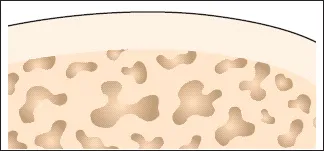
4 Trabecular bone showing disorganization of structure.
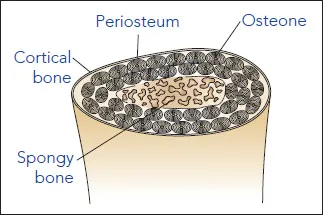
5 A section through bone showing the position of trabecular and cortical bones.
Cellular structure of bone
It is necessary to discuss in some detail the cellular structure of bone in order to understand better the process of bone development, and there...
Table of contents
- Cover Page
- Physical Therapy and Massage for the Dog
- Copyright Page
- Contents
- Preface
- Acknowledgements
- Abbreviations
- 1 Introduction to Physical Therapy and Massage
- 2 Anatomy and Physiology
- 3 How a Dog Moves
- 4 Exercise and Activity Preparation
- 5 Rehabilitation Techniques
- 6 Massage in Physical Therapy
- 7 Common Diseases and Pathologies
- Glossary of Terms
- Further Reading
- Appendix
- Index
Trusted by 375,005 students
Access to over 1.5 million titles for a fair monthly price.
Study more efficiently using our study tools.
Frequently asked questions
Yes, you can cancel anytime from the Subscription tab in your account settings on the Perlego website. Your subscription will stay active until the end of your current billing period. Learn how to cancel your subscription
No, books cannot be downloaded as external files, such as PDFs, for use outside of Perlego. However, you can download books within the Perlego app for offline reading on mobile or tablet. Learn how to download books offline
Perlego offers two plans: Essential and Complete
- Essential is ideal for learners and professionals who enjoy exploring a wide range of subjects. Access the Essential Library with 800,000+ trusted titles and best-sellers across business, personal growth, and the humanities. Includes unlimited reading time and Standard Read Aloud voice.
- Complete: Perfect for advanced learners and researchers needing full, unrestricted access. Unlock 1.5M+ books across hundreds of subjects, including academic and specialized titles. The Complete Plan also includes advanced features like Premium Read Aloud and Research Assistant.
We are an online textbook subscription service, where you can get access to an entire online library for less than the price of a single book per month. With over 1.5 million books across 990+ topics, we’ve got you covered! Learn about our mission
Look out for the read-aloud symbol on your next book to see if you can listen to it. The read-aloud tool reads text aloud for you, highlighting the text as it is being read. You can pause it, speed it up and slow it down. Learn more about Read Aloud
Yes! You can use the Perlego app on both iOS and Android devices to read anytime, anywhere — even offline. Perfect for commutes or when you’re on the go.
Please note we cannot support devices running on iOS 13 and Android 7 or earlier. Learn more about using the app
Please note we cannot support devices running on iOS 13 and Android 7 or earlier. Learn more about using the app
Yes, you can access Physical Therapy and Massage for the Dog by Julia Robertson,Andy Mead in PDF and/or ePUB format, as well as other popular books in Medicine & Physiotherapy, Physical Medicine & Rehabilitation. We have over 1.5 million books available in our catalogue for you to explore.