Rock Mechanics Through Project-Based Learning
eBook - ePub

Rock Mechanics Through Project-Based Learning

  1. 148 pages
  2. English
  3. ePUB (mobile friendly)
  4. Available on iOS & Android
eBook - ePub

Rock Mechanics Through Project-Based Learning

About this book

Traditional textbooks on rock mechanics often fail to engage students in the learning process as such books are packed with theory that students are unlikely to use in their future employment. In contrast, this book delivers the fundamentals of rock mechanics using a more practical and engaging project-based approach which simulates what practitioners do in their real-life practice. This book will be of great help to those who would like to learn practical aspects of rock mechanics and better understand how to apply theory to solve real engineering problems.

This book covers geology, rock mechanics principles, and practical applications such as rock falls, slope stability analysis and engineering problems in tunnels. Throughout the whole book, the reader is engaged in project-based work so that the reader can experience what rock mechanics is like and clearly see why it is an important part of geotechnical engineering. The project utilizes real field and laboratory data while the relevant theory needed to execute the project is linked to each project task. In addition, each section of the book contains several exercises and quiz questions to scaffold learning. Some problems include open-ended questions to encourage the reader to exercise their judgement and develop practical skills. To foster the learning process, solutions to all questions are provided to allow for learning feedback.

Frequently asked questions

Yes, you can cancel anytime from the Subscription tab in your account settings on the Perlego website. Your subscription will stay active until the end of your current billing period. Learn how to cancel your subscription.
No, books cannot be downloaded as external files, such as PDFs, for use outside of Perlego. However, you can download books within the Perlego app for offline reading on mobile or tablet. Learn more here.
Perlego offers two plans: Essential and Complete
  • Essential is ideal for learners and professionals who enjoy exploring a wide range of subjects. Access the Essential Library with 800,000+ trusted titles and best-sellers across business, personal growth, and the humanities. Includes unlimited reading time and Standard Read Aloud voice.
  • Complete: Perfect for advanced learners and researchers needing full, unrestricted access. Unlock 1.4M+ books across hundreds of subjects, including academic and specialized titles. The Complete Plan also includes advanced features like Premium Read Aloud and Research Assistant.
Both plans are available with monthly, semester, or annual billing cycles.
We are an online textbook subscription service, where you can get access to an entire online library for less than the price of a single book per month. With over 1 million books across 1000+ topics, we’ve got you covered! Learn more here.
Look out for the read-aloud symbol on your next book to see if you can listen to it. The read-aloud tool reads text aloud for you, highlighting the text as it is being read. You can pause it, speed it up and slow it down. Learn more here.
Yes! You can use the Perlego app on both iOS or Android devices to read anytime, anywhere β€” even offline. Perfect for commutes or when you’re on the go.
Please note we cannot support devices running on iOS 13 and Android 7 or earlier. Learn more about using the app.
Yes, you can access Rock Mechanics Through Project-Based Learning by Ivan Gratchev in PDF and/or ePUB format, as well as other popular books in Technology & Engineering & Civil Engineering. We have over one million books available in our catalogue for you to explore.

Chapter 1

Introduction and book organization

1.1 Rocks and rock mechanics

This book is about rocks and their properties. We often use the word β€˜rock’ in our daily life, but does it have the same meaning in rock mechanics? Commonly used definitions state that the term β€˜rock’ refers to a hard substance made of minerals, which requires drilling, blasting, wedging, or other brute force to excavate. Many engineering structures are built on rocks, while rocks are commonly used as construction material for several engineering applications. For this reason, engineers and researchers are required to have a sound knowledge of rock properties and understand the behavior of rock mass under stresses.
Question: Concrete and dry clay are hard as well; are they also rock?
Answer: No, dry clay and concrete are not rock. Although concrete is as hard as rock, it is artificial material, while clay becomes very soft when saturated.
Rock mechanics is the subject that deals with rock response to applied disturbance caused by natural and engineering processes. Through this book, the reader will not only learn the fundamentals of rock mechanics, but they will also see practical applications of the theoretical knowledge.
Question: Is rock mechanics the same as engineering geology?
Answer: No, they are different. Engineering geology mostly deals with the application of geological fundamentals to engineering practice, while rock mechanics covers the engineering properties of rock.

1.2 Book organization

The book is organized in such a way that each chapter first explains its relevance to the project and then it briefly provides key theoretical concepts necessary to complete a certain part of the project. Chapter 2 provides the project description and data from field investigation and laboratory testing. Chapters 3 and 4 are related to basic geology as they deal with the effects of geology on rock formation (Chapter 3) and common types of rock (Chapter 4). Chapter 5 discusses common rock exploration methods and techniques, while Chapter 6 is dedicated to discontinuities in rock mass. Rock properties and rock testing methods are described in Chapters 7 and 8, respectively. Chapters 9–12 show practical applications of rock mechanics, including the assessment of rock mass properties (Chapter 9), rock fall (Chapter 10) and landslide (Chapter 11) disaster, and common issues with rock mass during tunnel construction (Chapter 12).
Each chapter also provides a few practical problems that the reader can use for more practice. It is suggested to solve each problem first before referring to the step-by-step solution provided afterwards. Even though it may be difficult to work out the final answer, spending time on each problem will improve the reader’s understanding of the relevant material and help to develop problem-solving skills. To reinforce the knowledge of rock behavior and review the key concepts, the reader can also take a review quiz at the end of each chapter.

Chapter 2

Project description

This project deals with a dam built in Southeast Asia in 1970s. After its completion, there was a concern that the neighboring slopes might experience stability issues during rainy seasons. The risk analysis indicated that if the slope failed, it would affect the major transportation routes around the dam. To collect more information about the slope conditions, field investigations including geological mapping, boreholes and joint surveys were performed. A series of laboratory tests were conducted on core specimens to obtain the engineering properties of rock. The field and laboratory data is given in the following sections.

2.1 Data from site investigation

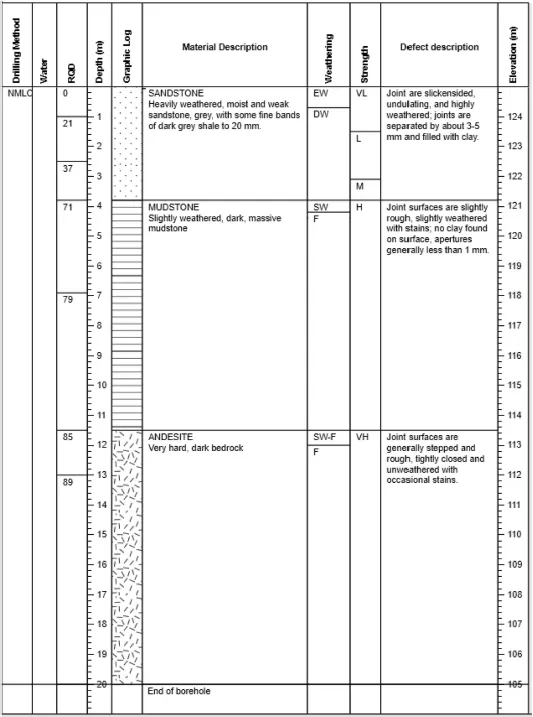
Figure 2.1 presents a map of the studied area. Four boreholes were drilled along the A-Aβ€² line, and the borehole logs are given in Figures 2.2–2.5.

2.2 Data from laboratory testing

Initial examination of core size and its mass was performed to determine rock density. The obtained data for three rock types – sandstone, mudstone and andesite – is given in Table 2.1.
For each type of rock, laboratory testing was conducted to determine its engineering properties. Intact specimens of sandstone collected at a depth of 2 m were used for a series of triaxial tests. The lab data from these tests is summarized in Table 2.2 in terms of the principal stresses (Οƒ1f, Οƒ3f) at failure.
The samples of mudstone were collected at a depth of 7 m for a series of point load tests with an axial direction of load. The sample size and the force recorded at failure are given in Table 2.3.
A cylindrical specimen of andesite (diameter of 50 mm and height of 100 mm) collected at a depth of 18 m was tested under unconfined compression and the obtained results are presented in Table 2.4.
A few other tests performed on rock specimens will be discussed later in this book, including slake durability and Schmidt hammer tests (Chapter 7).

2.3 Project tasks

The objectives of this project are to establish the geological setup of the site, determine the rock mass properties, estimate slope stability along the A-Aβ€² line (Figure 2.1), perform rock fall hazard assessment (at Point R in Figure 2.1) and discuss geotechnical issues that may occur during tunnel construction. The project includes several tasks which are connected as follows:
Figure 2.1
Figure 2.1 Map of the studied area
  1. Analysis of geological conditions at the project site. This involves determining the major geological units, identifying geological structures and discussing their effect on rock properties (Chapters 3 and 4).
  2. Analysis of the borehole logs and drawing a cross-section along the A-Aβ€² line. This involves describing the properties of each geological unit and identifying the rock layer(s) that may cause geotechnical issues. This part will be explained in Chapter 5.
  3. Analysis of joint characteristics of the rock mass and their effect of rock strength will be discussed in Chapter 6.
  4. Analysis of the lab data and determination of the engineering properties of intact rock specimens. This involves estimating the rock properties such as porosity, compressive and tensile strength, cohesion and friction angle. The laboratory procedures and data interpretation techniques will be discussed in Chapters 7 and 8.
    Figure 2.2
    Figure 2.2 Borehole BH1, Elevation – 231 m. Borehole log legend: Drilling method: NMLC – diamond core 52 mm. Weathering: EW – extremely weathering, DW – distinctly weathering, SW – slightly weathering, F – fresh. Strength: VL – very low, L – low, M – medium, H – high, VH – very high.
    Figure 2.3
    Figure 2.3 Borehole BH2, Elevation – 200 m. Borehole log legend: Drilling method: NMLC – diamond core 52 mm. Weathering: EW – extremely weathering, DW – distinctly weathering, SW – slightly weathering, F – fresh. Strength: VL – very low, L – low, M – medium, H – high, VH – very high.
    Figure 2.4
    Figure 2.4 Bore...

Table of contents

  1. Cover
  2. Half Title
  3. Title
  4. Copyright
  5. Contents
  6. Preface
  7. Conversion factors
  8. About the author
  9. 1 Introduction and book organization
  10. 2 Project description
  11. 3 Rock mass formation
  12. 4 Rocks and rock minerals
  13. 5 Rock exploration
  14. 6 Discontinuities in rock mass
  15. 7 Rock properties and laboratory data analysis
  16. 8 Stresses and failure criteria
  17. 9 Rock mass ratings and properties
  18. 10 Rock falls
  19. 11 Rock slope stability
  20. 12 Rocks and tunnels
  21. References
  22. Index