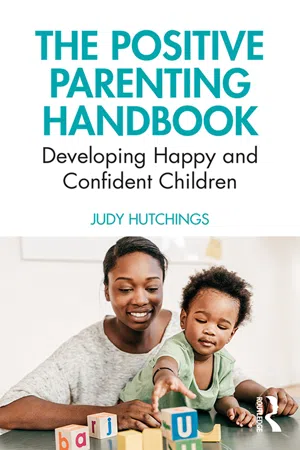
Drawing on Judy Hutchings many years of work with parents and children, The Positive Parenting Handbook is a concise, straightforward guide that offers simple solutions to daily dilemmas. The clear and easy advice provides parents with skills and tools that support positive parent/child relationships for happy and confident children. It explains common behaviour problems in young children and offers expert advice on:
-How to build strong bonds and let children know they are important to you
-How to encourage behaviour we want to see through praise and small rewards
-Giving instructions that children are more likely to follow
-How ignoring some unwanted behaviours can be helpful
-Strategies for managing difficult behaviour
-Teaching new behaviour to our children
-Developing children's language.
It includes six case studies of how these strategies have helped real families with everyday problems at bedtime and mealtimes, during toilet training, out shopping and when children experience anxiety.
Together with suggestions of other useful books and information sources, The Positive Parenting Handbook is ideal for all parents, including those of children with diagnosed developmental difficulties, and the range of professionals who work with them.
Understanding common behaviour problems in young children
Children’s behaviour problems, like tantrums, hitting, spitting, swearing and running away, are simple and easy to learn and are very common, particularly during children’s early years. This is when they do not have sufficient language to ask for things or understand that they cannot have something at that moment. In fact a lot of the skills that we want children to learn are helped if they have sufficient language to communicate what they want and understand what we want them to do. Waiting, taking turns, sticking at something or recognising that other people want something different are hard to learn and depend, to a large extent, on children’s ability to use language to understand other people and to manage their own behaviour. Importantly they can also, increasingly, use their thinking skills to manage their own behaviour when they become frustrated or are faced with problems. It is important to see the behaviour that we want from children as something that they have not yet learned.
Sometimes we try out solutions to everyday problems that don’t work, often through lack of sufficient thought about why the problem behaviour is occurring. So we need to work out the reason(s) behind the behaviour and decide on realistic, achievable goals that will replace problem behaviours. To be successful we have to identify the events occurring around each problem behaviour that will help explain it. This will clarify whether the child’s behaviour achieves a positive consequence, avoids an instruction, is developmentally unachievable or is avoidance of an anxiety-provoking situation.
Antecendents – when and under what circumstances does the problem occur?
The first thing to identify is the situation in which problem behaviour occurs. We call this the antecedent. A problem might only occur when one parent gives the instruction, for a particular instruction, in the presence of particular people or when the child is tired or hungry. It might only occur when there is a particular programme on the TV that the child wants to watch. So we need to identify what else is going on, was it bedtime? A meal time? Did it involve more than one child? Were there visitors? And where it was occurring – at home? In a shop? At a friend’s house?
Behaviour – what does the child do?
The second step in understanding the problem is to get a really clear picture of what the child does. Do they argue, ignore, run and hide, hit someone etc.?
Consequence – what response does the child’s behaviour achieve?
The final step is to identify what happens in response to the child’s behaviour or the consequence. Of course it may not happen every time, sometimes we say no and stick to it, whereas at other times we might give in for the sake of peace and quiet.
This process of describing problem situations in terms of Antecendents, Behaviour and Consequences, is generally known as the ABC approach and is really helpful in working out why children behave the way they do and deciding what are realistic alternatives. This ABC process is key to deciding how to deal with problem behaviours.
Functions of child behaviour – general principles
Your child may have tantrums or present challenges for lots of different reasons. The same problem behaviour can serve different functions, sometimes it can be a way of avoiding an instruction, such as to go to bed; at other times it can be a way of getting a demand met, such as for sweets or a drink; and on another occasion it can be a way of dealing with frustration and generating help when things go wrong. A problem behaviour may get attention, but it might also occur because the child cannot avoid the problem because the alternative is developmentally beyond them or may not have been learned. This is why it is important to look at each situation where problems occur, because each different situation may need to be dealt with in different ways.
The same behaviour problem occurs for different reasons in different children. One child’s refusal to go to school might be because they are being teased and have become anxious about school, another child might find being at home more rewarding than school, because they can play computer games all day; another child can get rewarded by meeting other truanting friends and engaging in risky activities, such as drinking or smoking.
What follows are examples of common reasons for the occurrence of problems:
i) Attention
One of the most frequently heard explanations for problem behaviour is that it is for attention. Young children need lots of attention and if they cannot get it in positive ways they can find other ways to get it, because at one level “any attention is better than none”. Getting attention for problem behaviour is a risky strategy, since parents often respond inconsistently and children and adults can be alternately rewarded. The parental attention that rewards the behaviour may not be particularly pleasant, but, for a young child who gets insufficient positive attention, it may suffice in the short term even if it does not work every time. This is why giving positive attention (see Chapter 2) and investing our time in our children for their own sakes is so important. If children get enough positive attention they will not need to use problem behaviour to get it. Since we also tend to do things for people we like, investing in our relationship with our children can also make them much more willing to follow instructions.
ii) The problem behaviour may achieve a tangible reward
Although parental attention may have established problem behaviours, over time it may cease to be reinforcing, particularly if parents become more negative and critical in trying to control their child’s behaviour. So, children are likely to use problematic behaviour to achieve short-term tangible rewards instead. Parents may “give in” to stop the confrontation, such as giving a child a biscuit or sweets at the supermarket till because the child has learned to persist with an aggressive behaviour and cease only when the demand for the sweets or biscuits is met. In another situation the problem behaviour may be a threat that achieves a reward, for example, saying to another child “give me that toy or I will hit you”.
iii) The child’s demand is immediately complied with by the parent
Sometimes the child does not “need” to have a tantrum because the parent has learned to comply with the child’s demands immediately, so avoiding a tantrum. Identifying this pattern of reward is harder, because the parent has learned to pre-empt problem child behaviour by meeting the demand before the child has a tantrum. A 13-year-old child with a significant developmental difficulty demanded that cola and crisps were on the table when he arrived home from school in a taxi. His past, very aggressive tantrums had led his mother to avoid any confrontation by providing what he wanted before he asked for it. Teaching him to greet his mum and wait for his cola and crisps using the principles described in this book, took some time.
iv) Avoiding or resisting following an instruction
Refusal to follow instructions is typical of children both with and without behavioural problems. Most children follow more than 50% of instructions, and we generally accept that, but some children follow less than others and need more support to learn to do this. There are a number of reasons why children fail to follow instructions:
a) The child may be capable of following the instruction but may not have been taught what to do.
b) The child may not be able to do what is being asked because the instruction is not developmentally appropriate.
c) It could be because what the child is doing at the time – playing with Lego, watching TV, etc. – is more rewarding than what they are being asked to do, such as getting ready for bed.
b) Sometimes the task is developmentally appropriate, but not explained clearly enough. This is a particular challenge for children whose language skills may not be sufficient to correctly interpret what is required of them. Chapter 4 has some key ideas for helping children to follow instructions.
v) The child’s behaviour generates support.
Some problem behaviours generate help to deal with frustration
Sometimes children are frustrated by their failure at an activity and a tantrum is a call for help. The child may be doing a puzzle, building a tower or trying to get dressed and it goes wrong. This can often be a problem for inattentive children, such as those with ADHD (who tend to rush at tasks) or those with developmental challenges (who may have communication difficulties).
vi) The behaviour stops something nasty from happening
Aggressive responses to a perceived or actual threat can remove the threat – for example when a child behaves aggressively towards someone who has been unkind to them in response to teasing or being excluded.
vii) The behaviour avoids a stressful situation
Some behaviours reduce stress through avoidance of what appear to be problem situations. This can occur in situations that generate anxiety, such as social situations or transitions from one activity to another, for example, for children with an autistic spectrum disorder. This also applies to children with other specific difficulties, such as dyslexia, who can avoid situations that demand the skills that they find challenging. Forms of avoidance that produce severe physiological responses are described as phobias.
The ideas in this little book will suggest ways of addressing these everyday challenges that have been used to help many parents over the last 40 years.
2 Building a positive relationship
Letting children know that they are important to us
Thirty-five years ago advice to parents about how to encourage their children’s good behaviour concentrated on two things. First they were advised to look for any “good” behaviour that the child showed and to notice and praise it and, by doing so, to make it more likely to happen again. Then they were told to look at “problem” behaviour and work out ways to make it less likely to happen again. Ideas about how to get better at doing both of these things are included in the chapters on rewarding good behaviour and managing difficult behaviour. However, we now know that there is something fundamental that is more important than both of these activities and must come first. That is investing time in our children, in order to learn about them and their interests and to let them know that they are important to us. This chapter is about what that is and how to do it.
The things that children do that parents think of as “good” or “bad” only account for a small amount of their time, in fact less than one quarter of it. What children do the rest of the time can be seen by parents as “doing their own thing” or playing, in which parents sometimes take little interest. After all, it provides a welcome opportunity for a busy parent to get on with daily chores. Parents who have a difficult or demanding child, or a child with learning difficulties or other special needs, inevitably have to spend more time helping their child, so the tendency to let the child “get on with it” when they are occupied may be even stronger.
Play, however, is very important to children. Showing interest in their child’s play is also a way that parents can improve their relationship with their children quickly and effectively. By play we are talking about playing with toys, acting and most other things that children do without instructions from adults or that parents might like them to do on their own. When a parent shows that what their child is doing is also important to them it improves their relationship with their child and increases the likelihood that it will happen again. This spending time and taking notice of children is sometimes called “attending”.
Attending lets children know that we are watching them and interested in them when they are doing something that they have chosen to do. It is not about keeping track of children’s behaviour to make sure that they are behaving appropriately, which is another important skill that parents need. It is about showing interest in children for their own sake.
Parents of children with developmental challenges or difficult behaviour can spend a lot of time helping their children learn to do things that are difficult for them or trying to stop them from misbehaving or harming themselves. When children are playing or occupying themselves quietly it is easy to leave them to their own devices. But this is just when it helps to “attend” to children and to what they are doing.
Attending helps children know that their parents value them as individuals, appreciate the things that they do and are not only concerned with getting them to do as they are told. Children who are good at following instructions or advice generally do this because they have a positive relationship with their parents and want to please them because of the interest that their parents have shown in them.
Attending is a way that parents can “tune in” to the things that children are doing and notice and respond to what they are saying and doing to communicate with their parents. It also helps parents to learn more about their children, and what they can do, so as to have realistic expectations about their behaviour. When someone really listens to you and notices what you are doing it makes you feel good because you feel valued. Think of the people who care about you. You know it because they show an interest in you and let you know that your views matter to them. When a relationship between a parent and child is going well this happens naturally. ...
Table of contents
Cover
Half Title
Title Page
Copyright Page
Table of Contents
Foreword by Judy Hutchings
The Children’s Early Intervention Trust (CEIT)
1. Introduction: understanding common behaviour problems in young children
2. Building a positive relationship: letting children know that they are important to us
3. Praising and rewarding children’s positive behaviour
4. How to get better at giving instructions
5. Ignoring problem behaviour
6. Managing difficult behaviours
7. Teaching new behaviour to our children
8. Developing children’s language
9. Summing it all up
10. Typical problems experienced by real families: positive parenting in action
Solving a bedtime problem
A morning problem
A shopping trip
A toileting problem
An eating problem
Avoidance and anxiety-based problems
Trusted by 375,005 students
Access to over 1.5 million titles for a fair monthly price.
Study more efficiently using our study tools.
Frequently asked questions
Yes, you can cancel anytime from the Subscription tab in your account settings on the Perlego website. Your subscription will stay active until the end of your current billing period. Learn how to cancel your subscription
No, books cannot be downloaded as external files, such as PDFs, for use outside of Perlego. However, you can download books within the Perlego app for offline reading on mobile or tablet. Learn how to download books offline
We are an online textbook subscription service, where you can get access to an entire online library for less than the price of a single book per month. With over 1.5 million books across 990+ topics, we’ve got you covered! Learn about our mission
Look out for the read-aloud symbol on your next book to see if you can listen to it. The read-aloud tool reads text aloud for you, highlighting the text as it is being read. You can pause it, speed it up and slow it down. Learn more about Read Aloud
Yes! You can use the Perlego app on both iOS and Android devices to read anytime, anywhere — even offline. Perfect for commutes or when you’re on the go. Please note we cannot support devices running on iOS 13 and Android 7 or earlier. Learn more about using the app
Yes, you can access The Positive Parenting Handbook by Judy Hutchings in PDF and/or ePUB format, as well as other popular books in Psychology & Education General. We have over 1.5 million books available in our catalogue for you to explore.