Analyzing the self-sufficient Danish island of Samsø, this book explains sustainability through a bio-geophysical understanding of how to best use society's limited resources to achieve true sustainability. The method used derives from the thermodynamic function of exergy. By analyzing exergy flows and establishing a system for evaluating the energy and the materials used in a society, the author creates a platform for monitoring certain indicators of sustainability. These indicators inform readers about the actions that must be taken and the time frames for achieving sustainability goals. The exergy-based approach is an important tool for carrying out such an analysis because it
Focuses on several key thermodynamic concepts and the usefulness of exergy analysis for evaluating sustainability
Explains sustainability by implementing thermodynamic laws to societal consumption and the use of resources
Discusses new methods that integrate energy and material fluxes and evaluates them against each other
Provides direct indicators for finding the largest problems/obstacles and deciding where measures should be taken
Includes instructions on how to establish an accounting system for evaluating the energy and the materials used in a society
This book is aimed for professionals, researchers, and students working on nature conservation and environmental management projects related to sustainability.
Introduction to Sustainability and Work Energy Analysis
1.1 Introduction to Sustainability Analysis
In this chapter, we investigate the currently accepted definition of sustainability and identify the need for a more precise definition, since only a unifying approach with clearly specified requirements can properly assist us in constructing a sustainable development process. In short, the moral obligation to care for future generations as laid down in the Brundtland report (WCED, 1987) and Rio Convention (UNESCO/UNCED, 1992) is clearly insufficient, for instance when formulating appropriate political actions to prevent potential damage from whatever we will face of changes in our environment arising from forecasted climate changes. An idealistic wish does not provide guidance for specific actions. The recent introduction of sustainable development goals (SDGs) represents a step forward (UNDP, w/o date), but again, a long list of possible initiatives will not necessarily cause the proper measures to be taken.
Many attempts have been made to sharpen the definition of sustainability, in particular the problem of how to integrate the various proposals in a more systematic way. This includes considerations on systemic properties and approaches to the analysis of sustainability in regions and society as well as in nature. Interestingly, presentations of the concept of sustainability often give priority to economic and macroscopic social issues, whereas—as this study shows—the world looks different when viewed through the eyes of laymen and ordinary people. Suddenly, the local, microscopic and environmental issues come into play.
The dichotomy between our perception, recognition and eventual conceptualization of problems affects possibilities and restraints in the future and thereby represents a key issue in our attempts to achieve sustainable development. Such issues need to be resolved. The chances of achieving progress and moving society towards increasing sustainability seem to be higher the closer scientists manage to work with local people who experience problems directly in their own lives.
One special problem remains to be solved in all theoretical aspects of achieving sustainability. In fact, the issue is very simple when dealing with types of societal analyzes which are able to tell us simple things such as what we are doing and what is the relative importance of the things we are doing. Such simple knowledge is necessary in order to tell how close or far away from sustainability we are and what we can do now or will have to do to in the future. Among the many approaches proposed in the literature during recent decades, work energy (aka exergy) provides us with a strong candidate to use as the entry point for such an analysis. All in all, it is considered to provide a satisfactory unifying platform that enables us to make a cross-boundary analysis comprising both energetic-material and societal and environmental issues.
Ever since the publication of the report of the Club of Rome, widely known as “Limits to Growth” (Meadows et al., 1972), there has been public concern about our excessive use of natural resources and their possible depletion. This book appeared only shortly after the author Rachel Carson in another publication, The Silent Spring (Carson, 1962), had pointed out the negative consequences of our industrialized activities and production methods arising from their utilization and release of various types of chemicals and wastes which were having a high impact on the state of our environment—which, in turn, would have an impact on ourselves and our societies. We have to learn much faster from our mistakes (EEA, 2013) and pay much more attention to the potential dangers inherent in our activities by applying responsibility (Jonas, 1984) through the precautionary principle (Kriebel et al., 2001).
It has become clear that depletion of the primary energy drivers of our society, namely fossil fuels in the form of oil or coal, is coming closer and closer to its limit; it is only a matter of time before the situation begins to impact the present level of global activity. Nevertheless, we face great difficulties in developing a concerted plan of action that would allow the necessary measures to be taken to counteract this development.
Meanwhile, the situation with fossil fuels finds its parallel amongst almost all the material resources that we regard as necessary to the way we currently live our lives. As pointed out by Hubbert as early as 1962 (Hubbert, 1962), most resources will sooner or later be exhausted. This is indeed the situation not only for many of the metals we use but also for simpler materials like sand for cement, and plaster for the construction industry.
Concerted actions may in some cases be much easier to take on a more local scale, as is the case here with the island of Samsø, where the obvious motto has been to think and act locally.
1.2 The Sustainability Concept
The concept of sustainability appeared in our language in connection with a report published by the World Commission on Environment and Development with the title Our Common Future (WCED, 1987) also known as the Brundtland report. The publication ably represented the outcome of a much longer process initiated in Stockholm in 1972 where the UN held a conference concerned with the human environment. This was at a time when the issues raised in the previously mentioned books by Carson and the Club of Rome were already well known. Some 5 years after the appearance of the Brundtland report, an international conference was held in Rio de Janeiro, resulting in the so-called Rio Convention or Rio Declaration (UNESCO/UNCED, 1992). Ever since it first appeared, the definition of sustainability has been criticized for being unclear, and many thoughts and suggestions have been dedicated to the questions, What does it actually mean to be a sustainable society?—and, if we can possibly agree on a proper definition, How do we actually achieve it?
The most commonly quoted citation and also a very central formulation of the issue of sustainability comes from the Brundtland Report (WCED, 1987), which tells us that
[s]ustainable development is development that meets the needs of the present without compromising the ability of future generations to meet their own needs.
The difficulties caused by such an imprecise statement have attracted much criticism. What exactly will our needs be in the future? In fact, do we even know what we need at present? And is it necessary to meet our needs in the same way in the future as we do today? Would it be sustainable to use up some resources to create a new technological platform for future existence? After all, we have put some severe constraints on future generations by using up most of the easily accessible fossil-fuel deposits on Earth in just two centuries. Wouldn’t it be better to meet the “needs of future generations” by being extremely foresighted? This means that we should start to develop new technologies to replace the existing ones in order to substitute non-renewable resources with renewable ones. Considering the severity of the situation, many consider that this cannot happen fast enough.
There is no doubt that without a much clearer and more stringent definition, sustainability stands out as a rather vague concept. The different angles from which the topic can be addressed—economic, societal and environmental—leave many people with the impression that we can settle for only one of these aspects. In fact, we need all of them at the same time. That additional flavours have been added to the concept so that a society can be designated as possessing either weak or strong sustainability (Daly and Cobb, 1989; Barbier, 2019; Barbier and Burges, 2017)—and even different graduations between—does not help the situation.
Although the Brundtland report comes out with some quite clear descriptions both of the problems and of the actions needing to be taken in consequence, it is not clear how and where these actions should be taken. Who is responsible for their implementation?
More recently, several new concepts and ideas have emerged, and these are now proposed as a possible way to integrate and evaluate the cycles of energy and matter flow that occur within our societies as well as in nature. Work energy represents such a concept. It finds its strength in its applicability to a wide range of environmental issues, thus serving as a common platform of analysis. This is considered necessary in order to get closer to a more precise definition of what sustainability actually means to our present and future societies.
1.3 Sustainability—A Materialistic Definition
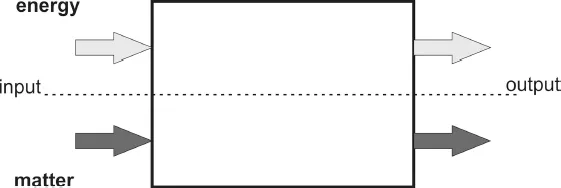
A major and fundamental issue concerning the resources that we use to drive our society is that they mainly come in two forms, either energy or matter, and both forms basically stem from resources that may be considered either renewable or non-renewable in character (see Figure 1.1).
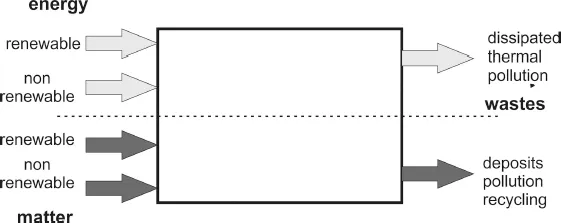
As mentioned earlier, the double-dual character of the work energy flows is adopted as the entry point of this analysis. Thus, a given flow will be assigned a position on a sustainable–non-sustainable axis and, at the same time, be designated as belonging to either an energy or a matter flow (see the end of Chapter 3) (see Figure 1.2).
In this context, we distinguish between sustainable and non-sustainable flows or resources by correlating sustainability with renewability. Simply formulated, a resource is considered to be sustainable when it is renewed (formed or regenerated by reuse or recycling) on the same time scale at which it is consumed/used by the system (see also Section 1.3.2).
Figure 1.1 In many representations of our society the resources used to drive our activities have been shown as either belonging to flows of energy or matter. Both are used to produce products, goods or services we believe are necessary for the realization of our everyday life (e.g. Cleveland and Ruth, 1997).
Figure 1.2 Inspired by H. T. Odum, a further partitioning of the two flows is undertaken. To reach a sustainable state of our society, it is of utmost importance where the energy or materials are coming from, whether they stem from non-renewable or renewable resources. True environmental sustainability is reached only when all energy is based on renewable energy forms and all materials are perfectly recycled and extraction of virgin materials is not needed.
1.3.1 Energy Perspectives
We need energy to run our society, and this energy is derived from sources that are very different in character: these include fossil fuel, biomass, solar radiation, wind power and hydropower.
Also, the extraction of energy from these different sources requires very different technological levels in a given society. A wood-burning stove for domestic heating differs significantly in its technological demands on society from domestic heating solutions using district heating or co-generation plants—which demand an advanced infrastructure—or from solar panels, electric heaters or heat pumps.
A huge problem is presented by the fact that a major part of all energy used today is directly derived from finite resources, that is resources that if not recycled will run out someday. Not only resources such as coal, oil and natural gas but also tar sands and shale oil belong in this category—although on different time scales—and will eventually turn out to be finite. The same is the case with energy stemming from nuclear fission plants, not considering the various other problems, such as the residual radioactivity in the wastes, arising from this type of energy production. For interpretations emphasizing the role of thermodynamics, refer to Rifkin (1989), Cleveland and Ruth (1997), Daly (1992), Hammond (2004).
According to some authors, we may be able to reach a situation where we are able to exploit a much larger proportion of the solar radiation reaching the Earth (e.g. Ayres, 1998, 1999). This optimistic view is built on the fact that the energy input from solar radiation in principle is unlimited. We just need to become much better at using it, and then all problems of energy supply will have been solved. But in the meantime, the improvement of such exploitation is not only dependent on existing technologies but also closely linked to material resources that are finite.
The discussions on such issues originate in the works of Georgescu-Roegen (1971) (Daly, 1995; Gowdy and Mesner, 1998) and have continued ever since. As Georgescu-Roegen pointed out, no energy conversion will be perfect, and all conversions of materials too will lead to dissipation (see the later discussion). His conclusion is therefore that once energy has been invested in upgrading matter (as illustrated, for instance, by decreased statistical entropy; Rechberger and Graedel, 2002), we should do everything within our power to keep it at an upgraded level and save energy by not allowing it to disintegrate and spread again (see Section 1.4). This point accentuated the value of reuse and recycling of materials at a time when this had not yet become an issue and demonstrates how foresighted the views of Georgescu-Roegen actually were.
1.3.2 Material Perspectives
All material resources seem to share the property of being finite; by comparison, see Hubbert’s peak (Hubbert, 1962) described earlier. The amount of matter available to us is limited by the size of our planet and by the size of the part of the Earth’s crust that we are technically able to exploit. Finite in this context means that these resources will eventually come to an end and that the extraction of virgin material cannot continue forever. For convenience here, we will not enter into the discussion of matter being available as either resource or reserve and whether these have actually been proved to exist or not. The issue of matter existing as either a resource (total) or as a reserve (economically viable to extract) involves economic considerations that are beyond the scope of this treatise.
If finiteness is considered, a resource can only be considered as sustainable if it is not consumed at a rate faster than the rate with which it is (re)produced. By production, we here mean that the resource is produced so it may be utilized as virgin material. By reproduction we refer to the fact that reuse and recycling make it possible to use the same materials several times, thus reducing the pressure on and demand for virgin materials.
1.4 Integrating with Physics
One of the major obstacles to giving a clear(er) definition of the concept of sustainability—as almost seen from the definition given earlier—is that such a definition must necessarily involve a set of paradigms that do not normally share a sufficient number of world views to make this an easy task.
Getting closer to a proper and rigorous definition must necessarily involve disciplines such as the following:
Physics
Chemistry
Geology/geography
Biology
Ecology
Sociology
Economics
Of these, the first five are viewed as fundamental elements of environmental sustainability, without which the sociological and economic versions of sustainability will not exist. Hence, the latter are seen as inferior and not included.
Many intertwining subdisciplines, that is mixes of knowledge from the preceding discussion, such as atmospherics, meteorology, hydrodynamics, physical chemistry, thermodynamics, soil sciences, knowledge of climatic belts, organisms and populations, must be brought in before we can determine a...
Table of contents
Cover
Half Title
Series
Title
Copyright
Contents
Foreword
Preface
Acknowledgements
Author
Reading Instructions
1. Introduction to Sustainability and Work Energy Analysis
2. Work Energy and Sustainability
3. Methodological Considerations
4. Analysis of the Energy Sector
5. Work Energy Analysis of the Public Sector
6. Work Energy and Private Sector
7. Work Energy Analysis of the Agriculture, Forestry and Fisheries Sector
8. Work Energies of the Industry, Trade and Commerce Sector
9. Work Energy Analysis of Nature
10. Solid Waste—Estimating Amounts and Potentials
11. Work Energy Budgets—Overview and Discussion
12. Conclusions and Perspectives
References
Index
Trusted by 375,005 students
Access to over 1.5 million titles for a fair monthly price.
Study more efficiently using our study tools.
Frequently asked questions
Yes, you can cancel anytime from the Subscription tab in your account settings on the Perlego website. Your subscription will stay active until the end of your current billing period. Learn how to cancel your subscription
No, books cannot be downloaded as external files, such as PDFs, for use outside of Perlego. However, you can download books within the Perlego app for offline reading on mobile or tablet. Learn how to download books offline
Perlego offers two plans: Essential and Complete
Essential is ideal for learners and professionals who enjoy exploring a wide range of subjects. Access the Essential Library with 800,000+ trusted titles and best-sellers across business, personal growth, and the humanities. Includes unlimited reading time and Standard Read Aloud voice.
Complete: Perfect for advanced learners and researchers needing full, unrestricted access. Unlock 1.5M+ books across hundreds of subjects, including academic and specialized titles. The Complete Plan also includes advanced features like Premium Read Aloud and Research Assistant.
Both plans are available with monthly, semester, or annual billing cycles.
We are an online textbook subscription service, where you can get access to an entire online library for less than the price of a single book per month. With over 1.5 million books across 990+ topics, we’ve got you covered! Learn about our mission
Look out for the read-aloud symbol on your next book to see if you can listen to it. The read-aloud tool reads text aloud for you, highlighting the text as it is being read. You can pause it, speed it up and slow it down. Learn more about Read Aloud
Yes! You can use the Perlego app on both iOS and Android devices to read anytime, anywhere — even offline. Perfect for commutes or when you’re on the go. Please note we cannot support devices running on iOS 13 and Android 7 or earlier. Learn more about using the app
Yes, you can access Sustainable Development Indicators by Søren Nors Nielsen in PDF and/or ePUB format, as well as other popular books in Biological Sciences & Environmental Science. We have over 1.5 million books available in our catalogue for you to explore.