This book explores the fundamental questions about whistleblowing and summarizes what we know about the experiences of whistleblowers. It provides a detailed summary of the current legal protection for whistleblowers and some general guidelines for reporting misconduct.
eBook - ePub
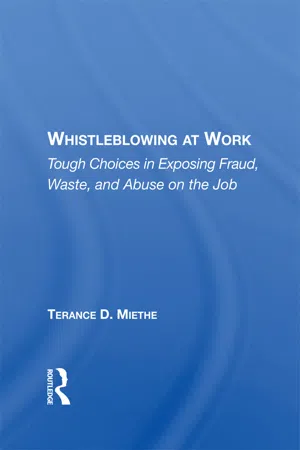
Whistleblowing At Work
Tough Choices In Exposing Fraud, Waste, And Abuse On The Job
- 264 pages
- English
- ePUB (mobile friendly)
- Available on iOS & Android
eBook - ePub
About this book
Information
1
Introduction
U.S. workers observe fraud, waste, and abuse at work on a daily basis. Sexual harassment, employee theft, breaches of confidentiality, discriminatory employment practices, safety and health violations, consumer rip-offs, and financial frauds are both endemic to our society and a growing national epidemic. Consider what some ordinary citizens have seen at their workplaces in the past few years:
- Students in a "gifted" program receive personal computers and other high-tech equipment, but a teacher at the same public school can't get such basic educational equipment as dictionaries and pencils for her students because the district has no money. Many parents of the "gifted" children are high-level administrators or staff in the school district.
- A field engineer observes that the construction company he is working for failed to properly install a gas-proof membrane and uses insufficient amounts of reinforcement materials in the construction of a multi-billion-dollar subway tunnel.
- A television station employee is sexually harassed by her production manager and is discriminated against in a promotion decision.
- A nurse at a county hospital notices that her immediate supervisor is not following proper procedures for collecting and testing blood donations, risking the health of both patients and donors through the transmission of hepatitis and the AIDS virus.
- An administrative assistant, reviewing her financial records, discovers that county commissioners are using public funds to pay for their private automobiles and family vacations.
- Contrary to industry standards regarding the humane treatment of animals, a worker sees animals routinely skinned alive at a meat-processing plant.
- An air-cargo pilot notices that ground workers are not properly deicing airplanes before they depart in bad weather.
- An accountant discovers that the company manager is selling its product at below market value. The manager is receiving kickbacks in exchange for selling the product at the lower price.
- A maintenance worker at a company that produces highly explosive materials sees a co-worker smoking cigarettes in a restricted area.
- A clerical worker in a nonprofit organization observes another employee steal a computer from the office.
What would you do if you saw these activities? There are several options. You could do nothing, convincing yourself that it's none of your business, no harm is being done, or it's someone else's problem. Another option is to report it directly to your immediate supervisor or to someone else within the company. How about going outside the company and reporting it to the police, district attorney, attorney general, or another governmental agency?
Unfortunately, before you choose a course of action, think about this: There are some clear advantages and numerous, often unexpected, disadvantages for each option. Whatever you do, it's a no-win situation.
Take "doing nothing" or what academics call being a "silent observer." Often considered the safest option, inaction is impossible for many workers because they are under a higher moral or legal obligation to report fraud, waste, and abuse. The failure to act is insubordination in the military and in other settings may result in civil or criminal charges for aiding and abetting, collusion, or conspiracy. When inaction results in serious injury or death to other people (as happened in the example of improper blood testing), you may suffer lifelong guilt and psychological distress. Even when the consequences to others are less severe, silent observers often report deep regret and remorse for not speaking out.
Reporting misconduct to an official within the company is an equally unattractive option. Some employers may offer small perks (like a pat on the back or a small bonus) for helping the company identify "bad apples" or avoid negative publicity. However, at the same time that praise is given for your efforts, management will often chastise you privately for being a "squealer" and define you as an untrustworthy and dangerous employee. The reasoning behind their negative evaluations is simple: Persons willing to snitch on friends and co-workers will probably do the same upon discovery of more severe and systemic misconduct by the corporation itself. If you are considered the company spy or snitch, your relationship with fellow workers will also deteriorate as a result of speaking out.
Finally, you could go totally outside the company and report the misconduct to an external agent—police, attorney, news reporter, regulatory agent, government official. Here, the outcome and consequences are also unattractive. Unless you are totally indispensable to the organization (for instance, married to the chief executive officer or possessing skills that can't be replaced), your act of defiance of company norms by "airing dirty laundry" is often professional suicide and usually results in swift, certain, and severe forms of organizational retaliation. You could lose your job (or be forced to resign because the company has made your life totally miserable), co-workers may shun and avoid you, other employers may blacklist you from receiving similar jobs, and severe economic and psychological harm may haunt you for the rest of your life. Of course, you may be entitled to financial compensation for being illegally fired or demoted, but taking legal action to be reinstated is expensive and time consuming, and legal judgments typically favor the company rather than the employee.
So, what did these ordinary people do and what happened to them? Here's a summary:
- The teacher wrote a letter to state legislators about running a private school within a public institution. When it became known that she had "gone public," she was dismissed in the middle of the semester. She subsequently filed a lawsuit against the school district for denying her First Amendment rights to "free speech," was awarded more than $100,000 in the lawsuit, and was ultimately reinstated to her teaching position. However, she now suffers from stress-related medical problems and has totally lost faith in other people and social institutions.
- The construction engineer reported the shoddy construction practices to numerous local, state, and federal agencies. He was fired from his job (presumably because of a reduction-in-force necessity) but has continued the fight for the last eight years to expose the deficiencies and force the company to take major corrective action. He has recently filed a state lawsuit, seeking monetary compensation for exposing this major problem. Although the experience has left deep financial and psychological scars, he has received some vindication from the growing public recognition of the construction flaws and the major health hazards posed by this public works disaster,
- After filing a complaint against the manager for sexual harassment, the television employee was denied the opportunity to apply for an advanced position within the station. Management claimed that she was a troublemaker and an incompetent worker (contrary to her written performance evaluations). She feels totally victimized by the experience and has now filed a lawsuit against the station for sex discrimination.
- The nurse questioned her supervisor on the inappropriate blood-testing procedures but nothing was changed for several weeks. As a consequence, at least three patients contracted the AIDS virus, and two of them have died from AIDS-related complications. Feeling personally responsible for not being more assertive with the incompetent supervisor, the nurse quit her job and now works at a hospice for terminally ill people. Lawsuits have been filed against the small county hospital where the tainted blood donations were collected. Fearful of physical threats made by local residents and co-workers, who will lose their jobs if her lawsuit is successful, the nurse was forced to leave town.
- Concerned about being falsely implicated with the county commissioners for misappropriation of public funds, the administrative assistant contacted an attorney and was advised to involve federal law enforcement officials. She wore a "wire" to get the commissioners' admission of wrongdoing and taped the offer of a $10,000 bribe for her silence by one of the commissioners. After four officials were indicted and pleaded guilty, the administrative assistant took another job and moved out of town. She feels good about what she did, but she was very concerned about retaliation while still living in the small town.
- The meat-packing worker reported the animal abuse on several occasions to his manager, but nothing was done. His superior said something like "Hey, they are only dumb animals—no big deal!" The worker was a college student, trying to make a few extra bucks on a part-time basis. He thought about reporting the abuse to PETA (People for the Ethical Treatment of Animals) or another animal-rights group, but he decided it wasn't worth it. Several weeks later, he went back to school.
- The air-cargo pilot was a new employee at the company when he observed the poor deicing efforts. He remained silent about the incident and other dubious practices because he didn't want to create any problems. He left the company for another job shortly after the episode. In retrospect, the pilot feels some guilt for not reporting the safety violations to aviation authorities.
- The accountant confronted the company manager about the price kickbacks and then reported the practice to the company stockholders. Lacking direct evidence of the manager's fraud (such as canceled checks), only about half of the stockholders believed the accusations. After continuing to work for several months in a now hostile and high-stress work environment, the accountant received a medical disability, retired, and left town. The accountant says that he doesn't talk about the incident, but it is clear that this experience dramatically altered his life.
- The maintenance worker reported the smoking incident to his supervisor. Because unauthorized smoking had previously caused a major explosion that killed two employees at the same plant, the offending employee was fired, and the maintenance worker was praised by management for his action.
- After the clerical worker reported the computer theft to her boss, the employee was asked to return the equipment and was subsequently fired. Formal criminal charges, however, were not filed against the thief, possibly to minimize any negative publicity about misconduct within the nonprofit organization. The clerical worker was neither praised nor criticized by management for her actions. A replacement was hired after the incident, and things quickly returned to normal.
As illustrated by these examples, reactions to misconduct are wide and varied. Some people feel no major compulsion to speak out, and their organizations seem content with this inaction. Other employees become strongly committed to disclosing the abuse to authorities outside the organization and take whatever steps are necessary even in the face of severe and swift organizational retaliation. What individual, organizational, and situational factors account for these differences? And how can employees in a variety of work settings best respond to organizational misconduct without getting burned?
If your experiences are like those of other employees, the decision to "blow the whistle" will have lasting consequences. In fact, whistleblowing—the reporting by employees and former employees of illegal, unethical, and otherwise inappropriate conduct to someone who has the power to take corrective action—is often associated with marital conflict and family disruption, declines in psychological well-being, alienation from co-workers, short- and longterm financial distress, and a diminished faith and trust in other people and major social institutions.
Using data from personal interviews and surveys of employees in various work settings, this book examines whistleblowing and its individual and organizational consequences. Chapter 2 begins with a definition of whistleblowing, identifying its major forms, and describes the problems with studying whistleblowers. Special attention is given to isolating the key aspects and unique features of whistleblowing as a form of snitching. Chapter 3 describes the emergence of whistleblowing as a primary method for the detection and control of organizational misconduct. Available data on the prevalence of illegal activity at work, and alternative methods for controlling it, are also reviewed.
The extent of whistleblowing and its correlates—that is, the social and psychological attributes of whistleblowers, the situational factors, and the organizational characteristics that increase or decrease the likelihood of its occurrence—are covered in Chapter 4. Subsequent chapters examine the individual and organizational consequences of whistleblowing (Chapter 5), the legal rights and safeguards for whistleblowers (Chapter 6), and case histories of particular whistleblowers (Chapter 7). The concluding chapter provides a summary of strategic choices and practical advice for persons who are considering whether and how to report organization misconduct. The appendix provides a listing of support services for whistleblowers.
2
What Is Whistleblowing and How Do We Study It?
Most of the people described in the Introduction are whistleblowers. Except for the airline pilot who remained silent, the others are designated as "whistleblowers" because they are employees or former employees who report misconduct to persons who have the power to take action (see Miethe and Rothschild 1994; Miceli and Near 1992). Although this definition is fairly general, it is important to recognize that whistleblowing has come to mean so many different things to different people that it defies an unambiguous description. Widely used synonyms such as "snitches," "squealers," "rats," "moles," "finks," "stools," "blabbermouths," "tattletales," "ethical resisters," and "people of conscience" clearly illustrate our diverse perceptions of whistleblowers in U.S. society.
Definitional Issues
The general definition of whistleblowing used here includes basic elements and implies several other factors that distinguish it from other forms of snitching. The basic elements of whistleblowing and its unique aspects are described below.
The Office Snitch
A starting point for defining whistleblowers is to consider them the "office snitch." This short phrase, although highly pejorative, nonetheless captures two crucial aspects of whistleblowing: (1) its social acceptability and (2) where it occurs.
Let's first examine the social acceptance of whistleblowing. The two extreme positions are represented by the "snitch" and the "savior." As a snitch, the whistleblower is considered a lowlife who betrays a sacred trust largely for personal gain. When the betrayal occurs among children, the snitch is the tattletale or fink. The snitch who divulges intimate secrets about friends is called the "gossip," whereas the snitch who receives financial payment or other direct benefits from exposing "dirt" is the informant. The prison snitch is the "rat," and the "mole" is the company snitch who is planted by the organization itself. Whistleblowers are unique snitches in that their disclosures involve organizational misconduct, occur within the work setting, and are not necessarily supported by the organization (as is true of moles). From this perspective, the whistleblower is the office snitch.
Although often overlooked and minimized, a positive side exists for each type of snitching. In other words, the snitch can also be a "savior." By telling a parent that the neighbor's kid is lighting firecrackers without adult supervision, for example, the tattletale averts a serious injury. The gossip who tells of another's amorous interests or abusive history may help a friend make the right decision. The rat helps prison officials maintain order within their institutions. Paid informants may help apprehend and convict serious and dangerous offenders. Similarly, the actions of nationally renowned whistleblowers such as Frank Serpico, Karen Silkwood, and "Deep Throat" ultimately lead to major changes in formal organizations, industry, and politics.
Whether whistleblowers are viewed as snitches or saviors depends, of course, on one's perspective. Richard Nixon, for example, probably didn't consider the anonymous "Deep Throat" a public savior. Nor did the officers exposed by the charges of mass corruption made by Frank Serpico against the New York Police Department or tobacco industry officials upon the disclosures by Dr. Jeffrey Wigand of the manipulation of nicotine levels in cigarettes. As discussed in detail later, the public image of whistleblowers as snitches or saviors and the social acceptability of this practice depends on how it is done and a variety of other factors. Nonetheless, whistleblowers are more typically viewed as snitches than public saviors even when their actions contribute to the greater good of a society.
The second important aspect of the label "office snitch" is that it implies that whistleblowing occurs in the context of...
Table of contents
- Cover
- Half Title
- Series Page
- Title
- Copyright
- Contents
- List of Tables and Figures
- List of Acronyms
- Preface and Acknowledgments
- 1 Introduction
- 2 What Is Whistleblowing and How Do We Study It?
- 3 Snitching, Changing Work Organizations, and Whistleblowing
- 4 The Prevalence and the Profile of Whistleblowers
- 5 Individual and Organizational Consequences of Whistleblowing
- 6 The Legal Protection of Whistleblowers
- 7 Case Histories of Six Whistleblowers
- 8 Strategic Choices and Practical Advice
- Appendix: Support Organizations and Resources for Whistleblowers
- Cited Studies and General References
- Index
Trusted by 375,005 students
Access to over 1.5 million titles for a fair monthly price.
Study more efficiently using our study tools.
Frequently asked questions
Yes, you can cancel anytime from the Subscription tab in your account settings on the Perlego website. Your subscription will stay active until the end of your current billing period. Learn how to cancel your subscription
No, books cannot be downloaded as external files, such as PDFs, for use outside of Perlego. However, you can download books within the Perlego app for offline reading on mobile or tablet. Learn how to download books offline
Perlego offers two plans: Essential and Complete
- Essential is ideal for learners and professionals who enjoy exploring a wide range of subjects. Access the Essential Library with 800,000+ trusted titles and best-sellers across business, personal growth, and the humanities. Includes unlimited reading time and Standard Read Aloud voice.
- Complete: Perfect for advanced learners and researchers needing full, unrestricted access. Unlock 1.5M+ books across hundreds of subjects, including academic and specialized titles. The Complete Plan also includes advanced features like Premium Read Aloud and Research Assistant.
We are an online textbook subscription service, where you can get access to an entire online library for less than the price of a single book per month. With over 1.5 million books across 990+ topics, we’ve got you covered! Learn about our mission
Look out for the read-aloud symbol on your next book to see if you can listen to it. The read-aloud tool reads text aloud for you, highlighting the text as it is being read. You can pause it, speed it up and slow it down. Learn more about Read Aloud
Yes! You can use the Perlego app on both iOS and Android devices to read anytime, anywhere — even offline. Perfect for commutes or when you’re on the go.
Please note we cannot support devices running on iOS 13 and Android 7 or earlier. Learn more about using the app
Please note we cannot support devices running on iOS 13 and Android 7 or earlier. Learn more about using the app
Yes, you can access Whistleblowing At Work by Terry Miethe in PDF and/or ePUB format, as well as other popular books in Social Sciences & Sociology. We have over 1.5 million books available in our catalogue for you to explore.