First published in 1986. The abolition of regional disparities is one of the main targets of Indonesian economic policy. Within the scope of the Indonesian-German Technical Cooperation the East Kalimantan Transmigration Area Development Project (TAD) is intended to contribute to supporting this policy. This study was carried out to support this work - as a first step to gain relevant information. The report is based on interviews with transmigrant families. They were made before transmigration in the so-called 'transitos' in Java and Bali and after transmigration in eight settlements in Riau and East Kalimantan.
- 162 pages
- English
- ePUB (mobile friendly)
- Available on iOS & Android
eBook - ePub
Transmigration in Indonesia
About this book
Information
PART 1
TRANSMIGRATION WITHIN THE FRAMEWORK OF INDONESIAN DEVELOPMENT POLICIES
1.1 Economic and Social Background
1.1.1 Disparities and Dualisms
The analysis of Indonesian transmigration programmes has first to take into consideration the socio-economic background of the country as a whole and of the region which send settlers to the so-called outer islands. In this context the disequilibrium in the regional distribution of the population between Java and the other islands is of paramount importance. Java and the small island of Madura have a share of only 6.9 % in the total area of Indonesia; both islands are inhabited, however, by 61.9 of the population of the country.1
The population density in this area is already 691 persons/sq.km. This is much higher than the density in often-cited densely or over populated countries. The comparative figures are 104 in P.R. China, 210 in India and 630 in Bangladesh.2
The situation is aggravated by the natural growth of population. The annual average growth rate of about 2.3 in Indonesia as a whole is the main barrier to the development of the country. Even if it were possible to reduce the natural increase to 2 p.a., in the year 2000 more than 1,000 persons/sq.km. would live in Java and Madura (cf. Table 1).
This fact has to be seen against the background of the Indonesian economy which is still dominated by the agricultural sector. Nearly two thirds of the entire labour force are employed here (incl. forestry and fishery), producing more than one quarter of GDP.
Table 1: Estimates of Population Development and Population Density in Java and Madura under Different Assumptions (1990-2080)
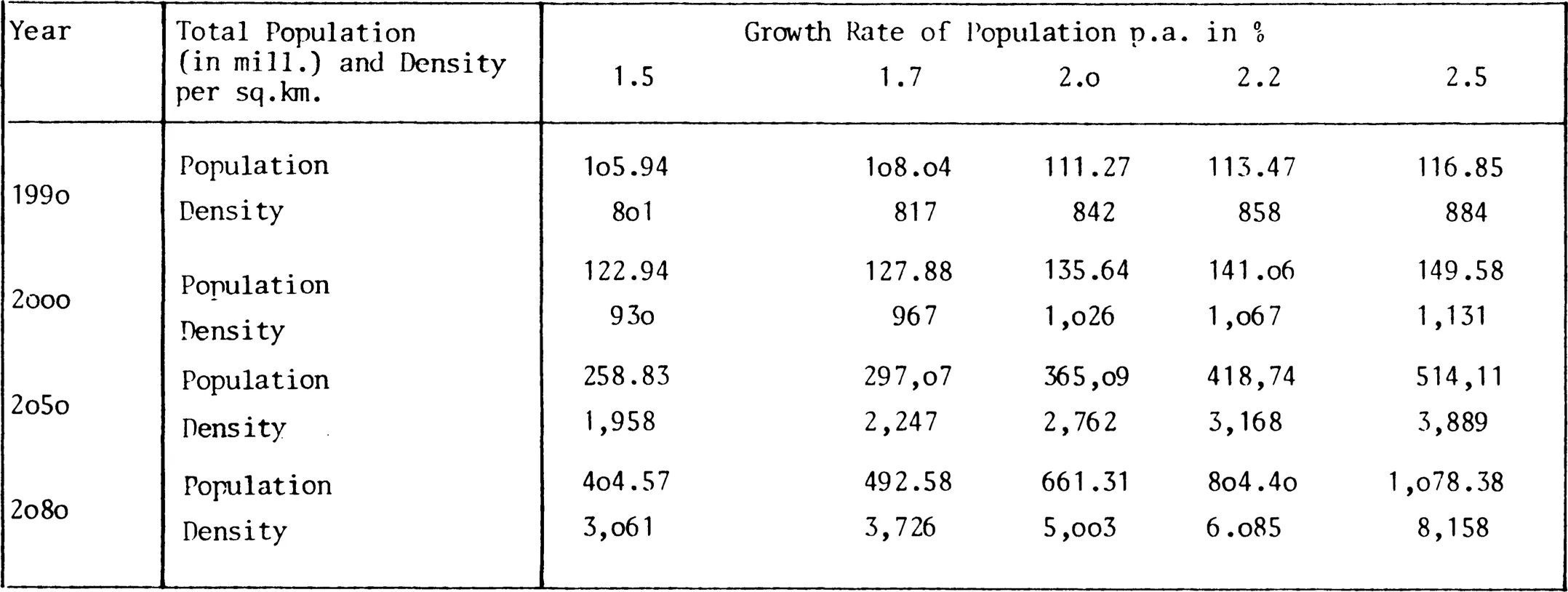
a Basis: 91,282 mill inhabitants in 1980; area 132,187 sq.km.
Source: Own calculations
In Java, particularly, agriculture is characterized by smallholder farms. Only in East Java there are large scale plantations usual. Due to the good soil conditions up to three harvests per year are possible. The introduction of better seed materials, plant protection and fertilizer has also improved the situation of smallholders. The progress reached so far is, however, not sufficient to safeguard the physical existence of the increasing population in the agricultural areas in the longer run.
This is mainly a consequence of too small farm sizes. The last agricultural census, carried out in 1973, underlines the difficult situation. 88.5 of the Indonesian farmers had less than 2.0 ha at their disposal, 54.1 even less than 0.6 ha (cf. Table 2). The average farm size in Java ran up to 0.7 ha (compared with 1.8 ha in Sumatra and 2.5 ha in Kalimantan).
Table 2: Farm Size and Number of Farm Units in Indonesia
| Farm Size (in ha) | Number of Farms | ||
| In 1,000 Units | In % of All Farms | % of Cultivated Area | |
| Less than 0.3 | 4,105 | 28.6 | 5.2 |
| 0.3 till less than 0.6 | 3,666 | 25.5 | 11.2 |
| 0.6 " " " 2 | 4,941 | 34.4 | 36.5 |
| 2 " " " 5 | 1,353 | 9.4 | 26.6 |
| 5 " " " 10 | 224 | 1.6 | 10.2 |
| 10 " " " 15 | 47 | 0.3 | 3.9 |
| 15 and above | 37 | 0.2 | 6.4 |
| Total | 14,373 | 100.0 | 100.0 |
Source: Agric. census 1973
According to preliminary information from the statistical office there is a clear tendency towards a further increase of mini-farms in Java.
In the period since 1971 the per-capita-income has grown with a rate of 5 % per year. But this statistical average does not reflect the weak economic position of the poor. In spite of the overall progress and the diminution of income disparities it is estimated that in Java 47 of the population still live below the poverty line1 – most of them in rural areas. If the average income (per capita) is fixed at loo, Java reaches only a figure of 75.5 while Sumatra records 166.7 and Kalimantan even 225.9.2 During the decade from 1970-80 the annual growth rate (per capita) of Java ran up to 4.6 %, while Kalimantan realized 11.7%.
Poverty affects not only the smallholders, but even more the landless, for which very often permanent job opportunities do not exist. Indonesia has no detailed employment statistics. It can, however, be assumed with a high degree of probability that 15 of...
Table of contents
- Cover
- Title Page
- Copyright Page
- Preface
- Table of Contents
- List of Tables
- O. Summary
- Part 1 Transmigration within the Framework of Indonesian Development Policies
- Part 2 The Situation Before Transmigration - Reasons and Expectations
- Part 3 The Situation after Transmigration - Success or Failure?
- Annexes I Tasks of Centres and Institutions under the Secretariat General of the Ministry of Transmigration
- Annexes II Personnel of the Ministry of Transmigration (1984/85)
- Annexes III Foreign Assisted Projects in Transmigration (up to Dec 1984)
- Annexes IV Experts and Consultants in Foreign Assisted Transmigration Projects
Trusted by 375,005 students
Access to over 1.5 million titles for a fair monthly price.
Study more efficiently using our study tools.
Frequently asked questions
Yes, you can cancel anytime from the Subscription tab in your account settings on the Perlego website. Your subscription will stay active until the end of your current billing period. Learn how to cancel your subscription
No, books cannot be downloaded as external files, such as PDFs, for use outside of Perlego. However, you can download books within the Perlego app for offline reading on mobile or tablet. Learn how to download books offline
Perlego offers two plans: Essential and Complete
- Essential is ideal for learners and professionals who enjoy exploring a wide range of subjects. Access the Essential Library with 800,000+ trusted titles and best-sellers across business, personal growth, and the humanities. Includes unlimited reading time and Standard Read Aloud voice.
- Complete: Perfect for advanced learners and researchers needing full, unrestricted access. Unlock 1.5M+ books across hundreds of subjects, including academic and specialized titles. The Complete Plan also includes advanced features like Premium Read Aloud and Research Assistant.
We are an online textbook subscription service, where you can get access to an entire online library for less than the price of a single book per month. With over 1.5 million books across 990+ topics, we’ve got you covered! Learn about our mission
Look out for the read-aloud symbol on your next book to see if you can listen to it. The read-aloud tool reads text aloud for you, highlighting the text as it is being read. You can pause it, speed it up and slow it down. Learn more about Read Aloud
Yes! You can use the Perlego app on both iOS and Android devices to read anytime, anywhere — even offline. Perfect for commutes or when you’re on the go.
Please note we cannot support devices running on iOS 13 and Android 7 or earlier. Learn more about using the app
Please note we cannot support devices running on iOS 13 and Android 7 or earlier. Learn more about using the app
Yes, you can access Transmigration in Indonesia by Dietrich Kebschull in PDF and/or ePUB format, as well as other popular books in Politics & International Relations & Development Economics. We have over 1.5 million books available in our catalogue for you to explore.