Throughout the modern era, scholars have shown a continuing concern with the extent to which position in the occupational structure affects psychological development. This book examines whether work experiences and age (often considered as a proxy for stage in the work career) interact such that the effects of occupational conditions on the person
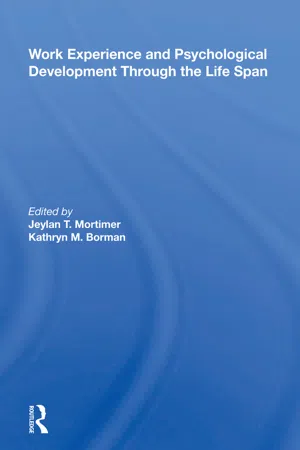
- 316 pages
- English
- ePUB (mobile friendly)
- Available on iOS & Android
eBook - ePub
Work Experience And Psychological Development Through The Life Span
About this book
Information
1. Introduction
Jeylan T. Mortimer
Throughout the modern era, scholars have shown a continuing concern with the extent to which position in the occupational structure affects psychological development. Social scientists now view this issue as a key question in the study of social structure and personality (House 1981). There is widespread recognition that work can be a liberating force, contributing to the development of human potential and individual expression. However, there is disagreement as to whether work in modern industrial (and post-industrial) societies fulfills this promise. Many years ago, Emile Durkheim argued that the complex division of labor in modern societies encourages more autonomous, individuated personalities: "..far from being trammelled by the progress of specialization, individual personality develops with the division of labor... individual natures, while specializing, become more complex" (Durkheim 1964:403-404). Others, led by Karl Marx, declared to the contrary that the industrial revolution contributed to the fragmentation and simplification of work tasks and a vast reduction in the worker's control over the productive process and the uses of labor. To Marx, these changes were alienating and dehumanizing: the worker "does not fulfil himself in his work, but denies himself, has a feeling of misery, not of well-being...is physically exhausted and morally debased" (Marx 1964:169).
Contemporary scholars have continued this line of inquiry, affirming the negative consequences of highly routinized and fragmented jobs (Walker and Guest 1952; Blauner 1964; Seeman 1967), and the pervasive psychological benefits to be drawn from more complex, self-directed work activities (Kohn and Schooler 1983; Mortimer et al. 1986). There is growing consensus upon a "generalization model" of adult socialization at work, that attitudes, values, and ways of thinking are learned and generalized from basic modes of adaptation to problems encountered in the workplace (Kohn 1977; Mortimer and Simmons 1978). People observe their actions at work and the consequences of those actions, and form judgments about themselves, other people, and orientations toward life in general in accord with these processes of learning, generalization, and attribution (Bern 1972; Kohn 1981:290; Rosenberg 1981).
But while it is often assumed that occupations "mold" the personality (Park et al. 1925; Hughes 1958; Kanter 1977), empirical relationships between dimensions of the job and measures of psychological development at any single point in time could as well be due to processes of occupational selection. That is, persons may choose their jobs, or be selected for them by employers, according to their previously existing psychological dispositions (Rosenberg 1957; Davis 1965; Holland 1976). Studying the same persons through time is necessary to demonstrate that work experiences do engender change in psychological attributes. However, the occupational selection and socialization hypotheses should not be considered mutually exclusive or contradictory; persons might choose or attempt to alter their jobs (with varying success), while at the same time being subject to the influence of work experiences.
In fact, a rapidly accumulating body of empirical research indicates a continuous reciprocal relationship between the person and the job environment, as workers influence the character of their experiences on the job, and occupational conditions, in turn, affect the further course of their psychological development. In studying a large, nationally representative sample of men in 1964, and then re-surveying them ten years later, Melvin Kohn, Carmi Schooler, and their colleagues (1983) demonstrated that the psychological differences between persons with varying conditions of work cannot be fully explained by processes of selection to the job. Thus, the most plausible rival explanation for the relationships of work and personality has been effectively refuted.
Analyses of other data sets have similarly shown that work experiences influence psychological development, as well as being affected by prior psychological characteristics. Thus, work autonomy was found to have positive effects on occupational values (Mortimer and Lorence 1979a), the sense of self-competence (Mortimer and Lorence 1979b), and work commitment (Lorence and Mortimer 1981) in a panel of highly educated young men ten years out of college (Mortimer et al. 1986). Similarly, autonomy at work fostered self-esteem in a national panel of recent high school graduates (Mortimer and Finch 1986a). Finally, in a representative panel of the U.S. labor force, this same dimension of work experience contributed significantly to job involvement (Lorence and Mortimer 1985) and job satisfaction (Chapter 5, this volume). This clarification of the causal linkage between work and psychological functioning enhances our understanding of the connections between social structure and personality.
The evidence is therefore quite compelling that work experiences--especially those indicative of autonomy and self-direction--have pervasive psychological consequences. Only very recently, however, have researchers begun to investigate whether occupational experiences have the same or different implications for psychological development in various phases of the work life. In addressing this intriguing question, this book joins the concerns of sociologists interested in the life course and life span developmental psychologists. For each of these areas of scholarly work, understanding the extent to which individual psychological attributes remain the same or change through the course of life, and understanding the environmental (e.g., work) conditions which influence the magnitude and direction of such change, are of central importance. Moreover, the questions addressed in each chapter have relevance for the more applied concerns of educators, counsellors, personnel workers, and administrators whose efforts are directed toward guiding the person through the career or toward designing developmentally optimal work environments.
This book examines whether work experiences and age (often considered as a proxy for stage in the work career) interact such that the effects of occupational conditions on the person change in different phases of the life cycle. That is, do the effects of work on psychological development vary as workers move through their careers? When do the processes by which work affect the personality begin? Do they taper off, continue with the same strength indefinitely, or increase with longer exposure to the job environment? Do work-related attitudes stabilize with age, or is psychological development in response to work a life-long process? Do jobs have psychological effects of the same kind throughout the worklife, or might work conditions that are deleterious in one phase have more salutary consequences in another? Very few empirical studies have been directed toward understanding whether there is differential responsiveness, depending on age, to the varying conditions and rewards of work.
Further, it is now well recognized that workers do not just passively absorb their work experiences; they actively choose and alter their jobs. Selection of work and/or molding the job in accord with prior attitudes and orientations would support a conceptualization of the person as actively determining the course of development, influencing the work role which may importantly affect further processes of personal change. In considering occupational choice or selection, it is common to focus on the youngest workers, those initially entering the labor force. For they may be most consciously trying to match their values, abilities, and needs with the rewards that are potentially available in the work sphere (Blau et al. 1956; Mortimer and Lorence 1979a). As workers "settle in" to their jobs, psychological orientations may be seemingly less consequential, unless they substantially influence the worker's level of performance and resulting promotion opportunities. As workers reach their career ceilings, occupational experiences and rewards may further stabilize, being determined more by structural factors, such as organizational policies regarding seniority, than by psychological orientations. These observations would indicate a declining influence of psychological orientations on work experiences as workers move through their work lives. However, other considerations suggest that the person may continue to actively affect the character of his or her work environment thoughout the career. For example, as the young worker moves beyond the initial entry position, increases in seniority as well as informal power could heighten the potential to change or mold one's job in line with personal wishes. And the worker's personality characteristics could lead to different reactions to both successes and setbacks on the job, which might occur at any time in the career.
However, we have just begun to address the issue of process and change in these reciprocal interrelations of work and personality. How do the processes by which occupational experiences influence the personality, and how do the processes by which the person selects and molds the job in accord with prior values, self-concepts, needs, and other dispositions, change as the individual moves through the work career?
Most prior studies in the area of work and personality have not been designed to investigate whether occupational conditions have distinct implications for personal development in different phases of life, or in various stages of the work career. While it is possible to compare the relationships between work conditions and psychological constructs in different age groups with survey data collected at a single time, a cross-sectional design is not optimal for addressing issues of psychological change. An explicit focus on process is needed. A better understanding of change over time can be derived from studying workers of different ages over a period of time. In the absence of a longitudinal study, an interview or questionnaire schedule could be designed to elicit retrospective accounts of transitions and changes at earlier points in the career. Alternatively, an investigator could examine processes of adjustment contemporaneously in relation to particular problems and transitions in distinct phases of the worklife. The chapters in this book pursue all of these strategies.
The first section of this volume assesses young people's initial encounters with the work world, considering adolescent part-time workers who hold jobs while they are still in school and young adults who have recently left high school. These studies are very pertinent to the question as to when work begins to influence psychological development. It is sometimes said that because of the marginal and transitory character of employment among students, it has relatively little psychological impact upon them. If work experience and the worker identity in this early stage of life have little "salience" (Rosenberg 1981), employment may have negligible implications for personal development. Another line of reasoning, however, supports the view that for young people, employment is a highly influential experience. There is evidence that people are most responsive to the impacts of environmental forces shortly after the acquisition of new social roles (Van Maanen and Schein 1979; Hall 1971; Nicholson 1984). Employed adolescents have taken on a new role which consumes many of their waking hours. Moreover, it is widely assumed that adolescence is a critical period for the formation of personality (Erikson 1959), and that personal attributes developed in this phase of life are likely to persist through the life course. If this is the case, the personalities of young people, including adolescent part-time workers as well as those who have recently left high school, may be even more malleable in response to work than those of older persons (Sears 1981; Glenn 1980).
Greenberger, in her chapter on work in adolescence, points out that part-time work is an increasingly prevalent phenomenon, extending across class groups. The developmental implications of this experience, however, are not well understood. While many commentators have been quite optimistic that work experience in youth will build character, promote positive work values, and integrate the young into adult society, empirical research has indicated both negative and positive developmental consequences. From her study of part-time workers in four California high schools, it would appear that working long hours is not particularly beneficial for adolescents' psychosocial development, nor is it conducive to achievement and involvement in school. Her utilization of follow-up data collected on a subset of her sample helps to clarify the causal processes through which early part-time work while in high school influences adolescents' personal development.
Greenberger is particularly interested in the effect of work on individual autonomy--"personal attributes that should help individuals to function effectively and maintain themselves independently in society"--and social integration. She reports some evidence that self-reliance increases among girls, but not boys, in response to work. Adolescent girls are more likely than boys to view working as an expression of their independence and initiative. Her study also suggests that the ability to work with persistence and to obtain satisfaction from completing tasks are fostered by adolescent employment. But because of the age-segregated character of most jobs available to the young, for most youngsters working promotes greater integration into the adolescent, and sometimes deviant, peer society of fellow workers than the more conventional and work-oriented adult society.
Moreover, given the nature of "youthwork," she argues that employment on the part of young people is less likely than in earlier eras to provide effective socialization to future occupational roles. Most young people do simple work that requires little training or skill, and has minimal potential for advancement. Further, since most youth now work to enhance their own immediate consumption potential and style of life--not to help their families-- their employment does not imply the assumption of social responsibility, as was the case for youngsters in earlier eras, for example, during the Great Depression. Elder's (1974) study of that cohort of adolescents as they moved into adulthood demonstrates that for them, work had very positive developmental consequences. The findings of Greenberger's study, along with other recent work (Mortimer and Finch 1986b; Finch and Mortimer 1985), challenge the popular wisdom that adolescent part-time work while in school facilitates the transition to adulthood or fosters other positive developmental outcomes.
Borman intensively studied 25 adolescents who had recently left high school to obtain regular full-time jobs, using systematic observation and interviewing techniques. She followed these young people over a one-year period, documenting their initial attempts to locate jobs and to successfullly adjust to the world of work. The lack of higher educational credentials and work experience on the part of these young job-seekers made their entry to the work world an especially problematic period in their careers. They faced pressing issues: locating a job, learning to manage their time and other resources, balancing their work and nonwork interests, developing personal habits that met with the expectations of their employers, integrating themselves into the work setting, and maintaining their employment through time when the work they performed was, for the most part, routine, uninteresting, low-paying, lacking in advancement opportunity, and dissatisfying. She describes the formal and informal methods the respondents used to locate jobs, and reports that the young males in her study were more effective than young females in utilizing informal contact networks in job search.
Borman's study draws attention to important nonwork experiences that foster the development of an occupational identity and commitment to work. Having a supervisor who acted as mentor was especially conducive to the emergence of positive work orientations and to the integration of the novice into the work setting. However, relatively few employers or supervisors were willing to invest their time and energy in developing such a relationship, since they tended to view the young worker as transient and as lacking the capacity to assume major responsibility. The availability of emotional support, as well as more tangible resources from the family of origin, was a further dimension of these youths' life experiences that eased their transition to work.
The two chapters in the first section of this book offer important insights with regard to the timing of occupational influence on the person. They support the position that the processes by which work affects psychological development begin in the very initial stages of the work career. Greenberger indicates both beneficial outcomes--e.g,, increases in self-reliance and the ability to work with persistence--and what might generally be considered more deleterious consequences--such as diminishing interest, involvement, and achievement in school. Borman describes the formation of an initial occupational identity and commitment among yo...
Table of contents
- Cover
- Half Title
- Title
- Copyright
- Contents
- 1 Introduction
- PART 1 WORK AND PSYCHOLOGICAL DEVELOPMENT IN YOUTH
- PART 2 THE INFLUENCE OF WORK ON THE PSYCHOLOGICAL DEVELOPMENT OF MEN AND WOMEN IN ADULTHOOD
- PART 3 MIDCAREER AND OLDER WORKERS
- About the Contributors
- Author Index
- Subject Index
Trusted by 375,005 students
Access to over 1.5 million titles for a fair monthly price.
Study more efficiently using our study tools.
Frequently asked questions
Yes, you can cancel anytime from the Subscription tab in your account settings on the Perlego website. Your subscription will stay active until the end of your current billing period. Learn how to cancel your subscription
No, books cannot be downloaded as external files, such as PDFs, for use outside of Perlego. However, you can download books within the Perlego app for offline reading on mobile or tablet. Learn how to download books offline
Perlego offers two plans: Essential and Complete
- Essential is ideal for learners and professionals who enjoy exploring a wide range of subjects. Access the Essential Library with 800,000+ trusted titles and best-sellers across business, personal growth, and the humanities. Includes unlimited reading time and Standard Read Aloud voice.
- Complete: Perfect for advanced learners and researchers needing full, unrestricted access. Unlock 1.5M+ books across hundreds of subjects, including academic and specialized titles. The Complete Plan also includes advanced features like Premium Read Aloud and Research Assistant.
We are an online textbook subscription service, where you can get access to an entire online library for less than the price of a single book per month. With over 1.5 million books across 990+ topics, we’ve got you covered! Learn about our mission
Look out for the read-aloud symbol on your next book to see if you can listen to it. The read-aloud tool reads text aloud for you, highlighting the text as it is being read. You can pause it, speed it up and slow it down. Learn more about Read Aloud
Yes! You can use the Perlego app on both iOS and Android devices to read anytime, anywhere — even offline. Perfect for commutes or when you’re on the go.
Please note we cannot support devices running on iOS 13 and Android 7 or earlier. Learn more about using the app
Please note we cannot support devices running on iOS 13 and Android 7 or earlier. Learn more about using the app
Yes, you can access Work Experience And Psychological Development Through The Life Span by Jeylan T Mortimer in PDF and/or ePUB format, as well as other popular books in Psychology & History & Theory in Psychology. We have over 1.5 million books available in our catalogue for you to explore.