
- 720 pages
- English
- ePUB (mobile friendly)
- Available on iOS & Android
eBook - ePub
Handbook of Pneumatic Conveying Engineering
About this book
Pneumatic conveying systems offer enormous advantages: flexibility in plant layout, automatic operation, easy control and monitoring, and the ability to handle diverse materials, especially dangerous, toxic, or explosive materials. The Handbook of Pneumatic Conveying Engineering provides the most complete, comprehensive reference on all types and s
Information
1
Types of Pneumatic Conveying Systems
1 INTRODUCTION
Pneumatic conveying systems are basically quite simple and are eminently suitable for the transport of powdered and granular materials in factory, site and plant situations. The system requirements are a source of compressed gas, usually air, a feed device, a conveying pipeline and a receiver to disengage the conveyed material and carrier gas. The system is totally enclosed, and if it is required, the system can operate entirely without moving parts coming into contact with the conveyed material.
High, low or negative pressures can be used to convey materials. For hygroscopic materials dry air can be used, and for potentially explosive materials an inert gas such as nitrogen can be employed. A particular advantage is that materials can be fed into reception vessels maintained at a high pressure if required.
1.1 System Flexibility
With a suitable choice and arrangement of equipment, materials can be conveyed from a hopper or silo in one location to another location some distance away. Considerable flexibility in both plant layout and operation are possible, such that multiple point feeding can be made into a common line, and a single line can be discharged into a number of receiving hoppers. With vacuum systems, materials can be picked up from open storage or stockpiles, and they are ideal for clearing dust accumulations and spillages. Pipelines can run horizontally, as well as vertically up and down, and with bends in the pipeline any combination of orientations can be accommodated in a single pipeline run. Material flow rates can be controlled easily and monitored to continuously check input and output, and most systems can be arranged for completely automatic operation.
Pneumatic conveying systems are particularly versatile. A very wide range of materials can be handled and they are totally enclosed by the system and pipeline. This means that potentially hazardous materials can be conveyed quite safely. There is minimal risk of dust generation and so these systems generally meet the requirements of any local Health and Safety legislation with little or no difficulty.
Pneumatic conveying plants take up little floor space and the pipeline can be easily routed up walls, across roofs or even underground to avoid any existing equipment or structures. Pipe bends in the conveying line provide this flexibility, but they will add to the overall resistance of the pipeline. Bends can also add to problems of particle degradation if the conveyed material is friable, and suffer from erosive wear if the material is abrasive.
1.2 Industries and Materials
A wide variety of materials are handled in powdered and granular form, and a large number of different industries have processes that involve their transfer and storage. Some of the industries in which bulk materials are conveyed include agriculture, mining, chemical, pharmaceuticals, paint manufacture, and metal refining and processing. In agriculture very large tonnages of harvested materials such as grain and rice are handled, as well as processed materials such as animal feed pellets. Fertilizers represent a large allied industry with a wide variety of materials.
A vast range of food products from flour to sugar and tea to coffee are conveyed pneumatically in numerous manufacturing processes. Confectionery is an industry in which many of these materials are handled. In the oil industry fine powders such as barite, cement and bentonite are used for drilling purposes. In mining and quarrying, lump coal and crushed ores and minerals are conveyed. Pulverized coal and ash are both handled in very large quantities in thermal power plants for the generation of electricity.
In the chemical industries materials include soda ash, polyethylene, PVC and polypropylene in a wide variety of forms from fine powders to pellets. Sand is used in foundries and glass manufacture, and cement and alumina are other materials that are conveyed pneumatically in large tonnages in a number of different industries.
1.3 Mode of Conveying
Much confusion exists over how materials are conveyed through a pipeline and to the terminology given to the mode of flow. First it must be recognized that materials can either be conveyed in batches through a pipeline, or they can be conveyed on a continuous basis, 24 hours a day if necessary. In batch conveying the material may be conveyed as a single plug if the batch size is relatively small.
1.3.1 Dilute Phase
For continuous conveying, and batch conveying if the batch size is large, two modes of conveying are recognized. If the material is conveyed in suspension in the air through the pipeline it is referred to as dilute phase conveying. If the material is conveyed at low velocity in a non-suspension mode, through all or part of the pipeline, it is referred to as dense phase conveying. Almost any material can be conveyed in dilute phase, suspension flow through a pipeline, regardless of the particle size, shape or density.
1.3.2 Dense Phase
In dense phase conveying two modes of flow are recognized. One is moving bed flow, in which the material is conveyed in dunes on the bottom of the pipeline, or as a pulsatile moving bed. The other mode is slug or plug type flow, in which the material is conveyed as full bore plugs separated by air gaps. Moving bed flow is only possible in a conventional conveying system if the material to be conveyed has good air retention characteristics. Plug type flow is only possible in a conventional conveying system if the material has good permeability.
1.3.3 Conveying Air Velocity
For dilute phase conveying a relatively high value of conveying air velocity must be maintained. This is typically in the region of 2400 ft/min for a very fine powder, to 3200 ft/min for a fine granular material, and beyond for larger particles and higher density materials. For dense phase conveying, air velocities can be down to 600 ft/min, and lower in certain circumstances. Because of the fine particle size required to provide the necessary air retention, particle density does not have such a significant effect on the minimum value of conveying air velocity in moving bed type dense phase conveying.
1.3.4 Solids Loading Ratio
The solids loading ratio, or phase density, is a useful parameter in helping to visualize the flow. This is the ratio of the mass flow rate of the material conveyed divided by the mass flow rate of the air used to convey the material. It is expressed in a dimensionless form. For dilute phase, maximum values that can be achieved are typically of the order of 15, although this can be higher if the conveying distance is short and the conveying line pressure drop is high.
For moving bed flows, solids loading ratios of well over 100 can be achieved if materials are conveyed with pressure gradients of the order of 10 lbf/in2 per 100 foot of horizontal pipeline. For plug type flows the use of solids loading ratio is not so appropriate, for as the materials have to be very permeable, maximum values are only of the order of about 30. Despite the low value of solids loading ratio, materials can be reliably conveyed at velocities of 600 ft/min and below in plug type flow.
2 SYSTEM TYPES
A wide range of pneumatic conveying systems are available, and they are all generally suitable for the conveying of dry bulk particulate materials. The majority of systems are conventional, continuously operating, open systems, in a fixed location. To suit the material being conveyed, or the process, however, innovatory, batch operating and closed systems are commonly used. Many of these systems can be either positive or negative pressure in operation, or a combination of the two. In this review some of the more common systems are presented.
The problem of system selection is illustrated in Figure 1.1. This shows the combinations that are possible for conventional pneumatic conveying systems with a single air source. Only system types are presented in detail, with positive pressure, vacuum, and combined positive and negative pressure systems considered, in relation to both open and closed systems.
With such a wide range and choice of system types, a useful starting point is to consider the alternatives in pair groupings:
- □ Open and closed systems Open systems are the norm for pneumatic conveying, particularly when conveying with air. Closed systems would only be employed for very specific circumstances, such as with highly toxic and potentially explosive materials.
- □ Positive pressure and negative pressure systems Materials can be sucked as well as blown and so either pressure or vacuum can be employed for pneumatic conveying. This is often a matter of company or personal preference.
- □ Fixed and mobile systems The majority of pneumatic conveying systems are in fixed locations and so this is not identified as a particular case. A variety of mobile systems are available for specific duties.
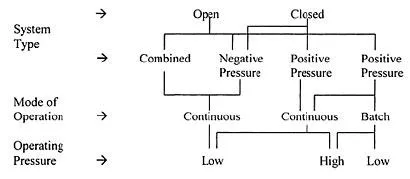
Figure 1.1 Diagram to illustrate the wide range of conveying systems available for conventional systems operating with a single air source.
- □ High and low pressure systems In pneumatic conveying, high pressure typically means any pressure above about 15 lbf/in2 gauge. For systems delivering materials to reception points at atmospheric pressure, 100 lbf/in2 gauge is typically the upper limit, due to the problems of air expansion. Very much higher pressures (typically 300 to 400 lbf/in2) can be employed if delivering materials to reception points maintained at pressure, such as chemical reactors and fluidized bed combustion systems.
- □ Conventional and innovatory systems Conventional systems are those in which the material is simply fed into a pipeline and either blown or sucked, and so this is not identified as a particular case since this is the norm. Innovatory systems are those in which the material to be conveyed is conditioned in some way, either at the feed point or along the length of the pipeline, generally in order to convey the material at low velocity and hence in dense phase, if the material has no natural capability for low velocity conveying.
- □ Batch and continuously operating systems Both of these types of conveying are common in industry.
- □ Single and multiple systems The majority of conveying systems are single units. It is possible, however, to combine units for certain duties.
- □ Dilute and dense phase systems Dilute and dense phase conveying do not relate to any particular type of system. Any bulk particulate material can be conveyed in dilute phase. It is primarily the properties of the material that determine whether the material can be conveyed in dense phase, particularly in conventional conveying systems.
- □ Pipeline and channel flow systems In the vast majority of pneumatic conveying systems the material is conveyed through pipelines. Fluidized motion conveying systems generally employ channels having a porous base, through which air is introduced, and they are very limited with regard to vertical conveying.
3 CLOSED SYSTEMS
For certain conveying duties it is necessary to convey the material in a controlled environment. If a dust cloud of the material is potentially explosive, nitrogen or some other gas can be used to convey the material. In an open system such environmental control can be very expensive, but in a closed system the gas can be re-circulated and so the operating costs, in terms of inert gas, are significantly reduced.
If the material to be handled is toxic or radioactive, it may be possible to use air for conveying, but very strict control would have to be maintained. A closed system would be essential in this case. Continuous conveying systems are probably the easiest to arrange in the form of a closed loop. A typical system is shown in Figure 1.2.
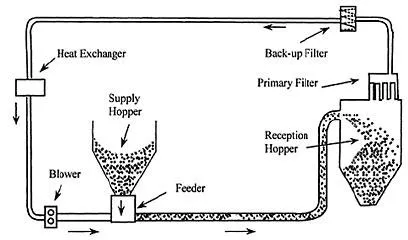
Figure 1.2 A closed loop pneumatic conveying system.
A null point needs to be established in the system where the pressure is effectively atmospheric and provision for make up of conveying gas can be established there. If this is positioned after the blower the conveying system can operate entirely under vacuum. If the null point is located before the blower it will operate as a positive pressure system.
A back-up filter would always be recommended, because positive displacement blowers and compressors are very vulnerable to damage by dust. This is simply a precaution against an element in the filter unit failing. There will generally be an increase in temperature across an air mover and so in a closed loop system it may be necessary to include a heat exchanger, otherwise there could be a gradual build up in temperature. The heat exchanger can be placed either before or after the air mover, depending upon the material being conveyed.
4 OPEN SYSTEMS
Where strict environmental control is not necessary an open system is generally preferred, since the capital cost of the plant will be less, the operational complexity will be reduced, and a much wider range of systems will be available. Most pneumatic conveying systems can ensure totally enclosed material conveying, and so with suitable gas-solid separation and venting, the vast majority of materials can be handled quite safely in an open system. Many potentially combustible materials are conveyed in open systems by incorporating necessary safety features.
4.1 Positive Pressure Systems
Although positive pressure conveying ...
Table of contents
- Cover Page
- Half Title
- Series Page
- Title Page
- Copyright Page
- Dedication
- Preface
- Table of Contents
- 1. Types of Pneumatic Conveying Systems
- 2. Feeding Devices
- 3. System Components
- 4. Gas-Solid Flows
- 5. Air Requirements
- 6. Air Only Data
- 7. Conveyed Material Influences
- 8. Pipeline Material, Orientation, and Bends
- 9. Stepped Pipeline Systems
- 10. Pneumatic Conveying of Coal and Ash
- 11. Pneumatic Conveying of Food and Chemicals
- 12. Pneumatic Conveying in the Aluminum Industry
- 13. Conveying of Cement and Drilling Mud Powders
- 14. Conveying of High Density and Other Materials
- 15. System Design Using Conveying Data
- 16. Quick Check Design Methods
- 17. Innovatory Conveying Systems
- 18. Fluidized Motion Conveying Systems
- 19. Commissioning and Throughput Problems
- 20. Erosive Wear Problems
- 21. Material Degradation Problems
- 22. Health and Safety Issues
- 23. Pneumatic Conveying Test Facilities
Trusted by 375,005 students
Access to over 1.5 million titles for a fair monthly price.
Study more efficiently using our study tools.
Frequently asked questions
Yes, you can cancel anytime from the Subscription tab in your account settings on the Perlego website. Your subscription will stay active until the end of your current billing period. Learn how to cancel your subscription
No, books cannot be downloaded as external files, such as PDFs, for use outside of Perlego. However, you can download books within the Perlego app for offline reading on mobile or tablet. Learn how to download books offline
Perlego offers two plans: Essential and Complete
- Essential is ideal for learners and professionals who enjoy exploring a wide range of subjects. Access the Essential Library with 800,000+ trusted titles and best-sellers across business, personal growth, and the humanities. Includes unlimited reading time and Standard Read Aloud voice.
- Complete: Perfect for advanced learners and researchers needing full, unrestricted access. Unlock 1.5M+ books across hundreds of subjects, including academic and specialized titles. The Complete Plan also includes advanced features like Premium Read Aloud and Research Assistant.
We are an online textbook subscription service, where you can get access to an entire online library for less than the price of a single book per month. With over 1.5 million books across 990+ topics, we’ve got you covered! Learn about our mission
Look out for the read-aloud symbol on your next book to see if you can listen to it. The read-aloud tool reads text aloud for you, highlighting the text as it is being read. You can pause it, speed it up and slow it down. Learn more about Read Aloud
Yes! You can use the Perlego app on both iOS and Android devices to read anytime, anywhere — even offline. Perfect for commutes or when you’re on the go.
Please note we cannot support devices running on iOS 13 and Android 7 or earlier. Learn more about using the app
Please note we cannot support devices running on iOS 13 and Android 7 or earlier. Learn more about using the app
Yes, you can access Handbook of Pneumatic Conveying Engineering by David Mills,Mark G. Jones,Vijay K. Agarwal in PDF and/or ePUB format, as well as other popular books in Technology & Engineering & Industrial Engineering. We have over 1.5 million books available in our catalogue for you to explore.