This book is available to read until 4th December, 2025
- 304 pages
- English
- ePUB (mobile friendly)
- Available on iOS & Android
eBook - ePub
Available until 4 Dec |Learn more
The Poetics of Childhood
About this book
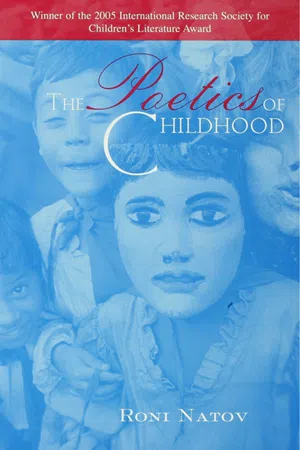
Children's literature provides a medium through which writers re-create or approximate the sensibility of a child. But what exactly is this sensibility, and how does it find creative expression in adulthood? What language can portray the seemingly untranslatable experience of a child?The Poetics of Childhood, winner of the 2005 International Resear
Frequently asked questions
Yes, you can cancel anytime from the Subscription tab in your account settings on the Perlego website. Your subscription will stay active until the end of your current billing period. Learn how to cancel your subscription.
No, books cannot be downloaded as external files, such as PDFs, for use outside of Perlego. However, you can download books within the Perlego app for offline reading on mobile or tablet. Learn more here.
Perlego offers two plans: Essential and Complete
- Essential is ideal for learners and professionals who enjoy exploring a wide range of subjects. Access the Essential Library with 800,000+ trusted titles and best-sellers across business, personal growth, and the humanities. Includes unlimited reading time and Standard Read Aloud voice.
- Complete: Perfect for advanced learners and researchers needing full, unrestricted access. Unlock 1.4M+ books across hundreds of subjects, including academic and specialized titles. The Complete Plan also includes advanced features like Premium Read Aloud and Research Assistant.
We are an online textbook subscription service, where you can get access to an entire online library for less than the price of a single book per month. With over 1 million books across 1000+ topics, we’ve got you covered! Learn more here.
Look out for the read-aloud symbol on your next book to see if you can listen to it. The read-aloud tool reads text aloud for you, highlighting the text as it is being read. You can pause it, speed it up and slow it down. Learn more here.
Yes! You can use the Perlego app on both iOS or Android devices to read anytime, anywhere — even offline. Perfect for commutes or when you’re on the go.
Please note we cannot support devices running on iOS 13 and Android 7 or earlier. Learn more about using the app.
Please note we cannot support devices running on iOS 13 and Android 7 or earlier. Learn more about using the app.
Yes, you can access The Poetics of Childhood by Roni Natov in PDF and/or ePUB format, as well as other popular books in Literature & Literary Criticism. We have over one million books available in our catalogue for you to explore.
Information
1
Constructions of Innocence
I. William Blake
1.
Without Contraries is no progression.
—WILLIAM BLAKE, THE MARRIAGE OF HEAVEN AND HELL
Peter Ackroyd, Blake’s recent biographer, began his work by declaring, “In the visionary imagination of William Blake there is no birth and no death, no beginning, and no end, only the perpetual pilgrimage without within time towards eternity.”1 Blake portrayed Innocence as a layered and fluctuating state. Between 1793 and 1818, various editions of Songs of Innocence were published, in which “no two copies ever contained] the poems in the same order” (Ackroyd 118). Blake’s decision to move certain poems from Innocence to Experience reflected his sense that the two “contrary states of the human soul” were fluid. He saw Innocence as a singularly fragile state that can only be approximated in its articulation—and then only in art, where it could be captured metaphorically in moments, almost like a still life. For, as Ackroyd said, “there is no birth and no death” for Blake but, rather, always the movement “towards eternity,” Blake’s higher innocence, the origins of which can be glimpsed in visions rather than fully realized in the real world. Nonetheless, through description of the shapes it takes in the real world, most directly seen in the figure of the child, we can approach its meaning for Blake in his best-known work, Songs of Innocence and of Experience.
Harold Pagliaro claims that, “Understood from the child’s point of view, and not from Blake’s … or our own, Innocence is a condition of unself-conscious identification with the world.”2 And when the child runs up against experience that defies Innocence, such as the restraints and various institutions that sever us from our natural selves, the instinct is toward denying anything that threatens it. What makes Blake’s Innocence “poignant,” says Jean Hagstrum, is “its capacity for being blighted by society. There passes now and then over it the shadow of Experience, a cloud that suggests the coming dark but that does not destroy the day.”3
Certainly, Songs of Innocence celebrates the states of Innocence. Some of the simpler lyrics seem without shadows. “Laughing Song” resonates with the spontaneity of laughter: “the green woods laugh with the voice of joy/ … the air does laugh/ … And the green hill laughs with the noise of it./ … [T]he meadows laugh … the grasshopper laughs,” and the children who all laugh are “merry and join with me,” says the speaker, in one indication of harmony. “Infant Joy” also celebrates the singular state of peace and happiness associated with innocence—before the infants is cast out of such harmony and propelled into the patriarchal world of language and law. Here the infant speaker says, “I have no name/ I am but two days old.—/ … I happy am/Joy is my name.” All other lyrics of Innocence involves tears—of loss, of fear, of separation—or suggest their imminence.
The central devastating impulse of innocence is to create myths, rationalizations, and projections, as the innocent child cannot conceive of or tolerate the cruelty of its world. If we extend what modern psychoanalysts such as Winnicott and Alice Miller describe as the “false self,” created as an accommodation to parental needs, to society’s demands that further necessitate denial, we might be close to the sense of Blake’s dramatic lyrics. In a much-quoted lyric of Innocence, the child speaker of “The Little Black Boy” has incorporated the lessons of his mother that depict God as benign protector who purposely created “black bodies and this sun-burnt face” so “[t]hat we may learn to bear the beams of love.” There he declares, of the little white boy, “I’ll stand and stroke his silver hair./ And he like him and he will then love me.” In “The Chimney Sweeper,” the child-speaker is sold, as poor children were at four through seven years of age, “while yet my tongue/ Could scarcely cry weep weep weep weep.” He relates the story of little Tom Dacre, a fellow sweeper, whose vision of an Angle opening the coffins of “thousands of sweepers” and setting them free leads him to conclude, “So if all do their duty, they need not fear harm.”
There seem to be two types of innocents in Blake’s Songs: those who feel “unself-consciously united with the world,” like the speaker of “Infant Joy,” and those who “unself-consciously prolong” that state (Pagliaro, 11), like the speakers of “The Little Black Boy” and “The Chimney Sweeper.” And their caretakers similarly consist of two types: those adults who sympathize with the children and those entrenched in restraining structures of the world that Blake despised. But even the guardians of innocence can’t protect the children from entry into the invariably unjust world. And children sense this, hence their tears. This painful truth is revealed in the “magic” or otherworldliness that necessarily accompanies such protection. As Thomas R. Frosch notes, children are saved only through the intervention of an angle, a glowworm, God, or the vision of an afterlife.4 A child can’t help but notice, whether that observation is tolerated in consciousness or driven into the unconscious, how lost and vulnerable he or she is likely to be at any given moment. Just as any childhood dream of separation suggests the inevitable severing of child from parent, similarly the figure of the magic helper implies the ways in which we are hopelessly torn from each other, and this is intuited by the child speakers even in the poems of Innocence. Frosch notes how each of the lyrics “focuses on a crisis of Innocence, its moment of transition into something else” (Frosch, 75). Innocence is an unstable state, difficult to locate or sustain. The central concern of the Songs of the Innocence and of Experience seems to be not so much Innocence or Experience, “but the borderline between them” (Frosch, 75).
Blake lived in the liminal spaces between “contrary states” of mind. His reality required negotiating the demands of daily life and the visions that grew in intensity throughout his life. Even as a child, he saw visions that Ackroyd claims were eidetic, images, “seen as real sensory perceptions” (Ackroyd, 24). His first vision of “a tree filled with angels” appeared when he was eight or ten years old and he believed all people would see such visions, that they are therefore universal, were it not for worldliness “ ‘which blinds the spiritual eye’ ” (Ackroyd, 24). Ackroyd offers, “Perhaps there is a sense in which, with all his contrariness and extreme sensitivity, he remained a child.… [H]is visions became a way both of lending himself a coherent identity and of confirming a special fate; they afforded him authenticity and prophetic status in a world that ignored him” (Ackroyd, 25). However, we interpret his visionary sensibility, it is clear that for Blake Innocence was palpable in these visions and that they were representations of the unity of past and future, and of the connection between all things—the worldly glimpsed in visions of the heavenly, the heavenly reflected in the world; that “heaven longs to see itself in material form, while the world aspires to be reunited with its spiritual essence” (Ackroyd, 48) As he says in “The Divine Image” of Innocence.
Mercy has a human heart
Pity, a human face:
And Love, the human form divine
…
Where Mercy, Love and Pity dwell
There God is dwelling too.
And in “A Divine Image” of Experience, “Cruelty has a Human Heart/ And Jealousy a Human Face/ Terror the Human Form divine” as well. Those who repress or deny what they see in the world remain frozen or regress into Ignorance, the potential stasis of Experience. However, Blake suggests a dialectic as the driving force toward the wisdom he sought in a state of higher Innocence.
For Blake, Experience was the fallen world. Critics have had some success in pinning down this realm, the essence of which, according to Frye, “appears to be discreteness or opacity … a self-enclosed entity unlike all others” (Frye, 516). Hagstrom saw Blake’s Experience as “blighted Innocence … a purgatory” on the way to heaven. “Experience is related to Innocence as a fossil is to a living creature…. [It] is not primarily a state of nature. It is psychological, political, social — a condition of man and his institutions…. Experience is the work of church, state, and man in society” (Hagstrum, 530), which locates Blake as politically radical and as a dissenter.
The child became for Blake the create furthest and freest from the fallen world, and childhood the state most distant from its corrupting influence. But, within the child, who resides in this fallen world, Innocence battles with Experience toward some vision of release from its shackles. Thus, “The Chimney Sweeper” of Experience is conscious of having retained a sense of self, as he described himself, “A little black thing among the snow:/ Crying weep, weep in notes of woe?” He learns to feign a public image of “happiness” before the authority figures of his life — his “ ‘father & mother … [who] are both gone up to the church to pray./ … to praise God & his Priest & King/ Who made up a heaven of our misery.’ ” However, he privately asserts,
“They clothed me in the clothes of death,
And taught me to sing the notes of woe.
And because I am happy, & dance & sing,
They think they have done me no injury.”
Although this image of the chimney sweeper’s state is bleak, there is no selfblame, as he is able to locate the source of his pain and the truth of its origins. Aware of the oppressive forces that imprison him, he is free to express a sense of self, that separates him from the darkness, albeit in the imagination — which is where Blake saw the harmony of Innocence and Experience resolve in higher Innocence. For him, Innocence and Wisdom were natural partners, while Ignorance resided with Experience and with those who, in their denial of the worldliness of the world, ultimately denied the spiritual as well. As David Wagenknecht notes, “Blake’s secular and religious concerns are one: to demonstrate that the ordinary world of extensive, fallen vision includes the imaginative wherewithal for that world’s intensive visionary transformation.”5 Blake worked throughout his life to find forms that could contain such expression.
Within the past ten years, the unity of word and image in Blake’s work has been widely discussed.6 Blake as painter, engraver, and poet created a harmony between his gifts, demonstrated in the illuminated manuscripts of Songs of Innocence and of Experience. Just as he sought a reconciliation of all contraries—the generic ones, such as male and female, youth and age, and such modes as expansive and contracted, opaque and translucent, attractive and repulsive. (Ackroyd, 144)—he worked to create an art that would join image and word. Songs of Innocence and Experience were printed, poems of Experience on the back plates of the poems of Innocence, so that they “could be held as one object in the hand” (Ackroyd, 143). He etched into the copper plates the words of the poems, backward, so that they would appear as images right side up. Words, thus, were imaged as sketches, each poem an illumination.7 Only in the poetic imagination and in the work of art it issued could such harmony be secured.
The pairings of the poems by their titles, Innocence with Experience, directed by the subtitle, “Shewing the Two Contrary States of the Human Soul,” compel us to read them as opposites. But I find myself struck by the permeable boundaries and the interpretation of the two states. Certainly we find shadows of Experience in the poems of Innocence, as mentioned earlier, and glimmers of Innocence in the voices and images of the poems of Experience. Read separately, which also is valid, and considering the shifting of order noted above, one might focus on each poem’s resolution, the point at which each poem comes to rest. But, when read in pairs or even within a particular image, they suggest not synthesis or reconciliation but a tension sustained by the shifting voices and echoes, and the images that capture a turning point in process, a corner not yet turned.
The “Introduction” to Innocence, for example, is a complex lyric, which introduces the various states that will recur throughout the poems. The child “on a cloud,” heavenly in its innocence, directs the more experienced piper—initially revealing the complexity of the child’s innocence, while the speaker/poet seems to have moved through Experience into a state of higher Innocence. The child begins with laughter, a spontaneous expression of Innocence, but then weeps at the piper’s song of “merry chear.” I assume that he is intuiting some loss, some sadness from a knowledge earlier and perhaps deeper than words, since the piping songs of happy chear,” the child demands, and weeps, “with joy to hear” the movement from pure music into song. The conjoining of joy and sadness, expressive of emotional freedom, also transcends the boundaries of the either/or thinking Blake’s dialectic worked against—which is always at the core of complexity. The song unifies sound and which can attain a permanence in writing, as the child instructs the piper “to sit thee down and write/in a book that all may read.” The movement here is from the one child/listener to the many, so that “Every child may joy to hear.”
Art provides for the many a source of inspiration and healing, as the single child vanishes and the piper goes on to narrate his creative process. There also is the suggestion of the loss of the childlike and spontaneous as the child disappears and words emerge. The ambiguous image at the end of the poem, when he says, “And I make a rural pen./ And I stain’d the water clear,” always brings tears to my eyes. Whether it is the resonance of the primal biblical cadences or the haunting image they portray. I feel a sense of awe as I pause at those lines: at how he stained the water clear, at how he also cleared it with his song. Some suggest that Blake is simply inverting the word order, that with his pen the piper is staining the clear water; however, the tension between opposites contained in the one image captures most closely the dynamic of these poems. The water has been sullied, but impurity produces an awareness, the expression of which illuminates experience, as poems, in their concise and suggestive language, often do. The poem does seem, however, to resolve in its assertion of the universality and primariness of art.
The one child united with “Every child” marks a connection with the “Introduction” to Songs of Experience, where the Bard, a more evolved version of the piper.
Present, Past, & Future sees,
Whose ears have heard
The Holy Word,
That walk’d among the ancient trees.
The Bard has transcended Experience, and as visionary poet, keeper and teller of the story of humanity, like the piper and the divine child-director of Innocence, he implores “the lapsed Soul … [to] fallen fallen light renew!” Earth is in a fallen state and its answer to the Bard does not inspire hope—
Earth rais’d up her head,
From the darkness dread and drear.
Her light fled:
Stony dread!
And her locks cover’d with grey despair.
But the Bard evokes an ambiguous image of timelessness in the time-bound world when it implores Earth not to turn away: “The starry floor,/ The watry shore/ Is giv’n thee till the break of day.” Similar to the lessons of “The Pretty Rose Tree” and “Ah! Sun-Flower,” it warns against turning away from beauty, love, and desire or from the richness of this Earth. Against “the pale Virgin shrouded in snow,” Blake places “the Lilly white, [who] in Love delight[s],/ Nor a thorn nor a threat stain her beauty bright.” The sorrow and joy of “Introduction” to Innocence and the beauty of the expansive sweep from “the starry f...
Table of contents
- Cover
- Half Title
- Title Page
- Copyright
- Contents
- Dedication
- Series Editor’s Foreword
- Acknowledgments
- Introduction
- Chapter 1. Constructions of Innocence
- Chapter 2. Carroll and Grahame: Two Versions of Pastoral
- Chapter 3. The Body of the Mother
- Chapter 4. Childhood and the Green World
- Chapter 5. The Dark Pastoral
- Chapter 6. The Antipastoral
- Chapter 7. The Contemporary Child in Adult Literature
- Chapter 8. The Contemporary Child in Children’s Literature
- Afterword
- Endnotes
- Bibliography
- Index