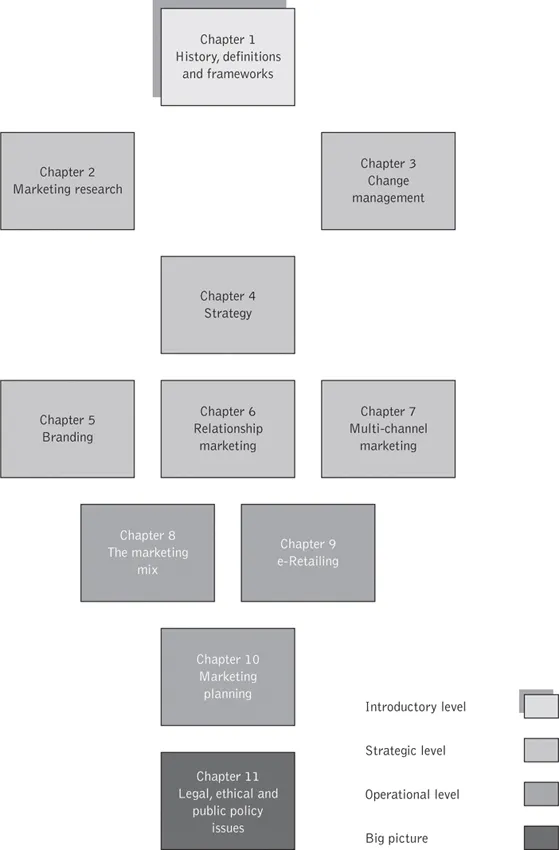
Since the much-hyped dot.com crash, treading the e-business path can be daunting. In these increasingly uncertain and cynical times, this useful text unpicks the challenges of e-Marketing for many types of business. It uses topical case studies and accompanying web material to provide an up-to-date study of effective marketing strategies. Topics in
• chapter 11 – Legal, ethical and public policy issues
Key Learning Points
After completing this chapter you will have an understanding of:
• Historical context of Web developments
• Terms of reference used in the book
• An overview of the major evolving debates in Internet marketing
Ordered List of Sub Topics
• A brief review of the history of the Internet
• Overview of recent developments
• Governance
• Access
• Key definitions
• Frameworks for Internet marketing
• Lessons from history and cautionary tales
• Chapter summary
• Case study: The rise and fall of Boo.com
• Further reading
• Questions
• Web links
A BRIEF REVIEW OF THE HISTORY OF THE INTERNET
In 1969, the Internet was just a demonstration project linking up four university campuses in the USA, but it now boasts in excess of 300 million users across the world. It was supported by the US Department of Defense’s Advanced Research Project Agency (ARPA). The Internet was based on an original concept developed by the Rand Corporation in the early 1960s, and added to by bodies such as the UK’s National Physical Laboratory (NPL). The objective of the research was to provide the USA with a communications network that would survive in the event of a nuclear conflagration. The project was codified into a set of protocols (eventually called TCP/IP) by Vinton Cerf during the mid-1970s, and deployed across all the interlinked networks in 1983. Growth between 1980 and 1987 shows numbers of hosts in the tens of thousands.
After 1987, when the US funding body the National Science Foundation (NSF) started to work with the Internet, the number leapt into the hundreds of thousands. Many non-US academic sites and scientific and research bodies linked up at this point. It was inherent in the technology that new nodes could easily be added to the Internet, and this has permitted the exponential growth of users. Moreover, all messages are treated equally – there is no inherent prioritization of messages – so no matter what computer is being used, all messages have equal rights regardless of whether the user is an employee of a large corporation or an individual accessing the Internet from home.
No single entity owns the Internet or is wholly responsible for its functioning. It is a decentralized network whose operation is influenced by a number of bodies and forces, not least large commercial interests such as Cisco and Microsoft, which help drive information and communication technology (ICT) standards and innovation in the marketplace itself, and as members or otherwise of the various bodies. Between 1987 and 1995, however, one of the most dominant influences on the Internet and Web was the NSF, which subsidized its use along with scientific and academic institutions that paid for servers and created Web content. The ethos underpinning the Internet at this point was one of not-for-profit, and the lack of packet prioritization underpinned an essentially democratic spirit among its user communities. It was only with the emergence of the World Wide Web (WWW) that individuals with little knowledge of such protocols could participate in this electronic medium. By use of hypertext (embedded links within electronic documents) and a pointing device such as a mouse, navigation through a series of Web pages was made possible for novice users. The development of the Web browser Mosaic in 1993 meant that rapid colonization of the network by commercial interests began. It is from this point that e-Commerce dates, at least in its Internet manifestation.
Earlier forms of e-Commerce include Electronic Data Interchange (EDI). This is the exchange of information and orders by trading partners using technically defined templates. It traces its origins to 1969, when a US freight company sought to optimize its freight shipments by use of cabling alongside its tracks to link it with customers. The succeeding decades saw many large corporations taking up EDI based on value-added networks operated by private-sector organizations such as IBM to the point where by 1995 there were in excess of 30,000 EDI networks in Europe alone. Another early mechanism was Electronic Funds Transfer (EFT), and for two decades international settlements by banking interests have been undertaken via the SWIFT system. Intranational settlements have been made by BACS since 1982. As opposed to the Internet, which uses protocols that are open and non-proprietary, these EDI systems are closed or proprietary systems that are open only to invited participants.
The Internet as we know it today consists of small area networks belonging to individual organizations (local area networks, LANs), networks spread across large geographic areas (wide area networks, WANs) and individual computers. To connect to the Internet, a computer or network uses the TCP/IP protocol. The Internet itself usually utilizes an operating system called UNIX. Within the Internet there are more networks. These include:
• backbone networks (e.g. the NTSNET system);
• commercial networks (businesses with direct links to the Internet)
• service providers that offer smaller firms an Internet connection;
• non-commercial networks belonging to educational/research organizations; and
• gateway networks which allow their subscribers access to the Internet (e.g. America Online (AOL) or Compuserve).
Most Internet sites have an address or ‘domain name’ that acts as a telephone number for individuals wishing to reach them. Transfer of information uses File Transfer Protocol (FTP). These files can contain images, video clips, sound recording, text or graphics. In short, the Internet is capable of transmitting anything that can be put in digital form. This means that the cost of information transfer is becoming negligible, distance is increasingly irrelevant and content can be accessed almost immediately. For a relatively small outlay on a computer, a suitable telecommunications link (e.g. via a phone line and modem), and an online account provided by an Internet Service Provider (ISP), individuals located across the globe can access this massive network, which is growing at an exponential rate. The network – the Internet – hooks up the physical infrastructure of computers via cable and wireless links, enabling users to access rich informational sources and use interactive forms of communication such as email.
The latest statistics concerning Internet growth can be found at Network Wizards (see www.nw.com). It is perhaps unsurprising to note that the densest concentrations of users are in North America (60 per cent) and Europe. From being a relatively unknown medium at the beginning of the 1990s, by 2000 the Internet was heading for 100 million hosts (i.e. separate computers linked up) across the world. Compaq estimates that the number of users will grow from around 300 million in 2001 to around 1 billion in 2005. In addition to these fixed hosts that link individual desktop computers to the Internet will be mobile hosts linking up mobile phones to it using wireless technology. The implications of such new Internet access mechanisms for marketing strategy will be discussed in Chapters 4 and 7.
For more detail on the development of the Internet, Hobbe’s Internet Timeline identifies a chronology of events and the individuals behind them at www.zakon.org/robert/internet/timeline Another excellent historical source by one of the key players is Weaving the Web by Berners-Lee (1999).
OVERVIEW OF RECENT DEVELOPMENTS
Governance
Principal among the bodies that have a prescribed influence on the ongoing development of the Internet and the Web are the Internet Engineering Task Force (IETF), the World Wide Web Consortium (W3C) and the Internet Corporation for Assigned Names and Numbers (ICANN). The IETF was created in 1986 to be responsible for drawing up the technical standards for the Internet, and comes under the aegis of the Internet Society (ISOC) – created in 1992 – which assumes overall responsibility for the organization of its development. W3C focuses on the development of the Web (a subset of the Internet) and was created in 1994. It is chaired by the Web’s original creator, Tim Berners-Lee. ICANN, created in 1998, controls the accreditation of domain name registrars which undertake the business of registering Web sites. Decisions made by these bodies determine how Internet and WWW operations take place, and, by definition, what products and/or services are to be successful in the market. Internet 2 is a collaborative project involving over 100 universities that is focusing on increasing the speed of information transfer over the Internet. This is intended to drive forward collaborative use of the Web for learning purposes, for example through video conferencing and virtual laboratories, which struggle to achieve suitable transmission speeds with current technology.
The UK government is committed to extending the use of the Internet. According to the Prime Minister, Tony Blair, speaking in 2000, ‘The Internet-driven knowledge economy is becoming the preserve of an elite.’ He drew upon a study from technology and management consultants Booz, Allen and Hamilton, which showed that Britain is top of the e-league in Europe, in terms of Internet use and revenue from e-Commerce. The study also shows that 45 per cent of those online in the UK are aged between 15 and 24, and almost half of British users are in the top (AB) social group, but the poorer sector of the population uses the Internet very little. As a consequence, the Prime Minister pledged that ‘every British citizen should be able to go online within five years’. He wants the Internet to be available to all as part of a drive to position the UK at the forefront of the ‘new’ economy. The government aims to ensure that people can get online via computers at home, at work, and in libraries and schools, via digital television and mobile telephones.
Access
Business demands on the Internet are for increasing speed and greater bandwidth. As a result, ADSL (Asynchronous Digital Subscriber Line) is seen as the means of facilitating e-Commerce by offering rapid transfer rates to open up multimedia delivery to small and medium-sized firms (SMEs) and individuals. Such bandwidth has so far been available only to large companies using leased lines. Attempts to ‘unbundle the local loop’ to competition have not yet succeeded in the UK as the ex-monopolist BT has not moved quickly enough. As a result, high-speed services are not as prevalent as proponents of e-Commerce would like. In the USA, unbundling began in the mid-1990s. For more detail on this lengthy saga, see Burton (2001).
Currently there are in excess of 300 ISPs in the UK that offer Internet access services, and their pricing reflects the relative quality of service. Some ISPs went so far as to drop charges altogether in order to attract users. Freeserve (www.freeserve.com) got large market penetration quickly when it was launched in September 1998, and within a few months had a membership in excess of 2 million. A number of other UK ISPs quickly followed suit. Though Freeserve was effectively subsidizing the cost of user access, the rationale for doing so was linked to the value of a subscriber base to which adver...
Table of contents
Cover
Title
Copyright
Contents
List of illustrations
List of contributors
Acknowledgements
List of abbreviations
Introduction
1. History, definitions and frameworks
2. Marketing research
3. Change management
4. Strategy
5. Branding
6. Relationship marketing
7. Multi-Channel Marketing
8. The Marketing Mix
9. e-Retailing
10. Marketing planning
11. Legal, ethical and public policy issues
Conclusion
Glossary
References
Index
Trusted by 375,005 students
Access to over 1.5 million titles for a fair monthly price.
Study more efficiently using our study tools.
Frequently asked questions
Yes, you can cancel anytime from the Subscription tab in your account settings on the Perlego website. Your subscription will stay active until the end of your current billing period. Learn how to cancel your subscription
No, books cannot be downloaded as external files, such as PDFs, for use outside of Perlego. However, you can download books within the Perlego app for offline reading on mobile or tablet. Learn how to download books offline
Perlego offers two plans: Essential and Complete
Essential is ideal for learners and professionals who enjoy exploring a wide range of subjects. Access the Essential Library with 800,000+ trusted titles and best-sellers across business, personal growth, and the humanities. Includes unlimited reading time and Standard Read Aloud voice.
Complete: Perfect for advanced learners and researchers needing full, unrestricted access. Unlock 1.5M+ books across hundreds of subjects, including academic and specialized titles. The Complete Plan also includes advanced features like Premium Read Aloud and Research Assistant.
Both plans are available with monthly, semester, or annual billing cycles.
We are an online textbook subscription service, where you can get access to an entire online library for less than the price of a single book per month. With over 1.5 million books across 990+ topics, we’ve got you covered! Learn about our mission
Look out for the read-aloud symbol on your next book to see if you can listen to it. The read-aloud tool reads text aloud for you, highlighting the text as it is being read. You can pause it, speed it up and slow it down. Learn more about Read Aloud
Yes! You can use the Perlego app on both iOS and Android devices to read anytime, anywhere — even offline. Perfect for commutes or when you’re on the go. Please note we cannot support devices running on iOS 13 and Android 7 or earlier. Learn more about using the app
Yes, you can access Marketing the e-Business by Charles Dennis,Lisa Harris in PDF and/or ePUB format, as well as other popular books in Business & Business General. We have over 1.5 million books available in our catalogue for you to explore.