- 300 pages
- English
- ePUB (mobile friendly)
- Available on iOS & Android
eBook - ePub
About this book
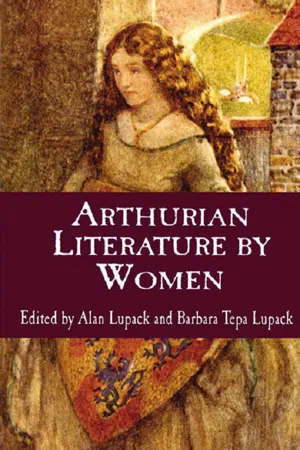
Arthurian Literature by Women: An Anthology is a collection of Arthurian poems, stories, and plays by women, from Marie de France to the present, all of which are either significant examples of Arthurian literature or innovative interpretations of Arthurian tradition. Rather than reproducing brief selections from contemporary novels that are readil
Information
Arthurian Literature by Women
Texts
The Honeysuckle
MARIE DE FRANCE
(TRANSLATED BY NORRIS J. LACY)
I am both pleased and very eager to tell you the truth about a lay entitled Chevrefueil: why it was composed and how it came about. Many people have recited it to me, and I have also found it in written form. It concerns Tristan and the queen and their wondrous love, which brought them great pain and eventually caused the two of them to die on the very same day.
King Mark, angry with his nephew Tristan, banished him from his land because of the young man's love for the queen. Tristan made his way to his own land and could not return. He spent a full year in South Wales, where he had been born. But then he risked death and destruction. You should not be surprised at that, for anyone who loves with true love is in distress and sorrow when he cannot satisfy his desires. Tristan was distraught and melancholy, and as a result he left his land and went directly to Cornwall, where the queen lived. So as not to be seen, he stayed in the forest all alone, showing himself only in the evening when it was time to find shelter. At night he took lodging with peasants and poor people. He asked them for news of the king's actions, and they told him they understood that there was a proclamation summoning the barons to Tintagel. There the king wanted to hold court at Pentecost, and everyone would be present. There would be much celebrating and rejoicing—and the queen would be with them.
Tristan was overjoyed to hear this news, for if she traveled there, he could not fail to see her pass by. On the day the king set out, Tristan entered the forest by the road he knew the procession would take. He cut a piece of a hazel branch and squared it. After preparing the stick, he carved his name on it with his knife. If the queen saw it—and she would surely be watching for it, since she had seen the same thing once before—she would know that the stick was placed there by her lover. It symbolized what was in a message he had sent to her: that he had been there for a long time, watching and waiting, to learn how he might be able to see her, for he could not possibly live without her. The two of them were like the honeysuckle that clings to the hazel: when it has attached itself to the wood and has twined around it, they can survive together; but should anyone try to separate them, the hazel quickly dies, and the honeysuckle with it. “My love, so it is with the two of us: you cannot live without me, nor I without you.”
The queen rode along. She looked down at the sloping path, saw the piece of wood, and understood what it was. She recognized the letters and ordered the knights with her to stop, saying that she wished to dismount and rest. They did as she commanded, and she moved away from her companions, accompanied only by her faithful servant Brangain. She went a short way off the path, and in the forest she found the man who loved her more than any living thing. Both of them were overcome with joy. They told each other everything that was in their hearts. Then she explained how he might be reconciled with the king and told him how distraught she had been when the king, because of an accusation made against Tristan, banished him from his land. Then she departed, leaving her lover behind, and at that moment they both began to weep.
Tristan returned to Wales, where he stayed until his uncle sent for him. At the queen's suggestion, Tristan, who was a skilled harpist, composed a new lay to commemorate what he had written and the joy he had experienced at seeing his beloved. I will briefly name it: the English call it Goatleaf, and the French, Chevrefueil. This is the truth about the lay I have told you here.
Lanval
MARIE DE FRANCE
(TRANSLATED BY NORRIS J. LACY)
I will tell you the story of another lay, just as it happened. It is about a very worthy young man whose name, in Breton, is Lanval. King Arthur, who was valiant and courtly, was at Carlisle, because the Scots and Picts were laying waste the country: they had invaded the land of Logres and were frequently pillaging it. The king was there in summer, at Pentecost.
He distributed rich gifts to his counts and barons and to the knights of the Round Table, whose equal did not exist in all the world. He gave wives and land to all, except to one who had served him. That was Lanval, whom he forgot about. No one called the king's attention to him, for many were jealous of Lanval, because he was worthy, generous, handsome, and valiant. Some feigned affection for him, but they would not have been saddened if some misfortune had befallen him. He was the son of a king and thus of noble lineage, but he was far from his land. He belonged to King Arthur's household, but he had spent all his wealth, for the king gave him nothing, and Lanval asked him for nothing. Now Lanval was downcast and overcome with sadness. That, my lords, is hardly surprising: a disconsolate man in a strange land can be very forlorn when he has nowhere to turn for help.
This knight whom I am telling you about had long served the king. One day he mounted his horse and went away to amuse himself. He left the city and, all alone, came to a meadow. He dismounted beside a flowing stream, but his horse was trembling violently. He loosened the saddle girth, and the horse went away from him to roll around on the meadow. Lanval lay down with his cloak folded beneath his head. He was distraught because of his misfortune, and nothing around him pleased him.
As he was lying there, he looked downstream and saw two young women coming toward him. Never had he seen more lovely women. They were richly dressed in fitted tunics of dark silk, and their faces were very beautiful. The older of them—I am telling you the truth about this—carried a pair of basins made of finely crafted gold, and the other carried a towel. They came straight to the place where the knight lay. Lanval, who was well-mannered, stood up as they approached. They greeted him first and gave him their message: “Sir Lanval, my lady, who is noble and wise and fair, sends us to you; now come with us. We will take you safely to her: see, her pavilion is nearby.”
The knight went with them, paying no attention to his horse, which was grazing on the meadow. They led him to the tent, which was beautiful and luxurious: neither Queen Semiramis, however much wealth, power, and knowledge she had, nor Emperor Octavian could have afforded even the flap of the tent. On top of it was a golden eagle; I cannot even guess the value of it, or of the ropes and poles that supported the walls. No king on earth, no matter how extravagant he might be, could have afforded it.
In the tent was the maiden. Neither the lily nor the rosebud, when it first appears in summer, could match her beauty. She lay on a fine bed, the coverings of which were worth a castle, and she wore only a shift. Her body was shapely and beautiful. To protect herself from the sun, she had covered herself with an expensive mantle of white ermine trimmed with Alexandrian silk, but her face, neck, breast, and side were uncovered. Her skin was whiter than the hawthorn blossom.
The knight approached, and the maiden called to him; he sat down beside the bed. “Lanval,” she said, “fair friend, for your sake I left my land; I have come far to seek you. If you are worthy and noble, no emperor or count or king has ever had such joy or profit as you will, for I love you more than anything.”
He looked at her and saw that she was beautiful, and Love's flame was kindled in his heart. He answered her in seemly fashion: “Fair lady,” he said, “if it pleased you to love me—if I were so fortunate—I would obey your every command, whether it be foolish or wise. I will do your will, and for you I will abandon the company of others. I never want to leave you: this is what I most desire.”
When the maiden heard the words of the man who loved her so much, she granted him her love and her body. Now Lanval's fortunes have changed!
Afterwards she gave him a boon: he would have in abundance whatever he most wanted. He could give gifts and spend liberally, and she would provide whatever he needed. Lanval was well provided for: however generously he spent, he would always have more gold and silver.
“My love,” she said, “now I warn you and command and entreat you never to reveal this to anyone. And I will tell you the truth: if our love were ever revealed, you would lose me forever. Never again could you see me or possess me.”
He answered that he would do as she commanded. He lay down beside her: now he was well provided for indeed ! He stayed with her all afternoon and until evening fell, and he would have stayed longer if he had been able and if his lady had permitted it.
“My love,” she said, “get up. You can remain no longer. Go now, and I will stay here. But I tell you this: when you wish to speak with me, you have only to think of a place where one could be alone with his lady without reproach or shame, and I will be there to do your bidding. No one except you will see me or hear my voice.”
Hearing this, he was overjoyed. He kissed her and then stood up. Those who had led him to the tent dressed him in rich garments. Thus dressed, he was the most handsome of young men, and he was by no means foolish or ill-mannered. They gave him water to wash his hands and a cloth to dry them; then they brought him food. He supped, as was proper, with his lady. He was graciously served, and he accepted it with pleasure, and there was one abundant dish that pleased him in particular: he repeatedly embraced and kissed his lady.
When they had finished eating, his saddled horse was brought to him. Lanval had been well served there. He took his leave, mounted, and set out for the city. He often looked back, very uneasy. He was pensive and fearful because of his adventure; he was astonished and ...
Table of contents
- Cover
- Half Title
- Full Title
- Copyright
- Contents
- Foreword
- Acknowledgment
- Introduction
- Texts
Trusted by 375,005 students
Access to over 1.5 million titles for a fair monthly price.
Study more efficiently using our study tools.
Frequently asked questions
Yes, you can cancel anytime from the Subscription tab in your account settings on the Perlego website. Your subscription will stay active until the end of your current billing period. Learn how to cancel your subscription
No, books cannot be downloaded as external files, such as PDFs, for use outside of Perlego. However, you can download books within the Perlego app for offline reading on mobile or tablet. Learn how to download books offline
Perlego offers two plans: Essential and Complete
- Essential is ideal for learners and professionals who enjoy exploring a wide range of subjects. Access the Essential Library with 800,000+ trusted titles and best-sellers across business, personal growth, and the humanities. Includes unlimited reading time and Standard Read Aloud voice.
- Complete: Perfect for advanced learners and researchers needing full, unrestricted access. Unlock 1.5M+ books across hundreds of subjects, including academic and specialized titles. The Complete Plan also includes advanced features like Premium Read Aloud and Research Assistant.
We are an online textbook subscription service, where you can get access to an entire online library for less than the price of a single book per month. With over 1.5 million books across 990+ topics, we’ve got you covered! Learn about our mission
Look out for the read-aloud symbol on your next book to see if you can listen to it. The read-aloud tool reads text aloud for you, highlighting the text as it is being read. You can pause it, speed it up and slow it down. Learn more about Read Aloud
Yes! You can use the Perlego app on both iOS and Android devices to read anytime, anywhere — even offline. Perfect for commutes or when you’re on the go.
Please note we cannot support devices running on iOS 13 and Android 7 or earlier. Learn more about using the app
Please note we cannot support devices running on iOS 13 and Android 7 or earlier. Learn more about using the app
Yes, you can access Arthurian Literature by Women by Alan Lupack,Barbara T. Lupack in PDF and/or ePUB format, as well as other popular books in Literature & Medieval Literary Collections. We have over 1.5 million books available in our catalogue for you to explore.