eBook - ePub
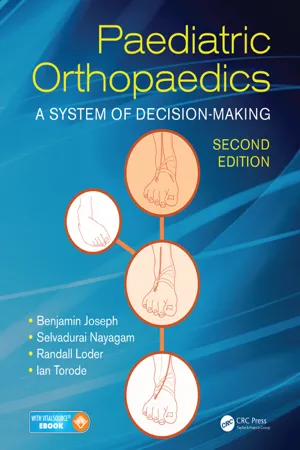
Paediatric Orthopaedics
A System of Decision-Making, Second Edition
- 600 pages
- English
- ePUB (mobile friendly)
- Available on iOS & Android
eBook - ePub
Paediatric Orthopaedics
A System of Decision-Making, Second Edition
About this book
Mastering the art and science of paediatric orthopaedics entails the acquisition of theoretical knowledge, the development of surgical dexterity and learning the process of clinical decision-making. Of these three components, clinical decision-making is arguably the most important.Featuring a practical focus, Paediatric Orthopaedics: A System of De
Information
SECTION 1
Deformities
1 General principles of treatment of deformities in children
Selvadurai Nayagam and Benjamin Joseph
2 Equinus deformity
Benjamin Joseph
3 Equinovarus
Selvadurai Nayagam
4 Calcaneus deformity
Benjamin Joseph
5 Cavus
Benjamin Joseph
6 Congenital vertical talus
Selvadurai Nayagam
7 Planovalgus deformity
Benjamin Joseph
8 Valgus deformity of the ankle and subtalar joint
Benjamin Joseph
9 Metatarsus adductus and skewfoot
Selvadurai Nayagam
10 Anterolateral bowing of the tibia and congenital pseudarthrosis of the tibia
Benjamin Joseph
11 Posteromedial bowing of the tibia
Benjamin Joseph
12 Tibial torsion
Benjamin Joseph
13 Flexion deformity of the knee
Benjamin Joseph
14 Genu recurvatum
Benjamin Joseph
15 Genu varum
Selvadurai Nayagam
16 Genu valgum
Selvadurai Nayagam
17 Coxa vara
Randall Loder
18 Femoral anteversion
Randall Loder
19 Cubitus varus and valgus
Benjamin Joseph
20 Varus and valgus deformity of the wrist
Benjamin Joseph
21 Scoliosis
Ian Torode
22 Kyphotic deformities of the spine
Ian Torode
23 Torticollis
Ian Torode
1
General principles of treatment of deformities in children
Introduction
Natural history of the deformity
Consequences of the deformity
Problems of management
Appearance
Loss of function
Pain and giving way (instability)
Secondary adaptive or degenerative changes
Aims of treatment
Principles of assessing deformity
Principles of analysis of deformity
Centre of rotation of angulation
Treatment options
Soft tissue
Bony tissue
Strategies for preventing recurrence
Muscle imbalance
Physeal damage
Metabolic bone disease
Soft tissue contracture
References
INTRODUCTION
Deformity is an alteration of structure (be it length, alignment or joint position) that produces, or has the potential to produce, symptoms or loss of function. It is one of the commonest reasons for consulting a paediatric orthopaedic surgeon. The impact of the visible anomaly to the child and parents is of a worrisome abnormality which the treating doctor will need to distinguish as either normal variant or disease. In the event of the latter, two additional issues need resolving:
1. what is the natural history of this condition?
2. what are the consequences if it is left untreated?
Decision-making becomes a great deal simpler with both questions answered (Table 1.1).
Natural history of the deformity
DEFORMITIES THAT TEND TO RESOLVE SPONTANEOUSLY
A high proportion of children who present to the doctor have innocuous deformities that resolve spontaneously. These normal variants include physiologic genu varum and valgum, infantile flatfoot, neonatal calcaneovalgus deformity and some torsional deformities of the femur and tibia. Recognising these diagnoses allows the doctor to reassure parents. In some children complete correction of such variants may not occur and follow-up until resolution is wise.
DEFORMITIES THAT TEND TO PROGRESS AND/OR RECUR AFTER SURGICAL CORRECTION
Paralytic deformities and those caused by physeal damage tend to progress until skeletal growth stops. Unless the underlying cause is removed (e.g. muscle imbalance or physeal bar), recurrence will follow seemingly satisfactory correction. Certain deformities, such as types of scoliotic curves, may progress even after skeletal maturity.
DEFORMITIES THAT REMAIN STATIC
Some deformities remain static; typically these include fracture malunions that have failed to remodel completely, either from severity of the original malalignment or from the advanced age of the child.
Table 1.1 Decision-making based on the natural history and consequences of deformities
Decision-making on the basis of the natural history of the deformity | |
Natural history of the deformity | Nature of intervention |
Deformities that tend to resolve spontaneously | Reassurance and follow-up |
Deformities that tend to progress | Early intervention to correct deformity and prevent progression or recurrence (if cure is not possible, a strategy to prevent progression is warranted) |
Deformities that remain static | Decision to intervene based on consequences of the deformity |
Decision-making on the basis of the consequences of the deformity | |
Consequences of the deformity | Decision to intervene |
Deformities that are cosmetically acceptable and cause no disability | No intervention |
Deformities that are cosmetically unacceptable but cause no functional disability | Consider intervention after weighing the risks potential complications of intervention |
Deformities that cause disability | Intervene |
Deformities that potentially lead to long-term deleterious consequences | Intervene early to prevent onset or progression of problems |
Deformities that may be beneficial | Avoid correction of the deformity |
Consequences of the deformity
COSMETICALLY ACCEPTABLE BUT NO FUNCTIONAL DISABILITY
These should be left alone.
COSMETICALLY UNACCEPTABLE BUT NO FUNCTIONAL DISABILITY
Whether a deformity is cosmetically unacceptable will vary between individuals and communities. The treating doctor has to be attuned to these differences.
CAUSES FUNCTIONAL DISABILITY
Treat the deformity and reduce disability.
POTENTIAL TO CAUSE FUNCTIONAL DISABILITY
Should treatment be offered when the child is fine at present but will not remain so if left alone? When supportive evidence is available, such deformities should be corrected before the disability develops. In other conditions, the uncertainty remains and the need for intervention evolves as more information is available.
PROBLEMS OF MANA...
Table of contents
- Cover
- Half Title
- Title Page
- Copyright Page
- Dedication
- Table of Contents
- Contributors
- Foreword
- Preface
- Preface to first edition
- SECTION 1 DEFORMITIES
- SECTION 2 DISLOCATIONS
- SECTION 3 DEFICIENCIES
- SECTION 4 DISCREPANCIES OF LIMB LENGTH
- SECTION 5 DECREASED JOINT MOBILITY
- SECTION 6 PARALYSES
- SECTION 7 EPIPHYSEAL AND PHYSEAL PROBLEMS
- SECTION 8 INFECTIONS
- SECTION 9 ACQUIRED DEFECTS IN LONG BONES
Trusted by 375,005 students
Access to over 1.5 million titles for a fair monthly price.
Study more efficiently using our study tools.
Frequently asked questions
Yes, you can cancel anytime from the Subscription tab in your account settings on the Perlego website. Your subscription will stay active until the end of your current billing period. Learn how to cancel your subscription
No, books cannot be downloaded as external files, such as PDFs, for use outside of Perlego. However, you can download books within the Perlego app for offline reading on mobile or tablet. Learn how to download books offline
Perlego offers two plans: Essential and Complete
- Essential is ideal for learners and professionals who enjoy exploring a wide range of subjects. Access the Essential Library with 800,000+ trusted titles and best-sellers across business, personal growth, and the humanities. Includes unlimited reading time and Standard Read Aloud voice.
- Complete: Perfect for advanced learners and researchers needing full, unrestricted access. Unlock 1.5M+ books across hundreds of subjects, including academic and specialized titles. The Complete Plan also includes advanced features like Premium Read Aloud and Research Assistant.
We are an online textbook subscription service, where you can get access to an entire online library for less than the price of a single book per month. With over 1.5 million books across 990+ topics, we’ve got you covered! Learn about our mission
Look out for the read-aloud symbol on your next book to see if you can listen to it. The read-aloud tool reads text aloud for you, highlighting the text as it is being read. You can pause it, speed it up and slow it down. Learn more about Read Aloud
Yes! You can use the Perlego app on both iOS and Android devices to read anytime, anywhere — even offline. Perfect for commutes or when you’re on the go.
Please note we cannot support devices running on iOS 13 and Android 7 or earlier. Learn more about using the app
Please note we cannot support devices running on iOS 13 and Android 7 or earlier. Learn more about using the app
Yes, you can access Paediatric Orthopaedics by Benjamin Joseph,Selvadurai Nayagam,Randall Loder,Ian Torode in PDF and/or ePUB format, as well as other popular books in Medicine & Pediatric Medicine. We have over 1.5 million books available in our catalogue for you to explore.