The Healthcare Innovator's Workbook
eBook - ePub

The Healthcare Innovator's Workbook

Making Lean Design in Healthcare Happen

  1. 96 pages
  2. English
  3. ePUB (mobile friendly)
  4. Available on iOS & Android
eBook - ePub

The Healthcare Innovator's Workbook

Making Lean Design in Healthcare Happen

About this book

This book gives the reader an inside look at creating a new healthcare service using practical examples and scenarios one would face if doing it themselves. This workbook is a follow-up to the recently published, Lean Design in Healthcare and offers a tactical version of the principles provided in the book. It parses the dialogue out into detailed reasons for the Lean Design in Healthcare's position and principles. This workbook contains examples and many exercises for the reader to complete to begin their own innovation journey.

Lean Design in Healthcare chronicles the journey of a fictitious healthcare delivery organization using the Simpler Design System principles based on Lean methodologies. While the characters and actual story is fictitious, it is based on the journey many healthcare systems and clients have taken, the issues they have faced, and the successes and failures they've had. This workbook takes the initial story further and includes leadership quotes and best practices to support the dialogue introduced in the first book. Exercises will be custom designed to match the story flow and provides practical information that readers can immediately apply in their work. Each chapter will start with an introduction and contain 10 exercises per chapter. Tools include those gleaned from actual application of Lean Product Development, Agile, Design for Six Sigma, and Design Thinking Principles.

Frequently asked questions

Yes, you can cancel anytime from the Subscription tab in your account settings on the Perlego website. Your subscription will stay active until the end of your current billing period. Learn how to cancel your subscription.
No, books cannot be downloaded as external files, such as PDFs, for use outside of Perlego. However, you can download books within the Perlego app for offline reading on mobile or tablet. Learn more here.
Perlego offers two plans: Essential and Complete
  • Essential is ideal for learners and professionals who enjoy exploring a wide range of subjects. Access the Essential Library with 800,000+ trusted titles and best-sellers across business, personal growth, and the humanities. Includes unlimited reading time and Standard Read Aloud voice.
  • Complete: Perfect for advanced learners and researchers needing full, unrestricted access. Unlock 1.4M+ books across hundreds of subjects, including academic and specialized titles. The Complete Plan also includes advanced features like Premium Read Aloud and Research Assistant.
Both plans are available with monthly, semester, or annual billing cycles.
We are an online textbook subscription service, where you can get access to an entire online library for less than the price of a single book per month. With over 1 million books across 1000+ topics, we’ve got you covered! Learn more here.
Look out for the read-aloud symbol on your next book to see if you can listen to it. The read-aloud tool reads text aloud for you, highlighting the text as it is being read. You can pause it, speed it up and slow it down. Learn more here.
Yes! You can use the Perlego app on both iOS or Android devices to read anytime, anywhere — even offline. Perfect for commutes or when you’re on the go.
Please note we cannot support devices running on iOS 13 and Android 7 or earlier. Learn more about using the app.
Yes, you can access The Healthcare Innovator's Workbook by Adam Ward in PDF and/or ePUB format, as well as other popular books in Business & Operations. We have over one million books available in our catalogue for you to explore.

Information

Year
2019
Print ISBN
9780367201401
eBook ISBN
9780429535383
Subtopic
Operations
Chapter 1
Players
Systematic innovation is an achievable goal for any organization. Whether you are the chief executive officer (CEO), middle management, or in the early stages of your career, you can make it happen. We face a lot of obstacles in today’s environment. Our penchant to spend more than what we have seems to be the major theme, whether that is time or money. Read the titles of these articles:
ā—¾A Foolish Take: Here’s how much debt the average U.S. household owes https://amp.usatoday.com/amp/107651700
ā—¾How Americans’ Love Affair with Debt Has Grown https://www.theatlantic.com/business/archive/2010/09/how-americans-love-affair-with-debt-has-grown/63552/
ā—¾Americans Are Spending Again: Average American Debt in 2017 https://www.studentdebtrelief.us/news/average-american-debt-2017/
ā—¾The Bureau of Labor statistics reports that dual income families are on the rise https://www.bls.gov/news.release/famee.nr0.htm
ā—¾Too Many Extracurricular Activities for Kids May Do More Harm Than Good https://psychcentral.com/news/2018/05/15/too-many-extracurricular-activities-for-kids-may-do-more-harm-than-good/135388.html
Unfortunately, our personal habits impact our professional work. We take the same [un] limits in time and money and try to get them to work in our healthcare system. We think there’s always more money, always available time, and always available people. But there isn’t. And with healthcare costs, healthcare workers’ burnout, regulatory dynamism, and consumerism all out of control, it’s time to systematize innovation. We need a process that updates healthcare services on a regular basis. The care models we deliver must be radically improved or disrupted. Outsiders think they can do it. Silicon Valley has tried. Disruption will come from within, but an insider will go outside to fix it. Why not be part of the solution now before it’s too late and the government forces a solution that is bad for everybody?
Services
Healthcare offers a service to patients: maintaining their health, or their ability to do life. That service is broken into many types of services. Each one of those services is delivered via a care model. Those care models could be a service line like orthopedics or gynecology. They could be delivering routine care, addressing a trauma, or treating something chronic. How we deliver those services determines patient satisfaction. When patients become dissatisfied, they find someone else who can take care of them. As a healthcare system, we want to grow our patient panel, not lose it. Let’s look at the totality of services offered as our portfolio of services. We can’t let those services get outdated or get behind the competitors. As leaders, we have a small city of employees who depend on us for their livelihood, and we take that responsibility seriously. Nothing ensures the future health outlook of our organization than taking steps to stay healthy today. That includes a constant update of our portfolio. This workbook helps establish that capability.
Some of those services aren’t core and are often outsourced so the organization can focus on practicing medicine.
ā—¾Clinical (e.g., blood services, dialysis, and lithotripsy)
ā—¾Financial (e.g., credit card processing, resource management/staffing, and revenue cycle management)
ā—¾Environmental (e.g., facility cleaning, waste management, and linens/laundry)
ā—¾Support services (e.g., ambulance, food services, and transcription)
According to research, purchased services can account for up to 35 percent of a typical U.S. hospital’s operating expenses. That leaves 65 percent of the budget for care. https://www.beckershospitalreview.com/supply-chain/5-common-misconceptions-about-hospital-purchased-services.html
We have the capability to define every single dollar spent. Our portfolio is a result of our choices. Where we go in the future is up to us, the leaders. Leadership guru John Maxwell defined leadership as ā€œinfluence.ā€ Influence is critical to implementing the principles in this book. https://www.johnmaxwell.com/blog/7-factors-that-influence-influence/
During my time at GE, one of the premier leadership development companies, we were taught a change accele...
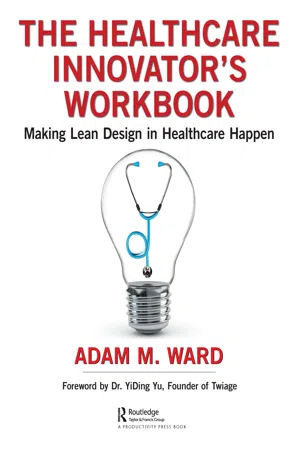
Table of contents

  1. Cover
  2. Endorsements
  3. Half Title
  4. Title Page
  5. Copyright Page
  6. Contents
  7. Foreword
  8. Author
  9. Introduction
  10. 1. Players
  11. 2. Basics
  12. 3. Basic Tools
  13. 4. RED Framework
  14. 5. Reflection
  15. Index