eBook - ePub
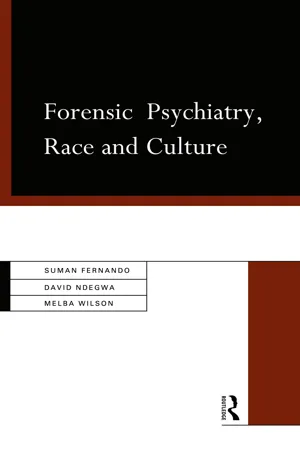
Forensic Psychiatry, Race and Culture
- 237 pages
- English
- ePUB (mobile friendly)
- Available on iOS & Android
eBook - ePub
Forensic Psychiatry, Race and Culture
About this book
Forensic psychiatry is the discipline which distinguishes the 'mad' from the 'bad', but are its values inherently racist? Why are individuals from non-Western backgrounds over-represented statistically in those diagnosed with schizophrenia and other serious illnesses? The authors argue that the values on which psychiatry is based are firmly rooted in ethnocentric Western culture, with profound implications for individual diagnosis and systems of care.
Through detailed exploration of the history of psychiatry, current clinical issues and present public policy, this powerful book traces the growth of a system in which non-conformity to the prevailing cultural norms risks alienation and diagnosis of mental disorder.
Information
Part I
Background
Chapter 1
Race and cultural difference
Historically, ideas about ‘race’ based on skin colour occurred in a context where the words ‘black’ and ‘white’ had been associated in the English language with heavily charged notions of good and bad and went hand in glove with prejudice from the very beginning. Then came slavery and colonialism feeding into racial prejudice and vice versa. Today, racism is fashioned by racial prejudice and under-pinned by economic and social factors; when implemented and practised through the institutions of society, often without people involved even being aware that they are being racist, it is called ‘institutional racism’ (Wellman, 1977). Concepts of cultural difference are often distorted by racist perceptions and ‘culture’ is often confounded with ‘race’ both historically and in modern Western thinking (see Fernando, 1988). This chapter will attempt to pick out some of the issues around race and culture that form a background to discussions about the emergence of forensic psychiatry that will follow in Chapter 2. Of all historical situations that have fashioned modern European thinking about race and cultural difference, the most significant events centre around the transatlantic slave trade and the colonial era, so this chapter will start with a brief overview of these two shameful and tragic episodes in European history. Then, the concepts of ‘race’, ‘culture’ and ‘ethnicity’, and racism will be discussed. Finally, the chapter will consider other issues, such as multiculturalism where racism is implicated in issues around cultural difference, that may help in understanding the theses presented in the succeeding chapters of this part of the book.
SLAVERY AND COLONIALISM
Slavery had existed in Europe and Africa for a long time before the transatlantic slave trade started (Pieterse, 1995); it was well established in ancient Greece and slaves had been an important European export to the world of Islam and to Byzantium. ‘What changed in the course of the sixteenth and seventeenth centuries was that slavery acquired a colour’ (1995:52). Slavery of black people by white people happened outside Europe to a large extent but it contributed significantly to the accumulation of capital in Europe that brought about the Industrial Revolution and it affected European thinking about race.
Initially, slavery thrived on greed and in turn fuelled racism and soon England became the foremost slave trading nation in the world. According to Fryer (1984) ‘it was their drive for profit that led British merchant capitalists to traffic in Africans. There was money in it. The theory came later’ (1984:134). And the theory of racism based on skin colour was articulated most strongly by European philosophers of the eighteenth century. As a corollary of the slave trade, black people became a visible minority in British cities by the final decade of the sixteenth century. As England's black community grew in numbers, there were calls for expulsion of blacks by the then monarch. Fryer (1984) quotes an open letter in 1596 from Queen Elizabeth I to the Lord Mayors of major cities stating that ‘there are of late divers blackamores brought into the realm, of which kind of people there are already here to manie’, and recommending ‘that those kind of people be sent forth from the land’ (1984:10). Apparently the Queen's call met with no response in spite of it being repeated in 1601 (Bygott, 1992).
With the abolition of the slave trade in 1807, racism became a crucial ingredient of colonialism. In his classic book Asia and Western Dominance, Panikkar (1959) traces the progress of European imperialism in Asia…. By the middle of the seventeenth century, the economic prosperity in Europe, as a result of slave labour and the plunder of the USA, led to the demand for superior goods from the advanced economies of the East—mainly in China and India. Trade gave way to conquest and colonisation, with Britain leading the way. As India was colonised, its industry was suppressed and destroyed and by the mid-nineteenth century, India had been changed from an exporter of manufactured goods to a producer of raw materials and later a source of indentured labour for other parts of European empires. Meanwhile, starting with the ‘opium wars’ between 1839 and 1842, successive raids into China by British, French and Portuguese forces, often accompanied by acts of vandalism (such as the burning of the Summer Palace in Peking by Lord Elgin in 1860), led to China becoming a semi-colonial state by 1900.
Christian missionaries from Europe started going to India about 1813 supporting a view of the superiority of Europe over Asia. According to Geoffrey Moorhouse (1983), William Wilberforce, a leader of the fight against the slave trade, considered that the conversion of India to Christianity was a cause greater than the abolition of slavery. In the debate which preceded the new India Act, he told the House of Commons in 1813 that he saw the subcontinent as a place which would ‘exchange its dark and bloody superstition for the genial influence of Christian light and truth’, the gods of the Hindus being ‘absolute monsters of lust, injustice, wickedness and cruelty. In short, their religion is one grand abomination’ (1983:69).
In the mid-nineteenth century the final onslaught on Africa began. Historian Basil Davidson (1984) describes how explorers were followed by the missionary drive and European coastal traders. An invasion of the mainland of Africa followed, Europeans were often impressed by the widespread violence and insecurity they found in some parts of Africa and they used this as moral justification for their invasions. But from the very first encounter, they established as a principle their alleged racial superiority over black Africans—an attitude among invaders that was new to Africans (Davidson, 1984):
However various the methods of colonial enclosure, the results were in one great aspect the same. They brought a new subjection by peoples who, unlike all previous and internal conquerors, regarded themselves as naturally superior to Africans, and who were also able to apply methods of oppression and exploitation of a range and intensity never known before.
(1984:286)
An agreement to divide up the continent (the ‘scramble for Africa’) was concluded by European powers at the Berlin conference in 1884/5, but full subjugation of Africa was not completed until about 1920. At that time, African society was organised in social groups—tribes—claiming descent from a common ancestor (Rodney, 1988). All the large states of nineteenth-century Africa were multi-ethnic and ‘their expansion was continually making anything like “tribal” loyalty a thing of the past’ (1988:228). As European powers moved into Africa in force, the nation states were destroyed and tribalism—loyalty to small social groups—encouraged in the interests of cheap colonial rule (Davidson, 1984). In spite of vast profits being made by European firms and European farmers, education and responsibility were withheld from blacks except for elites most of whom ‘were content to accept the values of their masters’ (1984:305). The overall result of colonialism was the disintegration of African economies, virtual eradication of African political power and the loss of ‘vital aspects of culture’ (Rodney, 1988:232).
Slavery was legally ended within the British Empire on 1 August 1834, but the emancipated black slaves in British colonies in the Caribbean were subjected to a period of ‘apprenticeship’ that tied them to work on the sugar plantations for a further four years (Fryer, 1988). Then, ex-slaves left the plantations and soon set up communal villages ‘through a remarkable process of self-help and solidarity’ (1988:29). Meanwhile European planters imported indentured labourers from British India to develop a ‘coolie’ system ‘built on the foundations laid by the slave system’ (1988:27). However, following an outcry from Indian public opinion, this system was abandoned. The British colonies in the West Indies were left with a multi-ethnic population of people with cultural roots in Africa, Asia and Europe—the vast majority being racially defined as ‘black people’.
Resistance
In Black People in the British Empire (1988), Peter Fryer states that: ‘nowhere within the British Empire were black people passive victims. On the contrary, they were everywhere active resisters. Far from being docile, they resisted slavery and colonialism in every way open to them. Their resistance took many different forms, both individual and collective. It ranged from a watchful and waiting pretence of acceptance—a subtle if elementary form of individual resistance to slavery—right up to large-scale mass uprisings and national liberation movements’ (1988:85). These movements in the Asian, African and West Indian colonies came to a head in the 1930s and 1940s. Then, with the weakening of two major European colonial powers, namely the UK and France, during the so-called ‘Second World War’ 1939–45 (defeat of Japan), Asian colonies started to become independent and the winds of change soon reached Africa and the West Indies. The final chapter was written in 1993 with the liberation (from white settler rule) of South Africa. But the aftermath of colonialism and slavery had clearly led to massive problems, especially in Africa, allowing the economic plunder—neo-colonialism—to continue throughout the second half of the twentieth century.
RACE
The classification of people into racial types on the basis of physical appearance has a long history in Western culture. And from the very beginning, skin colour was the most popular physical characteristic used for this purpose. In the eighteenth century, Linnaeus (1758) divided homo sapiens into the following varieties: americanus, europaeus, asiaticus, and later identified them in terms of being red, white, yellow and black, and ferus and monstrosus were identified by general characteristics. In the book, On the Natural Varieties of Mankind (1776 [1969]), Blumenbach, a German physician and anthropologist, coined the term ‘Caucasian’ to refer to what he thought was the ideal race best exemplified by people (Georgians) who then lived on the southern slopes of the Caucasian mountains. He advocated the theory that other races, which he named as Mongolian, Ethiopian, American and Malayan (using skin colour as the main criterion for so doing but adding hair, form, facial characteristics and the shape of skull), had ‘degenerated’ from this ideal ‘Caucasian’ type. (This concept of degeneration was taken up in the next century informing the construction of schizophrenia —see Chapter 2). Later, ‘Caucasian’ became a term applied to people from Europe, North Africa and the Middle East, but is now used loosely to mean ‘white-skinned’.
In 1853–5, de Gobineau's pioneering Essay on the Inequality of the Human Races (Essai sur l'inegalité des races humaine) which was well received in Europe (Proctor, 1988), claimed scientific status for casting ‘race’ ‘as the primary force in world history’ (1988:12). And, ‘scientific racism’ thrived in the eighteenth and nineteenth centuries. Darwin's theory of evolution in the mid-nineteenth century gave rise to a new concept of ‘race’ as a subdivision within the same species: ‘domestic races of the same species differ from each other in the same manner as, only in most cases in a lesser degree than do, closely-allied species of the same genus in a state of nature’ (Darwin, 1859:16). By analogy with his description of numerous ‘races’ within each species, the idea developed that, while human beings as a whole were a ‘species’ with fertile mating within it, individual (human) ‘races’ were ‘varieties’ or ‘subspecies’ with partial reproductive isolation from each other (Banton, 1987). Each race was seen as being subject to continual modification and development rather than to a static set of inherited characteristics. Although the idea of race as a subspecies promoted the concept of geographical race, it did not exclude the view that races may become separate types: it was held that a subspecies may evolve to a point where it is no longer able to interbreed with other forms and hence become a species.
This new view of race was a flexible and egalitarian one compared to that espoused by de Gobineau, although in The Descent of Man and Selection in Relation to Sex (1871) Darwin wrote about the likely extinction of ‘savage races’ because of their inability to change habits when brought into contact with ‘civilised races’. However, Darwin's ideas in On the Origin of the Species by Means of Natural Selection: or the Preservation of Favoured Races in the Struggle for Life (1859) were used to develop ‘Social Darwinism’ that argued for racial hierarchies. In Germany, social Darwinists, like Ploetz, ‘an anthropologist of repute’ (Bonger, 1943: 24), voiced fears that ‘racial degeneration’ may come about as a result of ‘medical care for the weak’ and the rapid multiplication of the poor and misfits of society (Proctor, 1988:15). The idea that crime and psychosis had a racial basis became such a fundamental belief in Germany by the turn of the nineteenth century that Näcke, described by Bonger (1943) as a well known criminologist, ‘very much taken in by the milieu-as-cause theory of crime’ (1943:23), was quoted by him as stating in 1906:
If one believes in the dissimilarity of the races in physical and psychical respect, then, consequently, one must conclude that the physical and psychical abnormalities and deficiencies in conscience will show certain quantitative and qualitative variations. And this, indeed, seems to be the case, especially where crime and psychosis are concerned.
(1943:23)
And Social Darwinism fed into the racial hygiene movement which then developed hand-in-hand with eugenics and the construction of schizophrenia as an illness.
As a result of the genocide of Jews and Gypsies in Germany during the 1940s, theories about racial differentiation and overt racism itself became unpopular after the military defeat of Germany in 1945. Post-war science rallied round anti-racism. But new forms of Darwinism, popularised recently by human ethologists (e.g. Robert Ardrey, 1967) and sociobiologists (e.g. Richard Dawkins, 1970), have revived racist ideas (see Barker, 1990). Both ethology and sociobiology suggest that ‘it is biologically fixed that humans form exclusive groups, and that these groups succeed internally in so far as they close up against outsiders’ (1990:18). Robert Ardrey (1967), arguing that ‘aggression’ (identified by ethologists as represented in a variety of animal behaviours) is ‘innate’, postulates that its exhibition towards outsiders is a natural condition because ‘the biological nation is the supreme natural mechanism for the security of a social group’ (1967:253). Richard Dawkins (1976) writes that ‘racial prejudice could be interpreted as an irrational generalisation of a kin-selected tendency to identify with individuals physically resembling oneself and to be nasty to individuals different in appearance’ and that this tendency ‘could have positive survival value’ (1976:8). Having invented the concept of ‘kin altruism’ as an extension of ‘the selfish gene’ sociobiologists appear to argue that it is natural to maintain ethnic boundaries with aggression towards competitive outsiders. Race thinking is implied and racism—and indeed aggression towards outsiders—is justified in both modes of thought.
Recent scientific advances have enabled geneticists to identify human genes that code for specific enzymes and other proteins. It is now possible to use information on the distribution of polymorphic proteins (i.e. proteins that have alternative forms that exist in varying frequencies in the human species) in order to calculate differences between individuals and between defined populations.J. S.Jones (1981) notes that eighty-four per cent of all genetic variation results from genetic difference between individuals belonging to the same tribe or nationality, six per cent from differences between tribes or nationalities, and ten per cent from genetic divergence between ‘racial’ groups. ‘In other words the genetic differences between the classically described races of man are on the average only slightly greater than those which exist between nations within a racial group, and the genetic differences between individual human beings within a population are far larger than either of these’ (1981: 189). Thus the genetic differences between (say) indigenous populations of France and Spain, or between different tribes of Africa, are similar to those between so-called races. A way of thinking that includes together in one ‘race’ everyone who has a particular skin colour or hair type or some other aspect of physical appearance, assigning borderline cases according to traditional ideas (e.g. that ‘white’ skin colour is pure and ‘non-white’ is caused by an admixture that corrupts that purity), is no longer biologically acceptable or useful in scientific practice.
The myth of race has been exploded but race as a social reality persists. Thus, in popular lore, and even in medical and scientific circles, racial differences are still seen as indicating biological differences—or at least physical ones that are inherited genetically—and skin colour remains the most popular basis for distinguishing one race from another. Continuing to use the concept of ‘race’ (defined in social terms by certain aspects of physical appearance) inevitably leads to problems of communication. For example, since the idea that pure races exist is a myth, there cannot be such a thing as hybrid or mixed races (unless the whole human race is thought of as ‘hybrid’ or ‘mixed’ racially) and a person cannot be described as being ‘of mixed race’—although the parents of a person can be described as ‘mixed’ in that they are perceived as being from different races.
While the assumption that racial groups are biologically distinct from each other is incorrect in scientific terms, race as a marker may be useful in a very limited way. For example, certain genetically transmitted conditions, such as Tay-Sachs disease (infantile amaurotic idiocy), sickle cell trait or sickle cell disease, and cystic fibrosis may be suspected when there is evidence of East European Jewish, West African and north European ancestry respectively (Molnar, 1983), and race may be used as an initial indicator to detect people who may be vulnerable to these conditions. But this use of ‘race’ in no way challenges the overall conclusion that scientifically, ‘as a way of categorising people, race is based upon a delusion’ (Banton and Harwood, 1975:8).
CULTURE
Culture was originally seen as ‘something out there’, a social concept, but it is now often seen as something ‘inside’ a person—a psychological state (D'Andrade, 1984). Culture may be described in terms...
Table of contents
- Front Cover
- Title Page
- Copyright
- Dedication
- Contents
- List of illustrations
- Notes on contributors
- Preface
- Acknowledgements
- Introduction
- Part 1 Background
- Part 2 Clinical issues
- Part 3 Public policy
- Part 4 Future prospects
- Bibliography
- Index
Trusted by 375,005 students
Access to over 1.5 million titles for a fair monthly price.
Study more efficiently using our study tools.
Frequently asked questions
Yes, you can cancel anytime from the Subscription tab in your account settings on the Perlego website. Your subscription will stay active until the end of your current billing period. Learn how to cancel your subscription
No, books cannot be downloaded as external files, such as PDFs, for use outside of Perlego. However, you can download books within the Perlego app for offline reading on mobile or tablet. Learn how to download books offline
Perlego offers two plans: Essential and Complete
- Essential is ideal for learners and professionals who enjoy exploring a wide range of subjects. Access the Essential Library with 800,000+ trusted titles and best-sellers across business, personal growth, and the humanities. Includes unlimited reading time and Standard Read Aloud voice.
- Complete: Perfect for advanced learners and researchers needing full, unrestricted access. Unlock 1.5M+ books across hundreds of subjects, including academic and specialized titles. The Complete Plan also includes advanced features like Premium Read Aloud and Research Assistant.
We are an online textbook subscription service, where you can get access to an entire online library for less than the price of a single book per month. With over 1.5 million books across 990+ topics, we’ve got you covered! Learn about our mission
Look out for the read-aloud symbol on your next book to see if you can listen to it. The read-aloud tool reads text aloud for you, highlighting the text as it is being read. You can pause it, speed it up and slow it down. Learn more about Read Aloud
Yes! You can use the Perlego app on both iOS and Android devices to read anytime, anywhere — even offline. Perfect for commutes or when you’re on the go.
Please note we cannot support devices running on iOS 13 and Android 7 or earlier. Learn more about using the app
Please note we cannot support devices running on iOS 13 and Android 7 or earlier. Learn more about using the app
Yes, you can access Forensic Psychiatry, Race and Culture by Dr Suman Fernando,Suman Fernando,David Ndegwa,Melba Wilson in PDF and/or ePUB format, as well as other popular books in Medicine & Medical Law. We have over 1.5 million books available in our catalogue for you to explore.