Fantasy City analyses the post-industrialist city as a site of entertainment. By discussing examples from a wide variety of venues, including casinos, malls, heritage developments and theme parks, Hannigan questions urban entertainments economic foundations and historical background. He asks whether such areas of fantasy destroy communities or instead create new groupings of shared identities and experiences. The book is written in a student friendly way with boxed case studies for class discussion.
- 256 pages
- English
- ePUB (mobile friendly)
- Available on iOS & Android
eBook - ePub
About this book
Information
Part I
GOING OUT AND STAYING IN
In 1987, Randall Duell, one of the pioneers of entertainment theming, was interviewed by the Amusement Park Journal Duell, known as the “dean of amusement park architects,” had been an art director at MGM Studios for a quarter of a century, working on such classic films as Singing in the Rain with Gene Kelly before turning to park design. The theme park business, Duell observed, is all about how to combine entertainment and commercial value. Unlike in real cities, visitors should “never look down an open street,” there should always be another attraction around the corner to draw people in and make them want to stay longer (Ruben 1987: 9).
For over a century, leisure merchants in the US, Canada, Australia and elsewhere have attempted to marry entertainment and commerce in order to create “something of interest on the street,” as Duell calls it. Like the quintessential roller coaster, urban entertainment has continuously looped the loop, rising to thrilling heights and then plunging back down. In part, this has reflected increases in leisure time, breakthroughs in new engineering technology or the fluctuating state of the economy. But, as I will argue in the first section of this book, it has also been closely tied to the odyssey of the American middle class as it has traveled in and out of the central city in search of prosperity, security and fun. I begin my account of this journey on New Year's Eve 1904, on the cusp of the “golden age” of popular urban entertainment in America.
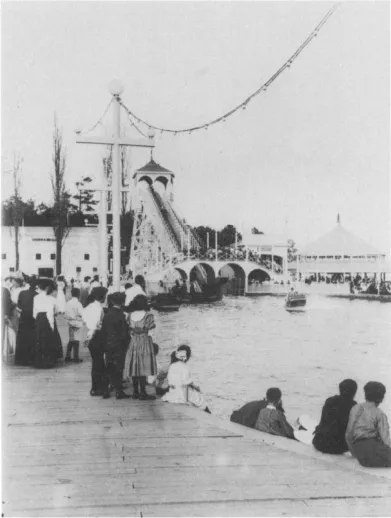
Figure l.l “Shooting the Chutes”: Scarboro Beach Amusement Park, 1907.
Source: Courtesy of City of Toronto Archives, The James Collection (no. 162).
1
“AT PRICES ALL CAN AFFORD”
The “golden age” of popular urban entertainment in America
In 1904, the Times Building, situated in the heart of the rapidly developing Times Square district of Manhattan, New York, was completed. In celebration, New York Times owner Adolph Ochs orchestrated a New Years Eve party on a scale not previously seen in America's largest metropolis.
At dusk, the streets around Times Square were crowded, and by nine o'clock the Square itself was jammed with partygoers. By ten o'clock, every restaurant on Upper Broadway was full and fashionably dressed men and women were being turned away, despite, in some cases, the offer of substantial sums of money to the doormen. At eleven o'clock, Fanciulli's Concert Band, featured performers at the 1904 St Louis World's Fair, filed into a makeshift bandstand along 43rd Street and started up a program which lasted into the small hours of the morning. “Broadway,” the Times correspondent marveled, “seemed the thoroughfare to which all faces were turned and about every man, woman and child who put foot upon the Street at one time or another during the evening visited Times Square.”
On the stroke of midnight, a cluster of fireworks was launched 1,000 feet into the air illuminating the sky. A deafening shout rose up from the crowd accompanied by an ear-splitting blast from hundreds of party horns. This was echoed by the sound of factory, locomotive and steamship whistles welcoming in 1905. “Never was a New Year's Eve more joyously celebrated.”1
The year 1905 was an early peak in what has come to be regarded as the “golden age” of popular urban entertainment in America. In the thirty-five years between 1895 and 1930, city life was transformed by the emergence of a new infrastructure of commercialized leisure: amusement parks, theaters, nightclubs and cabarets, baseball stadiums, ballrooms, burlesque houses, storefront nickelodeons and grand movie palaces. For the first time, historian David Nasaw observes, “the city was becoming as much a place of play as a place of work” (1993:9).
If you had traveled back in time a quarter century from this New Year's Eve celebration, you would have found a very different city and society. Rather than an apparent sense of common good fellowship, the world of leisure and entertainment in the nation's urban precincts reflected a class structure which had calcified after the Civil War. “The differences between mid-nineteenth century urban theaters,” muses cultural historian Robert Snyder,“increasingly expressed the social differences between New Yorkers, with drama and opera houses for the rich, cheap Bowery theaters for the poor, and foreign-language theaters for immigrants” (1989:5).
America's newly emerging industrial élite, having made their fortune from steel, railroads and banking, were anxious to create institutions and a lifestyle which would publicly proclaim their patrician taste and culture. One expression of this was the establishment of exclusive social clubs,2 from the downtown sanctuaries of Boston and New York where the members discussed politics, literature, science and technology over sumptuous meals, to the élite hunting and fishing associations which were the one indulgence the straight-laced “iron-makers” of Pittsburgh allowed themselves. The leading citizens in American cities further displayed their rank by financing a series of cultural institutions: the Boston Museum of Fine Arts (1870), the Metropolitan Museum of Art (1870), the Metropolitan Opera Company (1880). Less morally uplifting but also part of upper-class culture were the private gambling casinos, horse racing and college football games.
At the opposite end of the social spectrum was the leisure world of the industrial working class which revolved around two established institutions: the saloon and the cheap variety theater. In addition, popular amusements included restaurants, lecture halls and fraternal lodges, beer halls, billiard parlors, bowling alleys, picnic groves and pleasure gardens. Most of these were stratified by gender, being the sole preserve of men. Excluded from this “homosocial” network of leisure institutions, working-class women had a more circumscribed set of activities which largely centered round the family, church and neighborhood (Peiss 1986).
Virtual recluses from the recreational scene, the “respectable” middle-class shunned both the leisure pursuits of the élite and those of the working class. Instead, middle-class life was patterned by a reverence for quiet seclusion and privacy. It did, however, allow for family outings to libraries, concerts and travelogues and musicals sponsored by church-affiliated associations such as the YMCA (Nasaw 1993: 15).
Very few leisure and entertainment activities crossed class barriers. Some sporting events – trotting races, boating regattas – attracted a mixed crowd, but even then the more affluent patrons were careful to maintain their social distance from the “rabble” (Rosenzweig 1983: 68). Museums, the pride of the ruling class, were generally deemed “educational” and therefore acceptable places for the middle class to visit. On occasion the definition of what constituted a museum was stretched to include “freak shows” which had more in common with P.T. Barnum's circus than with the halls of learning. For the most part, however, it could be said that there was no public entertainment zone which spanned the social length of American society.
The commercialization of leisure
By the end of the nineteenth century, however, the situation had radically altered as a new commercial culture centered around leisure and entertainment established itself in urban areas– Its growth can be explained by a number of factors: more leisure time for workers; rising incomes; an expanding white-collar sector which included a considerable percentage of women; advances in technology, notably the electrification of street lights, trolley lines and advertising billboards; the growth of banks and financial institutions and the emergence of new sources of capital.
Merchants of leisure
Of particular note was the emergence of a cohort of entertainment entrepreneurs who had the vision and ability to raise capital in order to build an infrastructure of entertainment. Some of these “merchants of leisure” had made their fortune in other businesses, bringing money and know-how to the burgeoning public amusements industry. Marcus Loew, whose movie theater empire began with chains of nickelodeons and vaudeville houses had previously been a furrier, as had Adolph Zuker, a nickelodeon owner who formed Famous Players in 1912. Horace Bigelow, the “Great Amusement Caterer” of Worcester, Massachusetts, was already a wealthy boot and shoe manufacturer when he decided to transfer the techniques of mass production and vertical and horizontal integration to leisure-related enterprises (Rosenzweig 1983: 173). Henry Davis, who became Pittsburgh's leading vaudeville czar and who is generally credited with opening the first storefront nickelodeon theater there, was a high-profile real estate speculator who was the principal in purchases and sales of $2.5 million worth of downtown Pittsburgh property in 1905.3
Other merchants of leisure funded their entertainment ventures by soliciting funds from outside backers, some more respectable than others. Frederic A. Thompson and Elmer S. Dundy found the money to build Luna Park, Coney Island and the New York Hippodrome thanks to the United States Realty Company, a firm controlled by John W. “Bet a Million” Gates. Gates’ ventures into stock manipulation and trust-busting inspired the turn-of-the-century “robber barons” J. Pierpoint Morgan to warn that “the man cannot be entrusted with property” and Andrew Carnegie to declare “he's a broken-down gambler” (Wendt and Kogan 1948:10–11). The Shubert Brothers, whose Shubert Theatrical Corporation dominated legitimate theater venues in America up until the 1950s, were initially funded by George Cox, a saloonkeeper and real estate mogul who was the Republican boss of Cincinatti, and by Joseph L. Rhinock, a Kentucky congressman who had extensive race track interests and real estate holdings (Stagg 1968).
From 1906 onwards, a new, richer source of capital emerged in the form of investment banks such as Lehman Brothers and Goldman Sachs. Not only did they raise capital for mass market retailers such as Sears, Roebuck and Company but they also embraced the entertainment business, financing a variety of projects: theaters, electrical sign advertisements and even RKO (Radio-Victor-Keith Orpheum) one of the first full-service entertainment firms. Together with other brokers of the new corporate industrial order – public relations men and government information agents – for the first time these investment bankers created a national consumer market for the “culture of desire” that spun out across the country from urban entertainment districts such as Times Square (Leach 1991).
By the 1920s financing had expanded from the more adventuresome investment banks to financial houses of high standing such as Manufacturers Trust Company and the National Bank of Commerce. Thus, a prospectus prepared by the investment house of Halsey, Stuart & Co. in 19274 notes that “approximately $200,000 in motion picture securities have been financed through Wall and La Salle streets in the last twenty-four months.”
Creating a public culture
These new leisure merchants recognized early on the necessity of creating a public culture which was attractive, non-threatening and affordable in order to lure as wide a cross-section of society as possible. Vaudeville impresarios, for example, sought to actively reverse the fragmentation created by race, class, gender and ethnicity by pioneering a form of entertainment which would bring together people who expressed profoundly different ways of thinking and behaving. (Snyder 1989).
To do so required a sleight of hand worthy of a skilled illusionist. Increasingly, working people had money and free time but as a group on their own, they were seen as neither a reliable market nor one which was particularly profitable. The middle classes represented a more desirable clientele but, as we will see, they were deeply nervous of the blue-collar crowds which they believed were prone to drunkenness and rowdyism. In order to attract the former market without losing the latter, leisure entrepreneurs needed to convince less affluent patrons that they were being transported to magical realms (the amusement park, the movie palaces) beyond the orbit of everyday constraints of class and gender, and at the same time reassure bourgeois pleasure-seekers that these new public amusements were safe and physically and morally “clean.” To pull off this seemingly impossible task the merchants of leisure successfully constructed and marketed two concepts: “democracy's theater” and the “good-natured crowd.”
Democracy's theater
In a 1907 editorial in the trade magazine Moving Picture World, W. Stephen Bush rhapsodized that “the moving picture theater is not confined to any class or clique. The millionaire and the clerk, the laborer and the capitalist sit side by side and both find equal enjoyment in the pictures”.5 Similar comments were made in relation to amusement parks. Coney Island was depicted in the popular magazines of the day as “a mingling of individuals of all ranks and classes, college and factory workers dining next to each other, the disregarding of character or station, equality being taken for granted joyfully” (Weinstein 1992: 2). From 1900 to 1920, concludes Judith Adams, a present-day chronicler of the amusement park industry, Coney Island and other parks reflected the increased “democratic character” of society where “people of all classes, including the vast immigrant population could mingle with little regard for the strict social distinctions or mores of the time” (1991: 63). Baseball, fast becoming the most popular spectator sport at the turn of the century, also came to be regarded as symbolic of the democratic character of the emerging commercial culture. In his history of Shibe Park in Philadelphia, the first concrete and steel stadium to be built in America, Bruce Kuklick speculates that baseball “may have assisted in creating a mass democracy, eventually bringing social groups together.” One way this occurred, he suggests, is by popularizing so-called working-class attributes – informality, physical intimacy and the mixing of the sexes – among non-working-class baseball fans (1991: 47).
Are these commentators correct, did “democacy's theater” prevail? Not exactly. It's true that some leisure merchants attempted to project the idea that their facilities were open to everyone. In an advertisement for the soon-to-be-opened New York Hippodrome, promoters Thompson and Dundy proclaim themselves “Purveyors of Amusement for the Masses at Prices All Can Afford,” especially noting the availability of 1,500 seats in the Family Circle for twenty-five cents each.6 Motion picture kings, Balaban and Katz, explain in a 1925 issue of their Magazine that in their elaborate new movie palaces they had not “attempted to establish financial class distinctions, or to divide our auditoriums by means of reserved sections which seem to be more desirable and exclusive [because] the American people don't like this distinction.”7
Yet, at the same time, there is evidence to suggest that the lower strata of society were only admitted grudgingly to many of the new public amusement venues, and, as soon as it was financially feasible, were once again excluded. Movie entrepreneurs, for example, tested out the nickelodeon concept (i.e. five-cent storefront theaters) on less wealthy patrons, but soon abandoned them for a more selective middle-class audience who had a greater discretionary income and more leisure time (Gomery 1992: 29). Movie exhibitors, including those who were engaged in a rags-to-riches climb out of the ethnic slums, continually complained in trade journals, personal correspondence and Congressional testimony that nickelodeon audiences as a group were an albatross because they lacked “class” (Merritt 1976: 65–6).
Film scholars have expended some effort in using city and business directories to map out the growth of nickelodeons and movie theaters between 1905 and 1915 in various American urban locales. For the most part, their data suggest little evidence of any inclination to concentrate in working-class neighborhoods. Merritt (1976) discovered that Boston nickelodeons were located along busy main streets both downtown and in the surrounding residential communities of Dorchester, Roxbury, Cambridge, Sommerville, Newton, Belmont and Watertown. “No instance has been found,” he claims, “of a Boston movie theater opening between 1910 and 1914 in an area that could be described as a working-class community – Castle Square, the North End, the South End or North Roxbury” (p. 78).
Allen (1982) presents a detailed analysis of the location of motion picture exhibitors in Manhattan between 1906 and 1912. While few theaters were located in exclusively middle- and upper-class neighborhoods, neither were they found in the poorest areas. Rather, the major groupings of theaters were in traditional entertainment districts such as the Bowery and Union Square or in stable, high-density, ethnic neighborhoods such as Little Italy and Jewish Harlem.
From 1907, more and more entrepreneurs began to move away from storefront nickelodeons towards more elaborate and spacious middle-class theaters with mixed programs of film and vaudeville and, not incidentally, with higher prices. This did not eliminate working-class audiences but did limit their frequency of attendance.
But what of other venues beside movie theaters? Some – cabarets, roof-top theaters, restaurants with dance floors – traditionally had always been beyond the reach of the working class. Other venues deliberately discouraged grass-roots patronage. Professional baseball clubs restricted the number of bleacher seats; kept ticket prices high; and sc...
Table of contents
- Front Cover
- FANTASY CITY
- Title Page
- Copyright
- Dedication
- CONTENTS
- List of illustrations
- Preface and acknowledgements
- List of abbreviations
- Chronology of key events
- Introduction
- Part I Going out and staying in
- Part II Landscapes of pleasure
- Part III Entertaining developments
- Notes
- Bibliography
- Name index
- Subject index
Trusted by 375,005 students
Access to over 1.5 million titles for a fair monthly price.
Study more efficiently using our study tools.
Frequently asked questions
Yes, you can cancel anytime from the Subscription tab in your account settings on the Perlego website. Your subscription will stay active until the end of your current billing period. Learn how to cancel your subscription
No, books cannot be downloaded as external files, such as PDFs, for use outside of Perlego. However, you can download books within the Perlego app for offline reading on mobile or tablet. Learn how to download books offline
Perlego offers two plans: Essential and Complete
- Essential is ideal for learners and professionals who enjoy exploring a wide range of subjects. Access the Essential Library with 800,000+ trusted titles and best-sellers across business, personal growth, and the humanities. Includes unlimited reading time and Standard Read Aloud voice.
- Complete: Perfect for advanced learners and researchers needing full, unrestricted access. Unlock 1.5M+ books across hundreds of subjects, including academic and specialized titles. The Complete Plan also includes advanced features like Premium Read Aloud and Research Assistant.
We are an online textbook subscription service, where you can get access to an entire online library for less than the price of a single book per month. With over 1.5 million books across 990+ topics, we’ve got you covered! Learn about our mission
Look out for the read-aloud symbol on your next book to see if you can listen to it. The read-aloud tool reads text aloud for you, highlighting the text as it is being read. You can pause it, speed it up and slow it down. Learn more about Read Aloud
Yes! You can use the Perlego app on both iOS and Android devices to read anytime, anywhere — even offline. Perfect for commutes or when you’re on the go.
Please note we cannot support devices running on iOS 13 and Android 7 or earlier. Learn more about using the app
Please note we cannot support devices running on iOS 13 and Android 7 or earlier. Learn more about using the app
Yes, you can access Fantasy City by John Hannigan in PDF and/or ePUB format, as well as other popular books in Social Sciences & Human Geography. We have over 1.5 million books available in our catalogue for you to explore.