eBook - ePub
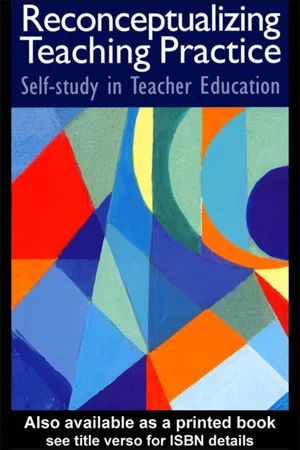
Reconceptualizing Teaching Practice
Developing Competence Through Self-Study
- 208 pages
- English
- ePUB (mobile friendly)
- Available on iOS & Android
eBook - ePub
About this book
Over the past ten years there has been increased interest in research on various aspects of teacher education, ranging from the preparation of teachers to continuing professional development. The increase of interest in how teachers become competent in very complex social settings is a result of a general recognition by researchers and policy makers alike that teachers are the key to any serious efforts at educational reform. This book addresses a variety of issues surrounding the field of inquiry into teaching practice that has become known as 'self-study', equivalent in many ways to the 'action research' movement, but at tertiary level.
Information
Topic
EducationSubtopic
Education GeneralPart I
Philosophical Perspectives
Introduction
Tom Russell
What is self-study? Where did it come from, and where is it going? To whom does it appeal, and why does teacher education in particular require an unusual and specialized term such as ‘self-study?’ In the chapters in this opening section, John Loughran, Jeff Northfield and Howard Smith write thoughtfully and perceptively about their experience of self-study. They draw conclusions from their experiences with a view to helping others engage in self-study, and their numbered lists of issues related to self-study and developing collective knowledge can be read as ‘guidelines’ for those embarking on self-study. One goal of this section overview, however, is to discourage reading these chapters solely for guidelines.
Teacher education is a uniquely perilous enterprise. In virtually all other domains of teaching, what one teaches and how one teaches are independent, although both ‘what’ and ‘how’ are relevant to the learning that results. But in teacher education, what and how we teach are interactive, and we ignore this interaction at our peril. Just as actions are said to speak louder than words, so how we teach may speak more loudly than what we teach. Teacher education is the easiest domain of teaching in which to experience one’s self as a ‘living contradiction’ (Whitehead, 1993).
For many reasons, rooted in culture and tradition, teacher education has seemed inattentive to the peril of the living contradiction, but those who partake of self-study seem captivated by it. This seems to tell us something about where self-study of teacher education practices came from and is going. There may still be some truth in the ‘Mickey Mouse’ characterizations of pre-service programs, and some teacher educators see self-study as one route out of that dilemma. While self-study may seem like a lonely and isolated activity, the Loughran-Northfield and Smith chapters indicate that it is quite the reverse. The goal is to turn the focus of inquiry on to the self, as expressed in the teaching activities of teacher education. This involves new forms of data-gathering and communication with the individuals one teaches, as one is teaching, and it also involves sharing with one’s teaching colleagues.
Refreshingly, the self-study field is new enough that there are no experts, and the field is likely to prosper and go further if it resists the tendency to see some people as experts simply because they began self-study earlier or appear to have written more about it. Who are the experts for the academic? What is to be gained by creating an uneven playing field? There is only one way to understand self-study, and that is to experience it personally.
In 1993, Hugh Munby and I began to talk about the ‘authority of experience’ to open up for each other a discussion about the ways in which personal experience can convey authority that might be contrasted with the authority of others’ experiences (‘Been there, done that—Do it my way’) or the authority of scholarly argument (‘Research shows that…’). At that time, our attention was on how new teachers learn from experience:
We use the term authority of experience because of our concern that students never master learning from experience during pre-service programs in a way that gives them direct access to nature of the authority of experience. If Schön is correct that there is a knowledge-in-action that cannot be fully expressed in propositions and that learning from experience has its own epistemology, then our concern is that learning from experience is never clearly contrasted with learning that can be expressed and conveyed in propositions. (Munby and Russell, 1994, p. 92)
Self-study is about the learning from experience that is embedded within teachers’ creating new experiences for themselves and those whom they teach. Like new teachers, teacher educators must learn to learn from experience and self-study is a way for teacher educators to do that. I invite readers to delve into these first two chapters by reading between the lines, listening for the original experiences of Loughran and Northfield and Smith. These chapters can and should be read for guidelines about self-study, but any such reading will be incomplete without also examining the experiences that support the conclusions. Then readers should create their own self-study exercises and activities, not alone but with students and colleagues. After focusing on one’s personal learning from self-study experiences, one is finally in a position to define self-study and to contribute to self-study by sharing the results with others. Our goal may well be the reinvention of learning to teach, enabling others to understand learning from experience by showing them how we do it ourselves.
References
MUNBY, H. and RUSSELL, T. (1994) “The authority of experience in learning to teach: Messages from a physics method class,” Journal of Teacher Education, 45, 2, pp. 86–95.
WHITEHEAD, J. (1993) The Growth of Educational Knowledge: Creating Your Own Living Educational Theories, Bournemouth: Hyde Publications.
1
A Framework for the Development of Self-study Practice
John Loughran and Jeff Northfield
Introduction
Interest in self-study is increasing as many teacher educators review the manner in which teaching about teaching is carried out in schools and faculties of education. This questioning arises, in part, from an increased desire and corresponding need by teacher educators to ensure that their teaching practice is congruent with the expectations they have of their student-teachers’ developing practice. Hence, the growing need for teacher educators to ‘practise what they preach’.
Reflection on practice and self-study are becoming important components of the push for closer scrutiny of an individual’s pedagogy in teaching about teaching, and they are linked to ideas about the development of knowledge through better understanding of personal experience. Studying one’s own practice sometimes leads to what Whitehead (1993) describes as ‘experiencing yourself as a living contradiction’ (p. 8).
Such an interpretation hinges on the understanding and recognition that ideas and aspirations may not be matched by teaching practices. In self-study, recognizing the dissonance between beliefs and practice is fundamental to action. While it is important to attend to experiencing self as a living contradiction, it may be equally important to include others in the interpretation of and response to the contradiction. While the term ‘self-study’ suggests an individual approach, attempting to better align beliefs and practice solely from an individual perspective may be a significant paradox within the term ‘self-study’.
In this chapter, we contend that it is working with an important ‘other’ that matters. Otherwise, self-study may simply be seen as rationalizing or justifying one’s actions or frames of reference. We argue that if self-study is to lead to genuine reframing (Schön, 1983) of a situation so that learning and understanding through reflection might be enhanced, then the self in self-study cannot be solely individual. The experience of an individual is the focus of the study but the individual need not be, and should not be, the sole participant in the process. The way self-study has come to be characterized, and some of the associated concerns surrounding its practice, are important in understanding how self-study might be better recognized and defined in practice.
The idea of self-study has evolved from several significant educational perspectives. In some ways, self-study appears to be related to the development of Schön’s (1983) ideas about reflection on practice. For example, Munby and Russell (1994) have developed Schön’s ideas to highlight the ‘authority of experience’ as a key to the way teachers may better understand teaching and learning. Furthermore, there is no educational change without ‘people’ change. By focusing on personal practice and experience, teachers may undertake genuine inquiry that leads to a better understanding of the complexities of teaching and learning.
Self-study may be defined as a participant study of experience and it has therefore inevitably been queried as a form of research. Thus, questions are rightly raised such as, ‘Is the outcome of a self-study merely personal reflections, or does self-study aspire to generalizable forms of knowledge?’ are rightly raised. There appear to be at least three responses to this question. The first explores the relationship between two ways of gaining knowledge about educational practice. Richardson (1994) distinguishes between two forms of research on practice: formal research and practical inquiry. We would suggest that self-study is an important form of practical inquiry. Richardson argues that, ‘Both forms…may be conducted by the practitioner, and at times, practical inquiry may be turned into formal research… One could suggest, then, that practical inquiry may be foundational to formal research that will be truly useful in improving practice’ (pp. 7–8).
A second response, from which some debate has developed, has been to argue that participant research has unique features that deserve acknowledgment and recognition as a distinct genre of research (Wong, 1995; Baumann, 1996; Northfield, 1996). A third response is to learn from observing the professional development that occurs when practitioners gain the confidence and skills to reframe and reflect on their experiences. Self-study is thus seen as an indication that a professional is willing to accept that experience is a major source of improvement in personal practice. This type of professional development has been well documented in the PEEL project (Baird and Mitchell, 1986; Baird and Northfield, 1992) and demonstrates how important such experiences are in the lives of schoolteachers. We believe that a similar situation also exists for teacher educators.
Encouragement of self-study thus becomes an option for all those committed to the improvement of professional practice. In fact, self-study may be one way of helping teacher educators grasp the sense of excitement in their teaching in teacher education programs that Tom (1996) describes as generally lacking due to the ‘external forces which sustain mundane and unimaginative teacher education…[and] underlying beliefs which deter teacher educators from questioning the traditional content and structure of our field’ (p. 19). The recent growth of interest and practice in self-study certainly addresses Tom’s (1996) assertions.
Questioning the theoretical underpinnings of a practical venture in self-study is both important and necessary as teacher educators attempt to address their pedagogical concerns in order to maintain the spark that is so important for teaching and learning about teaching. Such questioning is vital to teacher education if the importance of the knowledge base for learning about teaching is to be recognized and valued in the educational community, particularly so in terms of better articulating the pedagogy of teacher educators. The need for such recognition and articulation prompted recent collections by Russell and Korthagen (1995) and Loughran and Russell (1997), in which the need to highlight teacher education practices is portrayed as a crucial issue for schools and faculties of education.
Opening the Classroom Door: A Case Study of Self-study
This chapter builds on what we have learnt in a self-study of Jeff Northfield’s experiences during a one-year teaching allotment in a secondary school where he taught mathematics and science and was the Home Group teacher for one class of students in their first year of secondary school (Year 7). At the same time, he was the Director of Pre-service Education in the Faculty of Education at Monash University, an academic role with administrating, teaching and research responsibilities in teacher education, teaching and learning.
In some ways, Jeff’s return to teaching can be seen as a teacher educator trying to regain some of the important contact with schools, and with the teaching role within that context, that are so easily lost (or at least diminished) through the demands of an academic appointment. (See Russell, 1995, for a similar return to teaching by a teacher educator.) The desire to reacquaint himself with schools was important for many reasons, both professional and personal. At the forefront of his thinking was the value of ‘recent and relevant’ experience. Such recent and relevant experience was an important pragmatic response to his professional concerns for his own teaching in the preparation of the young teachers for whom he was responsible in the Teacher Education program at Monash University. There was also a desire to share the excitement of teachers (such as those in the PEEL project, as described in Baird and Mitchell, 1986, and Baird and Northfield, 1992) who appeared to be making a difference in classrooms as they worked to teach in ways that helped their students learn for understanding. This approach to teaching and learning was at the heart of the teaching approaches espoused in the teacher education program. Thus, Jeff’s desire to teach in a school was one way of attempting to better understand the strategies he was urging his students to use in their school teaching experiences. Finally, there was perhaps also a yearning for the pleasant memories of teaching associated with those times from much earlier in his teaching career. Therefore, an opportunity for a self-study was a real possibility. The complexities of teaching, learning, personal and professional beliefs and practice would be more available in a real context rather than in a contrived situation.
During his year teaching 7D, Jeff kept a daily journal of his teaching activities, including descriptions, reactions and interpretations associated with his teaching and his students’ learning. The journal was an important part of Jeff’s self-study of his teaching experience and he used it both to document and to reflect on his experiences as he attempted to teach his students in a manner that would encourage them to learn for understanding. In this return to secondary school teaching, ‘Jeff the researcher’ became ‘Jeff the practitioner’ and worked from a self-study/practical research perspective through to a more formal, more widely available and accessible research knowledge as documented in Loughran and Northfield (1996).
Opening the Classroom Door draws on three main data sources: Jeff’s daily journal, interviews conducted by Carol Jones with twenty-two of the students in the class, and student writing (from both regular classroom tasks and specific responses to classroom experiences). It is noteworthy that Jeff’s journal was also read by some of the teachers in the school and provided a stimulus for extended discussions about students, teaching and learning. Subsequent discussions with interested staff provided opportunities for reframing situations and experiences that could well have been missed or overlooked if the journal had remained a personal ‘closed’ book. At the end of the year, when Jeff reviewed the journal, he developed twenty-four theme statements about teaching and learning, which were in essence the culmination of a year’s self-study. The theme statements were grouped under five headings:
- Nature of learning
- Creating conditions for learning
- Student perspectives on learning
- Process of teaching and learning
- Overall reactions to the experience
Each statement summarized significant experiences and suggested possible interpretations of important issues related to teaching and learning. Yet this alone is not the extent of the self-study, nor is it alone what we would argue defines self-study.
Throughout Jeff’s year in the classroom, an important ‘other’ was involved. Carol Jones, a research assistant and an experienced teacher, spent time in Jeff’s classes observing his teaching. She also worked with and interviewed...
Table of contents
- Cover Page
- Title Page
- Copyright Page
- List of Tables and Figures
- Preface
- Foreword: Looking Forward: The Concluding Remarks at the Castle Conference
- Introduction: Reconceptualizing Teaching Practice
- Part I: Philosophical Perspectives
- Part II: Methodological Perspectives
- Part III: Case Studies of Individual Self-study
- Part IV: Case Studies of Collaborative Self-study
- Part V: Processes and Practices of Self-study
- Conclusion: The Value and the Promise of Self-study
- Afterword
- Notes on Contributors
Trusted by 375,005 students
Access to over 1.5 million titles for a fair monthly price.
Study more efficiently using our study tools.
Frequently asked questions
Yes, you can cancel anytime from the Subscription tab in your account settings on the Perlego website. Your subscription will stay active until the end of your current billing period. Learn how to cancel your subscription
No, books cannot be downloaded as external files, such as PDFs, for use outside of Perlego. However, you can download books within the Perlego app for offline reading on mobile or tablet. Learn how to download books offline
Perlego offers two plans: Essential and Complete
- Essential is ideal for learners and professionals who enjoy exploring a wide range of subjects. Access the Essential Library with 800,000+ trusted titles and best-sellers across business, personal growth, and the humanities. Includes unlimited reading time and Standard Read Aloud voice.
- Complete: Perfect for advanced learners and researchers needing full, unrestricted access. Unlock 1.5M+ books across hundreds of subjects, including academic and specialized titles. The Complete Plan also includes advanced features like Premium Read Aloud and Research Assistant.
We are an online textbook subscription service, where you can get access to an entire online library for less than the price of a single book per month. With over 1.5 million books across 990+ topics, we’ve got you covered! Learn about our mission
Look out for the read-aloud symbol on your next book to see if you can listen to it. The read-aloud tool reads text aloud for you, highlighting the text as it is being read. You can pause it, speed it up and slow it down. Learn more about Read Aloud
Yes! You can use the Perlego app on both iOS and Android devices to read anytime, anywhere — even offline. Perfect for commutes or when you’re on the go.
Please note we cannot support devices running on iOS 13 and Android 7 or earlier. Learn more about using the app
Please note we cannot support devices running on iOS 13 and Android 7 or earlier. Learn more about using the app
Yes, you can access Reconceptualizing Teaching Practice by Mary Lynn Hamilton in PDF and/or ePUB format, as well as other popular books in Education & Education General. We have over 1.5 million books available in our catalogue for you to explore.