- 220 pages
- English
- ePUB (mobile friendly)
- Available on iOS & Android
eBook - ePub
Remote Sensing of the Mine Environment
About this book
A guide for students and professionals, this introductory course book covers the basic principles of remote sensing and its applications in mine environment monitoring. Building from a reader's basic knowledge of mine monitoring, it teaches how to implement remote sensing techniques and how to interpret the acquired data for different purposes. Fol
Information
Chapter 1

Introduction
Extraction of mineral resources in a sustainable framework is vital for the welfare of human beings. The mining industry has ever been perceived negatively due to its impacts on land, water, and air at local, regional, and global levels. Minimizing the footprint of mining activities and the shift of current mining practices to a sustainable mining are key drivers towards mine environment monitoring. In this sense, remote sensing plays a significant role in mine monitoring to sustain safe and effective operations and mitigate the risks associated with them.
1.1 SUSTAINABILITY IN MINING
Increasing world population growth rate yields rising demand for finite natural resources. This results in accelerating depletion of non-renewable natural resources and makes human sustainability dubious. Public awareness and sensitivity related to environmental issues and use of scarce resources have led to sustainable development emerging as one of the major global issues since the 1980s. Sustainable development was first defined in 1987 by the Brundtland Commission of the United Nations as meeting the requirements of the present generations without compromising the ability of future generations to meet their own needs (UNGA, 1987). It was also defined as sustaining and improving living standards within a given carrying capacity of supporting eco-systems. This can only be achieved by meeting environmental, social, and economical demands concurrently (UNGA, 2005).
Sustainability concepts in mining industry are a rather more complex and controversial issue. It is argued that mining cannot truly be sustainable due to finite mineral resources. In contrast, the mining industry rejected the perception of finite mineral resources due to the discoveries of new deposits and improved technological facilities that allow mining of ore reserves, which were uneconomical in the past due to their depth, grade or other challenging factors. A growing public pressure and awareness compels the mining industry to address the issue of sustainability and to extract mineral resources within a sustainable development framework. The International Council on Mining and Metals has developed a sustainable development framework by defining a set of principles since 2001. These principles, also called The 10 principles, required to be implemented for sustainable mining, are given by ICMM (2003):
- Implement and maintain ethical business practices and sound systems of corporate governance.
- Integrate sustainable development considerations within the corporate decision-making process.
- Uphold fundamental human rights and respect cultures, customs, and values in dealing with employees and others who are affected by mining activities.
- Implement risk management strategies based on valid data and sound science.
- Seek continual improvement of public health and safety performance.
- Seek continual improvement of environmental performance of mining.
- Contribute to conservation of biodiversity and develop integrated approaches to land use planning.
- Facilitate and encourage responsible product design, use, re-use, recycling, and disposal of products during mining.
- Contribute to the social, economic, and institutional development of the communities around mining activities.
- Implement effective and transparent engagement, communication and independently verified reporting arrangements with the stakeholders.
The 10 principles in fact address the three aspects of sustainability associated with mining activities as issues related to business (principles 1–3), environment (principles 4–8) and society (9–10). Essentially, sustainable development in mining industry requires consideration of declining mineral and energy resources, ore grades and recovery factors, available resources, risks, and environmental and social impacts of mining and post-mining activities (Mudd, 2007). For addressing these issues and assessing sustainability of mining industry in a factual manner, extensive data about ore grades, production rates, economic benefits, environmental burdens etc. and their systematic analysis are required. In this regard, environmental monitoring of mining activities is vital to sustainable mining practices, especially for providing safe and improved mine environments as indicated in principles 5 and 6. Systematical monitoring and assessing the impacts of mining is also crucial for investigating biodiversity conservation and developing integrated land use planning methodologies, as addressed in principle 7. Therefore, a continuous monitoring framework for the mine environment can help in sustaining the mining industry as well as the development of society. The mine environment does not only cover the area of land where mining is practiced, but also involves the surrounding environment, which is larger than the licensed mining site. As mining can have impacts to the upstream and/or downstream environment, mine environmental monitoring should cover a relatively larger land-surface than the actual area of the mine, and this is where remote sensing provides cost-effective solutions.
1.2 ENVIRONMENTAL IMPACTS OF MINING
Mining inherently causes various environmental challenges ranging from land disturbance, to water and air pollution. These challenges might potentially affect the living standards of people, habitat, and overall environment in a local, regional or global scale if not managed well (Figure 1.1). The impacts of mining activities can be grouped into three main categories according to the level of affected environmental components as (i) land, (ii) water, and (iii) air disturbances. The type and magnitude of these disturbances change depending on the mine size, amount of the production, type of mining method, and the lifespan of the mine.
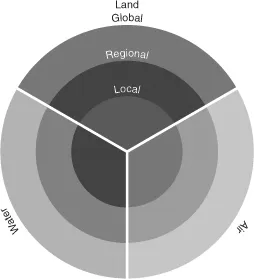
Figure 1.1 Classification of mining impacts and their extension (See color plate section)
Land disturbances
Geographical location and areal extension of mineral deposits are not controllable and mining takes place where the mineral deposits are found. Mining activities generally impose intensive land use change during exploration, development, and production stages, thus land disturbances become a principal consequence of mining. The magnitude of this disturbance depends upon the areal extent and depth of the ore deposit, and the type of mining method.
In surface mining, large volumes of overburden material are excavated and removed from one place to another causing continuous change in topography with time. Large amounts of rock and ore are stripped and stored, which consequently creates huge holes and piles in the landscape and leaves “scars” on the Earth surface (Figure 1.2). Removing top soil, which is an essential step to access and to strip overburden rock material, may result in displacement of soil, change in biodiversity, deforestation, and reduction of agricultural areas, disturbance of local water resources due to change in catchments areas and destruction of stream networks.
In addition to the land disturbance, large-scale surface mining operations can cause considerable amounts of deforestation due to the construction of the infrastructure of the mine. Another significant impact of mining activities on land is soil erosion. Although soil erosion is a natural process, mining activities can accelerate this process, the most erodible material, from one place to another when it is not removed and stored carefully. The fine sediments from the overburden dump site may be transported into the water resources after heavy rainfall.
When compared to surface mining, underground mining has less impact on land. However, mine subsidence can be a critical issue with certain underground mining methods such as longwall mining, caving methods etc., due to the removal of ore and distraction of the natural stress state of the rock strata. As a result, the ground level lowers and surface topography changes. The land disturbance due to subsidence occurs especially in longwall coal mining as this mining method relies on excavating the coal and leaving the rock on top of the coal to cavein. In order to quantify the effects of underground mining in a particular region, a thorough understanding of subsidence patterns should be achieved.
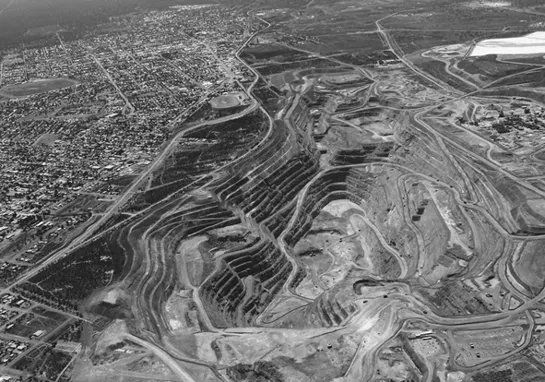
Figure 1.2 Aerial view of an open pit mine (Source: KCGM web site, http://www.superpit.com.au/PhotoLibrary/OpenPit/tabid/176/
Default.aspx, with the permission of KCGM) (See color plate section)
Default.aspx, with the permission of KCGM) (See color plate section)
In addition to the physical disturbance of the land in the mine site, mining activities can create chemical disturbance of the land mainly by soil pollution. The major causes of the soil pollution are:
- Acid rock/mine drainage,
- Contamination by heavy metal and leaching,
- Pollution by chemicals used for mineral processing and mine workshops.
The details of these pollution sources are explained in the water disturbance part, which also has implications for soil pollution.
Water disturbances
Considering the nature of the work and scale of operations, mining activities could also be one of the threats for water resources which are the critical and vital resource for human beings and habitat. The main impacts of mining on water resources are significant use of fresh water in mineral processing, and water pollution from discharged mine effluent and seepage from tailings and waste rock impoundments. Land disturbance also induces water disturbances. The change in surface water drainage networks due to land disturbance results in decreased catchment areas. In addition, land disturbance by deforestation, removal of top soil, dumping of overburden, etc. cause erosion by increasing the sediment load to the water resources. The impacts of water disturbance induced by land disturbance usually emerge over relatively long time periods. On the other hand, water disturbance due to mining activities on the water quality materializes in a relatively short period of time and can be hazardous to the habitat and environment. There are four main types of mining impacts on water quality. They are briefly described as follows:
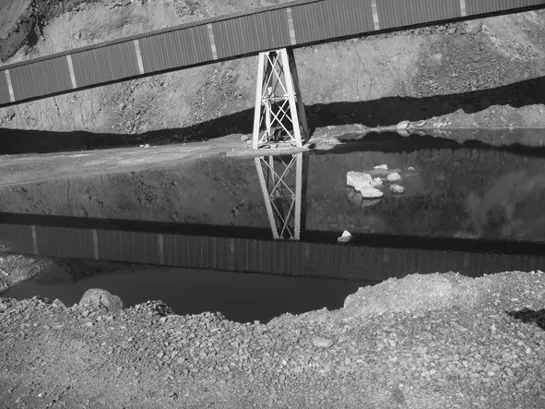
Figure 1.3 Acid mine drainage in an open pit copper mine (See color plate section)
- Acid Mine Drainage (AMD): Acid mine drainage (AMD) is one of the most severe environmental impacts of mining. It can be described as a natural process in which sulphuric acid and ferrous ions are produced when sulphides in rocks, like pyrite, react with air and water and oxidize (Figure 1.3). Therefore, AMD is mostly observed in mines where a large amount of rock, containing sulphide minerals, is exploited. The acidity of the environment increases when ferrous ions are oxidized and produce a hydrated iron oxide (Sengupta, 1993). Sengupta (1993) stated that a ton of coal containing one percent pyritic sulphur has the potential of producing 15 kilograms of hydrated iron oxide and around 25–30 kilograms of sulphuric acid. The acidic water body with a low pH creates a corrosive environment and cannot support the aquatic life. Acid mine drainage occurs as long as the source rock is exposed to air and water and until the sulphides are leached out. This acid leaching process occurs by rainwater or surface drainage and acidic water being carried to the streams, rivers, lakes, and groundwater. AMD could be a persistent environmental problem that must be monitored and controlled continuously. Figure 1.3 shows an example of acid mine drainage from a copper mine, where a small pond under the conveyor belt is formed by the collection of acidic surface water in the mine’s dump site. Figure 1.4 is another example of AMD, where groundwater coming from the abandoned galleries of an underground coal mine is discharging to a ditch next to an old mine road.
- Heavy Metal Contamination: Heavy metal contamination is another important environmental impact of mining for mines of heavy metal containing rocks. It is caused when heavy metals such as arsenic, cobalt, copper, cadmium, lead, silver, and zinc react with acidic water. Me...
Table of contents
- Cover
- Dedication
- Title Page
- Copyright
- Contents
- Preface
- About the Authors
- Chapter 1 Introduction
- Chapter 2 Principles of remote sensing
- Chapter 3 Remote sensing image analysis techniques
- Chapter 4 Remote sensing in subsidence monitoring
- Chapter 5 Remote sensing in slope stability monitoring
- Chapter 6 Remote sensing in mine reclamation
- Appendix
- Subject Index
- Color plates
Trusted by 375,005 students
Access to over 1.5 million titles for a fair monthly price.
Study more efficiently using our study tools.
Frequently asked questions
Yes, you can cancel anytime from the Subscription tab in your account settings on the Perlego website. Your subscription will stay active until the end of your current billing period. Learn how to cancel your subscription
No, books cannot be downloaded as external files, such as PDFs, for use outside of Perlego. However, you can download books within the Perlego app for offline reading on mobile or tablet. Learn how to download books offline
Perlego offers two plans: Essential and Complete
- Essential is ideal for learners and professionals who enjoy exploring a wide range of subjects. Access the Essential Library with 800,000+ trusted titles and best-sellers across business, personal growth, and the humanities. Includes unlimited reading time and Standard Read Aloud voice.
- Complete: Perfect for advanced learners and researchers needing full, unrestricted access. Unlock 1.5M+ books across hundreds of subjects, including academic and specialized titles. The Complete Plan also includes advanced features like Premium Read Aloud and Research Assistant.
We are an online textbook subscription service, where you can get access to an entire online library for less than the price of a single book per month. With over 1.5 million books across 990+ topics, we’ve got you covered! Learn about our mission
Look out for the read-aloud symbol on your next book to see if you can listen to it. The read-aloud tool reads text aloud for you, highlighting the text as it is being read. You can pause it, speed it up and slow it down. Learn more about Read Aloud
Yes! You can use the Perlego app on both iOS and Android devices to read anytime, anywhere — even offline. Perfect for commutes or when you’re on the go.
Please note we cannot support devices running on iOS 13 and Android 7 or earlier. Learn more about using the app
Please note we cannot support devices running on iOS 13 and Android 7 or earlier. Learn more about using the app
Yes, you can access Remote Sensing of the Mine Environment by Nuray Demirel,H. Sebnem Düzgün,H. Şebnem Düzgün in PDF and/or ePUB format, as well as other popular books in Technik & Maschinenbau & Ökologie. We have over 1.5 million books available in our catalogue for you to explore.