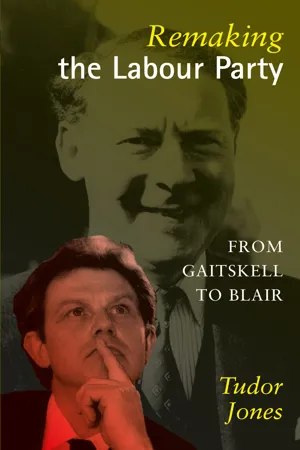
Remaking the Labour Party examines the development of revisionist thought in the Labour Party from the 1950s up to Tony Blair's successful attempt to rewrite Clause Four in April 1995. The main focus is upon the most distinctive and controversial aspect of Labour revisionism - its attitude toward public ownership and socialism, private ownership and the mixed economy.
Remaking the Labour Party comprises a detailed study of a process of ideological conflict which began with the Labour Party's debate in the 1950s over the link between public ownership and socialism. The deepening confrontation that arose from the revisionist thinking of Crosland and Gaitskell is explored in the Clause Four controversy of 1959-60 and in the uneasy compromise forged in its aftermath. The period of ideological truce under Harold Wilson's leadership is examined, together with the bitter conflict that later resurfaced in the party during the 1970s and early 80s. Finally, the study focuses on the second stage of Labour's policy and ideological rethinking which developed after 1983 under the leadership first of Neil Kinnock and then of Tony Blair.
Drwing on the author's own interviews with some of the leading protagonists of the debate, as well as upon a wide range of primary and secondary sources, Remaking the Labour Party will be of value to students of modern British politics and political thought, it will also be of interest to observers and members of the Labour Party.
- 208 pages
- English
- ePUB (mobile friendly)
- Available on iOS & Android
eBook - ePub
About this book
Information
1
Labour, public ownership and socialist myth
I
During the course of the Labour Party’s maturation as a political force, the idea of public ownership has been widely regarded as an enduring symbol of its socialist commitment. Nearly sixty years after Labour’s foundation, Emanuel Shinwell, formerly Minister of Fuel and Power in its first majority government, could thus maintain, at the 1957 Labour Party Conference in Brighton, that he was defending ‘the vital principles upon which this Party is based’.1 These, he believed, were being threatened by some controversial proposals in Industry and Society, the new Party policy statement that was then under debate. In opposing those proposals, Shinwell claimed that he was reaffirming Labour’s historic commitment to the public ownership of the means of production. Yet his firm conviction obscured a fundamental and contentious issue—the status of public ownership, both as an idea and as a policy, within the Party’s ideology and programmes.
An examination of the period of the Labour Party’s infancy—from 1900 until the First World War—provides, it must be said, only limited evidence in support of Shinwell’s view of public ownership as a’vital principle’ of the Party. As a political idea it had, admittedly, become established in the 1880s and 1890s as a central strand of British socialist thought. Furthermore, as Morgan has maintained,
At least as an aspiration, the public ownership of major industries, utilities and natural resources was inseparable from the socialist idea in Britain from the foundation of Keir Hardie’s Independent Labour Party in 1893 down to the Second World War.2
Indeed, the ideal of widespread public ownership manifestly formed ‘the jewel in the crown for dedicated socialists, Marxists and non-Marxists alike’.3 The belief, however, that public ownership constituted a fundamental principle of the Party from its very foundation has usually involved ascribing to Labour, even in its infancy, a distinctively socialist character. In opposition to such an interpretation many political historians have concurred with Crick’s observation that within Labour’s loose coalition of ideas and interests,
socialism itself, except in a very broad sense, is only one element in this coalition…certainly subsidiary, in both electoral and historical terms, to the Labour Party as the representative of organized labour.4
Various traditions of political thought can certainly be identified as influences upon the early Labour Party—among them radical or social liberalism, Victorian ethical reformism, the evolutionary socialist ideas of the Fabian Society and the Independent Labour Party (ILP), and the attitudes of British labourism. All of these helped to shape the Party’s policies, priorities and character. With some justification, therefore, Labour’s political thought, throughout the course of its development, has been described as an intellectual stockpot,5 with old and new ingredients mixed together in an often haphazard manner.
Any analysis of Labour’s early character which attaches primary importance to the influence of socialist ideas consequently seems misconceived. Similarly flawed are historical accounts that seek to emphasize a set of fundamental socialist principles, clearly distinguishable from social liberal beliefs, to which Labour’s earliest supporters were allegedly committed. For, partly as a result of enduring liberal influences, a climate existed in which, as Bealey observed, ‘the socialist society of the future was not a keen matter of debate at official levels of the Labour Party before 1914’.6
As Labour gradually emerged from 1915 onwards as a distinct national party, Ramsay MacDonald’s flexible form of socialism was assuming greater prominence.7 But it was not until the movement towards parliamentary and electoral independence was well under way—that is, after 1918—that socialist ideas such as public ownership occupied the central position in Labour thinking later accorded to them by their most fervent advocates.
Nevertheless, public ownership itself had still been regarded by a section of the pre-1914 Labour Party as a central tenet of socialism. Such a view was already entrenched in a long tradition of socialist thought. As Pelling has pointed out,
Socialists of the late nineteenth and early twentieth centuries have almost all been committed to the aim of public ownership, in one form or another, of the means of production, distribution and exchange.8
That aim had been pursued since the 1880s in a stream of books, pamphlets, articles and speeches. The Fabians in their programme of 1887 thus sought to achieve ‘the reorganisation of Society by the emancipation of Land and Industrial Capital from individual and class ownership, and the vesting of them in the community for the general benefit’.9 A few years later Sidney Webb restated the Fabian belief that ‘the main principle of reform must be the substitution of Collective Ownership and Control for Individual Private Property in the means of production’.10 These sentiments were endorsed by the Independent Labour Party at its inaugural conference in 1893 when it announced that its central objective was ‘to secure the collective ownership of all the means of production, distribution and exchange’.11
On the level of policy-making public ownership had also been advocated during this period within the developing trade union movement. In 1887 Keir Hardie, then a Scottish miners’ leader, had called for the nationalization of mines, railways, minerals and land.12 His demands found widespread support at the Trade Union Congress (TUC), where, from the 1890s onwards, his list of suitable candidates for state ownership was defended and even extended in a series of resolutions. It was not, however, until 1908 that a specific policy commitment—involving the railways—was approved by the Labour Party Conference. Further commitments, concerning the waterways and coal mines, were undertaken by the Party in 1910 and 1912.
Closer scrutiny of this new policy orientation on Labour’s part suggests a pragmatic rather than doctrinal motivation; for the most insistent pressures for public ownership of the railways and coal mines emanated from the railywaymen’s and miners’ unions. It was their demands for improved wages, hours and working conditions that intensified those pressures.13 Viewed from this perspective, public ownership could be seen as another aspect of the early Labour Party’s ‘politics of interest’.14 Its endorsement by the Party could thus be regarded as a development of the policy of redressing various trade union grievances that was sedulously pursued from 1906 to 1914.
Any interpretation, however, of Labour’s early commitment to public ownership which overlooks doctrinal factors appears inadequate. While attitudes towards that policy were shaped from the start by hard practical considerations, they also reflected current trends in political thought. They could be broadly related, for instance, to New Liberal ideas, with their emphasis on a more interventionist, enabling State. They were connected, too, with arguments advanced by socialist trade unionists within the TUC. Indeed, in the specific case of the proposal to nationalize the coal mines, it has been argued that that policy was ‘put forward in the early days as part and parcel of the general Socialist programme, and not on the ground that mining was in a special position in relation to the British economy’.15
But in spite of the growing force of socialist arguments within the Labour Party and the TUC, there seems little justification for interpreting this as firm evidence that before 1914 Labour was either abandoning social liberal ideas or embracing a coherent socialist ideology. In its infancy the Party continued to lack a distinctive socialist identity. It remained, in MacDonald’s description, a ‘socialistic’ party, subject to strong social liberal and other non-socialist influences. Its early policy commitments and priorities were not, therefore, anchored to clearly articulated socialist ideas such as public ownership. That ideological link was not to be forged until the end of the Great War.
The year 1918 has been widely regarded as a watershed in the history of the Labour Party since it brought two major new developments. First, the Annual Conference adopted in February 1918 a new Party constitution and organizational structure. Second, a further Conference, held in June 1918, officially accepted a new policy statement, drafted by the leading Fabian theorist Sidney Webb and entitled Labour and the New Social Order.
The new Constitution contained among other things an outline of the ‘Party Objects’, which included a brief statement, again largely drafted by Webb, of Labour’s general domestic purpose. Set out in what later became known as Clause IV, Part Four, this committed the Party
To secure for the workers by hand or by brain the full fruits of their industry, and the most equitable distribution thereof that may be possible, upon the basis of the common ownership of the means of production and the best obtainable system of popular administration and control of each industry or service.16
The second innovation of 1918, the acceptance of Labour and the New Social Order, involved the publication of the Party’s first extended statement of aims, including recommendations for minimum living standards (a ‘National Minimum’, in Webb’s phrase) and for an expansion of social services to be financed through the combined effects of direct taxation and nationalization of industry.
The immediate political significance of ‘Labour and the New Social Order’ has aroused conflicting judgements.17 Its ideological importance, however, as well as that of Clause IV of the new Constitution, has been widely recognized by political historians. Egon Wertheimer claimed that Labour’s documents marked the Party’s transition ‘from social reform to socialism’,18 while, in G.D.H.Cole’s view, they ‘unequivocally committed the Labour Party to Socialist objectives in the sense in which Socialism had been advocated by the Fabian Society and by other “evolutionary” Socialists’.19 Bealey pointed out that Labour and the New Social Order is ‘usually regarded as the first official acceptance by the Labour Party that it was a Socialist party’,20 while Pelling maintained that Clause IV ‘for the first time explicitly committed the party to a Socialist basis’.21 In similar terms, Beer regarded the 1918 pronouncements as indications of ‘a basic change in ideology’ that involved a movement away from radical Liberalism towards acceptance of ‘the comprehensive ideology of Socialism’.22 Once those formal commitments had been made by the Party, it was thereafter ‘accepted and official usage to say that its ultimate aim was a new social order, the Socialist Commonwealth’.23 Even Miliband, who judged Labour and the New Social Order to be devoid of any serious socialist intent, acknowledged that the document at least served notice ‘that Labour had finally done with its own version of Liberalism’.24
Labour and the New Social Order did indeed underline the Party’s break with Liberal reformism, as well as its commitment to the transformation of British society. The document thus declared that ‘what has to be reconstructed after the war is not this or that Government Department, or this or that piece of machinery, but, so far as Britain is concerned, society itself.25 One of the major instruments of social reconstruction and one of the central ‘pillars’ of the new society was identified as ‘the Democratic Control of Industry’.26 The new social order would be characterized by ‘a genuinely scientific reorganization of the nation’s industry, no longer deflected by industrial profiteering, on the basis of the Common Ownership of the Means of Production1’.27
This vision of a transformed economy had also been projected in Clause IV of the new Party Constitution adopted in February 1918. Establishing public ownership at the forefront of Labour policy, Clause IV provided the only specific reference to the Party’s domestic aims to be found in the new Constitution. The Clause’s prominence thereby conferred on itself ideological significance, providing a formal recognition of the socialist identity confirmed in Labour and the New Social Order.
The wider implications of this have, however, been questioned by McKibbin. Underplaying the role of socialist ideas in the wartime growth of the Labour Party, he has maintained that
It is easy to be overimpressed with the socialist objective and to be unconcerned with the corpus of the 1918 constitution…[which] embodied not an ideology but a system by which power in the Labour Party was distributed.28
In McKibbin’s view, the trade unions, with their dominant influence within the Party, were prepared to accept ‘the socialist objective’ embodied in Clause IV ‘partly because they had always been collectivist, partly because they had advocated nationalization of specific industries even before the war, partly to indulge the Fabians, and partly because they did not think it mattered very much’.29 Furthermore, the unions’ willingness to ‘indulge’ th...
Table of contents
- Cover
- Title
- Copyright
- Contents
- Preface
- 1. Labour, public ownership and socialist myth
- 2. The emergence and refinement of Labour revisionism, 1951–9
- 3. The climax of revisionism: Gaitskell and the Clause IV dispute
- 4. Revisionism diluted, 1960–70
- 5. Revisionist social democracy in retreat, 1970–83
- 6. Revisionism reborn? 1983–92
- 7. The triumph of revisionism?: Modernization under Smith and Blair
- 8. Conclusion
- Notes
- Bibliography
- Index
Trusted by 375,005 students
Access to over 1.5 million titles for a fair monthly price.
Study more efficiently using our study tools.
Frequently asked questions
Yes, you can cancel anytime from the Subscription tab in your account settings on the Perlego website. Your subscription will stay active until the end of your current billing period. Learn how to cancel your subscription
No, books cannot be downloaded as external files, such as PDFs, for use outside of Perlego. However, you can download books within the Perlego app for offline reading on mobile or tablet. Learn how to download books offline
Perlego offers two plans: Essential and Complete
- Essential is ideal for learners and professionals who enjoy exploring a wide range of subjects. Access the Essential Library with 800,000+ trusted titles and best-sellers across business, personal growth, and the humanities. Includes unlimited reading time and Standard Read Aloud voice.
- Complete: Perfect for advanced learners and researchers needing full, unrestricted access. Unlock 1.5M+ books across hundreds of subjects, including academic and specialized titles. The Complete Plan also includes advanced features like Premium Read Aloud and Research Assistant.
We are an online textbook subscription service, where you can get access to an entire online library for less than the price of a single book per month. With over 1.5 million books across 990+ topics, we’ve got you covered! Learn about our mission
Look out for the read-aloud symbol on your next book to see if you can listen to it. The read-aloud tool reads text aloud for you, highlighting the text as it is being read. You can pause it, speed it up and slow it down. Learn more about Read Aloud
Yes! You can use the Perlego app on both iOS and Android devices to read anytime, anywhere — even offline. Perfect for commutes or when you’re on the go.
Please note we cannot support devices running on iOS 13 and Android 7 or earlier. Learn more about using the app
Please note we cannot support devices running on iOS 13 and Android 7 or earlier. Learn more about using the app
Yes, you can access Remaking the Labour Party by Tudor Jones in PDF and/or ePUB format, as well as other popular books in Politics & International Relations & Communism, Post-Communism & Socialism. We have over 1.5 million books available in our catalogue for you to explore.