- 288 pages
- English
- ePUB (mobile friendly)
- Available on iOS & Android
eBook - ePub
About this book
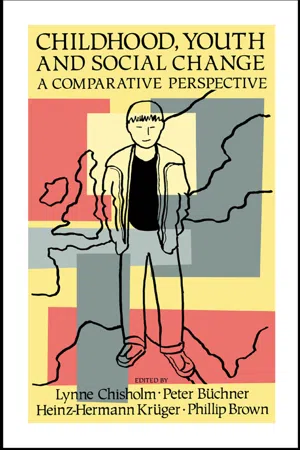
The English language version of proceedings of a bilateral UK/FRG conference held at Philipps Universitaet, Marburg. The theme of this conference was the examination of childhood and youth as life-stages in the context of contemporary social and cultural change, with an eye to future developments.
Information
Chapter 1
Childhood and Youth Studies in the United Kingdom and West Germany: An Introduction
Lynne Chisholm, Phillip Brown, Peter Büchner and Heinz-Hermann Krüger
The chapters in this volume were written for a bilateral United Kingdom (UK)–West German (FRG) conference held at the University of Marburg Institute of Education in November 1988. Our aim was to examine ‘chidhood’ and ‘youth’ as socially constructed stages of the life course in the context of contemporary social and cultural change. We wanted to assess and compare how theory and research in these fields had developed in recent decades, and to look at particular aspects of life conditions, experiences and transitions as these apply to children and young people. We also wanted to consider the direction of social and cultural change as understood and interpreted by researchers from each country. A consequence of engaging in comparative analysis is that it forced us all to question what we took to be sociological ‘commonsense’. The study of youth and childhood in the UK and FRG stem from different sociocultural and academic traditions, and it is always easier (and perhaps more satisfying!) to point out the weeds, rather than the flowers, in a neighbour's garden. It was soon evident that productive cross-cultural communication and research needed to be grounded in an appreciation of the different national contexts and perspectives. Our hope, therefore, is that this volume represents part of a growing European dialogue, and not simply a collection of isolated empirical papers concerning childhood and youth in the FRG and the UK.
The need for pan-European studies of childhood and youth has increased in importance and not only as a result of the creation of a single market in Western Europe (1992) and the rapid thawing of East-West relations, but due to the increasing globalization of economic markets and communications. The expansion of international trade and consumer markets, along with the rapid advancement in mass communications and tourism, has contributed to an internationalization of childhood and youth in the advanced economies. They now have wider access to other cultures and different lifestyles. Although the UK has been a de facto multicultural society for some time, it is only particular groups in specific cities and regions who might be described as living in an internally cosmopolitan culture, so that satellite media and an increasingly accessible Europe may not simply be ‘more of the same’ for British children and young people. West Germans are yet to recognize themselves as living in a multicultural society, despite the established presence of guestworker minority communities from a range of Southern European countries, most notably from (rural) Turkey. Ethnic minorities live on the margins of West German society, with few links into the indigenous culture. West German children rarely have much contact with minority group children unless they live in specific areas (for example, Kreuzberg in West Berlin) or attend an urban Hauptschule (secondary school). On the whole, West German children are far more likely to know about Yugoslavia, Greece and Turkey as a result of family holidays rather than as a result of having friends amongst children whose families came from those countries to live and work in the FRG. There has, however, been some mild discussion about the rising insertion of ‘American’ ways of life and the English language into young people's lives and experiences. It is certainly true that ‘slang’ used by German youth is anglicized to a much greater extent than ten years ago. Blue jeans and Marlboro cigarettes exert a strong appeal, although they are being subjected to increasing competition from a more European champagne, silk and Lacoste style.
What this highlights is both the similarities and differences which exist within and between nation-states. The FRG is a more economically powerful and affluent society than the UK. Although all European countries have been hit by economic recession during the late 1970s and the early part of the 1980s, rates of adult and youth unemployment have always been higher in the UK (despite numerous attempts by the British government to massage the unemployment figures). In 1987 the official unemployment rate was 10. 6 per cent in the UK and 6.4 per cent in the FRG. In the UK those under 25 years of age made up for a little over a third of this total, compared to a little over a fifth of under 25-year-olds to the FRG. In both countries there has been a further decline in the official rates of unemployment, in September 1989 the unemployment rate was 6.3 per cent in the UK and 5.6 per cent in the FRG.
Measured in terms of Gross Domestic Product (GDP) the FRG is the more productive and wealthier country. Annually, with 1967 hours, West German working hours are the shortest of all the industrial nations, and employees usually have six weeks' paid holiday (cf. Die Zeit, 1989). In the USA, annual paid holidays average two weeks and the working year measures 1912 hours (of the industrial nations, only the Japanese, at 2149 hours per year, work longer than this). The UK appears in the middle of the scale, with 1778 annual working hours and three to four weeks’ paid holiday. However, in terms of productivity per hour worked, the UK performs very poorly in comparison with most other industrial nations. Average earnings per hour (in non-agricultural activities) were 17.68 DM in the FRG in 1987 compared to £4.27 in the UK. What is similar between the UK and FRG is income distribution. In 1984 the lowest 20 per cent of the population received 7 per cent and 7.9 per cent respectively, the top 20 per cent of earners received approximately 40 per cent of total income in both countries.
Despite the obvious problems involved in interpreting these data between countries, in purely economic terms the FRG is doing relatively well. This helps to explain some of the preoccupations of contemporary West German social theorists, who are writing about a society with a stronger economy and generally higher standard of living. It is no coincidence that in the FRG the debate about West German children and youth has focused on the declining importance of class cultural experiences and the ‘curricularization’ of youngsters’ lives. In other words there has been an extension of formal participation in a wide range of sports, leisure and ‘improving’ activities outside school (this tendency is also noticeable in France, where there has been an explosion in summer schools and camps). West German youth experience; an almost universal post-school vocational education/training system, more ‘leisurely’ university studies, and an extended process of ‘settling down’ in adulthood often when they are in their mid-to-late twenties.
Economic factors are not, of course, the only reasons for socio-cultural differences between different Western European societies. Cultural traditions and values diverge, too, and in the case of the FRG continuity was overturned and broken in a particularly dramatic way by the Third Reich. The ‘empty space’ left by its destruction and the circumstances of its defeat was, and is, culturally problematic. One viable response was to emphasize the virtues of enterprise and materialism rather than a new political and moral consensus. In turn, it was the recoil from a materialist culture which fuelled the post-1968 ‘alternative’ social and political movements that continue to be a strong feature of contemporary West German society. Again, the tension in West German social life between ‘materialism’ and ‘culturalism’ helps to explain the interest in lifestyles analysis, the idea of youth as a ‘cultural fraction’, and the role of cultural capital as expressed in the changing exigencies of children's and young people's lives.
At the close of the 1980s we stand on a narrow ridge. Behind us lies post-war Europe, ahead of us the unfamiliar terrain of post-1992, in which closer EEC political union will reshuffle the social and cultural cards. What implications change in Eastern Europe will have in this context are, as yet, unpredictable. One consequence is already apparent, however: the influx of (largely young and qualified) East Germans and other ‘ethnic Germans’ from various parts of Eastern Europe is helping to solve a number of social and economic problems confronting the FRG. Western European countries are undergoing a demographic shift towards an ageing population. This shift is sharpest in the FRG, where the birth rate is poised to drop below replacement rate. The newcomers provide an immediate source of consumer-oriented, skilled and semiprofessional workers who require relatively little state or employer investment in comparison with the cost of retraining or upgrading the skills of the approximately two million unemployed West Germans.
The implications of the changing age structure of Western Europe and the consequences of what has been labelled the ‘demographic time-bomb’ has concentrated the minds of employers and policy makers in both the UK and FRG. However, a recent survey (NEDO, 1989) among UK employers found that a third of the construction firms canvassed thought that numbers of young people would rise in the coming years; but equally, only 20 per cent of all 2000 employers in the study were aware that, although there will be fewer school-leavers in the 1990s, the labour force overall is projected to expand. Similarly, there has as yet been little recognition within government or higher education that if the UK is to double its output of graduates by the year 2015 (as proposed by the former Secretary of State for Education and Science in early 1989), then there will have to be a significant increase in educational resources from the public sector. Moreover, an IMS (1989) report on how to achieve this aim concluded, firstly, that the proportion of young people staying on after 16 and attaining ‘A’ levels must be raised by a third (from approximately 14 per cent to 21 per cent). Secondly, the persistent social class and gender inequalities in educational opportunity and outcome must be eradicated, and alternative routes of certification and progression through to higher education must be developed. What such changes would mean for children's and young people's lives inside and outside the classroom or lecture theatre has not yet received serious consideration.
In West Germany, most people know that there are ‘too few’ (indigenous) children being born and that this poses a serious problem in the future, because there will be few economically active citizens contributing to the costs of pensions and health insurance. The state has begun to introduce social policy measures designed to encourage women to have more children, including parental leave carrying a ‘salary’ of (currently) £200+ per month for ten months (longer in some provincial states) and longer-term guaranteed rights to return to one's former employment. The reasons for the decline in the birth rate run much deeper than such measures can address; however it is common to hear West Germans lament the fact that children are at the bottom of societal concerns and priorities. There is also considerable professional and public concern about the level of stress to which many children and young people are subjected given a highly competitive schooling system in which formal ized, continuous assessment begins at an early age. Children and their parents have come to see ‘grades’ as the most important thing about schooling. School success has become increasingly important not only as a determinant of future occupational status, but as a measure of social worth.
Given the similarities and differences which exist between European countries, the above examples offer some support for the view that the lives of children and young people are in some ways more homogenized and in others more polarized, both within their own societies and in comparison with others. The search for theoretical frameworks which can hold this kind of tension rather than produce mono-causal accounts which oppose each other is the major task of this volume. Individual contributions may position themselves differently within the terms of debate, but ultimately all are concerned to explore the structured and dynamic relations between institution and identity, collectivity and individualism, structure and agency, constraints and possibilities. There is little question that we must all begin seriously to venture beyond our national back gardens if we are to keep pace with understanding the course of social change. The coming generations of European children, at least in the EC, will no longer grow up, go to school, and become adults and workers under the same, nationally bounded conditions their parents knew. Wider social and economic changes may both draw lifestyles closer together across Europe and produce new patterns of regional and cultural differentiation. These are all very large themes for research to address, but the small beginnings of this volume are an attempt to place them firmly on the agenda.
Approaches to Childhood and Youth in the UK and the FRG
Over the last decade British and West German perspectives on childhood and youth have shown clear differences in emphasis. This is especially evident in the case of youth studies. The social science of childhood still remains in its own infancy. Writing on childhood has largely been confined to developmental psychology or as a subsidiary element of the sociology of the family, although a number of social historians have done much to release the study of childhood from this intellectual orthodoxy, and to open the way to more fruitful lines of enquiry (Gillis, 1980; Aries, 1962).
In this volume the chapters which address themselves specifically to childhood all draw attention to the underdevelopment of childhood studies. Diana Leonard provides a comprehensive review of the research literature, and goes on to suggest how we might approach the study of childhood in the future. She proposes that new insights into childhood experience can be gained by making more use of cultural anthropological and sociohistorical perspectives, drawing on Delphy's analysis of systematic social inequalities in family households. From this standpoint, the analysis of childhood cannot be separated from the question of gender oppression. John Hood-Williams adopts a similar line of argument in which childhood is understood in terms of the structured power relations which intersect patriarchy and generation. He interprets research findings about British children's lives in that light. Peter Büchner, however, places his assessment of contemporary childhood in the FRG into the context of processes of ‘individualization’ and biographical destructuring which are, it is argued, beginning to affect everyone's lives. He considers the positive and negative aspects of children's changing schooling, leisure and family lives, without making an ultimate judgment in either direction. His analysis implies that the social construction of childhood is in the process of qualitative change, and that this affects all children in the advanced societies. Jürgen Zinneker's analysis attempts to integrate the study of childhood and youth. His argument suggests not only that contemporary social change affects these two life stages in both similar and different ways, but also that the social constructions of childhood and youth are interdependent. The boundaries between childhood and youth are by no means self-evident or permanently fixed. What we understand to be the status, demands and activities associated with each can shift both in absolute terms and in relation to one another.
In the UK, the interest in youth (sub)cultures which emerged during the seventies gave way over the eighties to a focus on the problems associated with youth unemployment, education and training. Contemporary British ‘youth studies’ is characterized by the search for more sophisticated understandings of the reproduction of complex, differentiated forms of social inequalities. The concept of youth transitions occupies a central position in the attempt to find more satisfactory ways of understanding the relationship between social structure and action across time and space. Interestingly, the question of how fundamental changes beyond national boundaries (for example, the single European market) will affect the young in general has not been widely addressed.
Youth studies in the FRG has a rather longer history than in the UK and enjoys a higher profile as an established interdisciplinary research specialism. Writers can draw on a bank of data which now includes the possibility of historical cross-sectional comparison, thus enabling a more systematic tracing of youth and social change than is readily accessible from existing British material. In the late 1970s West German youth research came to be identified with the youth sub-cultural studies popularized by writers associated with the Centre for Contemporary Cultural Studies at the University of Birmingham. But the German researchers did not embrace the neo-Marxist brand of cultural studies characteristic of the Centre's work, and which guided the direction taken by British youth studies in the eighties (see chapter 3 by Chisholm). Critical theory in the German context has led youth researchers to focus on critical modernization theory (Beck, 1983; Olk, 1985) and, increasingly, the recent work of Bourdieu (1986). In the FRG and the UK there has been a split between ‘cultural’ and ‘school-to-work’ studies, but an interest in the concepts of social biography and the life-course are beginning to draw together these two kinds of research in both countries, which suggests that this may be a promising channel for cross-cultural research.
The contributions from Peter Büchner, Heinz-Hermann Krüger and Jürgen Zinneker demonstrate the ways in which Beck and Bourdieu have been applied to the analysis of structural and cultural change in childhood and youth. Underlying Büchner's argument is the idea that childhood is becoming increasingly taken up with the acquisition of cultural capital. Children's lives are busier, chasing credentials in ever-expanding areas of their experience. Time and space come to be used, and controlled, differently, which in turn affects the children's relationships with parents, other adults, and peers. Heinz-Hermann Krüger compares the framing and sequencing of life-course events during the youth phase as this was typically experienced and normatively expected in the 1950s compared with the 1980s. He sees the differences between the two periods as providing empirical support for the proposition that the youth phase no longer consists of a standard sequencing of life events which mark transition stages to adulthood. Young people can no longer count on a secure labour market slot, they do not necessarily want to establish a ‘conventional’ family and the ages at which various transitions are accomplished vary widely. Jürgen Zinneker uses both the concepts of ‘cultural capital’ and ‘individualization’ to propose a series of changes in childhood and youth which are already identifiable and which will become more pronounced in the future. Essentially, he argues that the transmission and acquisition of cultural capital is now the main currency for reaching and reproducing favourable social positions. Leisure activities and life-style join education and training as the mediators of competitive and individualized acquisition of cultural ‘credentials’ both formal and informal. All may compete, but at the cost of making individuals more dependent and responsible for their own decisions, choices and biography.
The implications of constructing one's own biography are also addressed in Helga Krüger's chapter, but she places her argument very firmly within a framework which emphasizes the structure of constraints and possibilities confronting different groups of German youth. She describes the highly regulated youth labour market in the FRG, and why some researchers in her view have incorrectly interpreted youth unemployment and underemployment as an example of how economic change is fuelling the individualization processes because everyone is now vulnerable to market changes. Krüger's analysis suggests that education, training and employment in West Germany is locked just as tightly into the social reproduction of gender and class inequalities as is the case in Britain. This is an important point. The broad sweep of critical modernization theory tends to neglect structural differentiations within generalized social groups, and the fact that cultural capital is acquired within unequal social conditions and power relations. Steffani Engler's chapter is interesting in this context. She reminds us, firstly, that university students also belong to the category ‘youth’, which prompts the reflection that research in this area has been rather neglected in the UK since the mid-seventies. But secondly, she too is particularly concerned to explore the reproduction of social inequalities through transition mechanisms. Her analysis begins to chart anticipatory socialization into subject-specific student cultures using Bourdieu's concept of social space, which combines both the economic and cultural aspects of capital resources.
Steffani Engler and Helga Krüger take up postions which are closer to those favoured by Phil Brown, Lynne Chisholm, and Gill Jones/Claire Wallace. All emphasize the complex structuring and dynamics of internal differentiation in societies marked by systematic inequalities. Lynne Chisholm sets the scene by reviewing the development of youth studies in the UK over the past twenty years or so, before moving on to consider both the theoretical weaknesses of dominant analytic frameworks and the direction of current social changes as these relate to young people's lives and prospects. She concludes that the evidence for the UK more readily supports a thesis of increasing social polarization than of an individualized distribution of social risks, but that in any event we shall only gain insight into the (structured) processes of social reproduction and change by mapping social biographical traject...
Table of contents
- Cover Page
- Title Page
- Copyright Page
- Acknowledgments
- Chapter 1: Childhood and Youth Studies in the United Kingdom and West Germany: An Introduction
- Chapter 2: What Does the Future Hold? Youth and Sociocultural Change in the FRG
- Chapter 3: A Sharper Lens or a New Camera? Youth Research, Young People and Social Change in Britain
- Chapter 4: Persons in Their Own Right: Children and Sociology in the UK
- Chapter 5: Growing Up in the 1980s: Changes in the Social Biography of Childhood in the FRG
- Chapter 6: Schooling and Economic Life in the UK
- Chapter 7: Caught between Homogenization and Disintegration: Changes in the Life-phase ‘Youth’ in West Germany since 1945
- Chapter 8: The Shifting Sands of a Social Contract: Young People in the Transition Between School and Work
- Chapter 9: Beyond Individualization: What Sort of Social Change?
- Chapter 10: Patriarchy for Children: On the Stability of Power Relations in Children’s Lives
- Chapter 11: Illusory Equality: The Discipline-based Anticipatory Socialization of University Students
- Chapter 12: Youth, Race and Language in Contemporary Britain: Deconstructing Ethnicity?
- Chapter 13: How ‘Black’ are the German Turks? Ethnicity, marginality and Interethnic Relations for Young People of Turksih Origin in the FRG
- Chapter 14: Changing Leisure and Cultural Patterns Among British Youth
- Chapter 15: West German Youth Cultures at the Close of the Eighties
- References
- Notes on Contributors
Trusted by 375,005 students
Access to over 1.5 million titles for a fair monthly price.
Study more efficiently using our study tools.
Frequently asked questions
Yes, you can cancel anytime from the Subscription tab in your account settings on the Perlego website. Your subscription will stay active until the end of your current billing period. Learn how to cancel your subscription
No, books cannot be downloaded as external files, such as PDFs, for use outside of Perlego. However, you can download books within the Perlego app for offline reading on mobile or tablet. Learn how to download books offline
Perlego offers two plans: Essential and Complete
- Essential is ideal for learners and professionals who enjoy exploring a wide range of subjects. Access the Essential Library with 800,000+ trusted titles and best-sellers across business, personal growth, and the humanities. Includes unlimited reading time and Standard Read Aloud voice.
- Complete: Perfect for advanced learners and researchers needing full, unrestricted access. Unlock 1.5M+ books across hundreds of subjects, including academic and specialized titles. The Complete Plan also includes advanced features like Premium Read Aloud and Research Assistant.
We are an online textbook subscription service, where you can get access to an entire online library for less than the price of a single book per month. With over 1.5 million books across 990+ topics, we’ve got you covered! Learn about our mission
Look out for the read-aloud symbol on your next book to see if you can listen to it. The read-aloud tool reads text aloud for you, highlighting the text as it is being read. You can pause it, speed it up and slow it down. Learn more about Read Aloud
Yes! You can use the Perlego app on both iOS and Android devices to read anytime, anywhere — even offline. Perfect for commutes or when you’re on the go.
Please note we cannot support devices running on iOS 13 and Android 7 or earlier. Learn more about using the app
Please note we cannot support devices running on iOS 13 and Android 7 or earlier. Learn more about using the app
Yes, you can access Childhood, Youth And Social Change by Lynne Chisholm in PDF and/or ePUB format, as well as other popular books in Education & Education General. We have over 1.5 million books available in our catalogue for you to explore.