- 227 pages
- English
- ePUB (mobile friendly)
- Available on iOS & Android
eBook - ePub
About this book
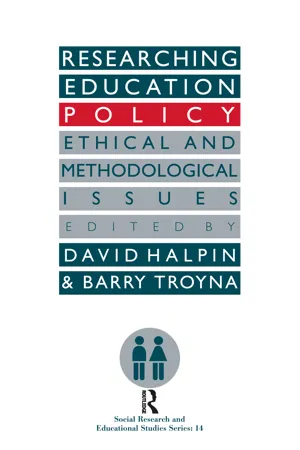
The methodology researching of educational policy is the subject of this book. It takes a "behind the scenes" look at the conducting, the analysis and the interpretation of research carried out into educational policy issues revolving around the 1988 Education Reform Act.; The contributors draw on their project research experience to demonstrate the breadth of issues lionked with such policy research, and cover the gender and power balance between interviewer and interviewee, the difficulties resulting from different ideological stances of researchers and researched, and difficulties in finding links between research and policy.
Information
Chapter 1
Reforms, Research and Being Reflexive About Being Reflective
Barry Troyna
Reforms
The debate about educational policy in Britain (and other western democratic societies) is hotting up. It is salutary to recall, for instance, that as recently as the early 1980s certain British academics were lamenting the paucity of policy studies in this country, contrasting this sorry state of affairs with the comparative wealth of literature in the United States. ‘The most striking feature of the British literature in this field’, wrote Michael Parkinson in 1982, ‘is how relatively little of it there is.’ He continued: ‘As a result the important areas about which we remain ignorant far outweigh those about which we know a little. And the gaps exist at both a theoretical and empirical level’ (1982, p. 114).
Although political scientists and sociologists engaged in policy studies still tend to turn a blind eye to the strides made by educationists in exploring this field ‘at both a theoretical and empirical level’ over the last decade or so (see for instance, Hill, 1993), it is undoubtedly the case that things have improved since Parkinson wrote his review of the literature. This is mostly due to the excitement generated by the plethora of educational reforms introduced by successive Conservative governments since 1979. These reforms are part and parcel of an ideological shift from ‘welfarism’ to ‘neo-liberalism’ (Miller and Rose, 1991) and draw inspiration from a conception of democracy framed in terms of individualism. Their impact on the shape and provision of education in England and Wales has been both fundamental and pervasive.
But reforms along these lines have not been confined to these shores. Guided by similar political and ideological imperatives, the move towards self-governing schools, in particular, and the espousal of what Fazal Rizvi calls the ‘associated rhetoric of devolution, parent and community participation and school-based decision-making’, have also left their indelible mark on the educational landscape in North America, Australasia and parts of mainland Europe (Rizvi, 1993, p. 143). The nature and extent of these reforms indicate that the sphere of education has provided a fertile ground for the cultivation and legislative enactment of these ideologies. Indeed, precisely why factions of the Right have been so successful in gaining the ascendancy in education is one of the questions which has dominated the debate about educational policy studies in the 1980s and 1990s (see for instance, Apple, 1993; Dale, 1989; Hall, 1988; Rizvi, 1993). This is how Michael Apple explains the Right’s accomplishment:
The social democratic goal of expanding equality of opportunity (itself a rather limited reform) has lost much of its political potency and its ability to mobilize people. The ‘panic’ over falling standards and illiteracy, the fears of violence in schools, and the concern with the destruction of family values and religiosity, have all had an effect. These fears are exacerbated, and used, by dominant groups within politics and the economy who have been able to move the debate on education (and all things social) onto their own terrain, the terrain of standardization, productivity and industrial needs. Since so many parents are justifiably concerned about the economic futures of their children—in an economy that is increasingly conditioned by lowered wages, unemployment, capital flight and insecurity—rightist discourse connects with the experiences of many working-class and lower middle-class people. (Apple, 1989, p. 7)
In England and Wales, the 1988 Education Reform Act (ERA) has been emblematic of the political processes to which Apple draws attention. It has also provided the most important shot in the arm to the study of education policy in Britain. Although the ERA constitutes only one of eighteen pieces of legislation on education introduced so far under Conservative rule, it is this package of reforms, comprising 238 clauses and eighteen schedules, which has threatened to bring about the most fundamental reconstitution of the educational system in England and Wales in over forty years. As Jackson Hall noted at the time, the ERA ‘was not about the development or reformulation of the 1944 settlement, but about replacing it’ (cited in Chitty, 1990, p. 198). Richard Johnson put some flesh on the bones of Hall’s comment in what has turned out to be a remarkably prescient observation:
I believe that the main configurations of formal schooling will be unrecognizable by the mid 1990s in many respects: the powers of local education authorities (LEAs), for example; the balance of public and private provision; the role of the central state… The transition will be as fundamental as that of 1780–1840 (the birth of ‘mass schooling’) or as that of 1865–1880 (the creation of a civic education service). By the end of the century the ‘growth’ of 1870–1970 may look like a specific historical phase, with its typical educational forms oddly relative to my children’s children. (Johnson, 1989, p. 92)
Subsequent legislation, including the 1993 Education Act, has consolidated the ideological rationale for, and extended some of the substantive measures contained within, the ERA. These initiatives have led to a restructuring of the education system along market-led lines. Actually, to use Julian Le Grand and Will Bartlett’s more precise term, the education system now has the properties of a ‘quasi-market’ (Bartlett, 1993). In ‘quasi-markets’, producers are encouraged to compete against one another and consumers are encouraged to express their preferences, but.…no money actually changes hands’ (Bartlett, 1993, p. 126).
Allegedly, the reforms have introduced greater diversity of provision. In the school sector this is bound together with a prescribed curriculum, compulsory testing and a formula for funding institutions which rests on a commitment to ‘horizontal equity’ (Dixon, 1991). Although the Conservatives tend to stress and celebrate the way their reforms have led to deregularization of the system, this is only part of the story. As Andy Hargreaves and David Reynolds point out: The rhetoric is consumer choice and diversity. The reality is product standardization. Kentucky Fried Schooling!’ (Hargreaves and Reynolds, 1989, p. 10).
It is probably not an exaggeration to say that no stone in this ensemble of legislative initiatives has been left unturned by educational researchers. A quick glance at the relevant shelves in bookshops and libraries and the contents of specialist journals and publishers’ catalogues reveals that matters such as the financial and governance implications of school-based management; the provision of Grant Maintained Status to schools; establishment of City Technology Colleges; the National Curriculum and the new modes of testing and assessment have all been subject to rigorous scrutiny. The setting up the ERA Research Network (Halpin, 1990) and various task groups operating under the auspices of the British Educational Research Association (see, for instance, Wallace, 1992), alongside the establishment of new (and dedicated issues of established) academic journals (see Ball and Shilling, 1994; Siraj-Blatchford and Troyna, 1993), have provided educational policy researchers with other conduits for the dissemination of substantive findings based on their inquiries into the Act.
Research
These contemporary educational reforms have also acted as a catalyst for the development of a genre of policy studies which break rank both with empiricist accounts of education policy and with those which rest upon managerialist perspectives on the policy process. Since the early 1980s, there has been a burgeoning of education policy studies which give centre stage to social scientific interpretations of the antecedents, production and orientation of education policy. These studies, according to Gerald Grace (1984), constitute ‘policy scholarship’. In his view they contrast favourably with studies undertaken by what he calls ‘policy scientists’. Research structured along these latter lines approximates to what C.W.Mills (1959) referred to as ‘abstracted empiricism’. That is to say, it is reactive and infatuated with the description and evaluation of organizational reform, management improvement and implementation strategies and procedures.
Some researchers contest Grace’s distinction within this field of enquiry, arguing that it is at best divisive, possibly even illusory. They prefer to place their studies in the self-proclaimed discourse of ‘education policy sociology’ (see, for instance, Ball, 1990a). Jenny Ozga reckons that this genre of research is ‘rooted in the social science tradition, historically informed and drawing on qualitative and illuminative techniques’ (Ozga, 1987, p. 14). Like Grace’s categories, ‘education policy sociology’ is a controversial, possibly imprecise, more likely inaccurate, appellation (see Troyna, 1994). However, like the term, ‘policy scholarship’, ‘education policy sociology’ gives some clues to the ‘more theoretically sophisticated and historically informed approach’ to policy studies which has arisen in the last few years (Grace, 1989, p.88 88). Of course, this is not to suggest that these recent studies, whatever they are called, have made a clean break with the earlier, atheoretical, apparently value-free and objective, stance on policy studies. On the contrary, it is Ozga’s concern that certain studies of ERA and post-ERA developments continue along the ‘policy-science’ road by sacrificing the elaboration of theory on the altar of (abstracted) empiricism. In her view, these studies are more concerned with the accumulation of information about particular issues than with positioning their analyses in the ‘bigger picture’ of the role of the State in education policy making (Ozga, 1990).
Despite Ozga’s critique, some of the current theoretical and empirical explorations of educational policy show a healthy disregard for managerialist and bureaucratic conceptions of the policy process. In fact, this corpus of research reveals influences from an impressive array of theoretical and disciplinary sources. Some are embedded in Marxist frameworks (Cultural Studies, 1991; Dale, 1992; Hatcher and Troyna, 1994), while others draw on pluralist approaches (Ball, 1990a; Kogan, et al. 1984; McPherson and Raab, 1988) and feminist perspectives (Blackmore and Kenway, 1993; Hughes, 1992). It is also possible to discern the influence of various (mainland European) theorists on studies of contemporary education policy. These include Foucault (Ball, 1990a; Bowe, Ball and Gold, 1992; Kenway, 1993), Baudrillard (Bowe, Gewirtz and Ball, 1992), Bourdieu and Offe (Codd, 1992) and Barthes (Bowe, Ball and Gold, 1992; Maguire, 1991; Rosie, 1992). There are also significant differences in the way education policy ‘scholars’ (to use Grace’s appellation) have operationalized their research designs. Some, such as McPherson and Raab (1988), have relied almost entirely on interviews; others, like Salter and Tapper (1981), have emphasized primary source documentation; while Bowe, Ball and Gold (1992), Deem and Brehony (1993) and Walford and Miller (1991), among others, have adopted a ‘partial’ ethnographic approach. Researchers working along these lines in Britain have also derived their empirical evidence from a range of research sites: Whitehall, schools, local education authorities, private residencies and governing bodies. All in all, then, it seems that what Janet Finch (1985) called ‘methodological eclecticism’ reigns supreme in this subfield of education policy studies.
Being Reflective
It is our expectation that the book (like the seminar series on which it was based) would contribute to that emerging body of literature which challenges the idealized conceptions of social research found in traditional research-methods textbooks. Technicist conceptions of research, which focus purely and simply on ‘how to do’ empirical projects, continue to dominate the research literature (see for instance, Bell, 1987; Cohen and Manion, 1980; Moser and Kalton, 1957). However, in their determination to lay bare the allegedly logical and sequential phases of the conception, execution and dissemination of social research, these interpretations of the activity help to sanction and reproduce the ‘myth of objectivity’ (Medawar, 1963). In contrast, Researching Education Policy was conceived from a perspective in which research is not construed as something pristine but as something ‘carried out by flesh and blood figures who are engaged in real life activities’ (Jacubowicz, 1991, p. 5). To reiterate the point made earlier: its purpose is to highlight the ways in which academics working in the field of educational policy grapple with the theoretical, ethical and political dramas associated with their research.
This genre of writing is often labelled ‘reflexive’, a diffuse concept which is used by academics in a bewildering number of ways. In some contexts, it seems to denote an allegiance to particular epistemological stances; in others, to methodological practices. Different again are those contexts where the two meanings are conflated—or confused (see Bonnett, 1993; Hammersley, 1983; Steier, 1991; Woolgar, 1988 for discussion). Some writers characterize their work as ‘reflexive’ but make no attempt to define the term (e.g., Nias, 1991) while others avoid the word entirely. Then again there are those who prefer to label accounts drawn in this fashion as ‘reflective’, ‘first-hand’, ‘post hoc ’, ‘autobiographical’, or some such variant. Meanwhile, there are those who see the exercise as bordering on catharsis. They use phrases such as ‘confessional’ or ‘warts and all to characterize the exposes on their research. Raymond Lee reckons that accounts such as these often assume the status of ‘heroic tales’ in which the diligence, cleverness and artifice of the researcher is very much to the fore (Lee, 1993, p. 121). However, as Alastair Bonnett notes, these ‘heroic tales’, or auto-critique as he calls the process, tend to efface the social location of authors ‘even as they subject themselves to a seemingly rigorous exercise in self- criticism’ (Bonnett, 1993, p. 165).
...Table of contents
- Front Cover
- Social Research and Educational Studies Series
- Title
- Copyright
- Contents
- Acknowledgements
- Series Editor's Preface
- Introduction
- Chapter 1 Reforms, Research and Being Reflexive About Being Reflective
- Part 1: Theory, Scholarship and Research into Education Policy
- Part II: The Ethics of Research into Education Policy
- Part III: Methodological Perspectives on Research into Education Policy
- Evaluation and Research—Project Outline (Chapter 4)
- Notes on Contributors
- Index
Trusted by 375,005 students
Access to over 1.5 million titles for a fair monthly price.
Study more efficiently using our study tools.
Frequently asked questions
Yes, you can cancel anytime from the Subscription tab in your account settings on the Perlego website. Your subscription will stay active until the end of your current billing period. Learn how to cancel your subscription
No, books cannot be downloaded as external files, such as PDFs, for use outside of Perlego. However, you can download books within the Perlego app for offline reading on mobile or tablet. Learn how to download books offline
Perlego offers two plans: Essential and Complete
- Essential is ideal for learners and professionals who enjoy exploring a wide range of subjects. Access the Essential Library with 800,000+ trusted titles and best-sellers across business, personal growth, and the humanities. Includes unlimited reading time and Standard Read Aloud voice.
- Complete: Perfect for advanced learners and researchers needing full, unrestricted access. Unlock 1.5M+ books across hundreds of subjects, including academic and specialized titles. The Complete Plan also includes advanced features like Premium Read Aloud and Research Assistant.
We are an online textbook subscription service, where you can get access to an entire online library for less than the price of a single book per month. With over 1.5 million books across 990+ topics, we’ve got you covered! Learn about our mission
Look out for the read-aloud symbol on your next book to see if you can listen to it. The read-aloud tool reads text aloud for you, highlighting the text as it is being read. You can pause it, speed it up and slow it down. Learn more about Read Aloud
Yes! You can use the Perlego app on both iOS and Android devices to read anytime, anywhere — even offline. Perfect for commutes or when you’re on the go.
Please note we cannot support devices running on iOS 13 and Android 7 or earlier. Learn more about using the app
Please note we cannot support devices running on iOS 13 and Android 7 or earlier. Learn more about using the app
Yes, you can access Researching education policy by David Halpin in PDF and/or ePUB format, as well as other popular books in Education & Education General. We have over 1.5 million books available in our catalogue for you to explore.