- 240 pages
- English
- ePUB (mobile friendly)
- Available on iOS & Android
eBook - ePub
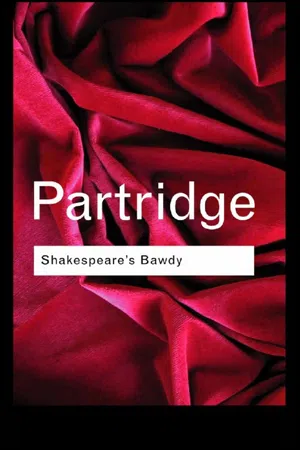
Shakespeare's Bawdy
About this book
This classic of Shakespeare scholarship begins with a masterly introductory essay analysing and exemplifying the various categories of sexual and non-sexual bawdy expressions and allusions in Shakespeare's plays and sonnets. The main body of the work consists of an alphabetical glossary of all words and phrases used in a sexual or scatological sense, with full explanations and cross-references.
Information
1
INTRODUCTORY
Among the most generally interesting and particularly provocative books upon Shakespeare since (say) 1925 are Dover Wilson’s magistral edition of Shakespeare’s Works, H. Granville-Barker’s brilliant Prefaces, G. Wilson Knight’s profound studies, Hugh Kingsmill’s thoughtful The Return of William Shakespeare, Chambers’s authoritative William Shakespeare, and, in another order, Kenneth Muir & Sean O’Loughlin’s The Voyage to Illyria and Hesketh Pearson’s popular, wind-fresh A Life of Shakespeare. (This selection is not intended to belittle such important books as those by Edgar I. Fripp and Leslie Hotson.) None of them,1 however, attempts a serious study of the main subject treated in the ensuing pages, whether in the sketch that is this essay or in the glossary, which, self-contained, deals with many themes that, even at this date, could not be handled in an essay designed to meet the needs of students of literature and oflovers of Shakespeare. This is not an in camera monograph for professional sexologists.
Little-minded men and women, [as The Times Literary Supplement said in a leader entitled ‘Artist and Public’ in its issue of August 17, 1940], write and paint their rubbish and the public laps it up, to the degradation of its taste. But the large-minded artist will always find within himself a great deal in common with the common people. We have given up supposing that Shakespeare’s sensational plots and bawdy jokes were only a high-brow’s concessions to the groundlings.1 The modern consciousness of responsibility to the public in general will incline the large-minded artist to brave any exquisite sneers at the seductions of popularity, of royalties, of the box-office and so forth, and to make the most, not the least, of everything in him which is common to all men. It is no business of the artist, as artist, to educate the public. It is the very core of his business so to present his vision of truth that it can be shared and trusted by as many as possible when first he puts it forth, and by more and more as the public is trained in knowledge and judgment.
All this is almost what Shakespeare himself might have said for he knew what he was about in his plays and his poems; knew, too, that his work would survive. He sometimes regretted making himself ‘a motley to the view’ in his role of actor: he never expressed a doubt of posterity’s opinion of his writings; he had good reason not to fret on that score.
No writer of even half the stature of Shakespeare could doubt that posterity would correctly appraise his worth; although perhaps only a second Shakespeare could adequately evaluate William Shakespeare. Much has been written about his ‘universal mind’. But what of his universal soul, his universal sympathy, his universal manhood?
I should not care to say that, during his life, Shakespeare was ‘all things to all men’,1 for that stock-phrase has, in certain circles, come to have une signification assez louche, but he does seem to have been ‘most things to all decent men’. Throughout his writings, as obviously in his life, Shakespeare reveals, occasionally in an explicit, generally in an implicit way, that in his spirit, his mind, his emotions, he strove to reconcile those opposites which, in fact (as sometimes he perceived), made him ‘the myriad-minded’, the universal-spirited, the catholic-emotioned man he so dazzlingly, so movingly, was in life and in print. In his general outlook and in his attitude towards sex and towards bawdiness, he shows that he was both an idealist and a realist; a romantic and a cynic; an ascetic and a hedonist; an etherealist and a brutalist; a philosopher and ‘the average man’; a saint and a sinner; a kindly tolerator and a Juvenal-satirist; an Illuminate and a Worldly-Wise; a strict moralist and a je-m’en-fichiste; a glowing optimist (‘How beauteous mankind is! O brave new world’) and a Werther-cum-Hardy victim of Weltschmerz; a believer in a Godlovelied heaven and a pedestrian with feet scarce-lifting from earth all too earthy; the most lambently lyrical and dew-sweet of poets (Romeo and Juliet) and the most materialistically terre à terre of soured prose-writers (Pompey, Apemantus, the Porter in Macbeth); the most exacerbated libido-driven, yet expert, sensualist and—via l’homme moyen sensuel—the purest, most innocent novice; the subtlest thinker and the simplest emotionalist; an Ariel of the further empyrean and a Caliban of the nearest mud; a dialectical Portia and a love-living Juliet; a Cordelia and a Goneril; an Imogen and a Gertrude; a Cleopatra and a Miranda; an Antony and a Brutus; a Coriolanus and a tribune, a married man—a bachelor—a monk. He was in his life, as he is to us now, all these persons and many more, with all the intermediary types and stages thrown in, with all their variations and nuances of character and temperament.
Not so strange, then, that Shakespeare’s spirit, mind, and body, as expressed in his life and his works, should have been the arena on which was fought an almost continuous battle between forces the highest and the lowest, the best and the worst, the most spiritual and the most anti-spiritual; nor is it strange that he should bitterly have resented that compromise which he was obliged to make rather more often than was consonant with his deep-based contempt for compromise. Shakespeare was at the back of my mind when, in 1939, I wrote1 a passage elaborating this theme: the tragedies of unavoidable compromise and of ‘the world’s slow stain’.
If ever there were a man filled with the joy and sap of life, it was Shakespeare; and if ever there were a man compact of spiritual needs and loveliest and noblest aspirations, it was Shakespeare. He could muse and meditate with the most meditative, also could he talk and do things with the best conversationalist and the most energetic man of action. Thinker, yet not remote from the stressful hurly-burly; dreamer, yet practical businessman; deliberate sater of that desirous, sex-hungry body, yet merciless contemner of his own yielding; condemning too his dark mistress, yet continuing to love the woman she might have been—and, for his happiness, should have been; never finding the ideal love, yet forever seeking it, for he knew that such love is, this side heaven, man’s most abiding joy and content and safety; expressing the physical aspect of love in its most intimate details, either with frank joyousness and animal spirits or with a self-reviling brutality and as if moved by an irresistible need to cleanse, not merely his bosom but his entire system, of this most perilous stuff, yet with his eyes upon a starry portal that might allow him, spirit-weary, mind-lorn, body-aching, to enter a house of tranquillity: complete and enduring union with such a woman as could joyously, unquestioningly, bring him the peace and the bliss of perfect understanding, unreservèd sympathy, and an unflawed understanding. He never found that woman, that home, that peace.
If the world blamed him for the frankness that spared nothing, he did not care: he might almost have been the epigrammatist that declared, ‘A dirty mind is a constant joy’, or the literary critic that, of a novel by Maupassant, had the courage to say, ‘A book about cads, for cads; but jolly good reading’1: nevertheless, he deeply cared that, however often and however outspokenly he might describe the dirt, he should also praise that to which he aspired: the true, the beautiful, and the good. Shakespeare was, physically, a pagan; also, he took a lively, very curious interest in sex. He was no mere ‘instinctive’ sensualist, but an intellectual voluptuary and a thinker keenly, shrewdly, penetratingly, sympathetically probing into sex, its mysteries, its mechanism, its exercise and expertise, and into its influence on life and character. And being the world’s most supple as well as most majestic (he could out-play Milton on the verbal organ), subtlest as well as strongest writer, he expressed his views on love and passion and sex, with a power and pertinence unrivalled by other great general writers and with a picturesqueness unapproached by the professional amorist writers; the latter excel him only in technical details and in comprehensiveness, and then only because he was not concerned to write a bréviaire divin de l’amour, an ars amoris, a Married Love. Before we pass to some account of the non-sexual bawdy, of homosexuality, and of sex in Shakespeare, let us obtain a prefatory idea of his approach to and treatment of sex by looking at that system of imagery which he exhibited in English and which was imitated by the 17th Century amatory poets, the 18th Century amorists, and by such 19th Century writers as Meredith (a little), Swinburne (much), and Maurice Hewlett (continuing into the present century): the geography and topography of the female sexual features.1
Vaguely topographical is the passage at Romeo and Juliet, II i 17–33, but as it is insufficiently general and various for our present purpose, it must be omitted. Much superior is the passage at Venus and Adonis, verses 229–240, where Venus, passionately hugging Adonis, seeks thus to convert his reluctance to ardent desire and amorous deeds:
‘Fondling,’ she saith, ‘since I have hemm’d thee here
Within the circuit of this ivory pale,
I’ll be a park, and thou shalt be my deer;
Feed where thou wilt, on mountain or in dale:
Graze on my lips; and if those hills be dry,
Stray lower, where the pleasant fountains lie
’Within this limit is relief enough,
Sweet bottom-grass, and high delightful plain,
Round rising hillocks, brakes obscure and rough,
To shelter thee from the tempest and from rain:
Then be my deer, since I am such a park;
No dog shall rouse thee, though a thousand bark.’
The general sense is clear: clear, too, is most of the imagery. I do not care to insult anybody’s knowledge or intelligence by offering a physiological paraphrase, nevertheless the inexpert reader would perhaps do well to consult the following terms in the glossary: park, deer, feed, mountain, dale, fountain, bottom-grass, plain, hillock, brakes.1
And, likewise ‘in the order of their first appearance’, the glossary will, at country, Ireland, buttocks, bogs, heir, cliff (sense 1), Spain, Belgia, Netherlands, low, prove not unuseful to those who, rightly or wrongly, have less than complete faith that the acuity of their perceptions will, in its full signification, elucidate every sexual reference in the famous passage at ІІІ і 110–136 of The Comedy of Errors, where Antipholus of Syracuse and Dromio of Syracuse discuss the monstrously fat kitchenwench that is being considered by the latter as a bride:
Antipholus. Then she bears some breadth?
Dromio. No longer from head to foot than from hip to hip: she is spherical, like a globe; I could find out countries in her.
Antipholus. In what part of her body stands Ireland?
Dromio. Marry, sir, in her buttocks: I found it out by the bogs.
Antipholus. Where Scotland?
Dromio. I found it by the barrenness; hard in the palm of the hand.
[With reference to agricultural infertility and to the legendary close-fistedness]
Antipholus. Where France?
Dromio. In her forehead; arm’d and reverted, making war against her heir.
Antipholus. Where E...
Table of contents
- COVER PAGE
- TITLE PAGE
- COPYRIGHT PAGE
- FOREWORD
- PREFACE
- 1. INTRODUCTORY
- 2. NON-SEXUAL BAWDY
- 3. HOMOSEXUAL
- 4. SEXUAL
- 5. GENERAL
- 6. VALEDICTORY
- GLOSSARY
Trusted by 375,005 students
Access to over 1.5 million titles for a fair monthly price.
Study more efficiently using our study tools.
Frequently asked questions
Yes, you can cancel anytime from the Subscription tab in your account settings on the Perlego website. Your subscription will stay active until the end of your current billing period. Learn how to cancel your subscription
No, books cannot be downloaded as external files, such as PDFs, for use outside of Perlego. However, you can download books within the Perlego app for offline reading on mobile or tablet. Learn how to download books offline
Perlego offers two plans: Essential and Complete
- Essential is ideal for learners and professionals who enjoy exploring a wide range of subjects. Access the Essential Library with 800,000+ trusted titles and best-sellers across business, personal growth, and the humanities. Includes unlimited reading time and Standard Read Aloud voice.
- Complete: Perfect for advanced learners and researchers needing full, unrestricted access. Unlock 1.5M+ books across hundreds of subjects, including academic and specialized titles. The Complete Plan also includes advanced features like Premium Read Aloud and Research Assistant.
We are an online textbook subscription service, where you can get access to an entire online library for less than the price of a single book per month. With over 1.5 million books across 990+ topics, we’ve got you covered! Learn about our mission
Look out for the read-aloud symbol on your next book to see if you can listen to it. The read-aloud tool reads text aloud for you, highlighting the text as it is being read. You can pause it, speed it up and slow it down. Learn more about Read Aloud
Yes! You can use the Perlego app on both iOS and Android devices to read anytime, anywhere — even offline. Perfect for commutes or when you’re on the go.
Please note we cannot support devices running on iOS 13 and Android 7 or earlier. Learn more about using the app
Please note we cannot support devices running on iOS 13 and Android 7 or earlier. Learn more about using the app
Yes, you can access Shakespeare's Bawdy by Eric Partridge in PDF and/or ePUB format, as well as other popular books in Literature & Languages. We have over 1.5 million books available in our catalogue for you to explore.