eBook - ePub
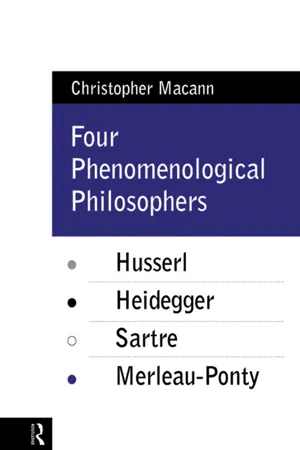
Four Phenomenological Philosophers
Husserl, Heidegger, Sartre, Merleau-Ponty
- 240 pages
- English
- ePUB (mobile friendly)
- Available on iOS & Android
eBook - ePub
About this book
Macann guides the student through the major texts of the four great thinkers of the phenomenological movement.
Information
Chapter 1
Edmund Husserl
Edmund Husserl
Edmund Husserl was born in 1859 in Prossnitz, a village in Czechoslovakian Moravia which, at that time, formed a part of the Austrian Empire. He initially studied mathematics and physics at Leipzig and Berlin but his transfer to the University of Vienna inaugurated a shift in interest towards philosophy. In 1886, he went to the University of Halle, where he became an assistant under Stumpf. But in 1900 he received an invitation to join the philosophy faculty at Göttingen, where he subsequently became professor in philosophy. In 1916 he obtained a full professorship at Freiburg im Breisgau, where he remained until his retirement. The last years of his life were overshadowed by Nazi politics, though his death, in 1938, saved him from witnessing the war unleashed with Hitler’s invasion of Poland.
The philosophical development of Edmund Husserl, the founder of twentieth-century phenomenological philosophy, can be divided into three main periods, the first period of his pre-transcendental or epistemological phenomenology, the middle period of his fully transcendental phenomenology and the last period of his so-called ‘genetic’ phenomenology. Although our attention will be concentrated on the middle period of his properly transcendental phenomenology, we shall nevertheless present Husserl’s thinking in terms of these three phases.
There is no one work which stands in the same relation to the Husserlian philosophy that Being and Time, Being and Nothingness and Phenomenology of Perception stand in relation to the thinking of their respective authors. Inevitably, therefore, we shall be obliged to take account of a number of texts stemming from different periods in Husserl’s development.
HUSSERL’S EPISTEMOLOGICAL PHENOMENOLOGY
The point of departure
Husserl came to philosophy from mathematics, a fact which is reflected in the very title of his first published work—The Philosophy of Arithmetic. Though he later came to qualify some of the theses presented in his first major work, it is worth noting that the approach he adopts here sets the stage for the entire further development of his thinking. For in this, his first attempt to account philosophically for the seemingly unequivocal ‘objectivity’ of a branch of the mathematical sciences, he already seeks to steer a course between psychologism and logicism. Indeed such an attempt may be taken to characterize the epistemological status of the first period in his philosophical development.1 For later he will come to see that a properly phenomenological philosophy cannot be developed along the lines of a simple mediation between the two pillars of epistemological philosophy, namely, the a priori analytic and the a posteriori synthetic (represented in Logical Positivism by the two-fold way in which propositions are said to be verifiable—as analytically or as empirically true or false), but calls instead for something in the way of a transcendental turn.
Psychologism, the view that the laws of knowledge can be derived from an understanding of the basic facts of psychic life, was a position represented by J.S.Mill and which had been taken up by such German predecessors of Husserl as Wundt, Sigwart and Lipps. Logicism, a position assumed by Natorp, Shröder, Voigt, and of course Frege, began as a reaction to psychologism, a reaction in which Husserl thought of himself as participating.
It lies outside the scope of this commentary to attempt a comparison of Husserl’s Philosophy of Arithmetic with Frege’s Foundations of Arithmetic. But the antagonism between the two conceptions of arithmetic can be very easily seen in their respective attitudes towards the two critical concepts ‘zero’ and ‘one’. For Frege (and Russell after him), the entire number series can be generated from these two fundamental concepts. For Husserl, on the other hand, ‘zero’ and ‘one’ are not concepts of number at all, and for the simple reason that, for Husserl, a number can only be generated by way of the (logical) concept of a ‘something in general’ and the (psychological) concept of ‘collective connection’. But the apprehension of one object requires no collective synthesis, or immediate apprehension of ‘togetherness’—and the same holds even more evidently of zero. From the very beginning, therefore, Husserl required that the objectivity of even the most ‘logical’ of objectivities be traced back to the structures of consciousness in and through which it first became possible. Fundamental notions such as ‘equality’, ‘similarity’, ‘whole and part’, ‘plurality and unity’ were regarded by Husserl as incapable of formal-logical definition. Rather, the validity of these notions had to be exhibited in concrete synthetic activities and through a disclosure of the types of abstraction through which they were generated. In his review of Husserl’s Philosophy of Arithmetic2 Frege could only regret the intrusion of psychological considerations into logic, a criticism which Husserl took seriously and against which he sought to defend himself.
Perhaps the best way to assess the significance of Husserl’s attempt to avoid the charge of ‘psychologism’ is with reference to the work of Brentano and Meinong, the former a generation or so older than himself, the latter more or less a contemporary. From Brentano, Husserl drew the principle that all consciousness, by its very nature, is a consciousness ‘of’, in other words, is intentional. However, the complementary side of Brentano’s intentional analyses, his concern with the immediate apprehension of psychic data in consciousness, proved too empirical for Husserl.3
Retaining Brentano’s emphasis upon psychic life as the real foundation of conscious activity, Meinong sought to liberate Brentano’s ‘phenomenology’ from empiricism through an appeal to ideality. Though still taking his stand in a descriptive psychology,4 Meinong sought to overcome the empiricism of his starting point in the evidences of internal perception through a characteristic disconnection of ‘higher order’ objectivities, objectivities which can, however, be built up on this same psychic basis. The unreality or ideality of the object, for Meinong, is marked out by the characteristic of ‘intentional inexistence’. With Meinong, the emphasis accorded to the unreality of the psychic object led to a multiplication of ontological regions, each with its own distinctive mode of representation, that is, with its own distinctive way of positing its object as ideal or inexistent.5
By eliminating the realism inherent in Brentano’s descriptions of psychic life, Husserl’s phenomenology moves beyond the limits of an empirical psychology. By replacing Meinong’s negative concept of ideality, characterized essentially by inexistence and, as such, standing out in stark contrast against the real psychic contents upon which it is based, with a more positive concept, Husserl’s phenomenology opens the way to a quite distinctive, eidetic analysis. What now ensures the invariability of the intentional object is not (as it was with Meinong) the invariability of the psychic content to which it is related. On the contrary, this psychic content, qua lived experience, can, with Husserl, undergo all kinds of variations, just as long as the wealth of psychic modifications is directed towards an object whose invariability is guaranteed by its ideality.
The Logical Investigations
The Logical Investigations are divided into a Prolegomena and six subsequent Investigations, of which the sixth is by far the longest. The general movement of these six researches is from the formal to the material, from the abstract possibility of a science of sciences, through an investigation of meaning and its relation to language, to a concrete analysis of the structures of consciousness and their relation to experience and to the knowledge of that which is given in experience.
However, for purposes of convenience, we shall not attempt to present the Logical Investigations Investigation by Investigation. Instead, the substance of this long and often elaborate work will be conveyed with reference to six guiding themes: (1) the controversy between formalism and psychologism, (2) language as the expression of meaning, (3) the correlational character of consciousness, (4) eidetic intuition, (5) the pure ego and finally (6) truth and knowledge.
To some extent these themes arise in the course of the Logical Investigations in the same order in which they will be dealt with here, but only to some extent. In particular, the Sixth Investigation, the last and the longest, tends to pull together the themes of all the preceding Investigations under the one all-embracing head of a phenomenology of truth and knowledge.
The Prolegomena begins by raising the same issue as that examined earlier in Philosophy of Arithmetic. As before, Husserl’s aim is to steer between the Scylla of formalism, for which logic exists as a technology of thought ultimately dependent upon certain arbitrarily (or at least conventionally) established concepts and procedures, and the Charybdis of psychologism, for which the laws of logical thought are in the end reducible to psychological laws governing the actual functioning of the human psyche. The Prolegomena assumes an anti-formalist position, because logical formalism disregards altogether the psychic life in which logical objectivities arise and through which they are sustained in being by, for example, a repetition of the same logical procedures on different occasions. It also assumes an anti-psychologistic position, because psychologism disregards, or rather regards as secondary, the ideal objectivities of formal thought (by making them depend upon certain concrete acts of counting, inferring etc). From a present day standpoint, it would seem that the principal objection to Husserl’s procedure would stem from the formalist direction. But in Husserl’s own day, psychologism offered the most persuasive account of the origin of logical thinking. It is for this reason that the critique of psychologism takes up the greater part of the Prolegomena.
Logic, especially in the very broad sense in which Husserl understands this term, obviously presupposes language, and indeed a quite special conception of language. The unusual feature of Husserl’s concern with language is that, for him, language is, first and foremost, the medium in which meanings are expressed and communicated. This implies that meaning is in some sense prior to language and can therefore only be attained, in its phenomenological purity, through a series of exclusions.
He begins to operate these exclusions in the First Investigation, by distinguishing signs (Zeichen), on the one hand, from indications (Anzeigen), on the other. Sign is the most general term. For every sign is a sign of something. But not every sign signifies. By a sign in the sense of an ‘indication’, Husserl tells us he means an object or state of affairs whose existence indicates the existence of a certain other object or state of affairs, in the sense that belief in the existence of the former constitutes a motive for belief in the existence of the other. Thus clouds may serve as indications of the imminent arrival of rain, symptoms as indications of the presence of a disease, a certain geological formation as an indication of the presence of oil and so on. The point of drawing this distinction is to exclude indications (Anzeigen) from the general province of expressions, properly so-called, that is, the province of that whose function it is to signify, to give expression to.
Husserl then goes on to distinguish, within the general province of signifying signs, that is linguistic expressions, a physical aspect from that aspect through which the expression is endowed with meaning. By the physical aspect of an expression, Husserl means the physiognomical gestures required for speech or writing, the contexts in which these gestures take place, as well as the outward manifestations of an expression—in the case of speech, audible sounds, in the case of writing, visible marks. All of this is incidental to the function of signification which is disclosed in and through those acts which, as it were, animate the lifeless sounds and marks in question. Any statement, whether spoken or written, can function as an expression, and so also can any part of such a statement, the concepts or phrases of which it is made up. But a statement is only an expression in so far as it is viewed from the standpoint of what it seeks to express, from the standpoint therefore of an outward ex-pression (pressing out) of something in itself inward and hidden, not merely the meaning as such but the meaning just as it is intended by the very meaning-giving consciousness in question.
Conversely, when I understand an expression uttered by someone else, necessarily my understanding is predicated upon a sensational apprehension (of the sounds emitted). But the understanding of the meaning is not reducible to this sensory input which, in the act of understanding, is immediately transcended towards the signification, what the sounds are taken to express. In order to reinforce the ideality of his conception of signification, Husserl takes note of, in order to rule out as irrelevant, expressions in which something other than the expression of an objective intention is meant by the speech act in question. Acts which are not primary bearers of signification, the kind of acts Austin called ‘performative’, acts through which desires, wishes, commands are expressed, together with the various forces (perlocutory/illocutory) which accompany such speech acts, also fall under this head. In so far as, by saying, I do something (by saying ‘I promise’, I actually do promise), what is done transcends the parameters of an objective expression—as do such accidental aspects of an expression as those whose meaning is dependent upon the person and the occasion of utterance. At the same time, Husserl will insist that occasional expressions, such as demonstratives, do also contain a core objective sense over and above that subjective sense which comes to them from the occasion of utterance. He who says ‘I’ means, in general, ‘whoever is uttering the expression’, and this no matter how variously that pronoun may refer to different people in actual contexts of utterance. Pure logic deals solely with those ideal unities which Husserl calls ‘significations’, and which have to be conceived in abstraction from the real variations attendant upon the differences of person, place and circumstance.
In the Fifth Investigation Husserl carries his phenomenology of language to its logical conclusion with reference to a function of nomination. In the case of names, and provided we add the article to the relevant noun or noun complex, a position of existence is normally implied. Just as a name is used to affirm the existence of a thing which, as such, can feature as the subject of a predicative judgment, so a whole phrase can function in this nominal manner, in which case it requires completion in a judgment which furnishes a predicate. Between a statement of fact, employed as a judgment, and a naming of this statement of fact which, as such, requires completion through further predication, a difference of essence prevails, for example between ‘It is raining’ and ‘that it is raining will please the farmers’. Thus, in general, nominating presentations differ from judgments, and positing presentations which affirm existence from non-positing presentations.
This appeal to the function of nomination has two results. First, it enables Husserl to treat states of affairs (expressed in complex expressions) as modifications of an act of simple nomination. Thus ‘S is P’ is convertible into the ‘being P of S’ or ‘that S is P’. Second, inherent in the function of nomination we find an objective reference, and this even before the introduction of questions concerning truth and intuitive fulfilment. It is this objective reference which provides a basis for the notion of an ‘objectivating act’.
The discussion is then extended in such a way that the critical concept of an objectivating act can be employed to clarify and amplify the initially vague notion of intentionality. An objectivating act (§41) is the primary bearer of matter. As such, it is what links the ‘unreal’ life of consciousness with a reality distinct from consciousness. Every intentional Erlebnis is either itself an objectivating act or has such an act at its base—for example, if it expresses a desire for some state of affairs. Since, in the final analysis, objectivating acts have been shown to be nominating acts, the unity of intentional life can ultimately be founded in language, not in the sense that it is reducible to the latter but in the sense that we can have no access to intentional Erlebnisse save by way of corresponding forms of expression in and through which the Erlebnisse in question are objectified.
But the function of signification, the meaning-giving acts of consciousness together with their expression in language, cannot be considered independently of what is signified, the meant—and here we come to our third heading. An examination of the subjectively determined life of consciousness would be meaningless if it did not stand in relation to its intentionally determined objectivities. It is this correlation ‘meaning-meant’ which governs the entire course of the Logical Investigations. It should, however, be noted that, on both sides, the common category of reality has been suspended from the start, in the first case in the name of what is actual (‘reell’ not ‘real’, or what will later be known as the ‘noetic’) and in the second in the name of what is ideal (‘ideell’, or what will later be known as the ‘noematic’). Whereas certain of the Investigations, such as the First and the Fifth, will concentrate primarily upon the meaning-giving side of consciousness itself, others, such as the Second, the Third and the Fourth, will focus on the meant and the intentional idealities which are objectified thereby. Even when one side of the correlation is examined without reference to the other, it should therefore always be borne in mind that this exclusion is purely artificial, an exclusion performed for the purposes of analytical convenience, and therefore one which in no way undermines the correlational character of Husserl’s phenomenological investigations.
Turning to the side of the meant, to the intentionally signified rather than the signifying activity of consciousness, we find, first of all, Husserl’s own novel conception of ‘ideational abstraction’. The Second Investigation is specifically devoted to the problem of abstr...
Table of contents
- Cover
- Halftitle
- Title
- Copyright
- Dedication
- Contents
- Preface
- 1 Edmund Husserl
- 2 Martin Heidegger
- 3 Jean-Paul Sartre
- 4 Maurice Merleau-Ponty
- Conclusion
- Select Bibliography
- Index
Trusted by 375,005 students
Access to over 1.5 million titles for a fair monthly price.
Study more efficiently using our study tools.
Frequently asked questions
Yes, you can cancel anytime from the Subscription tab in your account settings on the Perlego website. Your subscription will stay active until the end of your current billing period. Learn how to cancel your subscription
No, books cannot be downloaded as external files, such as PDFs, for use outside of Perlego. However, you can download books within the Perlego app for offline reading on mobile or tablet. Learn how to download books offline
Perlego offers two plans: Essential and Complete
- Essential is ideal for learners and professionals who enjoy exploring a wide range of subjects. Access the Essential Library with 800,000+ trusted titles and best-sellers across business, personal growth, and the humanities. Includes unlimited reading time and Standard Read Aloud voice.
- Complete: Perfect for advanced learners and researchers needing full, unrestricted access. Unlock 1.5M+ books across hundreds of subjects, including academic and specialized titles. The Complete Plan also includes advanced features like Premium Read Aloud and Research Assistant.
We are an online textbook subscription service, where you can get access to an entire online library for less than the price of a single book per month. With over 1.5 million books across 990+ topics, we’ve got you covered! Learn about our mission
Look out for the read-aloud symbol on your next book to see if you can listen to it. The read-aloud tool reads text aloud for you, highlighting the text as it is being read. You can pause it, speed it up and slow it down. Learn more about Read Aloud
Yes! You can use the Perlego app on both iOS and Android devices to read anytime, anywhere — even offline. Perfect for commutes or when you’re on the go.
Please note we cannot support devices running on iOS 13 and Android 7 or earlier. Learn more about using the app
Please note we cannot support devices running on iOS 13 and Android 7 or earlier. Learn more about using the app
Yes, you can access Four Phenomenological Philosophers by Christopher Macann in PDF and/or ePUB format, as well as other popular books in Philosophy & Modern Philosophy. We have over 1.5 million books available in our catalogue for you to explore.