eBook - ePub
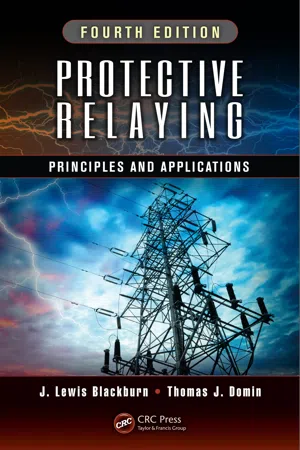
Protective Relaying
Principles and Applications, Fourth Edition
- 695 pages
- English
- ePUB (mobile friendly)
- Available on iOS & Android
eBook - ePub
About this book
This fourth edition of a bestseller covers the technological fundamentals of power system protection. Featuring refinements and additions to accommodate recent advances, the text describes analysis of protective systems during system disturbances and examines how regulations impact the way protective relaying systems are designed, applied, set, and monitored. Containing an expanded discussion of intertie protection requirements at dispersed generation facilities, it explores smarter, more flexible protective systems yet provides practical information on an array of equipment vintages to reflect the state of power systems today.
Information
Chapter 1
Introduction and General Philosophies
1.1 Introduction and Definitions
What is a relay; more specifically, what is a protective relay? The Institute of Electrical and Electronic Engineers (IEEE) defines a relay as “an electric device that is designed to respond to input conditions in a prescribed manner and, after specified conditions are met, to cause contact operation or similar abrupt change in associated electric control circuits.” A note adds: “Inputs are usually electric, but may be mechanical, thermal, or other quantities or a combination of quantities. Limit switches and similar simple devices are not relays” (IEEE C37.90, 1989).
Relays are used in all aspects of activity: home, communication, transportation, commerce, and industry, to name a few. Wherever electricity is used, there is a high probability that relays are involved. They are used in heating, air conditioning, stoves, dishwashers, clothes washers and dryers, elevators, telephone networks, traffic controls, transportation vehicles, automatic process systems, robotics, space activities, and many other applications.
In this book we focus on one of the more interesting and sophisticated applications of relays, the protection of electric power systems. The IEEE defines a protective relay as “a relay whose function is to detect defective lines or apparatus or other power system conditions of an abnormal or dangerous nature and to initiate appropriate control circuit action” (IEEE 100, 2000).
Fuses are also used in protection. IEEE defines a fuse as “an over-current protective device with a circuit-opening fusible part that is heated and severed by the passage of the overcurrent through it” (IEEE 100, 2000).
Thus, protective relays and their associated equipment are compact units of analog, discrete solid-state components, operational amplifiers, and digital microprocessor networks connected to the power system to sense problems. These are frequently abbreviated simply as relays and relay systems. They are used in all parts of the power system, together with fuses, for the detection of intolerable conditions, most often faults.
Protective relaying, commonly abbreviated relaying, is a nonprofit, nonrevenue-producing item that is not necessary in the normal operation of an electric power system until a fault—an abnormal, intolerable situation—occurs.
A primary objective of all power systems is to maintain a very high level of continuity of service, and when intolerable conditions occur, to minimize the outage times. Loss of power, voltage dips, and overvoltages will occur, however, because it is impossible, as well as impractical, to avoid the consequences of natural events, physical accidents, equipment failure, or misoperation owing to human error. Many of these result in faults: inadvertent, accidental connections and flashovers between the phase wires or from the phase wire(s) to the ground.
Natural events that can cause short circuits (faults) are lightning (induced voltage or direct strikes), wind, ice, earthquake, fire, explosions, falling trees, flying objects, physical contact by animals, and contamination. Accidents include faults resulting from vehicles hitting poles or contacting live equipment, unfortunate people contacting live equipment, digging into underground cables, and human errors. Considerable effort is made to minimize damage possibilities, but the elimination of all such problems is not yet achievable.
A dramatic illustration of the need and importance of power system protection is shown in Figure 1.1. This spectacular lightning strike occurred over Seattle during a storm on July 31, 1984, and in a region where lightning is infrequent. The isokeraunic charts for this area of the Pacific Northwest indicate that the probability of storm days when thunder is heard is five or fewer per year (Westinghouse Electric Corp., 1964). Although some 12,000 homes lost power during this storm, neither major damage nor prolonged outages were experienced by the local utilities. Fortunately, lightning protection and many relays operated to minimize the problems.
Figure 1.1

Lightning over Seattle—a vi...
Table of contents
- Cover Page
- Half Title page
- Title Page
- Copyright Page
- Contents
- Preface to the Fourth Edition
- Preface to the Third Edition
- Preface to the Second Edition
- Preface to the First Edition
- Author
- Chapter 1 Introduction and General Philosophies
- Chapter 2 Fundamental Units: Per-Unit and Percent Values
- 3 Phasors and Polarity
- 4 Symmetrical Components: A Review
- 5 Relay Input Sources
- 6 Protection Fundamentals and Basic Design Principles
- 7 System-Grounding Principles
- Chapter 8 Generator Protection/Intertie Protection for Distributed Generation
- Chapter 9 Transformer, Reactor, and Shunt Capacitor Protection
- Chapter 10 Bus Protection
- Chapter 11 Motor Protection
- Chapter 12 Line Protection
- 13 Pilot Protection
- 14 Stability, Reclosing, Load Shedding, and Trip Circuit Design
- Chapter 15 Microprocessor Applications and Substation Automation
- 16 Improving Protective System Performance
- 17 Problems
- Index
Trusted by 375,005 students
Access to over 1.5 million titles for a fair monthly price.
Study more efficiently using our study tools.
Frequently asked questions
Yes, you can cancel anytime from the Subscription tab in your account settings on the Perlego website. Your subscription will stay active until the end of your current billing period. Learn how to cancel your subscription
No, books cannot be downloaded as external files, such as PDFs, for use outside of Perlego. However, you can download books within the Perlego app for offline reading on mobile or tablet. Learn how to download books offline
Perlego offers two plans: Essential and Complete
- Essential is ideal for learners and professionals who enjoy exploring a wide range of subjects. Access the Essential Library with 800,000+ trusted titles and best-sellers across business, personal growth, and the humanities. Includes unlimited reading time and Standard Read Aloud voice.
- Complete: Perfect for advanced learners and researchers needing full, unrestricted access. Unlock 1.5M+ books across hundreds of subjects, including academic and specialized titles. The Complete Plan also includes advanced features like Premium Read Aloud and Research Assistant.
We are an online textbook subscription service, where you can get access to an entire online library for less than the price of a single book per month. With over 1.5 million books across 990+ topics, we’ve got you covered! Learn about our mission
Look out for the read-aloud symbol on your next book to see if you can listen to it. The read-aloud tool reads text aloud for you, highlighting the text as it is being read. You can pause it, speed it up and slow it down. Learn more about Read Aloud
Yes! You can use the Perlego app on both iOS and Android devices to read anytime, anywhere — even offline. Perfect for commutes or when you’re on the go.
Please note we cannot support devices running on iOS 13 and Android 7 or earlier. Learn more about using the app
Please note we cannot support devices running on iOS 13 and Android 7 or earlier. Learn more about using the app
Yes, you can access Protective Relaying by J. Lewis Blackburn,Thomas J. Domin in PDF and/or ePUB format, as well as other popular books in Technology & Engineering & Electrical Engineering & Telecommunications. We have over 1.5 million books available in our catalogue for you to explore.