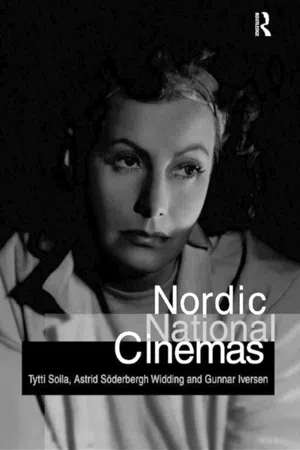
Nordic National Cinemas explores the film histories and cultures of Denmark, Finland, Iceland, Norway and Sweden. The authors examine each country's domestic film production, social and political context and domestic audiences from the beginning of this century to the twentieth century.
The authors not only explore the work of internationally renowned figures such as Mauritz Stiller, Victor Sjostrom, Carl Dreyer and Ingmar Bergman, directors of such classics as Vampyr, Ordet, Wild Strawberries and Cries and Whispers, but also nationally important film makers such as August Blom, Bodil Ipsen, Lau Lauritzen and Nils Malmros, they also discuss contemporary film makers including Gabriel Axel, director of Babette's Feast, the Kaurismaki brothers, directors of The Match Factory Girl and The Leningrad Cowboys and the recently acclaimed Lars von Trier, director of Breaking the Waves.
- 272 pages
- English
- ePUB (mobile friendly)
- Available on iOS & Android
eBook - ePub
Nordic National Cinemas
About this book
Information
Chapter 1
Introduction
Film production as a national project
Tytti Soila, Astrid Söderbergh Widding and Gunnar Iversen
The concept of national cinema has been central in several film historical texts and debates in recent years. As a departure point for the discussion of film in national terms, we find the assumption that a country’s film history can be considered from certain stylistic or thematic parameters, related to the country’s culture and the general background of the films which unite the country’s production, to be a more or less homogeneous phenomenon. As a typical example one could mention France, where among other features poetic realism is often mentioned as a specifically national tendency in French production, or Germany, where expressionism or the new German cinema play a similar part. These national film cultures have often functioned as a counterbalance to the hegemony of Hollywood. During some periods, as, for example, in the new German cinema, the ambition to create a domestic film has been the expressed intention of the film-makers. In films by a Fassbinder or a Wenders there is clearly inscribed a critique of the Hollywood cinema, yet at the same time these films relate to Hollywood on several levels. They constitute an antithesis, a formulation of an individual alternative, and they have been interpreted as such by the audience. At other times it seems more reasonable to regard the national element largely as a reflection of the audience, as something that arises in the film’s reception.
The concept of national cinemas has at the same time been questioned from many quarters. For example, Andrew Higson and Stephen Heath both claim that the device is a theoretical construction. The criticism of the concept originates among other things in the fact that, at the level of production only, it is difficult or impossible to isolate the films of individual nations from other countries’ production. However, the device’s characteristic of construction does not necessarily mean that it needs to be dismissed: it can after all be justified as an analytical tool. Furthermore, the degree of construction attributed to the term is dependent on whether, for example, one places the stress on production or reception. On revising sources like the companies’ material, reviews and the like, it has become apparent in Nordic contexts that there was an early and distinct awareness of national distinction, which has remained permanent through the decades regardless of whether the films of that particular country have been fostered or rejected by the critics and the audience, and regardless of the national distinction simultaneously being subordinate to various changes as far as thematic and stylistic design is concerned.
The purpose of this study is twofold. The first is to offer a detailed description of the marginal film culture which the Nordic countries constitute in an international language, and thereby give them a place on the map of film history. The thought behind this is also to contribute with a corrective to the international film canon where Bergman and Dreyer, as virtually the only major names, have been made to represent Nordic presence. As we have observed, film and nationality today constitute one of the most vital fields of discussion within cinema studies—the existence of the National Cinema series, of which this book is a part, is but one example. This clarifies the second purpose behind this study, namely to allow this book to make a contribution to the debate on national film. The starting point of this contribution is to be found in the unique situation that exists in Nordic film contexts where there is a high degree of integration and exchange between the countries but it is also apparent that popular themes and genres specific to each country respectively can be traced through history.
PERSPECTIVES OF THE NATIONAL ELEMENT
In discussing Nordic cinema from a national perspective we have proceeded from three different ways of approaching the national element.
1 As opposed to several other countries’ film cultures, Nordic cinema has been national in the specific sense that it has not, or to only a limited extent, been exportable to other countries. This means that it is national in a basic sort of way: a culture that stays within itself, something which exists only for that country.
Even within the Nordic countries the different nations’ domestic films are only exported to a limited extent. As an example, we will look at cinema in Norway during the 1980s. During this period, an average of ten Norwegian films were produced each year out of which only one was exported to Sweden, whereas some ten Swedish films were imported into Norway in the same period.
An important exception to this trend was the large Swedish export of films following the so-called breakdown of the sex barrier. The reason for this is that Swedish films are not only exotic but also sensational. In the latter concept there is the preconception of news value. Thus a rough borderline is established where the aberration in Swedish film production in comparison with other countries (and in particular with the normative American production) suddenly appears to have acquired such news value. This also gives rise to a number of questions. How and when does the difference become sensation? The whole problem of the dichotomy of the differencesimilarity, which is at the heart of every discussion on national cinema, is topicalized in this context.
The divergence of Nordic film versus, for example, American film is interesting: this is both national and international, and its national specificity at the same time constitutes the very basis for its distribution outside the borders of the own nation.
If one speaks of Nordic national cinema in this specific sense, however, it means that the very concept of ‘the national’ must be redefined. This is because earlier definitions of national Nordic film have been based on the exceptions—on the films of a Bergman or a Dreyer, which are paradoxically at the same time the most international films in the Nordic countries. We have instead proceeded from the basis of popular film, which has been seen by a majority audience in the country where it was made and which has been perceived by this audience to be specifically national.
2 This brings us to a second aspect of nationality in cinematic contexts, namely the question of the audience and its expectations in relation to national film.
National quality is enhanced in an interesting way if one considers the example of France. With the complete setback in production caused by the First World War, the French film industry, which at the time was the international leader, entered a prolonged period of crisis. It was only the breakthrough of sound film that brought about a revitalization of the French film, and then it had clear national overtones. This obviously goes to show the importance of language to national identity, but above all it is also an indicator as to what extent the film as a national phenomenon is a project. National cinema came into existence to the extent that a nation actively attempted to construct it, in a situation where external conditions allowed it. The state’s influence on Nordic cinema is something which to a particularly high degree accentuates this fact, but the awareness of what is specific for the nation and its marketability is also an important factor which plays a part in the concrete production decisions for the private producers.
The creation of a national cinema is thus a decision which originates in a need that is presumed to exist, and which is thereby also presumed to arouse sympathy in the audience. These presumptions are confirmed if one looks at the audience ratings. Within the different national cultures in the Nordic countries the audience favours domestic films in a most singular way, something that is clearly apparent from the history of Nordic cinema. This is true independently of cultural value patterns: during some periods the films of the home nation have been held up as models by the critics, yet during other periods they have been looked down upon.
It is thus with the audience in mind that one should seek the awareness of nationality in the first place. The knowledge that the rapids in the Finnish film version of the popular Finnish novel The Song of the Scarlet Red Flower (Laulu tulipunaisesta Kukasta) are in fact Finnish, for example—as opposed to the similar rapids in the Swedish version of the same film— created considerable differences with regard to the popularity of the respective films in Finland. However, it can also be said that the audience is deceived, so that the national authenticity of the images is something that only occurs in the film’s reception. An interesting example is the Norwegian film The Magic Moose (Trollelgen) (1927). This film has been defined by audience and critics alike as being prototypically Norwegian in its images. In reality it contains footage which the film-maker has retrieved from a Swedish documentary and then cut into his story. That the images deceive, however, does not alter anything as regards the film as a national symbol, which clearly indicates that national quality is a construction which should primarily be defined from the point of view of the spectators.
Nationality in the area of film thereby implies a relation to the topical and to the specific for the culture. A certain country’s national film is determined by the separate life values, in relation to other countries, which have been worked at in the form of fictions, rather than from any singularly demonstrable difference in stylistic measures between different countries’ productions. The concept of national cinema in other words both presupposes and relates to a context. To speak of a national cinema in a given country is a construction which thus becomes specific to the country only in relation to other countries, to ‘abroad’. At the same time it is of interest to analyse how the relationship between nationality and internationality changes. Particularly interesting in Nordic contexts are the complex relations which arise in the field between, first, each country’s individuality as it is conveyed in the films; second, the Nordic affinity and collaboration which unite the separate national projects, and third, the influence of other countries, especially the USA.
3 The third way in which we have sought to approach the national quality in Nordic cinema is via the search for specific elements in the actual film texts which constitute national markers. Common to film in all the Nordic countries is that one can view it as a distinct alternative to the dominant American film. In this way, Nordic film constitutes a corrective of sorts, a way of asserting not only each country’s national individuality, but the joint Nordic unity as an alternative, however peripheral, in relation to Hollywood’s style and mode of production. Here again, state influence enters the picture. The fact that these small nations also have numerically insignificant film production has made state regulation necessary to maintain production at a sufficiently high level both quantitatively and qualitatively, in order to resist the strong American influence.
THE RESEARCH SITUATION
In all the Nordic countries there exists a paradoxical situation in the area of film research. The state’s influence over the cinema institution is, as mentioned above, common to all Nordic countries. Despite this interest of the state, however, the film still has a low status in all these countries. It is from this perspective that one must realize the fact that film as such, and more specifically film history in particular as regards national production, is a neglected area. It would also seem that the fact that Nordic cinema has had so few international hits has contributed to this. If Sweden to a certain extent is an exception to the situation outlined above, it is doubtless due to the fact that it was Sweden where Sjöström and Stiller, and later Bergman, were active. This inferiority complex seems to have been the most effective research obstacle. Only international success has been sufficient to legitimize research into the film history of each nation in its own right.
It has been only during latter years that a research proper into film has developed at the universities, and that a study of national film has become legitimate. This has also resulted in a situation which is in many ways problematic for the film scholar. Because of this, the literature on film has largely been made up of separate surveys, while the basic research proper has not been carried out until quite recently. Essential areas are still lacking basic research. The map of Nordic film history still has its blank areas.
When one exposes the Nordic countries to closer scrutiny one will find that there are simultaneously vast differences in the research situation between the countries. In Sweden and Finland the literature is thus far more extensive than in Denmark or Norway. In Sweden as well as Finland there are also detailed filmographies which map the countries’ production. In Denmark and Norway, however, there have been as yet only filmographic attempts. It is interesting to compare Swedish and Danish literature in the field of cinema studies. If the Swedish body of texts would appear to be far superior in volume compared to the Danish literature, this is partly misleading. In Denmark, for example, there is a thorough and detailed mapping of the history of film production which lacks a Swedish counterpart, but virtually no aesthetic film history. It is also the case in both countries that extensive areas of film history fall outside of the writing of history. In both Denmark and Sweden the interest has been exclusively tied to certain periods and certain great auteurs.
At the same time the historical research into Nordic film is at present at a stage of dynamic development. Film history has appeared on the agenda at a number of Nordic universities. In Norway, for instance, this has resulted in a vast project covering the history of moving images. The research ranges over a wide field, from analysis of aesthetics and production-related aspects to the study of the films’ reception.
Yet another problem concerning research from an international perspective is that what is published in the international languages on Nordic cinema is written in the main by people who have not mastered the language in question or who have no knowledge of the national culture. It has also been difficult for such people to make a selection from each country’s national cinema, and they have thus been forced to trust in the official picture traded by way of the survey literature: starting from which films the film institutes have chosen to subtitle, and so on. The emphasis on secondary sources is thus extreme. The selection of films studied in these texts is also based on a consensus of sorts: it is exclusively the study of aesthetical masterpieces. In this book we are striving to place the exceptions in a particular context. International critics have not had access to the popular films and we think popularity is an important criterion in discussing national cinema. Which films have people actually seen? There is also a need for a comprehensive perspective on the complete production. The purpose of this work is specifically to fill this void by presenting a more complete picture of the film culture in each country respectively.
Chapter 2
Denmark
Astrid Söderbergh Widding
THE SILENT YEARS IN DENMARK: A PERIOD OF GREATNESS AND DECLINE
The history of Danish film begins in a grand way despite Denmark’s smallness, as the story of one of the world’s leading film nations. During the first half of the 1910s the so-called golden age of Danish film occurred, when Denmark, alongside France, had the status of being Europe’s most influential country in the realm of film production. But this period of greatness was to be short, and Denmark has since remained a marginal film country, with the exception of a few directors who have become internationally known. Surveys of film history, with their focus on auteurs and great or artistic productions, give few or no clues to the consistent production of films in Denmark, apart from its relatively few international successes—films that have seldom been exported but on the other hand have had a solid native audience through the decades.
Denmark occupies a unique position among the Nordic countries through its dense population in relation to its geographic size. The natural scenery that in film history has often been pointed out to be the most characteristic feature in Nordic film also plays an important part in the history of Danish film. There is no wilderness however, only the cultivated agrarian landscape one meets in the films. Urbanization came earlier in Denmark and is more prominent than in the neighbouring Scandinavian countries. This is also evident in film production where urban types of film like melodrama, drawing-room comedy and street realism were already common from the earliest years.
The film came to Denmark only one year after its birth. In 1896 the first public screening took place, arranged by Vilhelm Pacht, the owner of a place of entertainment in Copenhagen. He had seen Lumière’s showings in Paris and had brought home film and equipment. In that same year the first Danish film was produced by Peter Elfelt, who for ten years was virtually the sole film-maker in the country. From the beginning the film had an important, albeit limited, market in Denmark: films were shown regularly at the music-halls in Copenhagen, and there were some travelling cinemas as well. In 1904 the first permanent cinema opened in Copenhagen. It was followed by others in various parts of the country, and from 1906 the growth was almost explosive. In the same year a cinema owner in Copenhagen, Ole Olsen, set up his own film production company, Nordisk Films Kompagni (Nordisk Film Company). It was almost coincidental that he as well as his equals—businessmen in the entertainment industry—came to invest in film as a possible new source of income, which would turn out to exceed their wildest expectations.
By 1910 the Danish film industry was established and a stable production of considerable size had begun. Nordisk Films had within a few years become the second largest film company in Europe, next to Pathé, with a staff of 1700 people. Production was soon standardized in the company, both on narrative and stylistic levels, A few genres were developed in accordance with patterns similar to the American ones: mainly melodrama, farce and thriller. Besides Nordisk there were also a number of small companies, twenty-five in all, most of which produced only a handful of films before disappearing for good.
The film historian Ron Mottram describes the typical film style characterizing Nordisk’s productions. As a rule they comprise thrillers, tragedies and love stories with an intense acting style and marked lighting effects. Both interiors and exteriors are very realistic and natural scenery as well as urban settings are exploited in an ingenious way. A few stock characters appear and reappear in the Danish films of the period. Among these we find the circus performer, the prodigal son, the officer, the landowner and the earl. The film diva also makes her entrance in Nordisk’s films, such as Clara Wieth Pontoppidan and Asta Nielsen. Nielsen made her name as a star in The Abyss (Afgrunden) in 1910, directed by Urban Gad. It contained some innovative devices, for example, the lack of intertitles, but it achieved its reputation mainly as an erotic film with a touch of dark fatalism. Nielsen appeared in two other similar films, both directed by Gad, before leaving Denmark for Germany: The Black Dream (Den sorte drøm) and The Dancer (Balettdanserinden), both made in 1911.
The director August Blom, a former actor, was among the first to work to produce longer films—Ole Olsen had an aversion to productions lasting longer than one reel, that is, 15 minutes. In 1910 Blom staged Hamlet as a play in three acts, but the film company cut it down to a one-reel play. In the same year, however, the success of the 35-minute film White Slavery (Den hvide slavehandel)—produced initially by a smaller company, and immediately plagiarized by Ole Olsen—prompted the producers to begin to make longer films with up to an hour’s running time. In this way more theat...
Table of contents
- Cover Page
- Title Page
- Copyright Page
- Plates
- Acknowledgements
- Chapter 1: Introduction
- Chapter 2: Denmark
- Chapter 3: Finland
- Chapter 4: Iceland
- Chapter 5: Norway
- Chapter 6: Sweden
- Chapter 7: Conclusion
- Notes
Trusted by 375,005 students
Access to over 1.5 million titles for a fair monthly price.
Study more efficiently using our study tools.
Frequently asked questions
Yes, you can cancel anytime from the Subscription tab in your account settings on the Perlego website. Your subscription will stay active until the end of your current billing period. Learn how to cancel your subscription
No, books cannot be downloaded as external files, such as PDFs, for use outside of Perlego. However, you can download books within the Perlego app for offline reading on mobile or tablet. Learn how to download books offline
Perlego offers two plans: Essential and Complete
- Essential is ideal for learners and professionals who enjoy exploring a wide range of subjects. Access the Essential Library with 800,000+ trusted titles and best-sellers across business, personal growth, and the humanities. Includes unlimited reading time and Standard Read Aloud voice.
- Complete: Perfect for advanced learners and researchers needing full, unrestricted access. Unlock 1.5M+ books across hundreds of subjects, including academic and specialized titles. The Complete Plan also includes advanced features like Premium Read Aloud and Research Assistant.
We are an online textbook subscription service, where you can get access to an entire online library for less than the price of a single book per month. With over 1.5 million books across 990+ topics, we’ve got you covered! Learn about our mission
Look out for the read-aloud symbol on your next book to see if you can listen to it. The read-aloud tool reads text aloud for you, highlighting the text as it is being read. You can pause it, speed it up and slow it down. Learn more about Read Aloud
Yes! You can use the Perlego app on both iOS and Android devices to read anytime, anywhere — even offline. Perfect for commutes or when you’re on the go.
Please note we cannot support devices running on iOS 13 and Android 7 or earlier. Learn more about using the app
Please note we cannot support devices running on iOS 13 and Android 7 or earlier. Learn more about using the app
Yes, you can access Nordic National Cinemas by Gunnar Iverson,Astrid Soderbergh Widding,Tytti Soila in PDF and/or ePUB format, as well as other popular books in Media & Performing Arts & Film & Video. We have over 1.5 million books available in our catalogue for you to explore.