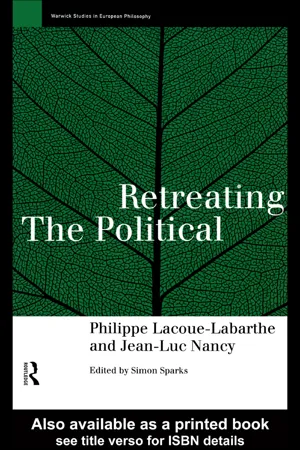
This collection of essays presents, for the first time in English, some of the key essays on the political by Philippe Lacoue-Labarthe and Jean-Luc Nancy. Including several unpublished essays, Retreating the Political offers some highly original perspectives on the relationship between philosophy and the political.
Through contemporary readings of the political in Freud, Heidegger and Marx, the authors ask if we can talk of an a priori link between the philosophical and the political; they investigate the significance of the 'figure' - the human being as political subject - in the history of metaphysics; and they inquire how we can 're-treat' the political today in the face of those who argue that philosophy is at an 'end'.
- 224 pages
- English
- ePUB (mobile friendly)
- Available on iOS & Android
eBook - ePub
Retreating the Political
About this book
Information
1
La panique politique1
Anyone who describes a panic as one of the plainest functions of the ‘group mind’ arrives at the paradoxical position that this group mind does away with itself in one of its most striking manifestations.
Freud, Group Psychology and the Analysis of the Ego2
If he lives among others of his own species, man is an animal who needs a master… But this master will also be an animal who needs a master.
Kant, ‘Idea for a Universal History with a Cosmopolitan Purpose’3
1 The notes which follow are indeed, discounting the usual formalities, notes. They were taken down in a summary and discontinuous fashion during a teaching project in progress over the last three years, a project which it is out of the question to expound in an article. At the same time, they constitute the first point of reference for a future exploration. If we are provisionally risking them here in this somewhat off-putting form, it is for a political reason: it is today necessary, indeed urgent, to demand a rigorous problematisation of the ‘relation’ between psychoanalysis and politics. The minimum of rigour henceforth consists in the refusal of a double impasse: that over which psychoanalytic instrumentations stumble when put more or less deliberately at the service of a received political thought (which may range from one communism or another to social democracy), for in this way one merely succeeds in reinforcing the initial problems which had to be explored; and the impasse of the proclamations (oscillating from the anarchist left to the libertarian right) according to which, once the libidinal trap of the political is unveiled, one ought to abandon it to the declining history of its Western delirium, and substitute for it an aesthetic or a moral doctrine. (We will not here go back over the political interests—and on the political interests of psychoanalysis—brought into play in each case.)
In other words, we are refusing the attitudes of theoretical (and practical) panic where, through a narcissistic discourse, everyone protects himself or herself from the feeling of the dissolution of the ties which guaranteed the cohesion of the Western mass.
This double refusal is not naïve. It does not come from an angelical desire to surmount the confrontations and deadlocks of politics. If confrontation is necessary, we know where to put ourselves; and, since it seems unavoidable today to be as specific as possible, let us say: on the left, as for example, Freud himself. But if it is a question of analysing, we also know where we ought not to put ourselves: namely, in submission to the political, to psychoanalysis, or to both. From now on, a demand ‘from the left’ and a demand for rigour move together through the deconstitution of this double submission. And here again, here especially, we have something to learn from Freud, no doubt one of the least submitted thinkers, including to his own doctrine.
2 We are constrained to exclude from these notes the examination of most references other than Freudian ones. This does not mean that we are proposing another and purer ‘return to Freud’. It is a question, rather, of something of Freud which henceforth makes its return because it has not yet really taken place, neither with him nor after him. Nor does this mean that we should have come or come back to Freud without the help or without the examination of what allows one today to read him. In this respect moreover we may recall, despite the lapse of time, what our reading of Lacan, The Title of the Letter, recorded as regards the debt and everything else. But with respect to the solicitations of the political problematic in or from psychoanalysis (Girard, Deleuze, Lyotard, Goux, Legendre, Castoriadis, Kaufmann), we cannot in these notes initiate the numerous discussions which would be necessary.
3 And in any case, we are choosing a quite different perspective as a point of departure. It is less a question of asking oneself what Freud says or does not say, or allows one to say about the political, than of wondering what the question of the political does in and to psychoanalysis. That is to say, first of all, it is a question of wondering about the place and the function of the analysis of culture (Kultur, civilisation, culture, the institution and the operation of humanity as such). One has already been able to pick out, here and there,4 the determining role of the motifs provided by the analysis of culture for psychoanalysis itself (if one understands by this the analysis of the individual psyche). But there is more. The analysis of culture might constitute, from the very inside of psychoanalysis, a displacement of such importance that it would seem to imply an overflowing of psychoanalysis.
Freud himself was unable to get the measure of this displacement, and we are still only able to pick out the basic facts of the problem. These at least are clearly found in Freud, and, for example, in the 1935 postface to An Autobiographical Study. In this text Freud designates the group of works written from 1920 to 1923 as his last important works in psychoanalysis proper (let us recall that in this group, concerning which Freud previously said that, in them, he was giving free rein to speculation, Beyond the Pleasure Principle and The Ego and the Id frame Group Psychology and the Analysis of the Ego: the two great texts which determine late psychoanalysis frame the text marking a transition in the analysis of culture). After which Freud declares that he has not written anything of importance for psychoanalysis. And he continues:
This circumstance is connected with an alteration in myself, with what might be described as a phase of regressive development. My interest, after making a lifelong detour through the natural sciences, medicine and psychotherapy, returned to the cultural problems which had fascinated me long before, when I was a youth scarcely old enough for thinking. At the very climax of my psycho-analytic work, in 1912, I had already attempted in Totem and Taboo to make use of the newly discovered findings of analysis in order to investigate the origins of religion and morality. I now carried this work a stage further in two later essays, The Future of an Illusion and Civilisation and its Discontents. I perceived ever more clearly that the events of human history, the interactions between human nature, cultural development and the precipitates of primeval experiences (the most prominent example of which is religion) are no more than a reflection of the dynamic conflicts between the ego, the id and the super-ego, which psycho-analysis studies in the individual—are the very same processes repeated upon a wider stage.5
At the end of a life of psychoanalysis—at the end of the life of psychoanalytic inauguration—a ‘regression’ thus leads an almost already posthumous Freud towards the ‘wider stage’ of culture. Would the wider stage not be a stage still other than the ‘other stage’?6 A stage more other, which would certainly not mean ‘wholly Other’ but, in a much simpler and much more complex way, the stage (if it is still a stage) of the Other. As for the ‘regression’ towards the ‘fascinations’ of the young Freud, would its function not be to go back, at the end, towards something like a more primitive stage of psychoanalysis itself? And a still more primitive stage than any primitive stage, and perhaps off-stage [hors-scène] or ob-scene [ob-scène],7 would it not be a matter of the stage of the Other? The problem of culture is never anything else for Freud than the problem of the Other or, to put it in a very banal way (on the register of the, apparently, constant banality in Civilisation), it is the problem of coexistence, and of pacific coexistence with the Other. It is therefore not a political problem, and not exactly the political problem because it is not certain that this problem arises for politics or that it arises on its own. But it is surely the problem of the political, which is to say, that concerning which the political begins to pose problems….
Why would such a problem—the Other—refer to the other of psychoanalysis, or else to an altered psychoanalysis? Why and how would it lead psychoanalysis towards something like an origin obscure to itself? This is basically what one would need to begin locating.
4 These questions have neither the form nor the intent of a psychoanalysis of psychoanalysis; they aim neither at confirming nor at disinstalling its identity by means of an abyssal operation which could throw light (but which light?) on the (social, political, philosophical) unconscious of Freud and of his science. The analysis of culture is precisely not an analysis of psychoanalysis, a model to which all recent attempts at interpreting and at interpellating the social, institutional, economic and political position of psychoanalysis have remained subject.8 It does not consist in a remainder unanalysed by Freud (in the perfectly legitimate sense in which Lacan has ceaselessly analysed the remainder left by Freud, or by Freud’s biologism, energetism and psychologism, as regards language). That the analysis of culture might, however, eventually have repercussions for the self-analysis of analysis, no less than the question of the Other on that of the ‘discourse of the Other [l’Autre]’, is plausible, but it is too early to tell.
5 Nor, on the other hand, is the wider stage a mere extrinsic appendix to the Freudian text which one could grasp without any psychoanalytic outlay and to any socio-political or philosophical ends. It is not outside of analysis, and yet it does not quite fit inside. It may well be the place where the division of the outside and the inside of psychoanalysis is blurred. Such a place always has the nature of a limit. The limit is not negative: it traces an identity—and this tracing excludes itself from what it traces out, simultaneously carrying along with it the identity outside itself. There is no limit which is not both internal and external: the political is at the limit of psychoanalysis, or is its limit: its origin, its end, and the line of an intimate fold which crosses it. In the text which we quoted, this line passes through the obvious opposition or contrariety (it is not a contradiction) between the two relations of psychoanalysis to the analysis of culture which Freud simultaneously establishes: one of which is a relation of mere ‘reflection’, the other, one of ‘repetition on a wider stage’. Rigorously, the two are irreconcilable (a reflection cannot be ‘wider’ without being distorting). Consequently, Freud never did reconcile them.
In a word: Freud was never able to derive, from the psychoanalysis of a subject presupposing the plurality of subjects (parental imagos or the instances of the second topic), the analysis of this very plurality. And to go straight to the political register: from the analysis of a subject presupposing the authority which assigns it, Freud was never able to derive the analysis of the institution of this authority. Moreover, he himself very clearly indicated this. Even if it means coming back to it later, let us immediately recall here two texts which stand out:
It [i.e. remorse] relates only to a deed that has been done, and, of course, it presupposes that a conscience—the readiness to feel guilty—was already in existence before the deed took place. Remorse of this sort can, therefore, never help us to discover the origin of conscience and of the sense of guilt in general…. But if the human sense of guilt goes back to the killing of the primal father, that was after all a case of ‘remorse’. Are we to assume that [at that time] a conscience and a sense of guilt were not, as we have presupposed, in existence before the deed?9
Moreover, in the case of some advances in intellectuality—for instance, in the case of the victory of patriarchy—we cannot point to the authority which lays down the standard which is to be regarded as higher. It cannot in this case be the father, since he is only elevated into being an authority by the advance itself.10
On the contrary, Freud always sought in the analysis of culture to point, in numerous ways, to the emergence of a subject neither from other subjects nor from a subject-discourse (whether it be of the other or of the same, of the father or of the brother), but from the non-subject or non-subjects. Now, the non-subject (insofar as one can name it), the withoutauthority, the without-father (the phrase ‘we must recall that the father too was once a child’ is found in Moses11), the without-super-ego and thus without-ego, anterior to every topic as well as to every institution, of an anteriority with which no regression can properly catch up, and ‘wider’ than every founding agency—the ‘non-subject’ forms, as one sees, the joint limit of psychoanalysis and of the political.
6 Let us thus introduce here without further delay, a hypothesis, indeed a thesis, which quickly turns out to be indispensable: if the limit of psychoanalysis is that of the subject, the same limit, insofar as it traces the contour of the political, is that of power. Power is neither the last question nor the first instance. With the question of the non-subject, that of a non-power or of an unpower necessarily arises.
In short, Freud instantly takes us to the common limit of a double question which is as old as metaphysics:
• how does the subject support itself? (if one recalls that the sub-ject, the substance, is the support);
• how does authority authorise itself?
Consequently, the very limit through which psychoanalysis overflows, the space of the ‘wider stage’, is not culture and politics as an apparatus ready to assign, to control and to evaluate psychoanalysis. It overflows, it overflows itself on the limit (also external/internal) of the political: If with the subject something other than the subject is in question, then, with power something other than power is in question.
7 But w...
Table of contents
- Cover Page
- Half Title Page
- Frontmatter 1
- Title Page
- Copyright Page
- Frontmatter 2
- Contents
- Editor’s Preface
- Acknowledgements
- Editor’s Introduction: Politica ficta
- 1 La panique politique—Philippe Lacoue-Labarthe and Jean-Luc Nancy
- 2 The Free Voice of Man
- 3 In the Name of…
- 4 ‘Political' Seminar
- 5 Foreword to The Centre for Philosophical Research on the Political—Philippe Lacoue-Labarthe and Jean-Luc Nancy
- 6 Opening Address to the Centre for Philosophical Research on the Political—Philippe Lacoue-Labarthe and Jean-Luc Nancy
- 7 The ‘Retreat' of the Political—Philippe Lacoue-Labarthe and Jean-Luc Nancy
- 8 Annexe—Philippe Lacoue-Labarthe and Jean-Luc Nancy
- 9 ‘Chers Amis' A Letter on the Closure of the Political—Philippe Lacoue-Labarthe and Jean-Luc Nancy
- 10 The Spirit of National Socialism and its Destiny—Philippe Lacoue-Labarthe
- 11 ‘What is to be Done?'—Jean-Luc Nancy
- Sources
- Supplementary Texts
- Notes
- Index
Trusted by 375,005 students
Access to over 1.5 million titles for a fair monthly price.
Study more efficiently using our study tools.
Frequently asked questions
Yes, you can cancel anytime from the Subscription tab in your account settings on the Perlego website. Your subscription will stay active until the end of your current billing period. Learn how to cancel your subscription
No, books cannot be downloaded as external files, such as PDFs, for use outside of Perlego. However, you can download books within the Perlego app for offline reading on mobile or tablet. Learn how to download books offline
Perlego offers two plans: Essential and Complete
- Essential is ideal for learners and professionals who enjoy exploring a wide range of subjects. Access the Essential Library with 800,000+ trusted titles and best-sellers across business, personal growth, and the humanities. Includes unlimited reading time and Standard Read Aloud voice.
- Complete: Perfect for advanced learners and researchers needing full, unrestricted access. Unlock 1.5M+ books across hundreds of subjects, including academic and specialized titles. The Complete Plan also includes advanced features like Premium Read Aloud and Research Assistant.
We are an online textbook subscription service, where you can get access to an entire online library for less than the price of a single book per month. With over 1.5 million books across 990+ topics, we’ve got you covered! Learn about our mission
Look out for the read-aloud symbol on your next book to see if you can listen to it. The read-aloud tool reads text aloud for you, highlighting the text as it is being read. You can pause it, speed it up and slow it down. Learn more about Read Aloud
Yes! You can use the Perlego app on both iOS and Android devices to read anytime, anywhere — even offline. Perfect for commutes or when you’re on the go.
Please note we cannot support devices running on iOS 13 and Android 7 or earlier. Learn more about using the app
Please note we cannot support devices running on iOS 13 and Android 7 or earlier. Learn more about using the app
Yes, you can access Retreating the Political by Phillippe Lacoue-Labarthe,Jean-Luc Nancy, Simon Sparks in PDF and/or ePUB format, as well as other popular books in Philosophy & Philosophy History & Theory. We have over 1.5 million books available in our catalogue for you to explore.