'Textual Practicecontains some of the most path-breaking, adventurous critical writing currently to be found in Britain' - Terry Eagleton, Linacre College, Oxford
- 200 pages
- English
- ePUB (mobile friendly)
- Available on iOS & Android
eBook - ePub
About this book
Information
Reviews
• Raymond Williams, The Politics of
Modernism: Against the New Conformists,
edited and introduced by Tony Pinkney
(London: Verso, 1989), 208 pp., £8.95
It’s the end of history! A spectre is haunting Europe—the spectre of consumerism! Postmodernism has hit the streets and capitalist democracy rules OK or not OK! Whatever the qualms about this postmodern scenario, no one can doubt after the earthquake that has run from November 1989 along the fault line of East and West Germany that a decisive break in the post-war period has occurred and that Europe is entering an entirely new set of political, economic and cultural relations. In this latest ‘postmodern’ heave, perestroika has destabilized and rejoined identities overnight, borders high and low have been literally crossed, and what passed as the grandest political narrative of post-war Europe has stalled and fallen. At the time of writing in late 1989, many are already convinced that this is the end of ‘socialism/communism’ (what’s the difference?), swayed by media talk of German reunification. The real, and one hopes, lasting claim meanwhile is that East Germany and other countries in the eastern bloc are breaking into a post-Stalinist era, to discover there less the end than the beginning of history. The promise of this moment lies therefore in ideas and programmes for socialist pluralism; in new, experimental, forms beyond ‘no longer existing socialism’ which, who knows, might help unlock the grip of ‘already existing capitalism’ upon postmodern culture in the west.
Who knows? Raymond Williams, a veteran crosser of borders, who pulled down walls and hierarchies, keyword by keyword as he went, would have made good sense of events in Europe. Indeed in an essay like ‘Towards many socialisms’ published in Resources of Hope (1989) he had already done so. This perspective, opening on to a new future, came towards the end of Williams’s reassessment of an entire political and cultural lexicon; from the early work on industry, democracy, class, art and culture, through the crucial double challenge to the traditional concepts of literary and cultural study and the static vocabulary of classic Marxism, to the green and European perspective of his last essays.
It was a pioneering and deeply instructive, indeed epic, achievement. The book of keywords was not complete, however, nor closed. Williams had not fully realized the importance of gender, as he admitted;1 nor, until the mid-1980s, had he turned directly to modernism. As for post-modernism, on present evidence, this was a word he could hardly bring himself to utter. Also—for possibly related reasons—American literature and culture made virtually no appearance in Williams’s work. Significantly, in these essays, the orthodoxies and marginal or apparent freedoms of American intellectual and political life, which comprise some of the subtleties of postmodernity, are introduced, as is the theme of race, via Edward Said, from an edited discussion with Williams. This item appears as an ‘Appendix’ after eleven other chapters. The core of these are from 1985–6 with outriders reaching back to the ‘Afterword to Modern Tragedy’ (1979) to the latest ‘Theatre as a political forum’ (1988). Six chapters, including those most directly on modernism and the avant-garde, have been previously published in different volumes. There is a short, distantly relevant chapter, previously a pamphlet, on Arts Council policy, the chapter ‘Culture and technology’ from Towards 2000, and an essay apiece on cultural studies and cultural theory. The first of this pair, together with two other essays ‘When was modernism? and ‘Cinema and socialism’, are newly published here.
This is the volume more or less as Williams was planning it, assembled now, as Pinkney explains, so as to follow ‘the underlying logic of a developing argument’. One missing chapter, ‘Against the new conformists’ (a grievous loss, as Pinkney says), remains as a general subtitle to signal Williams’s mounting polemic. Who the new conformists are we never learn, exactly, at least not from Williams, since his prose winds as ever through the ‘usual famous qualifying and complicating’2 across broad tracts where there is, as he might say, specific and necessarily complex work to be done; setting markers but naming no names. The reader is bound all the same to try to read this missing chapter into existence. Pinkney suggests we look for its ‘literary side’ to the early ‘Afterword to Modern Tragedy’, an editorial addition to Williams’s plan. ‘Literary’ is a surprising description for Williams’s sombre collocation here of tragic forms and social tragedy, but his perception of a ‘structure of feeling’ forming since the late 1960s—a mood marked in the midst of a dying order and a new official hardness and authoritarianism by danger and conflict, shock and loss, amounting as he puts it to ‘a widespread loss of the future’ (p. 96)—does effectively launch the book’s main cultural theme, lifting it away from the more direct treatments of modernism and the avant-garde in the opening five chapters.
These first chapters quickly establish modernism’s constructed and exclusive identity. Williams (implicitly) confirms Peter Bürger’s distinction between modernist autonomy and the avant-garde ambition to reintegrate art and social praxis, and very usefully explores the kind of co-ordinates for modernism tabled by Perry Anderson: the metropolis, new technology, exile and immigration, and political radicalism.3 As Pinkney underlines in his Introduction, however, it is an important argument and strategy in the book to survey and assess modernism from a position beyond its own self-definition. These first chapters already open this distance before Williams sets himself not only outside but against modernism’s boundaries, influence and deformations. In the ‘Afterword to Modern Tragedy’ he broods on the contemporary historical tragedy of non-communication and its intensified acceptance in naturalized dramatic forms (he cites Chekhov and Beckett) which sever connections and kill all hope. Later he assails the general cultural pessimism and technological determinism which sees new technologies, whether of the press, radio or TV, as producing unstoppable pap, and so retreats in horrified passivity to a non-existent realm of unsullied quality, or declines into a bottomless world of no standards, or adopts the cheerless contemporary radicalism of negative play. In the earlier essay, at the low point of 1979, one feels Williams’s grip on history tighten as all else shudders and drifts. Here in ‘Culture and technology’ from Towards 2000, he strikes two-handedly, a wrathful bard, at modernism’s degraded progeny: ‘the most reductive versions of human existence in the whole of cultural history’ (p. 130), and at its agents and inheritors who would deny the alternative future that the book reclaims. The shocks and dislocations of modernism have become the normalized universally circulated experience of a dominant ‘popular’ culture: ‘fragmentation, loss of identity, loss of the very grounds of communication…natural competitive violence; the insignificance of history; the fictionality of all actions; the arbitrariness of language’ (ibid.) have become the routine small change of a cultural establishment in league with paranational commodity exchange. A once-liberating modernism has become our jailor.
What Williams describes has become a familiar kind of ‘postmodernism’. Where others have seen pastiche and parody, Williams sees a deadening homogenization emanating from the centres of power, but against it and insistently, in a newly invigorated humanism, a popular resilience and the vitality of popular cultural activity (the words ‘human’, ‘vital’, ‘living’, ‘impulses’, ‘energies’, ‘active’, ‘irrepressible’ flood the pages of this essay). With this come proposals, long associated with Williams, for democratic cultural forms and institutions, and for a renewal of the original cultural studies project, engaged once more with the interests and pressures of people’s lives, regardless of formal disciplines. He is thus led to a practical utopianism, to ‘the known alternative principle of the common provision of all necessary common services’ (p. 128), and to the vision of ‘a new socialism, in numerous and complex societies’, for here are ‘the authentically modern movements’ (p. 139).
It seems churlish to complain of this. However, if Williams’s polemic is to stand at the door of the future, there are many subscribers who won’t get a look in. Williams would be the first to require specific and flexible attention, ‘analysis rather than summary’ of the kind of ‘multi-valent and both dynamic and uncertain process’ (p. 91) which makes up the contemporary as any cultural formation. Recent radical theory and criticism, however, seem not to deserve it: thus, where he might enlist he expels, and where he should discriminate he denounces. At the centre of his attack is the ‘language paradigm’, specifically the structuralist model which Williams sees as interrupting the authentic project in cultural studies and as circuiting the USA and France to resettle here as poststructuralism, in an unholy alliance with an accommodating ‘self-consciously modernist Marxism’ (p. 171). This whole undifferentiated enterprise from the 1960s to the late 1970s (or earlier and later—its boundaries are vague) represented a catastrophic return to formalism, ‘many wasted years’ (ibid.) in which ‘theory’ served only to deepen the hopeless negativities of the postmodern condition.
If by postmodernism we mean Jean Baudrillard, this entails the perception of a progressive detachment of the ‘signifier’ from the ‘signified’; from the realist moment, we might say, when image reflects reality, to the critical, ‘relative autonomy’ of modernism which masks or perverts that reality, to the final postmodern eclipse of the ‘signified’ by the ‘signifier’. So we are brought to the never ending end of things, the dead moment of achieved utopia. And thus Baudrillard in a gesture of resignation which cancels the self, and the real, and truth and history, comes to endorse the banal sublimities of a hyperreal culture of unanchored images. Arguing specifically against this new conformism—though he concedes the reality of hyperreality in present-day political culture especially—Christopher Norris has marked out an alternative theoretical route, not from Saussure, but in the post-Fregean tradition of analytic philosophy, as well as in Habermas’s ‘transcendental pragmatics’ which would reclaim reference, rationality, critique, and the grounds for political concern and action.4
Williams’s alternative is the road from Vitebsk, a resumption of the initiative begun in the critique of formalism by Voloshinov, Bakhtin and Medvedev. Here in theory and analysis (introduced notably by Williams a dozen years ago in Marxism and Literature) is a view of language as a dynamic, dialogic, social form, the record and agency of ideological difference and struggle. It is this model then that Williams (and Edward Said) would mobilize against the tyrannous fatalism of current orthodoxies.
One remembers however that the title of Williams’s intended chapter is written ‘Against the new conformists’. For Williams there are old as well as new conformists. One is asked therefore not only to root for Bakhtin against Baudrillard (say), but to find structuralism, poststructuralism, ‘modernist Marxism’ all equally guilty, in the same sentence. This tendency is seen to have uniformly denied reference and material reality, and thus, crucially for Williams, to have been anti-representational and anti-realist. Hence his charge in the opening chapter ‘When was modernism?’ that modernism has excluded ‘the great realists’ (in its hegemonic form, ‘modernism’ excluded and marginalized a number of other ‘modernisms’ too—American, black, feminist, non-English and fascist, but Williams does not comment on this). Hence too his argument and the evidence from Strindberg with which he opens two chapters for a ‘modernist naturalism’. By the last chapter, ‘The uses of cultural theory’, where he makes the fullest case for Bakhtin and Co. and the enemy is squashed together in the firing line, we know pretty well who these older conformists are. We could name names (Barthes, Lacan, Derrida, Althusser and assorted epigones) and could go on to name books, magazines, essays, as Williams does not. To do so, though, would, to say the least, modulate his polemic. Or ought to. As it stands a generation of ‘British post-structuralists’ stand accused of a false transfer of Saussurean categories (which they anyway misunderstood) to literary and cultural production, and of invoking an avant-garde ideology of autonomy as authority for a formalist, anti-popular and anti-radical criticism. One only has to begin to follow through, say, Catherine Belsey’s work or to consider the ‘cultural materialism’ of Dollimore and Sinfield or ‘new historicism’ ‘to say nothing’ of deconstructionist and post-Marxist feminisms, to see that these are not all ‘the same’ and that the charge of formalism is generally wildly off-beam, however sterile and unconnected some poststructuralist work has been.
Just to suggest the complications: Catherine Belsey’s critique of ‘classic realism’ (indebted to Althusser, Lacan and Screen) would seem to brand her Critical Practice (1980) as a major begetter of new conformism. In a later essay, ‘Literature, history, politics’ (1983), Belsey recognizes that her classification of kinds of texts here ‘may have been excessively formalistic’, and proposes, via Foucault, a ‘post-structuralist history…not of an irrecoverable experience, but of meanings, of the signified in its plurality’.5 The remaking, the ‘fictioning’, of literature will, she concludes, render up ‘our true history in the interests of a politics of change’.6 In the essay ‘Towards cultural history’ (1989) she says that ‘the transformation of English into cultural history would be unthinkable without the example of Raymond Williams’ (true, but others, including Belsey, have contributed to this process), and defines the project of cultural history as ‘a history of meanings, and struggles for meaning…. Its focus is on change, cultural difference and the relativity of truth. And its purpose is to change the subject, involving ourselves as practitioners in the political and pedagogic process of making history.’7 If this is ‘conformist’ then Williams was an Englishman.
Commenting elsewhere on ‘British post-structuralism’ Tony Pinkney says rightly that Williams did no more than adumbrate a full-scale analysis of this and other features in the post-sixties cultural formation.8 Yet he chastises it, misleadingly I think, in much the same terms as Williams, and then, in the present ‘Introduction’, commanding and subtle though it is, simplifies the matter even further. Barthes, Althusser, and after them British radical critics (Stephen Heath, Colin MacCabe, Belsey, Easthope, Eagleton—Pinkney does name names) were all excited, he says, indeed spellbound by what he calls the ‘Brechtian voodoo’ which granted modernism a ‘grisly afterlife’ (p. 23). Pinkney is right to suggest a specific historical and political context for Brecht, ‘within alienation analysing alienation’, and to question any direct transfer of his methods to Britain. But the series of points he scores against Brecht, derived in the main from Williams’s Drama from Ibsen to Brecht (that Brecht’s ‘complex seeing’ was not embodied in his work, that his drama was ‘“not oriented to growth”’, that it retained the Expressionist polarity of ‘“isolated individual versus total system”’, that he was ‘“h...
Table of contents
- COVER PAGE
- COPYRIGHT PAGE
- TITLE PAGE
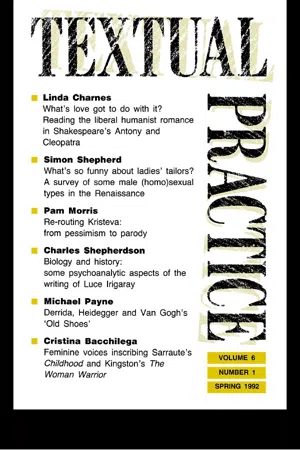
- WHAT’S LOVE GOT TO DO WITH IT? READING THE LIBERAL HUMANIST ROMANCE IN SHAKESPEARE’S ANTONY AND CLEOPATRA
- WHAT’S SO FUNNY ABOUT LADIES’ TAILORS? A SURVEY OF SOME MALE (HOMO)SEXUAL TYPES IN THE RENAISSANCE
- RE-ROUTING KRISTEVA: FROM PESSIMISM TO PARODY
- BIOLOGY AND HISTORY: SOME PSYCHOANALYTIC ASPECTS OF THE WRITING OF LUCE IRIGARAY
- DERRIDA, HEIDEGGER, AND VAN GOGH’S ‘OLD SHOES’
- FEMININE VOICES INSCRIBING SARRAUTE’S CHILDHOOD AND KINGSTON’S THE WOMAN WARRIOR
- LETTER
- REVIEWS
Trusted by 375,005 students
Access to over 1.5 million titles for a fair monthly price.
Study more efficiently using our study tools.
Frequently asked questions
Yes, you can cancel anytime from the Subscription tab in your account settings on the Perlego website. Your subscription will stay active until the end of your current billing period. Learn how to cancel your subscription
No, books cannot be downloaded as external files, such as PDFs, for use outside of Perlego. However, you can download books within the Perlego app for offline reading on mobile or tablet. Learn how to download books offline
Perlego offers two plans: Essential and Complete
- Essential is ideal for learners and professionals who enjoy exploring a wide range of subjects. Access the Essential Library with 800,000+ trusted titles and best-sellers across business, personal growth, and the humanities. Includes unlimited reading time and Standard Read Aloud voice.
- Complete: Perfect for advanced learners and researchers needing full, unrestricted access. Unlock 1.5M+ books across hundreds of subjects, including academic and specialized titles. The Complete Plan also includes advanced features like Premium Read Aloud and Research Assistant.
We are an online textbook subscription service, where you can get access to an entire online library for less than the price of a single book per month. With over 1.5 million books across 990+ topics, we’ve got you covered! Learn about our mission
Look out for the read-aloud symbol on your next book to see if you can listen to it. The read-aloud tool reads text aloud for you, highlighting the text as it is being read. You can pause it, speed it up and slow it down. Learn more about Read Aloud
Yes! You can use the Perlego app on both iOS and Android devices to read anytime, anywhere — even offline. Perfect for commutes or when you’re on the go.
Please note we cannot support devices running on iOS 13 and Android 7 or earlier. Learn more about using the app
Please note we cannot support devices running on iOS 13 and Android 7 or earlier. Learn more about using the app
Yes, you can access Textual Practice by Terence Hawkes in PDF and/or ePUB format, as well as other popular books in Literature & Feminist Literary Criticism. We have over 1.5 million books available in our catalogue for you to explore.