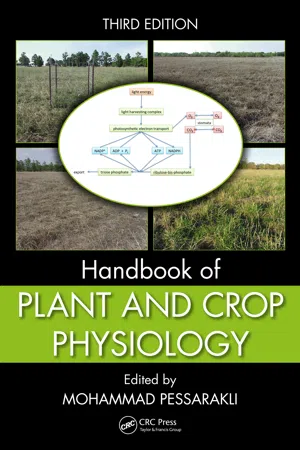
Continuous discoveries in plant and crop physiology have resulted in an abundance of new information since the publication of the second edition of the Handbook of Plant and Crop Physiology, necessitating a new edition to cover the latest advances in the field. Like its predecessors, the Third Edition offers a unique, complete collection of topics
- 1,018 pages
- English
- PDF
- Available on iOS & Android
eBook - PDF
Handbook of Plant and Crop Physiology
About this book
Information
Table of contents
- Front Cover
- Contents
- Preface
- Acknowledgments
- Editor
- Contributors
- Chapter 1: Cell Cycle Regulation and Plant Development: A Crop Production Perspective
- Chapter 2: Seed Dormancy, Germination, and Seedling Recruitment in Weedy Setaria
- Chapter 3: Alterations in Structural Organization Affect the Functional Ability of Photosynthetic Apparatus
- Chapter 4: Photoperiodic Control of Flowering in Plants
- Chapter 5: Role of Alternative Respiratory Pathway in Plants: Some Metabolic and Physiological Aspects
- Chapter 6: Growth Orientation of Underground Shoots: Stolons and Rhizomes and Aboveground Creeping Shoots in Perennial Herbaceous Plants
- Chapter 7: Structure and Metabolism of Underground Shoots in Perennial Rhizome-Forming Plants
- Chapter 8: Evaluating and Managing Crops Water Requirement
- Chapter 9: Biochemistry and Physiology of Carbon Partitioning in Crop Plants
- Chapter 10: Role of Nitric Oxide in Plant Development
- Chapter 11: Mitochondria in Plant Physiology
- Chapter 12: Signaling Molecules Involved in the Postharvest Stress Response of Plants: Quality Changes and Synthesis of Secondary Metabolites
- Chapter 13: Quantifying Immediate Carbon Export from Leaves Predicts Source Strength
- Chapter 14: Physiology of Grain Development in Cereals
- Chapter 15: C-Repeat Transcription Factors as Targets for the Maintenance of Crop Yield under Suboptimal Growth Conditions
- Chapter 16: Physiology of Crop Productivity in Cold Climate
- Chapter 17: Rates of Processes of Essential Plant Nutrients
- Chapter 18: Some Interactions of Mineral Nutrients and Organic Substances in Plant Nutrition
- Chapter 19: Role of Polyamines in Plant Abiotic Stress Responses
- Chapter 20: Physiological and Biochemical Mechanisms of Plant Tolerance to Heat Stress
- Chapter 21: Drought Resistance in Small Grain Cereal Crops
- Chapter 22: Drought Physiology of Forage Crops
- Chapter 23: Effect of Drought/Water Stress and Adaptation to Unintended Consequences of Wheat Growth and Development in Pakistan
- Chapter 24: Physiological Mechanisms of Nitrogen Absorption and Assimilation in Plants under Stressful Conditions
- Chapter 25: Effects of Hyperosmotic Salinity on Protein Patterns and Enzyme Activities
- Chapter 26: Reactive Oxygen Species Generation, Hazards, and Defense Mechanisms in Plants under Environmental (Abiotic and Biotic) Stress Conditions
- Chapter 27: Implications of Oxidative Stress for Crop Growth and Productivity
- Chapter 28: Physiological and Biophysical Responses of Plants under Low and Ultralow Temperatures
- Chapter 29: Stress Tolerance in Some European Resurrection Plants (Haberlea rhodopensis and Ramonda spp.)
- Chapter 30: Salinity and Amenity Horticulture
- Chapter 31: Physiological Responses of Cotton (Gossypium hirsutum L.) to Salt Stress
- Chapter 32: Isoprenoid Biosynthesis in Higher Plants and Green Algae under Normal and Light Stress Conditions
- Chapter 33: Metal Nanoparticles in Plants: Formation and Action
- Chapter 34: Arsenic Toxicity and Tolerance Mechanisms in Crop Plants
- Chapter 35: Small RNAs in Crop Response to Temperature Stress Noncoding RNAs in Plants
- Chapter 36: Comparative Genomics of Grass Genomes Using CoGe
- Chapter 37: Carbon Dioxide, Climate Change, and Crops in the Twenty-First Century: The Dawn of a New World
- Chapter 38: CAM Plants as Crops: Adaptable, Metabolically Flexible, and Highly Productive Cultivars
- Chapter 39: Advances in Improving Adaptation of Common Bean and Brachiaria Forage Grasses to Abiotic Stresses in the Tropics
- Chapter 40: Improving Maize Production under Drought Stress: Traits, Screening Methods, and Environments
- Chapter 41: New Approaches to Turfgrass Nutrition: Humic Substances and Mycorrhizal Inoculation
- Chapter 42: Use of Sewage in Agriculture and Related Activities
- Chapter 43: Water and Crops: Molecular Biologists’, Physiologists’, and Plant Breeders’ Approach in the Context of Evergreen Revolution
- Back Cover
Trusted by 375,005 students
Access to over 1.5 million titles for a fair monthly price.
Study more efficiently using our study tools.
Frequently asked questions
Yes, you can cancel anytime from the Subscription tab in your account settings on the Perlego website. Your subscription will stay active until the end of your current billing period. Learn how to cancel your subscription
No, books cannot be downloaded as external files, such as PDFs, for use outside of Perlego. However, you can download books within the Perlego app for offline reading on mobile or tablet. Learn how to download books offline
Perlego offers two plans: Essential and Complete
- Essential is ideal for learners and professionals who enjoy exploring a wide range of subjects. Access the Essential Library with 800,000+ trusted titles and best-sellers across business, personal growth, and the humanities. Includes unlimited reading time and Standard Read Aloud voice.
- Complete: Perfect for advanced learners and researchers needing full, unrestricted access. Unlock 1.5M+ books across hundreds of subjects, including academic and specialized titles. The Complete Plan also includes advanced features like Premium Read Aloud and Research Assistant.
We are an online textbook subscription service, where you can get access to an entire online library for less than the price of a single book per month. With over 1.5 million books across 990+ topics, we’ve got you covered! Learn about our mission
Look out for the read-aloud symbol on your next book to see if you can listen to it. The read-aloud tool reads text aloud for you, highlighting the text as it is being read. You can pause it, speed it up and slow it down. Learn more about Read Aloud
Yes! You can use the Perlego app on both iOS and Android devices to read anytime, anywhere — even offline. Perfect for commutes or when you’re on the go.
Please note we cannot support devices running on iOS 13 and Android 7 or earlier. Learn more about using the app
Please note we cannot support devices running on iOS 13 and Android 7 or earlier. Learn more about using the app
Yes, you can access Handbook of Plant and Crop Physiology by Mohammad Pessarakli in PDF and/or ePUB format, as well as other popular books in Biological Sciences & Biology. We have over 1.5 million books available in our catalogue for you to explore.