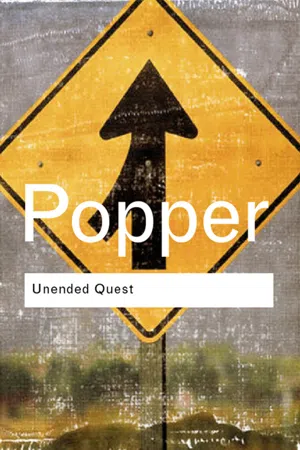
At the age of eight, Karl Popper was puzzling over the idea of infinity and by fifteen was beginning to take a keen interest in his father's well-stocked library of books. Unended Quest recounts these moments and many others in the life of one of the most influential thinkers of the twentieth century, providing an indispensable account of the ideas that influenced him most. As an introduction to Popper's philosophy, Unended Quest also shines. Popper lucidly explains the central ideas in his work, making this book ideal for anyone coming to Popper's life and work for the first time.
- 328 pages
- English
- ePUB (mobile friendly)
- Available on iOS & Android
eBook - ePub
About this book
Information
What to leave out and what to put in? That’s the problem.
Hugh Lofting, Doctor Dolittle’s Zoo.
1. OMNISCIENCE AND FALLIBILITY
When I was twenty I became apprenticed to an old master cabinetmaker in Vienna whose name was Adalbert Pösch, and I worked with him from 1922 to 1924, not long after the First World War. He looked exactly like Georges Clemenceau, but he was a very mild and kind man. After I had gained his confidence he would often, when we were alone in his workshop, give me the benefit of his inexhaustible store of knowledge. Once he told me that he had worked for many years on various models of a perpetual motion machine, adding musingly: “They say you can’t make it; but once it’s been made they’ll talk different!” (“Da sag’n s’ dass ma’ so was net mach’n kann; aber wann amal eina ein’s g’macht hat, dann wer’n s’ schon anders red’n!”) A favourite practice of his was to ask me a historical question and to answer it himself when it turned out that I did not know the answer (although I, his pupil, was a University student—a fact of which he was very proud). “And do you know”, he would ask, “who invented topboots? You don’t? It was Wallenstein, the Duke of Friedland, during the Thirty Years War.” After one or two even more difficult questions, posed by himself and triumphantly answered by himself, my master would say with modest pride: “There, you can ask me whatever you like: I know everything.” (“Da können S’ mi’ frag’n was Sie woll’n: ich weiss alles.”)
I believe I learned more about the theory of knowledge from my dear omniscient master Adalbert Pösch than from any other of my teachers. None did so much to turn me into a disciple of Socrates. For it was my master who taught me not only how very little I knew but also that any wisdom to which I might ever aspire could consist only in realizing more fully the infinity of my ignorance.
These and other thoughts which belonged to the field of epistemology were occupying my mind while I was working on a writing desk. We had at that time a large order for thirty mahogany kneehole desks, with many, many drawers. I fear that the quality of some of these desks, and especially their French polish, suffered badly from my preoccupation with epistemology. This suggested to my master and also brought home to me that I was too ignorant and too fallible for this kind of work. So I made up my mind that on completing my apprenticeship in October, 1924, I should look for something easier than making mahogany writing desks. For a year I took up social work with neglected children, which I had done before and found very difficult. Then, after five more years spent mainly in studying and writing, I married and settled down happily as a schoolteacher. This was in 1930.
At that time I had no professional ambitions beyond school-teaching, though I got a little tired of it after I had published my Logik der Forschung, late in 1934. I therefore felt myself very fortunate when in 1937 I had an opportunity to give up school-teaching and to become a professional philosopher. I was almost thirty-five and I thought that I had now finally solved the problem of how to work on a writing desk and yet be preoccupied with epistemology.
2. CHILDHOOD MEMORIES
Although most of us know the date and the place of our birth—mine is July 28, 1902, at a place called Himmelhof in the Ober St Veit district of Vienna—few know when and how their intellectual life began. So far as my philosophical development goes, I do remember some of its early stages. But it certainly started later than my emotional and moral development.
As a child I was, I suspect, somewhat puritanical, even priggish, though this attitude was perhaps tempered by the feeling that I had no right to sit in judgement on anybody except myself. Among my earliest memories are feelings of admiration for my elders and betters, for example for my cousin Eric Schiff, whom I greatly admired for being one year older than I, for his tidiness and, especially, for his good looks: gifts which I always regarded as important and unattainable.
One often hears it said nowadays that children are cruel by nature. I do not believe it. I was, as a child, what Americans might call a “softy”, and compassion is one of the strongest emotions I remember. It was the main component of my first experience of falling in love, which happened when I was four or five years old. I was taken to a kindergarten, and there was a beautiful little girl who was blind. My heart was torn, both by the charm of her smile and by the tragedy of her blindness. It was love at first sight. I have never forgotten her, though I saw her only once, and only for an hour or two. I was not sent to the kindergarten again; perhaps my mother noticed how much I was upset.
The sight of abject poverty in Vienna was one of the main problems which agitated me when I was still a small child—so much so that it was almost always at the back of my mind. Few people now living in one of the Western democracies know what poverty meant at the beginning of this century: men, women, and children suffering from hunger, cold and hopelessness. But we children could not help. We could do no more than ask for a few coppers to give to some poor people.
It was only after many years that I found that my father had worked hard and long to do something about this situation, although he had never talked about these activities. He worked on two committees which were running homes for the homeless: a freemasons’ lodge of which he was for many years the Master ran a home for orphans, while the other committee (not masonic) built and administered a large institution for homeless adults and families. (An inmate of the latter institution—the “Asyl für Obdachlose”—was Adolf Hitler during his early stay in Vienna.)
This work of my father’s received unexpected recognition when the old Emperor made him a knight of the Order of Francis Joseph (Ritter des Franz Josef Ordens), which must have been not only a surprise but a problem. For although my father—like most Austrians—respected the Emperor, he was a radical liberal of the school of John Stuart Mill, and not at all a supporter of the government.
As a freemason he was even a member of a society which at that time was declared illegal by the Austrian government, though not by the Hungarian government of Francis Joseph. Thus the freemasons often met beyond the Hungarian border, in Pressburg (now Bratislava in Czechoslovakia). The Austro-Hungarian Empire, though a constitutional monarchy, was not ruled by its two Parliaments: they had no power to dismiss the two Prime Ministers or the two Cabinets, not even by a vote of censure. The Austrian Parliament, it would seem, was even weaker than the English Parliament under William and Mary, if such a comparison can be made at all. There were few checks and balances, and there was severe political censorship; for example, a brilliant political satire, Anno 1903, which my father had written under the pen name Siegmund Karl Pflug, was seized by the police on its publication in 1904 and remained on the Index of prohibited books until 1918.
Nevertheless, in those days before 1914 there was an atmosphere of liberalism in Europe west of Czarist Russia; an atmosphere which also pervaded Austria and which was destroyed, for ever it now seems, by the First World War. The University of Vienna, with its many teachers of real eminence, had a great degree of freedom and autonomy. So had the theatres, which were important in the life of Vienna—almost as important as music. The Emperor kept aloof from all political parties and did not identify himself with any of his governments. Indeed he followed, almost to the letter, the precept given by Søren Kierkegaard to Christian VIII of Denmark.1
3. EARLY INFLUENCES
The atmosphere in which I was brought up was decidedly bookish. My father Dr Simon Siegmund Carl Popper, like his two brothers, was a doctor of law of the University of Vienna. He had a large library, and there were books everywhere—with the exception of the dining room, in which there was a Bösendorfer concert grand and many volumes of Bach, Haydn, Mozart, Beethoven, Schubert, and Brahms. My father, who was the same age as Sigmund Freud—whose works he possessed, and had read on publication—was a barrister and solicitor. About my mother Jenny Popper, née Schiff, I shall say more when I come to speak about music. My father was an accomplished speaker. I heard him plead in court only once, in 1924 or 1925, when I myself was the defendant. The case was, in my opinion, clear-cut.2 I had therefore not asked my father to defend me, and was embarrassed when he insisted. But the utter simplicity, clarity, and sincerity of his speech impressed me greatly.
My father worked hard in his profession. He had been a friend and partner of the last liberal Burgomaster of Vienna, Dr Carl Grübl, and had taken over his law office. This office was part of the large apartment in which we lived, in the very heart of Vienna, opposite the central door of the cathedral (Stephanskirche).2a He worked long hours in this office, but he was really more of a scholar than a lawyer. He was a historian (the historical part of his library was considerable) and was interested especially in the Hellenistic period, and in the eighteenth and nineteenth centuries. He wrote poetry, and translated Greek and Latin verse into German. (He rarely spoke of these matters. It was by sheer accident that I found one day some light-hearted verse translations of Horace. His special gifts were a light touch and a strong sense of humour.) He was greatly interested in philosophy. I still possess his Plato, Bacon, Descartes, Spinoza, Locke, Kant, Schopenhauer, and Eduard von Hartmann; J. S. Mill’s collected works, in a German translation edited by Theodor Gomperz (whose Greek Thinkers he valued hightly); most of Kierkegaard’s, Nietzsche’s, and Eucken’s works, and those of Ernst Mach; Fritz Mauthner’s Critique of Language and Otto Weininger’s Geschlecht und Charakter (both of which seem to have had some influence on Wittgenstein);3 and translations of most of Darwin’s books. (Pictures of Darwin and of Schopenhauer hung in his study.) There were, of course, the standard authors of German, French, English, Russian, and Scandinavian literature. But one of his main interests was in social problems. He not only possessed the chief works of Marx and Engels, of Lassalle, Karl Kautsky, and Eduard Bernstein, but also those of the critics of Marx: Böhm-Bawerk, Carl Menger, Anton Menger, P. A. Kropotkin, and Josef Popper-Lynkeus (apparently a distant relative of mine, since he was born in Kolin, the little town from which my paternal grandfather came). The library had also a pacifist section, with books by Bertha von Suttner, Friedrich Wilhelm Förster, and Norman Angell.
Thus books were part of my life long before I could read them. The first book which made a big and lasting impression on me was read by my mother to my two sisters and to me, shortly before I learned to read. (I was the youngest of three children.) It was a book for children by the great Swedish writer Selma Lagerlöf, in a beautiful German translation (Wunderbare Reise des kleinen Nils Holgersson mit den Wildgänsen; the English translation is entitled The Wonderful Adventures of Nils). For many, many years I reread this book at least once a year; and in the course of time I probably read everything by Selma Lagerlöf more than once. I do not like her first novel, Gösta Berling, though it is no doubt very remarkable. But every single one of her other books remains, for me, a masterpiece.
Learning to read, and to a lesser degree, to write, are of course the major events in one’s intellectual development. There is nothing to compare with it, since very few people (Helen Keller is the great exception) can remember what it meant for them to learn to speak. I shall be for ever grateful to my first teacher, Emma Goldberger, who taught me the three R’s. They are, I think, the only essentials a child has to be taught; and some children do not even need to be taught in order to learn these. Everything else is atmosphere, and learning through reading and thinking.
Apart from my parents, my first schoolteacher, and Selma Lagerlöf, the greatest influence on my early intellectual development was, I suppose, my lifelong friend Arthur Arndt, a relative of Ernst Moritz von Arndt who had been one of the famous founding fathers of German nationalism in the period of the Napoleonic wars.4 Arthur Arndt was an ardent anti-nationalist. Though of German descent, he was born in Moscow, where he also spent his youth. He was my senior by about twenty years—he was near thirty when first I met him in 1912. He had studied engineering at the University of Riga, and had been one of the student leaders during the abortive Russian revolution of 1905. He was a socialist and at the same time a strong opponent of the Bolsheviks, some of whose leaders he knew personally from 1905. He described them as the Jesuits of socialism, that is, capable of sacrificing innocent men, even of their own persuasion, because great ends justified all means. Arndt was not a convinced Marxist, yet he thought that Marx had been the most important theorist of socialism so far. He found me very willing to listen to socialist ideas; nothing, I felt, could be more important than to end poverty.
Arndt was also deeply interested (much more so than my father was) in the movement which had been started by the pupils of Ernst Mach and of Wilhelm Ostwald, a society whose members called themselves “The Monists”. (There was a connection with the famous American journal, The Monist, to which Mach was contributor.) They were interested in science, epistemology, and in what nowadays would be called the philosophy of science. Among the Monists of Vienna the “half-socialist” Popper-Lynkeus had a considerable following, which included Otto Neurath.
The first book on socialism I read (probably under the influence of my friend Arndt—my father was reluctant to influence me) was Edward Bellamy’s Looking Backward. I must have read it when I was about twelve, and it made a great impression on me. Arndt took me on Sunday excursions, arranged by the Monists, to the Vienna Woods, and on these occasions he explained and discussed Marxism and Darwinism. No doubt most of this was far beyond my grasp. But it was interesting and exciting.
One of these Sunday excursions by the Monists was on June 28, 1914. Towards evening, as we approached the outskirts of Vienna, we heard that the Archduke Franz Ferdinand, heir apparent of Austria, had been assassinated in Sarajevo. A week or so after this my mother took me and my two sisters for our summer holidays to Alt-Aussee, a village not far from Salzburg. And there, on my twelfth birthday, I received a letter from my father in which he said that he was sorry not to be able to come for my birthday, as he had intended, “because, unfortunately, there is war” (“denn es ist leider Krieg”). Since this letter arrived on the day of the actual declaration of war between Austria-Hungary and Serbia, it seems that my father realized that it was coming.
4. THE FIRST WORLD WAR
I was twelve, then, when the First World War broke out; and the war years, and their aftermath, were in every respect decisive for my intellectual development. They made me critical of accepted opinions, especially political opinions.
Of course, few people knew at that time what war meant. There was a deafening clamour of patriotism throughout the country in which even some of the members of our previously far from warmongering circle participated. My father was sad and depressed. Yet even Arndt could see something hopeful. He hoped for a democratic revolution in Russia.
Afterwards I often remembered these days. Before the war, many members of our circle had discussed political theories which were decidedly pacifist, and at least highly critical of the existing order, and had been critical of the alliance between Austria and Germany, and of the expansionist policy of Austria in the Balkans, especially in Serbia. I was staggered by the fact that they could suddenly become supporters of that very policy.
Today I understand these things a little better. It was not only the pressure of public opinion; it was the problem of divided loyalties. And there was also fear — the fear of violent measures which, in war, have to be taken by the authorities against dissenters, since no sharp line can be drawn between dissent and treason. But at the time I was greatly puzzled. I knew, of course, nothing about what had happened to the socialist parties of Germany and France: how their internationalism disintegrated. (A marvellous description of these events can be found in the last volumes of Roger Martin du Gard’s Les Thibaults.)5
For a few weeks, under the influence of war propaganda in my school, I became a little infected by the general mood. In the autumn of 1914 I wrote a silly poem “Celebrating the Peace”, in which the assumption was expressed that the Austrians and the Germans had successfully resisted the attack (I then believed that “we” had been attacked) and which described, and celebrated, the restoration of peace. Though it was not a very warlike poem I soon became thoroughly ashamed of the assumption that “we” had been attacked. I realized that the Austrian attack on Serbia and the German attack on Belgium were terrible things and that a huge appa...
Table of contents
- Cover
- Halftitle
- Title
- Copyright
- Contents
- Acknowledgements
- 1 Omniscience and Fallibility
- 2 Childhood Memories
- 3 Early Influences
- 4 The First World War
- 5 An Early Philosophical Problem: Infinity
- 6 My First Philosophical Failure: The Problem of Essentialism
- 7 A Long Digression Concerning Essentialism: What Still Divides Me from Most Contemporary Philosophers
- 8 A Crucial Year: Marxism; Science and Pseudoscience
- 9 Early Studies
- 10 A Second Digression: Dogmatic and Critical Thinking; Learning Without Induction
- 11 Music
- 12 Speculations About the Rise of Polyphonic Music: Psychology of Discovery or Logic of Discovery?
- 13 Two Kinds of Music
- 14 Progressivism in Art, Especially in Music
- 15 Last Years at the University
- 16 Theory of Knowledge: Logik Der Forschung
- 17 Who Killed Logical Positivism?
- 18 Realism and Quantum Theory
- 19 Objectivity and Physics
- 20 Truth; Probability; Corroboration
- 21 The Approaching War; The Jewish Problem
- 22 Emigration: England and New Zealand
- 23 Early Work in New Zealand
- 24 The Open Society and the Poverty of Historicism
- 25 Other Work in New Zealand
- 26 England: At the London School of Economics and Political Science
- 27 Early Work in England
- 28 First Visit to the United States: Meeting Einstein
- 29 Problems and Theories
- 30 Debates with SchröDinger
- 31 Objectivity and Criticism
- 32 Induction; Deduction; Objective Truth
- 33 Metaphysical Research Programmes
- 34 Fighting Subjectivism in Physics: Quantum Mechanics and Propensity
- 35 Boltzmann and the Arrow of Time
- 36 The Subjectivist Theory of Entropy
- 37 Darwinism as a Metaphysical Research Programme
- 38 World 3 or the Third World
- 39 The Body-Mind Problem and World 3
- 40 The Place of Values in a World of Facts
- Postscript
- Postscript to Marxism, 1992
- Notes
- Main Publications and Abbreviations of Titles
- Select Bibliography
- Index
Trusted by 375,005 students
Access to over 1.5 million titles for a fair monthly price.
Study more efficiently using our study tools.
Frequently asked questions
Yes, you can cancel anytime from the Subscription tab in your account settings on the Perlego website. Your subscription will stay active until the end of your current billing period. Learn how to cancel your subscription
No, books cannot be downloaded as external files, such as PDFs, for use outside of Perlego. However, you can download books within the Perlego app for offline reading on mobile or tablet. Learn how to download books offline
Perlego offers two plans: Essential and Complete
- Essential is ideal for learners and professionals who enjoy exploring a wide range of subjects. Access the Essential Library with 800,000+ trusted titles and best-sellers across business, personal growth, and the humanities. Includes unlimited reading time and Standard Read Aloud voice.
- Complete: Perfect for advanced learners and researchers needing full, unrestricted access. Unlock 1.5M+ books across hundreds of subjects, including academic and specialized titles. The Complete Plan also includes advanced features like Premium Read Aloud and Research Assistant.
We are an online textbook subscription service, where you can get access to an entire online library for less than the price of a single book per month. With over 1.5 million books across 990+ topics, we’ve got you covered! Learn about our mission
Look out for the read-aloud symbol on your next book to see if you can listen to it. The read-aloud tool reads text aloud for you, highlighting the text as it is being read. You can pause it, speed it up and slow it down. Learn more about Read Aloud
Yes! You can use the Perlego app on both iOS and Android devices to read anytime, anywhere — even offline. Perfect for commutes or when you’re on the go.
Please note we cannot support devices running on iOS 13 and Android 7 or earlier. Learn more about using the app
Please note we cannot support devices running on iOS 13 and Android 7 or earlier. Learn more about using the app
Yes, you can access Unended Quest by Karl Popper in PDF and/or ePUB format, as well as other popular books in Philosophy & Philosopher Biographies. We have over 1.5 million books available in our catalogue for you to explore.