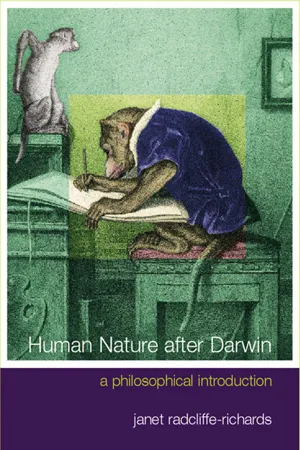
Human Nature After Darwin is an original investigation of the implications of Darwinism for our understanding of ourselves and our situation. It casts new light on current Darwinian controversies, also providing an introduction to philosophical reasoning and a range of philosophical problems.
Janet Radcliffe Richards claims that many current battles about Darwinism are based on mistaken assumptions about the implications of the rival views. Her analysis of these implications provides a much-needed guide to the fundamentals of Darwinism and the so-called Darwin wars, as well as providing a set of philosophical techniques relevant to wide areas of moral and political debate.
The lucid presentation makes the book an ideal introduction to both philosophy and Darwinism as well as a substantive contribution to topics of intense current controversy. It will be of interest to students of philosophy, science and the social sciences, and critical thinking.
- 336 pages
- English
- ePUB (mobile friendly)
- Available on iOS & Android
eBook - ePub
About this book
Information
1
The theory
To understand the implications of the Darwinian revolution, it is necessary to understand the world view it replaced. This chapter provides a brief introduction to Darwin’s theory of evolution by natural selection by presenting it as a successor to the scientific revolution of the sixteenth and seventeenth centuries, and as having the potential to complete the overthrow of the traditional ways of thinking that the earlier revolution had begun.
In particular, it distinguishes between teleological and non-teleological explanation, and shows Darwin’s theory as relying on non-teleological explanation in contexts where teleological explanation had previously seemed essential.
The first scientific revolution
When The Origin of Species was published in 1859, it not only offered a radically different account of animal origins from anything there had been before, but also carried the unmistakable implication that most traditional beliefs about our own nature and our destiny would need equally radical reconsideration. The zoologist G.G.Simpson, writing in 1966, said that all attempts to answer questions about the nature of human beings and the meaning of life before 1859 had been worthless, and that we should be better off if we ignored them completely (Simpson (1966)).
This book is about the implications of the Darwinian revolution for our understanding of ourselves and our situation, and in particular about the extent to which it demands changes in traditional ideas about the kind of thing we are. But to understand the extent of any such changes it is necessary to know what they are changes from; and since many of the most deeply rooted ideas of human nature are of ancient origin, it will be useful to go back not just to the world into which The Origin of Species exploded, but further still, to the time before the first scientific revolution of the sixteenth and seventeenth centuries, and consider how the world seemed to Western people then.
This will also be useful for another reason. The scientific revolution that began in 1543 with the publication of Copernicus’s idea that the earth was a planet in orbit around the sun, and reached its watershed with the publication of Newton’s Principia in 1687, is now far enough in the past to allow us to see clearly what kind of change it involved and how much difference it made to people’s understanding of themselves and their position. Since we are still in the thick of the Darwinian revolution the situation is much less clear, and the earlier revolution will provide some useful illustrations and analogies.
So, bearing in mind that this can be nothing more than the sketchiest of sketches, start by considering the situation before Copernicus (1473–1543), Galileo (1564–1642) and Newton (1643–1727).
Until this time, by far the most powerful and unified theory of the universe was that of Aristotle (384–322 BC). He thought of the cosmos as a series of concentric spheres, with the earth – itself spherical – at the centre. Enclosing the earth was a series of rotating solid, transparent (‘crystalline’) spheres which carried the sun, the moon, the planets and the fixed stars in their orbits, and, beyond them, the Empyreum, which enclosed them all.
These concentric layers differed in substance and nature, and there was, in particular, a radical difference between the heavens and the earth. The earth with its immediate surroundings – everything ‘sublunary’, below the moon – was made of the four earthly elements of earth, water, air and fire. Each of these had its own distinctive characteristics, and also its own natural position in the scheme of things, towards which it would move unless forcibly prevented and where it would remain until moved by external forces. Earth’s natural position was at the centre of the universe, followed by a layer of water, then air, and then, just below the moon, fire. This was why stones fell and flames rose: they were trying to get back to their natural positions. The sublunary elements were, however, mixed together and kept in a perpetual state of turmoil by the power of the heavens, and things made of them were subject to generation, corruption and decay as the various elements came together and separated.
The heavens – the crystalline spheres, and the heavenly bodies they carried – were quite different. They were composed of a fifth element – the ‘quintessence’ – and because they were pure, rather than composed of separate elements that could mix and scatter, they were not corruptible. The only change they were capable of was that of position, and their natural motion was not up or down, but circular – constant and unending. They were also more powerful than anything in the sublunary sphere, with strong influences over the earth and everything on it. Then, finally, beyond the heavens, there lay the Empyreum. This was the purest and most powerful region of all, and unsusceptible to change of any kind.
Aristotle’s universe became the basis of most intellectual ideas about cosmology after its reintroduction to the West through the Muslim world in the twelfth century, and it remained so until the scientific revolution of the seventeenth, for reasons that are not difficult to understand.
The first of these was that most of its foundations were intuitively plausible. If you think about the way things would seem to someone with no modern understanding of science, standing on the surface of the earth and watching what was going on around, you can easily see how this general view of things accorded with observation. The heavenly bodies do appear to move in circles round the earth; earth and water do appear to move naturally downwards unless prevented, and fire and air to move upwards. The heavens do seem far more powerful than the earth, and the main influence on what happens: people have always been at the mercy of climate and weather. Winds can devastate the land and churn up the seas; too much sun will burn you and shrivel your crops, too little will leave you and your plants to freeze. The only part of the scheme that does not look immediately plausible is the idea of a spherical earth, but this had also been recognized as in accordance with observation before the time of Aristotle. The curved shadow of the earth during lunar eclipses, the disappearance of ships over the horizon, and the extending of the horizon with altitude, were well-known phenomena.
Second, Aristotle fitted the elements of his scheme together into an impressive intellectual whole. The basis of the idea that the earth was a sphere at the centre of the universe, for instance, was not just that it was known to be spherical, and that everything else seemed to go round it; it also fitted the idea that the elements of which it was principally made – earth and water – naturally moved downwards unless positively prevented. This meant that matter would inevitably accumulate in the centre of the universe: if parts became separated from the centre, they would try to find their way back again. There could, therefore, be only one earth, and that must take the form of a sphere in the centre of things.
Of course the scheme was by no means complete or flawless, and the eventual development of modern science came about through persistent and determined attempts to deal with the many anomalies that appeared. The planets, for instance, always presented a problem, since they did not move in smooth circles (‘planet’ comes from the Greek for ‘wanderer’): they kept interrupting their progress round the earth with little backward movements known as retrogressions. But no other scheme offered anything like such a systematic account of observation, and the Aristotelian cosmology became even more established when it was systematized further in the second century AD by the Greek astronomer Ptolemy, in his Almagest. The Ptolemaic system explained the retrograde movements of the planets without giving up the fundamental Aristotelian idea that it was the nature of heavenly bodies to move in circles. This involved a good deal of contrivance, with complicated sets of epicycles (circles revolving round moving points on the circumferences of other circles) and various other ad hoc devices for ‘saving the appearances’ (making the theory fit the observations); but the system gave good predictions of the positions of the planets into the indefinite future, and its success helped to entrench the Aristotelian view of the cosmos.
Finally, the basic Aristotelian idea became further entrenched – most strikingly in the work of Dante – by an overlay of Christian theology which integrated the universe of concentric spheres with a theological and moral order. Hell – Dante’s inferno – was literally underground, at the centre of the universe, with Dante’s nine circles of Hell reflecting deeper and deeper turpitude. Above the earth rose the spheres of the heavens of increasing power and purity, kept in their motions by ‘intelligences’, and the nine orders of angels. And finally, beyond them all, lay the throne of God in the unchanging Empyreum. Mankind was in the middle of this scheme of things: the only being that combined heavenly and earthly natures. Human beings consisted of immaterial souls, whose substance was that of the heavens, and material bodies that were animated by those souls. The souls were striving to reach their natural position among other heavenly things; their earthly bodies were bent on pulling them downwards, to Hell. The cosmology both reflected and entrenched the Christian rejection of the material, and its conception of the bodily as sinful. It is one of the most striking ways in which these traditional ideas still linger.
This is only an impressionistic sketch, of course; and although it is useful in giving a sense of how the universe was regarded before the scientific revolution, and why it seemed so generally plausible, it must not be mistaken for a scheme that was uniform in detail, or accepted by everyone without much question. Most educated people took the fundamentals for granted, but everyone who considered the details was aware of problems. The crystalline spheres, for instance, raised problems both mechanical and theological. They needed to be solid, if they were to fulfil their purpose of pushing the planets around. But then how could the epicycles work? How could the planets move through the solid crystal? Similar problems arose for ascensions, which were the literal taking up of earthly bodies into the heavens. There were also persistent discrepancies between the geometrical models devised by astronomers and the observed motions of the heavenly bodies. The ad hoc contrivances for saving the appearances gradually proliferated into mechanisms of baroque complexity, in which epicycles were added to epicycles and joined by a menagerie of devices with names like ‘equants’ and ‘hippopedes’, in a never-quite-succeeding attempt to make the elements fit together. By the time of Copernicus, astronomy was widely recognized as being in a scandalous state; and it was the continuing failure to solve the problems of the Ptolemaic system that eventually led Copernicus to look for a more radical solution, and to suggest that the earth was itself a planet circling the sun.
We tend to think of the Copernican revolution as though it was Copernicus himself who gave us our present view of the solar system; and of course that is to some extent true. But Copernicus’s original proposal, although obviously radical in one way, was still conservative in most others. Like his contemporaries, Copernicus still accepted as background much of the Aristotelian system. He still took it for granted that the motions of the heavenly bodies must be explained in terms of perfect circles and crystalline spheres, and by the time his scheme had been worked out in detail his arrangement of circles turned out to be about as convoluted with epicycles as the system he was trying to replace. He also still accepted Aristotle’s ideas of mechanics, according to which things remained in their natural places unless there was a positive force moving them, and against this background the idea of a moving earth seemed simply incredible. If the earth was hurtling round the sun at high speed, why was there not a ferocious gale all the time? Why did loose objects not fly off into space? What force could possibly keep the earth moving? Some people were quickly persuaded by Copernicus’s scheme, but those who resisted, or treated it simply as a geometrical device, had good reason to be sceptical.
What changed things was the revolution in mechanics that came first with Galileo – who also was the first person to use a telescope for astronomy and discover changes and imperfections in the perfect and unchanging heavens – and finally with the work of ‘the incomparable Mr Newton’ (as Locke called him). The Aristotelian theory of distinct elements, each with its own natural motion and its own proper place in the universe, was replaced by Newton’s theory of universal gravitation, which regarded matter as the same kind of thing throughout the universe; and Newton’s laws of motion – according to which things remained at rest or continued in a straight line unless acted on by other forces – replaced the Aristotelian idea that force was needed to keep things moving. This removed the idea that it was the nature of the heavenly bodies to move in circles: the planets would (as it were) move in straight lines if they could, but were pulled into ellipses by the gravitational attraction of the sun. It also removed the need for a force to keep the earth moving, and accounted for our not being able to perceive its movements. The anomalies vanished, and the Copernican scheme – shorn of its encrustation of epicycles and unconstrained by requirements for circular motion – fell triumphantly into place.
All this was bound to make a considerable difference to people’s understanding of their place in the universe, though this did not take quite the form that is commonly believed. It is often said that when the Copernican revolution began to unfold, making the earth only one planet among others, part of the reason for people’s resistance was their losing a place of special privilege at the centre of things. But this mistakes the point. The earth was indeed at the centre of the Aristotelian universe, but human beings themselves were not; they were on the surface of the earth, which was some distance from the centre. And anyway, the Aristotelian view was that everything became less worthy, and less good, and less in every way, towards the centre – the lowest circle of Dante’s Hell was utterly frozen and immobile – so there was nothing cosmically impressive about being in the middle. The good, powerful, important things were (as our traditional thinking leaves no doubt) above. The real change came in the disappearance of the orderly, layered, cosmos, in which everything had its proper place, and in which the moral and theological order corresponded with the physical. With the Newtonian revolution the universe suddenly became infinite, and therefore without any centre at all – not even the sun. And, most important of all, the laws of nature became in this conception the same throughout the universe. The earth was the same sort of thing as the heavenly bodies, and not radically different in kind. Newton had broken down the distinction between the heavens and the earth.
This change in conception is, incidentally, particularly strikingly shown in the rapid and complete abandonment of astrology by astronomers. Astrology had been a respectable (though not very successful) science for most of the history of astronomy, and most astronomers had also been astrologers; belief in astrology had, indeed, provided much of the original motivation for the study of astronomy. Since the heavens were quite reasonably thought to be very different in kind from the earth and to have powerful effects on it, and since the seasons do change with the movement of planets across the background of the fixed stars, it was plausible to try to find connections between what went on in the heavens and what happened on earth – just as it was plausible to wonder about the significance of comets and (what we now know as) supernovae. It was natural, therefore, that enquiring people should take to watching the planets closely, with a view to predicting their movements and influences. But the whole basis of astrology had been the idea of a radical difference in kind and in power between the heavens and the earth; and if the earth is just one planet among the others, the heavens have no more influence on it than it has on them. There is no reason to think of celestial happenings as having any particular significance for events on earth, and certainly not of the kind that formed the basis of astrology. All the reasons for thinking astrology plausible had vanished.
So the change brought about by Copernicus and Newton was indeed a revolution, and obviously made a considerable difference to people’s conception of their place in the scheme of things. Spinning around in an infinite universe is decidedly less comfortable than being enclosed by spheres and angels and God; and if you disrupt the physics of a universe that also incorporates the moral and religious order, you are bound to cause some anxiety. Where, if there was no Empyreum, was the throne of God? Where was Hell? What if there were other inhabited planets in the universe; had it been necessary for them to have incarnations and salvations as well? If the Bible was not literally true in its account of heaven and earth, what did that imply for the rest of it? Obviously religious scepticism – which had always existed – found itself newly fuelled.
On the other hand, although the view of the world had radically and irrevocably changed, there was still a sense in which, from the point of view of people’s understanding of their own nature, all this could be seen as detail. Although the earth and heavens had been pulled together into a single scheme, and so could no longer be seen as characterizing the two essential aspects of human beings, this did not as such threaten the traditional distinction between the material and the spiritual. The idea of an immaterial soul put into human bodies by God, and of human distinctness from animals, who had no soul (or at least, only ‘souls of sense’, not rational souls), could still be kept intact. And although the advance of science led more and more to the study of the human body as a kind of machine, that in itself did not raise any direct problems. The body had always been thought of as material.
Furthermore, in spite of problems about the location of God now that there was no Empyreum, the change did not seem to most people to make the slightest dent in the idea of God as creator and sustainer of the universe. It was still regarded as obvious that intelligence must lie at the root of things. Inanimate matter could not possibly fill that position,...
Table of contents
- Cover
- Title
- Copyright
- Contents
- Acknowledgements
- Introduction
- Chapter 1: The theory
- Chapter 2: The sceptics
- Chapter 3: Internecine strife
- Chapter 4: Implications and conditionals
- Chapter 5: Biology as destiny
- Chapter 6: Blameless puppets
- Chapter 7: Selfish genes and moral animals
- Chapter 8: The end of ethics
- Chapter 9: Onwards and upwards
- Chapter 10: The real differences
- Notes
- Answers to exercises
- Revision questions
- Answers to revision questions
- Suggestions for further reading
- Bibliography
- Index
Trusted by 375,005 students
Access to over 1.5 million titles for a fair monthly price.
Study more efficiently using our study tools.
Frequently asked questions
Yes, you can cancel anytime from the Subscription tab in your account settings on the Perlego website. Your subscription will stay active until the end of your current billing period. Learn how to cancel your subscription
No, books cannot be downloaded as external files, such as PDFs, for use outside of Perlego. However, you can download books within the Perlego app for offline reading on mobile or tablet. Learn how to download books offline
We are an online textbook subscription service, where you can get access to an entire online library for less than the price of a single book per month. With over 1.5 million books across 990+ topics, we’ve got you covered! Learn about our mission
Look out for the read-aloud symbol on your next book to see if you can listen to it. The read-aloud tool reads text aloud for you, highlighting the text as it is being read. You can pause it, speed it up and slow it down. Learn more about Read Aloud
Yes! You can use the Perlego app on both iOS and Android devices to read anytime, anywhere — even offline. Perfect for commutes or when you’re on the go.
Please note we cannot support devices running on iOS 13 and Android 7 or earlier. Learn more about using the app
Please note we cannot support devices running on iOS 13 and Android 7 or earlier. Learn more about using the app
Yes, you can access Human Nature After Darwin by Janet Radcliffe Richards in PDF and/or ePUB format, as well as other popular books in Philosophy & Ethics & Moral Philosophy. We have over 1.5 million books available in our catalogue for you to explore.