Containing extensive artwork serving as demonstration, as well as downloadable resources with sound and video clips, this collection of essays on electroacoustic music explores the creative possibilities to be found in various forms of musical analysis.
Taking pitch, duration, intensity, and timbre as the four basic elements of music, the authors discuss electroacoustic works and examine:
* the applications of neumes * contemporary staff notation * sound orchestra and score files * time-domain representations * spectrograms.
Taking into consideration both the positive aspects (preservation of the abstract) and negative aspects (creative limitation) of these analytical methods, the authors have created a useful resource for students of electroacoustic music.
The evanescent nature of music and humanity’s duty to preserve creativity have led to various representations of musical abstractions. Since the eclipse of the oral tradition with the advent of the scribes, we have struggled to bridge the abyss of lost meaning between representation and intent. Just as the written word alone does not exclusively impart meaning, musical representation does not solely communicate compositional intent. Whether the musical representation consists of neumes, notes on a staff, or graphics, we are obliged to look beyond these visual artifacts and listen carefully to fully understand the music. The visual artifacts are, after all, nothing more than a means to harness the intent of some musical abstraction. This practiced balance among representation, compositional intent, and human perception is why music analysis is truly an art about an art.
1.1. The Four Basic Elements of Music
Many texts on the theory of music describe music in terms of four basic elements: pitch, duration, intensity, and timbre. Pitch, the highness or lowness of a note, is human perception of the physical phenomenon of frequency—the number of oscillations per second of a periodic waveform. There is a logarithmic correlation between a frequency measured in Hertz (Hz) and our perception of that frequency described as a pitch. Pitches are identified as members of the musical alphabet—A, B, C, D, E, F, and G. Human perception of 220 Hz is usually correlated with the pitch A. The A an octave higher has twice the frequency, or 440 Hz; whereas, the A an octave below has one-half the frequency, or 110 Hz. Arabic numerals are used to designate the octave of a pitch. The convention used in this book is that the pitch A above middle C has a note name and octave designation of A4.
Duration is the length in time of a musical event and may be described in terms of relative or absolute time; for example, “one event is twice as long as another,” or “an event is precisely 50 milliseconds in duration.” An elaborate system of notation comprised of such objects as eighth notes, quarter notes, half notes, and whole notes delineates relative durations. These relative durations may be interpreted as absolute duration with the inclusion of a time signature and a tempo marking. For example, a time signature of 4/4 indicates four beats in a measure, with a quarter note receiving one count. If this time signature appeared with a metronome marking of a quarter equals sixty beats per minute, the absolute duration of a quarter note would be one second.
The intensity of a musical event correlates with the listener’s perception of the loudness of a sound. Human perception of intensity is nearly logarithmic. The decibel (dB) is the logarithmic unit of measurement used to compare the intensities of two sounds. One sound played with twice the intensity of another is roughly equivalent to an increase of three decibels. Musicians have developed notational systems to represent intensity. Italian terms such as piano (soft) and forte (loud) describe the intensity or dynamics of a musical passage. Representations have been developed to vary dynamics over time using terms such as crescendi (to gradually get louder) and diminuendi (to gradually get softer). These terms are by no means absolute measurements of intensity and vary in performance according to any number of factors—the range of intensities that may be physically produced by an instrument in relation to other instruments in an ensemble, the character of the music, or the acoustics of the performance space, for example.
Timbre is defined as tone color: it is the element of music that differentiates two sound sources sounding the same pitch for the exact same duration at the same intensity. A timbre may be characterized by its spectrum—the frequencies present in a sound and their corresponding intensities over the duration of the sound. Partials are the building blocks of timbre. The lowest frequency is considered the first partial, or fundamental. Partial numbers increase for each frequency component sounding above the fundamental frequency. A spectrum may be categorized as harmonic or inharmonic. A harmonic spectrum contains partials that are integer multiples of the fundamental frequency. Conversely, an inharmonic spectrum contains partials that are not necessarily integer multiples of the fundamental. Being able to characterize a spectrum as harmonic or inharmonic is useful in categorizing timbre. Traditional acoustic instruments that produce a focused pitch, such as the violin or clarinet, produce predominantly harmonic spectra. Instruments, such as the snare drum or glockenspiel, that have a percussive, noisy attack produce inharmonic spectra.
Throughout music history, representations of musical abstractions have been a double-edged sword: a representation allows us to create, disseminate, and preserve a musical abstraction; yet, these representations may lead to interpretations that are inconsistent with the composer’s intent or, worse yet, constrain human creativity to the paradigm imposed by the representation. Consider the interpretations of the score of the unaccompanied cello suites by J. S. Bach performed by Yo Yo Ma (1983) and Mstislav Rostropovich (1995). These performers introduce subtle nuances in tempo, phrasing, character, and dynamics that illuminate the listener’s understanding of the composition several hundred years after the composer’s death. Next, consider the work of Arnold Schoenberg. The technique of twelve-tone composition exalted the organization of pitch and, thus, extended music composition within the constrained paradigmatic representation of the musical staff(Brindle 1966).
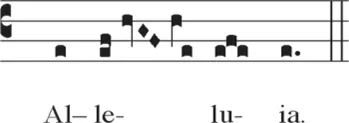
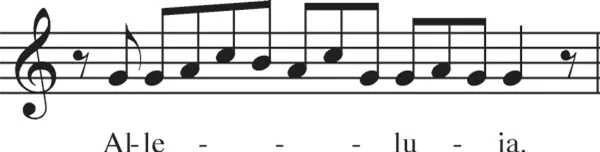
Figure 1.1, an “Alleluia” from the Liber Usualis, demonstrates the musical notation of Gregorian chant—a Roman chant codified by Gregory I during his papacy from 590 to 604 AD. The neumes embed compact meaning for the interpretation and performance of pitch, duration, intensity, and timbre. The four-line staffbegins with a clef sign denoting C5. As seen in the transcription from Gregorian chant to contemporary staffnotation in Figure 1.2, the neumes depict the pitch sequence, the rhythmic grouping, and how the pitches should be articulated in relation to the accompanying text. Despite the potent economy of neumatic representation, the Benedictines of Solesmes (1961) are compelled to augment this musical representation with a textual description stating that the ictus, or strong beat of a rhythmic grouping, may be accompanied by an increase in intensity and further intimated by a change in the timbre of the voice. Although this textual description extends understanding of the performance of the neumes, a significant range of possible interpretations remains: Should each ictus have the same intensity? Should the change in timbre be bright or dark?
Fig. 1.1 “Alleluia” as notated in the Liber Usualis (Benedictines xxviij). (DVD reference 1)
Fig. 1.2 Transcription of “Alleluia” from the Liber Usualis using contemporary staff notation. (DVD reference 2)
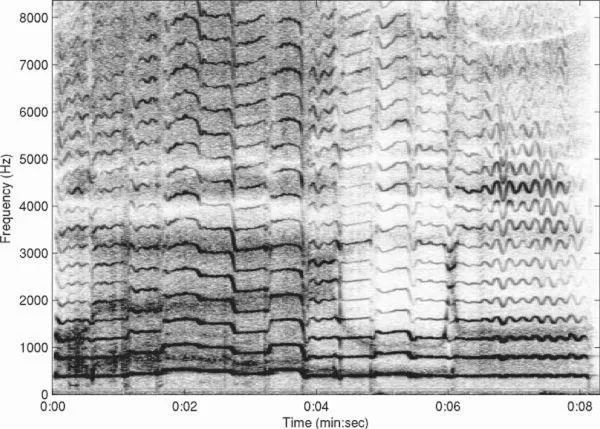
Figure 1.3, a spectrogram, is yet another representation of the same “Alleluia.” To create the spectrogram, a recording of the sung “Alleluia ” was analyzed using the Fourier Transform, a mathematical procedure used to analyze the frequency and amplitude of a signal over time (Moore 1978, 38–60, see chapter 2). The changes in pitch in Figure 1.2 correlate to the changes in frequency on the vertical, or Y-axis in Figure 1.3. The relative durations of Figure 1.2 are denoted as a sequence of absolute durations on the horizontal, or X-axis in Figure 1.3. The relative darkness of frequency or frequency regions in the spectrogram indicates the intensity of a partial. The timbre of the sung “Alleluia” is quantified by its partials. An analysis tool such as the spectrogram provides an objective representation of the change in timbre over time for this particular performance of the “Alleluia.” If the Benedictines of Solesmes had included a recording to accompany the spectrogram as a supplemental representation of the “Alleluia,” the likelihood of misinterpretation in the performance of Gregorian chant would be greatly reduced.
Fig. 1.3 Spectrogram of “Alleluia” from the Liber Usualis sung by a female cantor. (Kosmicki 2005; DVD references 3–6)
In Figure 1.3, the timbre of the sung voice on the initial syllable of alleluia, or “ah,” is sung on the pitch G4. The pitch G4 has a ...
Table of contents
Cover
Half Title
Series Page
Title Page
Copyright Page
Contents
Acknowledgments
1 Introduction
2 Visualization of Musical Signals
3 The Intention/Reception Project
4 Paul Lansky’s As If
5 Alvin Lucier’s I am sitting in a room
6 Jonathan Harvey’s Mortuos Plango, Vivos Voco
7 Philippe Manoury’s Jupiter
8 Barry Truax’s Riverrun
9 Philippe Manoury’s Opera K…
Annotated Bibliography
Glossary
Contributors
Index
Trusted by 375,005 students
Access to over 1.5 million titles for a fair monthly price.
Study more efficiently using our study tools.
Frequently asked questions
Yes, you can cancel anytime from the Subscription tab in your account settings on the Perlego website. Your subscription will stay active until the end of your current billing period. Learn how to cancel your subscription
No, books cannot be downloaded as external files, such as PDFs, for use outside of Perlego. However, you can download books within the Perlego app for offline reading on mobile or tablet. Learn how to download books offline
Perlego offers two plans: Essential and Complete
Essential is ideal for learners and professionals who enjoy exploring a wide range of subjects. Access the Essential Library with 800,000+ trusted titles and best-sellers across business, personal growth, and the humanities. Includes unlimited reading time and Standard Read Aloud voice.
Complete: Perfect for advanced learners and researchers needing full, unrestricted access. Unlock 1.5M+ books across hundreds of subjects, including academic and specialized titles. The Complete Plan also includes advanced features like Premium Read Aloud and Research Assistant.
Both plans are available with monthly, semester, or annual billing cycles.
We are an online textbook subscription service, where you can get access to an entire online library for less than the price of a single book per month. With over 1.5 million books across 990+ topics, we’ve got you covered! Learn about our mission
Look out for the read-aloud symbol on your next book to see if you can listen to it. The read-aloud tool reads text aloud for you, highlighting the text as it is being read. You can pause it, speed it up and slow it down. Learn more about Read Aloud
Yes! You can use the Perlego app on both iOS and Android devices to read anytime, anywhere — even offline. Perfect for commutes or when you’re on the go. Please note we cannot support devices running on iOS 13 and Android 7 or earlier. Learn more about using the app
Yes, you can access Analytical Methods of Electroacoustic Music by Mary Simoni in PDF and/or ePUB format, as well as other popular books in Media & Performing Arts & Music. We have over 1.5 million books available in our catalogue for you to explore.