- 224 pages
- English
- ePUB (mobile friendly)
- Available on iOS & Android
eBook - ePub
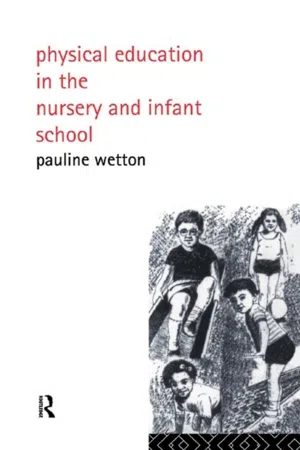
Physical Education in Nursery and Infant Schools
About this book
Provides guidance for different age levels, gives lesson plans and suggests some criteria by which teachers can measure their pupils progress.
Information
1
Curriculum and Planning
There are several important considerations that must be taken into account when establishing an educationally sound curriculum for physical education. The most crucial one is that the curriculum should be structured as an integral part of the total school curriculum and should reflect the schools’ philosophy about their particular children’s needs and the ways in which their own children learn. It is important to go beyond the general and sometimes clichéd statement, that the aims of physical education are the same as those of general education—that we are trying to ensure the greatest development of each child as an individual and that we are trying to prepare that child to take his place as a citizen in a democratic society. We all know that we are working towards the development of the whole person physically, socially, emotionally and intellectually, but it is important to think about how this can be achieved. Undoubtedly, physical education can make a significant contribution to the child’s total development, physical development, physical fitness and the development of the concept of ‘self’.
The first consideration then, when planning the curriculum of any educational establishment is to take careful account of the needs of the children. Initially, it is important to look at the environment in which the children live and also to look at the background against which the school life is set. A child, for example, who lives in a high-rise inner-city flat will probably need more access to play in the nursery and more outdoor PE lessons in the infant school than a child who lives in a cottage in the country. It is also possible that a child who lives in a socially deprived area may need a different programme from one who lives in an upper middle-class area. Clearly, it is necessary for each school to identify the characteristics, the interests and the motivating drives of children from these differing environments. Age, too, will play a part in the identification of needs, although maturational level, physique and physical fitness may be more important factors at the pre-school stage.
The following are suggested guidelines to be used when constructing a PE curriculum:
1. The curriculum should give direction to the programme and should be written in sufficient detail for each year group to ensure that activities are taught in a sequential manner.
2. The material should be selected from a wide variety of activities using different teaching methods so that each child experiences success.
3. The choice of activities should be based on sound educational principles and should offer something for all the children, regardless of their present skills.
4. Practical work should contain both vigorous activity and movement training, together with time for creativity, repetition and controlled free play.
5. The weather could affect programme planning and is an important consideration in the balance of a young child’s day. For example, prolonged periods of inclement weather (rain or snow) could result in an alteration to the programme. Outdoor lessons would need to be brought indoors and where playtime is not possible, then additional physical activities would need to be provided.
6. Allowance should be made for thematic work that the teacher may wish to integrate into the physical activity sessions.
7. Children’s special interests should be included as and when they arise.
8. The written detail should not restrict the teacher and her class, but should be regarded as a guide to lead her to the objectives of the programme and thus ensure progress.
9. Teachers should be aware of the language that can be acquired, repeated and assimilated whilst children are taking part in PE activities.
10. Teachers should also be aware of number concepts that can be reinforced in these activities.
However, the specific objectives of any PE curriculum should have a similar basis regardless of the geographical or environmental location of the school. These objectives are:
1. To develop levels of personal fitness.
2. To advance physical skills.
3. To promote physical growth.
4. To develop competency in movement.
5. To provide stimulating environments so that children can be creative, use their natural play instincts and release pent-up energy.
6. To guide play behaviour in social situations into desirable experiences.
7. To assist in the development of verbal and non-verbal communication.
8. To assist in the development of conceptual skills and cognitive awareness.
9. To help the children to develop self-concept and to be secure, happy and confident in life situations.
Planning to achieve these stated objectives requires considerable powers of observation and evaluation on the part of the teacher and ways to achieve this are discussed fully in Chapter 2.
However, it is possible to make a general statement about planning and I have divided this into two sections—pre-school and infant school.
PRE-SCHOOL
Pre-school play groups, nursery schools and nursery classes are all included in this section since even though each of these three kinds of establishment can be structured differently, they should have identical basic provision for young children. This basic provision should include the following:
- Free choice of access to a physical play environment.
- Locomotor and gross motor experiences.
- Fine motor and manipulative experiences.
- Group activities with the teacher.
1. There should be free access to physical play both indoors and outdoors (except in exceptionally bad weather) for all children during the free choice periods within the establishment. This physical play can be sub-divided into the following activities: locomotor, gross motor, fine motor and manipulative. It should be possible to experience physical play on a self-selection basis. Opportunities should be provided for the children to explore, try out, practise, consolidate and create their own movement patterns within an environment structured by the teacher. It is during this kind of play that the teacher can choose to intervene should she see an opportunity to advance the children’s learning. For childselected play activities, children should be exposed to the following experiences.
Table 1.1: A suggested weekly plan for teacher-directed activities
2. Locomotor and gross motor experiences, which include climbing up, along, over, under and through large pieces of apparatus; also, pushing, pulling, running, walking, balancing, jumping, crawling, carrying, throwing, lifting, riding equipment with wheels, building with large blocks, planks, etc. and ‘roughand- tumble’.
3. Fine motor and manipulative experiences include hammering, sawing, tying, zipping, pressing, cutting, inserting, pouring, holding, twisting and turning—hand activities, together with the use of crayons, brushes, chalks, etc. and modelling clay, plasticine, etc.
4. The teacher should, however, also organise group activities and occasionally, particularly for expressive activities, class activities in the following areas: rhythmic activities, including action songs and rhymes and also, dancing; expressive activities— movement based on selected themes or make-believe ideas; healthrelated fitness (see Chapter 3); special group activities (see Chapter 7); activities for three year olds and four year olds and games that involve practice in locomotor and manipulative skills. Table 1.1 illustrates a weekly plan that might be followed.
A lesson plan for a group activity might be structured as follows:
Introduction
‘I am going outside to play some games, you can join me if you like’, or ‘All the four-year-old children follow me!’
Warm-up
‘Run anywhere you like, when I clap my hands come and sit by me’ (4 repetitions) followed by ‘Stretch as tall as you can, now curl up as small as you can’ (3–4 repetitions).
Learning skills
‘Walk carefully and when I say “stop” stand very still and do not wobble’, followed by ‘Walk slowly and when I say “now” try and stand on one leg’.
Game
‘What time is it Mr Wolf?’
Each group activity should have a purpose and should be constructed with the following questions in mind:
- Why am I doing this? What are the children learning?
- Have I included some warm-up activities?
- Have I built on the material I presented last time?
- Are the children being given a new learning situation?
- How can I structure a game situation in which the children can use the skills already practised?
Sometimes during the year it may be necessary to alter this weekly schedule for a variety of reasons such as a special visit, or because of good or bad weather conditions. It is particularly important to extend the teacher-directed activities on days when children cannot have free access to the outdoor play area because of severe weather conditions. Most children have a need to run and exercise freely and when this is denied them they can become frustrated. On the other hand, during periods of warm weather the programme cane be supplemented by extra teacher-directed activities outdoors. Many pre-school leaders, for instance, arrange special ‘water’ sessions during the summer months. The children often have the pleasure of paddling in an inflatable paddling pool, or have fun with a hose pipe. Sometimes plastic baby baths are used. This kind of controlled water play with an adult is a good way of helping children to understand the properties of water and will help give them confidence when they go to the swimming pool. It is a very important first stage in teaching children to swim— making them ‘water happy!’
So that all this material is covered, there needs to be a written syllabus that lists and gives details of the learning experiences to which pre-school children will be exposed and some recognition of the fact that there will be, or should be, a difference in the activities of three-year-old children and those who have been in the nursery school for one year already. In view of the importance of helping children with special needs, written material with suggestions for providing activities for such children should be available (see Chapter 7).
THE INFANT SCHOOL
Compulsory education begins for this age group and this can make a difference to the planning of the curriculum. However, generally speaking, there should be at least one period of teacherstructured physical education each day. The periods or lessons should be selected from the following areas—large apparatus work, small apparatus work, gymnastic floorwork, movement connected with thematic work in the classroom, movement with music, including rhythmic work, swimming, games activities, and folk dancing. In addition, children should have access, in the classroom, to the following items and activities, depending on their age and level of maturity—large building blocks, toys with wheels for pushing, pulling and riding, dressing-up clothes, opportunities for cutting, pouring, holding and carrying items, twisting and turning things, using crayons, brushes, chalk, etc., modelling clay, etc., hammering, sawing and pressing items and finally, teacher-directed action songs and rhymes.
Children who have not had experience of either pre-school play group or nursery education will need special consideration as it is possible that they have not had access to the wide variety of physical learning experiences that the other children have enjoyed. The teacher will need to be very perceptive and may need to guide individual children to activities which will help them advance their physical skills. Patience is also needed as these children will require time to explore, to make mistakes and to master new skills. Hence there is a necessity, particularly in reception classes, to have some of the same facilities that are provided in nurseries and play groups. Schools might, for instance, consider providing a climbing frame with a slide indoors, or better still, free access to a playground outside.
The length of PE lessons in the infant school should vary depending on the age of the children, i.e. reception classes might have 15 minutes of movement with music whereas top infant classes might have 30 minutes. Teachers should be allowed flexibility in timing their lessons, provided that the sanctity of halltimetabling is not abused! Similarly, some reception-class children in certain environments might need two periods of PE per day, one indoors and one outdoors, or perhaps two lessons outdoors, particularly where free access to outdoor play is not possible.
The weekly programme will vary therefore, depending on the children’s backgrounds, on whether they are in reception class or middle or top infant classes, or whether the school is organised into year-band groupings, vertical groupings or, as in the case of village schools, all-age groupings. Broadly speaking then, there should be, in any given week and over any particular year:
- Activity which involves locomotor and gross motor development.
- Activity which involves fine motor development.
- Activity which involves moving rhythmically in a dance form.
- Activity which encourages physical fitness.
- (Ideally) activity in water.
These five areas can be explored through any of the mediums listed on p. *.
Where age-group banding is the norm, activities should be listed in sequential order for each age group so that skill can be acquired. The learning situation should be structured so that progression can be achieved. Furthermore, in order to facilitate this progression, a teacher should be prepared to communicate with the teacher taking the class the following year in order that she is aware of the stage the children have reached, so that continuity and progression is ensured.
It is important to plan the year’s programme so that all the activities which a school staff wish to include in the curriculum are taught. If there is no plan or syllabus, then learning can become very haphazard and important activities could be neglected. Because of the lack of facilities available in certain schools, it might be necessary for teachers to plan ahead the activities that can only take place in the summer months and require, for example, access to an outdoor grassed area or access to a swimming pool.
Structure, progression and the acquisition of skill are also more likely to occur if each teacher keeps a note of the material, taken from the syllabus, which has been covered in each lesson. The teacher who has planned her lesson is much more likely to have decided on a purpose or an objective for the lesson and is therefore more likely to teach and keep to her desired objective. These notes can be referred to on a daily, weekly, monthly or yearly basis and an effective evaluation can be made.
Finally, each lesson ...
Table of contents
- Cover Page
- Title Page
- Copyright Page
- Introduction
- 1 Curriculum and Planning
- 2 The Role of the Teacher
- 3 Health-Related Fitness
- 4 The Importance of Physical Play and Curriculum Content in Pre-schools
- 5 Gymnastics in the Infant School
- 6 Games in the Infant School
- 7 Dance in the Infant School
- 8 Classroom Activities in the Infant School
- 9 Swimming and Water Activities (age Three to Seven)
- 10 Children with Special Needs
- 11 Resources, Storage and Supplies
Trusted by 375,005 students
Access to over 1.5 million titles for a fair monthly price.
Study more efficiently using our study tools.
Frequently asked questions
Yes, you can cancel anytime from the Subscription tab in your account settings on the Perlego website. Your subscription will stay active until the end of your current billing period. Learn how to cancel your subscription
No, books cannot be downloaded as external files, such as PDFs, for use outside of Perlego. However, you can download books within the Perlego app for offline reading on mobile or tablet. Learn how to download books offline
Perlego offers two plans: Essential and Complete
- Essential is ideal for learners and professionals who enjoy exploring a wide range of subjects. Access the Essential Library with 800,000+ trusted titles and best-sellers across business, personal growth, and the humanities. Includes unlimited reading time and Standard Read Aloud voice.
- Complete: Perfect for advanced learners and researchers needing full, unrestricted access. Unlock 1.5M+ books across hundreds of subjects, including academic and specialized titles. The Complete Plan also includes advanced features like Premium Read Aloud and Research Assistant.
We are an online textbook subscription service, where you can get access to an entire online library for less than the price of a single book per month. With over 1.5 million books across 990+ topics, we’ve got you covered! Learn about our mission
Look out for the read-aloud symbol on your next book to see if you can listen to it. The read-aloud tool reads text aloud for you, highlighting the text as it is being read. You can pause it, speed it up and slow it down. Learn more about Read Aloud
Yes! You can use the Perlego app on both iOS and Android devices to read anytime, anywhere — even offline. Perfect for commutes or when you’re on the go.
Please note we cannot support devices running on iOS 13 and Android 7 or earlier. Learn more about using the app
Please note we cannot support devices running on iOS 13 and Android 7 or earlier. Learn more about using the app
Yes, you can access Physical Education in Nursery and Infant Schools by Pauline Wetton in PDF and/or ePUB format, as well as other popular books in Education & Early Childhood Education. We have over 1.5 million books available in our catalogue for you to explore.