Leisure Life is a ground-breaking study of men and masculinity. Focusing on the social networks and leisure lifestyles of a particular group of working-class men - 'the lads' - Tony Blackshaw argues that traditional social collectivities such as class are being superseded. Instead, leisure life is now the central arena in which individuals assert their identities and confirm their belonging. For 'the lads', leisure time is the pivotal point in a fragmented life which not only allows them to fashion some sense of order in a world of endemic disorder but also provides opportunities for the assertion of their masculinity.
The book uniquely combines 'the lads'' own raw and compelling accounts of their leisure experiences with a sophisticated interpretive analysis. In doing so, it draws on the work of major theorists such as Baudrillard, Derrida, Foucault, and especially Bauman to develop new critical insights into our understanding of the meaning of leisure.
Leisure Life awakens the sociological imagination. It offers a new approach to the study of masculinity and the ethnography of leisure, making it appropriate for courses in sociology, leisure, cultural and gender studies.
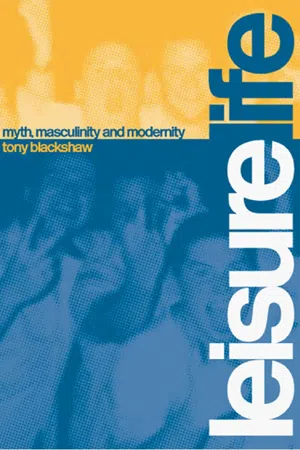
- 200 pages
- English
- ePUB (mobile friendly)
- Available on iOS & Android
eBook - ePub
About this book
Information
Chapter 1
Introduction
The leisure life-world of ‘the lads’
It was eight o’clock on Friday night, in Leeds city centre. The pub was at the upper end of Eastgate, before it meets the Headrow. The architecture was Edwardian, like many of the other buildings around there. It looked oppressive, with its decades of Leeds subsistence, and it was dirty: stained with acid rain, welkin muck and starling shit. We entered the pub, not for any particular reason, but simply because it seemed to be the most natural place for us to be, the uncultivated house fittings and furbishing a part of our sense of belonging. The pub was very much part of our Leeds, ‘town’, an imaginary Leeds dislocated by time, ostensibly narrow, among parts of which we regularly meandered across well worn tracks. Like the atmosphere, everything in the pub seemed familiar to us: the sense of heady conviviality, the sort of women there, the gamut of working-class male strangers, more so the prospect of heavy alcohol consumption. You could say the barman was in some sense ours, too, for before we had so much got through the doors his fat, tattooed fingers were already fumbling in the cooler at the back of the bar. Even our choice of drinks was part of this communal ritual, for he knew which one we would choose before we said it.
‘All right, lads. Carlsberg lager: only a £1 a bottle until ten o’clock,’ he said, unfastening the first of six bottle tops.
As the evening progressed it seemed to collide with so many other evenings that the smallest actions were both burdened with the past and imbricated unconditionally with the future. And when one of ‘the lads’, Sean, a tall, powerfully built man, some four months past thirtyfour years, returned from having his second piss explaining that he had swayed accidentally against some dickhead in the packed corridor leading back into the bar, we knew what was in prospect. The spastic had said something on the lines of ‘Watch who you’re pushin’, y’ fucker.’ Sean said he laughed in his face and smiled at his bird, but had decided to leave it at that.
The whole situation became straight away for us all at once familiar, repetitive and new. It was like a video-recording often replayed, only this time it was once again real. We already knew that Sean was going to ‘have’ the cunt despite what he had said, because he had looked deadly when he returned from the toilet. He had immediately got in another round before sitting down with a fresh Carlsberg, with which he was still measuring the remainder of the fuckhead’s life with large gulps from the bottle, when the silly twat came up to our table. We could sense that events would make a casualty of the spastic before very much longer.
The brave one, who might as well have had ‘I am a stupid cunt’ tattooed on his forehead, was staring at Sean, contemplating his opponent like a petulant football star, while his bird and spazwit mates looked on from a safe distance. In his mid-twenties, he was medium height, belligerent-looking and thin as a rake. He wore a checked Ben Sherman shirt outside a pair of white jeans. His thin blond hair was long and brushed back at the front and hung in a short mane down the back. His face was small and white, and blemished with the smallest of Borstal spots. The cunt wanted to be Ronan Keating, and although he was let down by the tattoo, it was mostly his eyes that wrecked his ambitions, because they each appeared to be looking in different directions.
‘What’s y’ game, long bastard?’ said the Boyzone wanna be.
It was still a startling image, even if Sean’s response was expected and solicited. Moreover, it offered itself as a tantalising metaphor for the leisure life-world. With an understanding that comes from a wealth of experience of knowing what to do on such occasions, it was the way in which Sean made not so much a rational decision as a reflexive deliverance that did it. He said nothing before nutting the cunt between the eyes and punching him in the stomach. Ronan the Rake looked as if he wanted to be sick as he fell prostrate on to the ground.
As Sean’s head did the strabotomy our collective past suffused us at once like overthe- top kitsch emptying into the present. Experiences common to us all geysered out of our minds, most of them not reaching our mouths. David ‘D-ranged’, however, was garrulous and he wanted to let the rest of the world know about ‘the lads’; and he did. ‘Anybody else want some of that?’ he challenged the rest of the pub. Our body language suggested that the rest of ‘the lads’ concurred. The leisure life-world now was an exercise in technicolor, as it once again raced to its culmination. In it the whole world seemed much clearer. Incandescent, its incumbents glowed, as it was we who were now the stars of our own Friday-night show.
For a short while the pub was in a mild state of confusion. A couple of split-arses edged along the walls to avoid the mêlée as they made for the toilets, faces uninterested. A party of spoonhead bastards looked on nonchalantly at the headbutted one on the floor, who, without wasting any time, cowered back towards his bird and friends, two of whom berated him at once for his naive petulance. The bar staff were eventually heard shouting for the bouncers to intervene, but they need not have bothered, for it was quickly all over.
‘Come on, let’s go,’ somebody said. And we did.
Ten months later. I was on the road, which has not been developed with pedestrians in mind, that leads the car driver towards the White Rose Centre, a shopping mall of barely one year, from where I could make out, in E.W. Burgess’s terminology, the intermediate area of the city between the commuters’ and the residential zones. But, at the point of that thought, and as if acting as an aide-mémoire to my crapulent brain, the sun peeped out from behind the wall of cumulonimbus to shine on the dilapidated estate of fifty or sixty council maisonettes, beyond the White Rose’s moat (no doubt designed as if to keep out the estate’s tenants), to remind me that Leeds is not at all characteristic of Burgess’s early twentieth-century Chicago. The urban spatial structure of Leeds is postmodern, reflecting the ambivalences of a city dedifferentiated in a post-industrialising process.
On this Saturday the estate on the other side of the moat was punctuated with properties tinned up for security reasons, which stood out like black pegs in an already rapidly decaying set of teeth. Juxtaposed with the medieval Stank’s Tithe Barn, the White Rose and the Arlington Business Centre, and the other steel and glass structures which compose the postmodern skyline in this part of south Leeds, the estate looked like an outsider in a world of avant-garde architecture, a flawed display at an exhibition to which it hadn’t been invited.
Early Saturday morning’s scrub of shoppers had swelled to a forest of regimental footsloggers. I was now walking through the busy department stores and eventually crossed the boundary which marks the starting point of what is ironically called Sainsbury’s ‘Savacentre’, a massive supermarket sandwiched between the last remaining three-quarters of the White Rose and the car park. The windows of the supermarket were draped with logotype World Cup advertising, with the words ‘Nestle Nesquik: the Official Breakfast Cereal for France 98' repeated between the frames.
In the near distance I spotted a familiar frame walking towards the open-plan entrance. The tall, powerfully built man, now some six weeks past thirty-five years, was wearing a familiar neck of light brown hair: shaved to number one and tapered, not squared. Sean was walking determinedly, left hand sunk into the pocket of the raincoat worn over his Levi jacket and matching jeans, his Kicker boots with tag displayed prominently: ‘a lad’s’ uniform. He carefully drew on the last remnants of the cigarette he was holding in his right hand, before entering the main shopping area of the supermarket. Two young girls accompanied him down the aisle, chatting, oblivious to the crowds as they walked quickly past the electrical goods. They knew that their dad was in a hurry. I decided I would catch up with Sean after he had done his shopping.
In the meanwhile I saw another man I once knew. He was not one of ‘the lads’. He was Jimmy Ronson and he was treading thin air as he endeavoured to get round the store on this day. Jimmy looked as if he had a few less teeth than he did the last time I saw him, which was when he was floating, intoxicated, around a Scandinavian supermarket for flawed consumers, shoving 79p frozen dinners down his trousers. He had obviously moved up-market.
This time he looked as though he was in dire need of whatever shit he was pumping into his body at the time. His hair was wet, his face and body were twitching and his arms and left leg jerked about incessantly. Seen as a whole, his klutzy performance reminded me of that one performed by the guitarist in the band Fine Young Cannibals when it played the song ‘Johnny, why don’t you come on home?’ during the 1980s. What distinguished Jimmy from the man who played to Johnny, however, was that Jimmy looked as if he was about to burst. Could Jimmy stay still long enough to lift something? Would he risk trying to make it through the tills?
I looked at the other trolley pushers around me. Nobody else watched Jimmy. Surprising, this, for people who inhere these places usually stare at men such as Jimmy, who looks like one of those tattooed underclass white people often seen modelling for the covers of social housing organisation annual reports. I didn’t want him to get caught thieving, but in my imagination I implored all the people there to watch him, and then perhaps they might have seen from Jimmy’s face what hard work is involved in raising the money to buy a wrap of ‘brown’ heroin, which today in inner-city Leeds costs less than a two-litre bottle of White Lightning cider. As he went out of my view I thought to myself that Jimmy Ronson was much more a reminder of our present condition than was the architectural skyline I had earlier observed outside.
I heard Sean coming closer to his turn at the till—beep, beep, beep, as the cashier shoved through the mountains of shopping. I tried to catch his attention but I had to squeeze my eyes shut against the slight hangover that I could scarcely distinguish from the shriek of the myriad electronic scanners in the store.
‘You look well rough. Too many beers last night?’
Sean walked towards me, his sharp blue eyes smiling warmheartedly. He put his arm around my shoulders and squeezed.
I’ve got some paracetamols in t’ trolley. Do y’ want some? (Laughing.)
He walked back towards his girls.
‘Wait a minute, Tone. I’ll be wi’ yer in a tick.’
I watched as Sean took the two girls in his massive arms and held each of them for a few seconds: firmly, warmly, protectively. Safe. Then he bent down and kissed each gently on the lips, before giving them money to buy a magazine and sweets. He told them verbally not to talk to any strangers, and his eyes made it known to them that they would find him outside the main doors, in the car park, talking to me.
We stepped outside the front entrance. The intermittent rain had stopped and there was a mild breeze that felt good. Sean pulled a packet of Embassy Regal from the pocket of his denim jacket and took out a cigarette. He struck a match with the skill of a smoker of twenty-plus years and inhaled deeply, then ran his left hand through his slick-backed hair. I stared at him for a moment, at his handsome face and his almost outdated uniform, the sort that belonged more to a 1970s Weston than to the middle-class White Rose shopping centre.
‘What you up to, cunty?’ he said endearingly.
‘Did you see Jimmy Ronson in there?’
‘Yeah, I gave him a wide birth. The dirty robbin’ cunt. He’s never lifted a finger and he wa’ always a robbin’ cunt, even at school. He’s fucked out on drugs. Even his family a’ fuckin’ wasters’ have rock-all to do wi’ him nowadays.’
‘Long time, no see, anyway.’
‘Yeah, I ‘ant been out wi’t’ lads for a couple a month, y’ know. Have you?’ I ignored his question. ‘Why?’
‘Mi work, an’ our lass’s always workin’. Like today, I’m lookin’ after t’ young’ns. She’s workin’ till four o’clock. That’s why I ‘ave to do t’ shoppin’ an’ that. I should be out at back end a’ next month, though. Anyway, I’ve got to shoot off, mi old lady an’ old man are comin’ over from Ireland this weekend. I’ll see y’ soon, Tone. Hey, by the way, y‘look a bit rough.’
‘I’m out tonight. I saw Stout in t’ Farmer’s Arms last night and he said that him and Stevey are goin’ in town for a few. I said I’d join ‘em. Do you fancy it?’ ‘Can’t make it, Tone. Sorry.’
Sean waved his right hand in the air, then turned towards the doors near to the magazine rack. As he did I saw an unfamiliar look on his face. He looked a forlorn figure as he stared into the shopping centre, looking for his girls. Those that were sharp blue only a few minutes ago were now large, sad eyes. I thought that I saw a tear trickling down his cheek, however, I definitely must have been wrong. Perhaps it was the hangover. I have never seen Sean cry when he is sober.
Starting points: the problem ‘Synthetic’ sociology Synthetic’sociology
The course of events described in the opening episode at the pub are evidently contemporaneous, but I should like to argue that they have an immutable quality that has remained stable for decades, perhaps for centuries. I suggest this is so because pub brawls are old hat and so are men, such as Sean and Ronan, who are not happy unless they are making an enemy. There is also a consistency in the ways ‘the lads’ construct an imaginary sense of community in the first episode, as it is established through their shared symbols and participation in communal rituals within and without the pub. This historical continuity in local social relations is well documented in the community studies literature (Hoggart, 1957; Dennis et al, 1969; Cohen, 1985).
Just the reverse, however, the events described in the second episode, observed in isolation, but understood also in the process of the juxtaposition, are purely contemporaneous. For as the representations of the cityscape of Leeds are revealed, and the features and actions of the characters come alive in the narratives, it becomes evidently clear that the second episode and the juxtaposition could have been located only in another time. Indeed, for even if the White Rose shopping mall wants to take itself seriously as the Meadowhall of Leeds, which it does, both the adjacent council estate and people like Jimmy Ronson serve only to subvert this seriousness with their own absurd inappropriateness. Seen in an analogous process, the men in the narratives represent an image of masculinity that is equally absurd and exhausted in the context of contemporary gender relations. Yet, at the very moment that we are led to believe that Sean is the epitome of the archetypal dinosaur and ‘hard’ man, the second episode reveals him to be the puritan, moralist ‘new’ man and intimate and receptive dad, rolled into one. This observation is an incongruity that undermines our initial understanding of Sean and disrupts the coherent order of things established in the first episode. I could go on. For as the juxtaposition unfolds, revealed are complex patterns and processes, both material and discursive in design, of de-differentiation, deconstruction (of hegemonic masculinity), decentredness, fragmentation and polarisation, uncertainty, risk, contingency, ambivalence and irony. The episodes are, to be sure, manifestations of a predicament created by recent structural transformations that would not have been the concern of sociology even, say, fifteen years ago.
This book is about the salience of leisure for working-class men in a sociality undergoing profound transformations. What I have set out below is the outcome of an indepth study of leisure in liquid modernity (Bauman, 2000a). Given the subject matter, and the way I am positioned within the research process (I was brought up with ‘the lads’ in the study), the theoretical orientation of the book is distinguishable from the ‘synthetic’ tradition (Mestrovic, 1998) in contemporary sociological thought, based on agency and structure, subject and object, and so on.1I shall argue that this process of distinguishing between two types of sociology, and by implication two processes of ‘methodology’, is both relevant and necessary, because the ontological and epistemological orientation of this ‘synthetic’ tradition is not equipped to undertake the task of this book. To substantiate the argument, I shall, in the first instance, discuss this assertion.
The view that describes the individual and communal leisure experience of the type embraced by ‘the lads’, and discussed above in the episodes, as a ‘separation’ from ‘normal’ life, a liminal stage of margin (Shields, 1991; Rojek, 1995), a ‘time-out’ response (Moore, 1994) to ‘paramount reality’ (Cohen and Taylor, 1992) is one that is still authoritative in sociology. From this point of view, leisure is important in the sense that it provides liminoid situations (Turner and Turner, 1978) which contribute to the functional equilibrium of the social system (Parsons, 1951). For as Rojek (1995:88) points out, when thought about in this sense, leisure thresholds of spontaneity and manumission cannot at any time be of any real facility, because although they may subvert ‘reality’, by giving rise to social conflict, challenging the status quo or even facilitating a spurious sense of belonging with participants, they remain ‘inauthentic’, or ‘safe’, because they do not survive the return to ‘normality’. For Rojek, as for Turner (1973), inside the leisure liminoid both time and space become changed, but ‘real’ time and space remain out there, undisturbed.
There exists a similar problem in neo-Marxist accounts. Marcuse (1970:179–80) preempts the postmodernists when he argues that, by the middle of the twentieth century, ‘repressive reason gives way to a new rationality of gratification in which reason and happiness converge’. And in marked contrast to Featherstone (1991), who discusses the notion that in what he describes as postmodernity we are moving towards a classless mass society where ‘everyone can be anyone’ Marcuse is propagating what was to become one of the most celebrated interpretations of the ways in which the advanced capitalist economy was beginning to reduce the revolutionary potential of the working classes through the market place (Marcuse, 1972). Embodied in the process of rationality of gratification are new possibilities for the exploitation of the working classes.
For Marcuse, in high modernity, industrial capitalism is usurped by commodity capitalism, and within this process the mechanisms of the market transform workers into consumers. Whereas capitalism in early modernity required asceticism—‘the constraint on impulse, the limiting of self-expression’ (Weber, 1930; Tawney, 1958), it now requires hedonism, or the ‘will to happiness’ (Bauman, 1997), through acts of leisure, pleasure and self-gratification. The logic of late capitalism now invades every sphere of our lives and even exploits the working classes through their leisure and pleasure pursuits. From this point of view, ‘the lads’’ actions can be interpreted as a form of labour that has a productive value, or surplus value, which is being exploited under capitalism. From this viewpoint ‘the lads’ can be seen to be alienated, in the sense that they have lost objective control over who they are, or who they are striving to be.
In a prodigious project, which to a large extent departs from earlier, and often crude, Marxian accounts, Habermas attempts to build on the earlier work of the Frankfurt school by giving recognition to communication and the media more readily than to the labour process. As Poster (1994) suggests, for Habermas, as for Baudrillard, the sign turns out to be of central significance. Yet Habermas’s political objectives are far more ambitious than Baudrillard’s. Indeed, where the latter locates the seeds of dissent in the nihilism of consumer culture—‘You want us to consume? OK, let’s consume always more, and anything whatsoever; for any useless and absurd purpose’ (Baudrillard, 1983:46)—the former imagines political and spiritual emancipation in the ‘ideal speech situation’ (Habermas, 1979:111–17). However, in embarking on this Utopian adventure, Habermas’s critical theory is confronted with the same quandary as Marcuse’s sociology, that is, the problem of revealing ‘structures of domination when no one is dominating, nothing is being dominated, and no ground exists for a principle of liberation from domination’ (Poster, 1994:81–2).
There also exists a different but related problem in the ‘new wave’ of writings on masculinities (see, for example, Connell, 1995; Horrocks, 1994; Mac An Ghaill, 1996; Seidler, 1994) which focus on the hegemony of masculinity to explore the multiplex of masculine behaviours and practices in a modern patriarchal society. These writings arguably oversimplify the masculinity debate in that they simply invert the logocentric modernist normalising principle by advancing theories which vilify men, such as ‘the lads’, instead of women (for a critique see Ryan, 1996). On top of that, masculinity theory carelessly advances the type of explanation it claims to be discordant with, in its own terms of reference, by promulgating a view that centres (rather than decentres) the shortcomings of inadequate modern men. The following quotation from Horrocks (1994:67) elucidates the overall gist of this viewpoint: ‘In becoming accomplices and agents of the patriarchal oppression of women, men are mutilated themselves psychologically…in hating women the male hates himself.’
Some ontological and epistemological questions
The structural functionalist account of Turner, the two respective neo-Marxian approaches adopted by Marcuse and Habermas and masculinity theory are very different at the level of their theoretical orientation. I mean this in the sense that, whereas Turner centres on flow-type experiences and societal co-operation, Marcuse and Habermas reckon with societal conflict, exploitation and false consciousness, ...
Table of contents
- Cover Page
- Title Page
- Copyright Page
- Preface
- Acknowledgements
- Chapter 1: Introduction
- Chapter 2: Deliberation
- Chapter 3: Initiation
- Chapter 4: Administration
- Chapter 5: Communion
- Chapter 6: Mythologisation
- Chapter 7: Felicitation
- Chapter 8: Emancipation
- Bibliography
Trusted by 375,005 students
Access to over 1.5 million titles for a fair monthly price.
Study more efficiently using our study tools.
Frequently asked questions
Yes, you can cancel anytime from the Subscription tab in your account settings on the Perlego website. Your subscription will stay active until the end of your current billing period. Learn how to cancel your subscription
No, books cannot be downloaded as external files, such as PDFs, for use outside of Perlego. However, you can download books within the Perlego app for offline reading on mobile or tablet. Learn how to download books offline
Perlego offers two plans: Essential and Complete
- Essential is ideal for learners and professionals who enjoy exploring a wide range of subjects. Access the Essential Library with 800,000+ trusted titles and best-sellers across business, personal growth, and the humanities. Includes unlimited reading time and Standard Read Aloud voice.
- Complete: Perfect for advanced learners and researchers needing full, unrestricted access. Unlock 1.5M+ books across hundreds of subjects, including academic and specialized titles. The Complete Plan also includes advanced features like Premium Read Aloud and Research Assistant.
We are an online textbook subscription service, where you can get access to an entire online library for less than the price of a single book per month. With over 1.5 million books across 990+ topics, we’ve got you covered! Learn about our mission
Look out for the read-aloud symbol on your next book to see if you can listen to it. The read-aloud tool reads text aloud for you, highlighting the text as it is being read. You can pause it, speed it up and slow it down. Learn more about Read Aloud
Yes! You can use the Perlego app on both iOS and Android devices to read anytime, anywhere — even offline. Perfect for commutes or when you’re on the go.
Please note we cannot support devices running on iOS 13 and Android 7 or earlier. Learn more about using the app
Please note we cannot support devices running on iOS 13 and Android 7 or earlier. Learn more about using the app
Yes, you can access Leisure Life by Tony Blackshaw in PDF and/or ePUB format, as well as other popular books in Social Sciences & Gender Studies. We have over 1.5 million books available in our catalogue for you to explore.