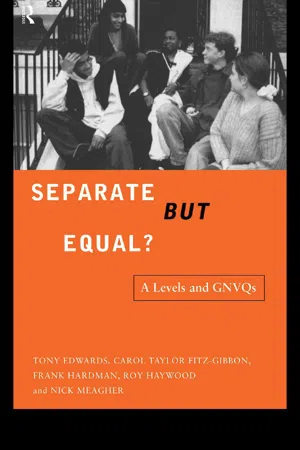
eBook - ePub
Separate But Equal?
Academic and Vocational Education Post-16
- 208 pages
- English
- ePUB (mobile friendly)
- Available on iOS & Android
eBook - ePub
Separate But Equal?
Academic and Vocational Education Post-16
About this book
This book looks in detail at the strong contrasts in the provision traditionally made for 'academically' and 'vocationally' minded students, and looks at differences and similarities in practice. The chapters report evidence of how students on both sides think they have been taught. They also report on how those students prefer to learn, how their teachers define the kinds of learning appropriate for particular qualifications and how the organisation of learning for 'different but equal' qualifications was observed in forty schools and colleges. The book's main focus is on the objectives and processes of learning at a stage which is certainly being transformed, but which is still powerfully shaped by myths about the sixth form and education of 'leaders'.
Trusted by 375,005 students
Access to over 1.5 million titles for a fair monthly price.
Study more efficiently using our study tools.
Information
Topic
EducationSubtopic
Education General1
CONTRASTS IN LEARNING?
Tony Edwards
Very damaging effects are attributed to that deep ‘divide’ between ‘academic’ and ‘vocational’ post-compulsory education which has marked the English education system. It has been blamed for keeping one side too narrowly academic and the other too narrowly practical. Even worse, a persistent belief that ‘real’ education post-16 is properly reserved for an academically minded minority has kept participation rates well below those of most comparable countries, thereby producing an under-educated and under-skilled workforce. Variations on those bleak conclusions have been repeated many times.
Recent ministerial descriptions of the divide as false, artificial and unnecessary make the damage attributed to it seem readily repairable by sensible curriculum reform, and no educational ‘engineer’ could be more sensible than Sir Ron Dearing. Yet although his review of post-16 qualifications (1996:1.13) recognises the ‘cultural obstacles’ to reform created by ‘pervasive attitudes inherited from the past about the relative worth of achievement in the academic and vocational pathways’, in particular their association with separated provision for ‘the able and the less able’, it makes only passing reference to the size of those obstacles and almost none to the long record of failure to surmount them. The persistent devaluing of vocational education, although increasingly challenged in policy rhetoric, reflects entrenched assumptions about the kinds of learning appropriate for future leaders and for even their most skilled followers. Different qualifications, or the lack of any qualifications at all, have served to allocate young people to different levels in the labour market. It has been assumed that an able minority are best prepared for high-status occupations by studying a few academic subjects in depth, the capacity of that specialised curriculum to survive fierce and persistent criticism being incomprehensible without an understanding of its association with preparing an elite. In contrast, vocational education has been provided largely for those regarded as being less able, as needing to be motivated by seeing direct connections between what they are learning now and their future employment, and as likely to enter technician-level occupations for which higher-order cognitive skills were taken to be largely irrelevant. It was the route for those judged to be unsuitable or who deemed themselves unsuited for advanced academic study, and it was almost entirely separated from extended general education (Green 1995).
Reviewing educational provision for the 15–18 age-group at a time when a trend to longer school life was just becoming apparent, the Crowther Committee (1959) identified ‘the education of the ablest’ as being ‘what the English system does best’. It also saw the high cost of that preoccupation as a neglect of the rest which was especially conspicuous at the post-compulsory stage. Yet even though most 16–19 year olds are now in education and training rather than in employment, which is the transformation Crowther hoped for, remarkably similar conclusions continue to be drawn. The system is still seen as ‘mainly geared to developing academic talents in a minority’, whose success then ‘casts a long shadow’ because it so accentuates one kind of educational achievement that alternatives are stigmatised as suitable only for those who have failed at something else (Smithers and Robinson 1991). Two ‘quite different traditions’ are described as co-existing almost without touching, one based on ‘an agreed content of [subject] knowledge and the abstract principles behind it’ and the other on ‘specific skills and competencies which are necessary to perform a job’ (National Union of Teachers 1996:3). To the extent that those traditions continue to be divided not only by curriculum and modes of learning but also by the prospects open to students working within them, then the ‘cultural obstacles’ to accepting them as different but not unequal appear formidable indeed. Large changes in the scale and scope of post-compulsory education may be blurring but are not yet covering the sides of the divide.
When the Crowther Committee deplored the waste of ability created by a highly selective education system, only 10 per cent of 17 year olds were in full-time education, compared with 60 per cent in 1996, and only 4 per cent were going on to higher education, compared with almost a third of the age-group who do so now. That growth, especially rapid during the years 1987–1993, has made staying on in many places the normal thing to do and turned not doing so into ‘a new counter-cultural form of dropping out’ (Green and Ainley 1995:15). While enough of the stayers have left full-time education at 17 to maintain unfavourable comparisons with (for example) Japan, Germany and France, claims to a ‘revolution in participation rates’ are largely justified from a more insular perspective (Department for Education press release, 27 July 1994). It is a revolution partly brought about by young people who remain in school or enter college because they have nowhere else to go. The steep decline in job opportunities for young people lacking the educational qualifications used by employers to screen applicants has brought a rising demand for at least an educational waiting room. But it also reflects rising levels of achievement at 16, and consequent aspirations for further credentials to confer relative advantage in the search for jobs (Ashford et al. 1993). Emphasis on GCSE A—C grades in school performance tables and elsewhere sustains a widespread perception of lower-grade passes as ‘failures’ and so depresses the ambitions of many in the middle range (Cockett and Callaghan 1996). Yet in 1996, 44 per cent of the mass entry for GCSE achieved five or more of those ‘good passes’ and so met the traditional requirement for progressing to A level that was being attained in the early 1960s by only 15 per cent of the age-group. Attributing that three-fold ‘rise in productivity’ to less rigorous examining or the popularity of easier subjects, which are the explanations favoured by believers in a ‘natural’ rationing of ‘real’ educational achievement, has to take account of the fact that A level results have risen in parallel despite that examination’s continuing (if sometimes questioned) reputation as a remaining bastion of academic standards. Higher education has itself become ‘a popular undertaking’ that draws in a third of the age-group at 18 compared with only 15 per cent even as recently as 1987, allowing the government to claim in its (1995) White Paper on Competitiveness that the United Kingdom has become ‘a European leader in graduate output’. Hopes of further expansion are therefore focused on the preceding stage, and that remains no more than a ‘medium participation system’. Indeed, relative success in graduate output highlights the relative failure to keep pace with the National Education and Training Target which prescribes that 60 per cent of the popula-tion should achieve by the age of 21 the level of educational performance (two A level passes or their equivalent) traditionally associated with academically and socially selected sixth forms.
The phrase ‘or equivalent’ indicates a main consequence of expansion, both the expansion already achieved and that intended. A level entries have risen threefold in thirty years. In two authoritative but inconsistent judgements, either they ‘may now be approaching the ceiling of academically-minded young people for whom A levels were designed’ or they have already expanded well beyond ‘the purposes for which they were created’ (Dearing 1995:5; 1996:3.5). Those seem notable understatements of how an exclusive model has been adapted to a mass market. The initial design was intended for the more academically inclined pupils among the ‘top 20 per cent’ of the ability range that the grammar schools recruited. Even that selected minority were never as ‘reasonably homogeneous in their academic abilities, inclinations and aspirations’ as universities found it convenient to assume when they were resisting any significant broadening of the sixth form curriculum (Schools Council 1980:29), and their diversity raised persistent objections that using the same examination as both an entry qualification for universities and a higher school leaving certificate forced large numbers of students into an inappropriately specialised and academic mould (Edwards 1983a). In the 1960s, rising numbers of so-called ‘new’ sixth formers, lacking the traditional prior achievement and academic aspirations, reinforced those objections and brought renewed demands for a less specialised (though not necessarily more vocational) alternative to A level. Thirty years later it had become generally agreed that the magnetic attraction of A level draws in far too many students who are not suited to the A level approach’ and for whom the risk of ‘disappointment’ is high (Dearing 1996:3.5). A necessary condition for reaching national targets that constitute a huge break with the traditional exclusiveness of English post-16 education is therefore seen as the successful introduction of qualifications offering different kinds of learning to new kinds of ‘advanced’ student, who would not previously have continued in full-time education. In an especially sharp break with the past, these ‘vocational’ or ‘applied’ alternatives to A level have to be both distinctively different in form and content and yet ‘equal’ (or ‘equivalent’ or ‘comparable’, these terms being used almost interchangeably) in the opportunities that they make available.
This is the challenge that the Dearing Report diminishes by giving it little attention. The traditional channelling of academically and socially selected cohorts along educationally stratified routes towards different levels of the labour market is exemplified in the Certificate of Pre-Vocational Education, which was explicitly offered to students described (by the government) as being ‘of broadly average ability with modest examination achievements at 16' who would nor-mally enter employment a year later. That its credential value was set even below that of O level explains why its more ambitious takers saw these pre-vocational courses as a way back to the ‘academic’ track rather than as an alternative way forward (Atkins 1984). In contrast, the BTEC National qualification was designed as a real alternative for students, many of whom were expected to be as able and ambitious as their A level contemporaries but who were also assumed to want their studies to be more practical and to have a direct bearing on their future employment. The promise of comparable prospects was then enhanced in publicity for Advanced GNVQs, hence the label of ‘new vocational A levels’ highlighted in the Department for Educations ‘brief guide’ to the new qualifica-tion (August 1993) and the accompanying assurance that its holders could move either into employment or into higher education. In Dearing’s definition of its fitness for purpose, it is well suited to students ‘whose approach to learning is by doing and finding out’ and to employers with a high regard for core skills and ‘more interactive learning styles’ (Dearing 1995:14). The promise is clear: a form of vocationally oriented but still general education is now available without the career disadvantages traditionally associated with it. It is to provide a bridge between two previously divided traditions.
Between promise and reality, however, lies the shadow thrown by A level’s ‘long life and innate quality’ (Dearing 1996:3.5). Its pedigree stretches back to 1951, and beyond that to a Higher School Certificate which also embodied the virtues attributed to specialised academic study. But while Dearing recognised the advantage bestowed on A level by appearing as the ‘gold standard’ qualifica-tion, he understated it in emphasising GNVQs’ especial relevance to employers. The competition between ancient and modern would be much less unequal if it were indeed true that—‘Employers generally had limited interest in A levels and even less in AS…[which] were therefore seen as primarily relevant to higher education’ (Dearing 1996, Appendices: 12, para. 21). That conclusion distorts A levels power as a multi-purpose credential. It may well be that most young people employed at 18 ‘were entering jobs for which the specific know-ledge gained from A levels was not relevant’, but that qualification has been heavily used as a proxy measure of ‘promising’ applicants’ ambition, self-reliance, capacity for hard work, and capacity to learn. It has therefore been and remains by far the most marketable credential. It is noted in the Dearing Report that although A level students felt less well prepared than their GNVQ contemporaries for entering employment, they had no doubts at all about the market value of good A level passes. Advanced GNVQs therefore have to win parity of esteem with a long-established market leader that attracts almost all the students judged academically capable of following that traditional academic route. They have to provide the same ‘level’ of qualification for students who are generally weaker academically. They have to resemble the established academic model in the opportunities to which they give access, but they also have to be sufficiently unlike A levels in how knowledge is organised, transmitted and assessed to appeal to the much wider constituency of students on which the attainment of ambitious national education targets depends.
That formulation of fitness for purpose serves to introduce the research on which this book is largely based. It is research that reflects the writers’ varied but complementary interests in approaches to learning that have traditionally marked off the ‘academic’ from the ‘vocational’ in English post-compulsory education. Carol Taylor Fitz-Gibbon had long been investigating students’ performance at A level, her research indicating differences in the ‘difficulty’ of subjects as well as in how they were taught. The extension of an already very large database to include the teaching of BTEC National was partly to see whether the different purposes and structure of that qualification were evident in the organisation of students’ learning, and also to see whether there were significant differences from A level in methods associated with successful performance. That evidence came largely from students’ reports of the frequency of various class-room activities. In their earlier work on the uniqueness of the English pattern of ‘study in depth’ and its capacity to resist change, both Tony Edwards and Roy Haywood had noticed how little was known directly about pedagogic practice on either side of the curriculum ‘divide’, despite the confidence with which generalisations were exchanged. In an application to the Economic and Social Research Council for funding to investigate ‘methods and effectiveness in post-16 teaching and learning’, Carol Taylor Fitz-Gibbon and they emphasised this lack of observational evidence and the potential benefits of combining it with statistical data derived from the A level Information System. Nick Meagher was the Resarch Associate for that project. Previously director of studies in an inner-city comprehensive school, he had a particular interest in the effects of broadening access to post-16 education by diversifying the kinds of learning experience it offered. Building on the ESRC-funded project, he subsequently carried out for the NCVQ (in collaboration with Roy Haywood) an intensive programme of classroom observation of Advanced GNVQ in twenty-four schools and colleges in England, Wales and Northern Ireland. Carol Taylor Fitz-Gibbon’s parallel contract with the NCVQ involved reanalysis of extensive statistical data on GNVQ practice. Work from both these later projects has also been drawn on in the book. Simultaneously with the ESRC research, Frank Hardman was comparing pedagogic practice in A level English Language and English Literature. As two of the ‘easier’ A levels identified by Dearing, they might not be expected to show large differences. Yet English Language was intro-duced as a separate A level in the mid-1980s as a deliberate move away from the academic study of literary texts and towards more ‘applied’ and even partly ‘vocational’ studies in which independent and collaborative learning would be strongly encouraged. Comparing how the two subjects were taught raised more general questions about how the nature of academic knowledge shapes its transmission. Before joining the staff of Newcastle University, Hardman had both co-ordinated the TVEI (Technical and Vocational Education Initiative) programme in a comprehensive school and headed its English department. Like many teachers, therefore, he had straddled the ‘divide’ between the academic and the vocational.
Although their perspectives and approaches differ considerably, all five contributors to the book are intrigued by the dilemma that pervades post-16 curricular reform. The versions of advanced general education embodied in GNVQs, more vocationally oriented and more applied than the established academic model, have to resemble this model sufficiently in market value that prospective students will not be diverted onto a less suitable pathway by the greater rewards to which it may lead. But GNVQs also have to be sufficiently unlike the established model to appeal to the much wider constituency of students on which raising the educational level of the workforce depends. It may well seem that distinctiveness of ‘approach’ is much easier to achieve than parity of esteem, given the different kinds of provision traditionally made for ‘academically’ and ‘vocationally’ minded students and the different curriculum traditions in which A levels are embedded and from which Advanced GNVQ has emerged. Certainly the key terms in discourse about them are drawn from such different vocabularies that they are very unlikely to be different ways of defining rather similar learning experiences. And in the hectic debate about their respective merits, contrasts are often drawn very sharply indeed. This is understandable. While Advanced GNVQs have to establish their distinctiveness as well as their credibility, A levels attract support from educational conservatives for whom a preoccupation with practicality and relevance represents a betrayal of real education. Their advocates are therefore inclined to polarise the supposed characteristics of each, ignoring such inconvenient complications as the popularity of some ‘applied’ A levels, the attention now being paid to those transferable skills that academic study has been assumed to develop, and the weight now placed on underpinning knowledge and conceptual understanding in GNVQ. It is certainly commonplace to criticise A levels for neglecting skills and GNVQs for neglecting knowledge, views caricatured by a GNVQ student’s complaint against a lecturer, presumably not yet socialised into GNVQ-approved ways of working, who continued to be ‘more of an A level teacher expecting you to learn masses of stuff from books instead of letting you find out for yourself’ (Chorlton 1994:97–98). A rather similar, generalised contrast appears in the Dearing Report. The Advanced GNVQ students surveyed as part of that review tended to see their learning as having been organised around independent study and ‘research’, while their A level contemporaries reported a predominance of ‘lectures’ (Dearing 1996, Appendices: 39–40.
A liking for sharp contrasts is also apparent among educational researchers. Fitz-Gibbon (1996) has criticised the tendency to pose research questions more realistically formulated as ‘how much of A and how much of B?’ in the stark form of ‘is it A or is it B?’. But the debate about post-16 provision has been and remains highly contentious. Drawing the sides in black and white is much more likely to attract attention than doing so in shades of grey, as Alan Smithers (1993) demonstrated in his highly publicised attack on NVQ and GNVQ models of learning.
Although written with Fitz-Gibbon’s warning in mind, Chapter 2 returns in more detail to the strong contrasts in the provision traditionally made for ‘academically’ and ‘vocationally’ minded students. From these are drawn expectations about practice, although reasons are also suggested as to why even these are less than clear cut. The chapters that follow are about differences and similarities in practice. They report evidence of how students on both sides of the curriculum ‘divide’, and from hundreds of schools and colleges, think they have been taught. They also report on how those students prefer to learn, how their teachers define the kinds of learning appropriate for particular qualifications, and how the organisation of learning for ‘different but equal’ qualifications was observed in forty schools and colleges. Although that evidence is placed in the context of current and recent changes in the scale and scope of post-compulsory provision, the book is not another account of already well-documented reforms and proposals for reform. Its focus is on the objectives and processes of learning at a stage which is certainly being transformed, but which is still powerfully shaped by myths about the sixth form and the education of ‘leaders’. It is with these large historical residues that the next chapter begins.
2
EDUCATING LEADERS AND TRAINING FOLLOWERS
Tony Edwards
Contemplating the future of the English ‘sixth form’ when rising numbers were already challenging its elite image, Alec Peterson suggested abandoning the term altogether as an obstacle to rational discussion. For many of his pre-war generation who ‘owe everything to the sixth form and will not forget it’, it was too ‘emotionally overloaded’ with memories of a time when, ‘with a handful of others,’ they first tasted intellectual excitement and saw the possibility of a university place ‘with all the accompanying visions of expanded ambitions and upward social mobility’ (Peterson 1973:2). That theme of irrational attachment to a partly mythical past appears in many accounts of resistance to change. For example, puzzled observers of the sixth form curriculum were advised to abandon any notion ‘that a curriculum is a set of arrangements which rationality has called into being and which rationality can alter’; that peculiar pattern of studying a very few subjects in depth was so bound into the grammar school tradition of preparing an academic elite for high status occupations that it had remained immovable against all criticism of excessive specialisation (Taylor et al. 1974:5). Deploring its immovability twenty years later, the first head of the National Curriculum Council recalled that debates about reforming A level had been ‘second in irrationality’ only to arguments about overcrowding the preceding stage. Thus reasonable proposals for curriculum space in which to develop cor...
Table of contents
- COVER PAGE
- TITLE PAGE
- COPYRIGHT PAGE
- FIGURES
- TABLES
- ACKNOWLEDGEMENTS
- 1. CONTRASTS IN LEARNING?
- 2. EDUCATING LEADERS AND TRAINING FOLLOWERS
- 3. LISTENING TO STUDENTS AND THE 50 PER CENT FRAMEWORK
- 4. CLASSROOM OBSERVATION IN ACADEMIC AND VOCATIONAL COURSES POST-16
- 5. A LEVEL ENGLISH LANGUAGE AND ENGLISH LITERATURE: CONTRASTS IN TEACHING AND LEARNING
- 6. LINKS BETWEEN LEARNING STYLES, TEACHING METHODS AND COURSE REQUIREMENTS IN GNVQ AND A LEVEL
- 7. CONCENTRATED AND DISTRIBUTED RESEARCH: REFLECTIVE OBSERVATIONS ON METHODOLOGY
- 8. CONCLUSION: DIFFERENT AND UNEQUAL?
- REFERENCES
Frequently asked questions
Yes, you can cancel anytime from the Subscription tab in your account settings on the Perlego website. Your subscription will stay active until the end of your current billing period. Learn how to cancel your subscription
No, books cannot be downloaded as external files, such as PDFs, for use outside of Perlego. However, you can download books within the Perlego app for offline reading on mobile or tablet. Learn how to download books offline
Perlego offers two plans: Essential and Complete
- Essential is ideal for learners and professionals who enjoy exploring a wide range of subjects. Access the Essential Library with 800,000+ trusted titles and best-sellers across business, personal growth, and the humanities. Includes unlimited reading time and Standard Read Aloud voice.
- Complete: Perfect for advanced learners and researchers needing full, unrestricted access. Unlock 1.5M+ books across hundreds of subjects, including academic and specialized titles. The Complete Plan also includes advanced features like Premium Read Aloud and Research Assistant.
We are an online textbook subscription service, where you can get access to an entire online library for less than the price of a single book per month. With over 1.5 million books across 990+ topics, we’ve got you covered! Learn about our mission
Look out for the read-aloud symbol on your next book to see if you can listen to it. The read-aloud tool reads text aloud for you, highlighting the text as it is being read. You can pause it, speed it up and slow it down. Learn more about Read Aloud
Yes! You can use the Perlego app on both iOS and Android devices to read anytime, anywhere — even offline. Perfect for commutes or when you’re on the go.
Please note we cannot support devices running on iOS 13 and Android 7 or earlier. Learn more about using the app
Please note we cannot support devices running on iOS 13 and Android 7 or earlier. Learn more about using the app
Yes, you can access Separate But Equal? by Tony Edwards,Carol Fitz-Gibbon,Frank Hardman,Roy Haywood,Nick Meagher in PDF and/or ePUB format, as well as other popular books in Education & Education General. We have over 1.5 million books available in our catalogue for you to explore.