- 304 pages
- English
- ePUB (mobile friendly)
- Available on iOS & Android
eBook - ePub
About this book
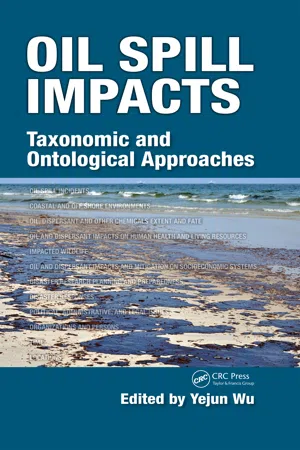
Starting with the 2010 Gulf of Mexico Deepwater Horizon oil spill incident, Oil Spill Impacts: Taxonomic and Ontological Approaches chronicles a timeline of events that focus on the impact of oil spills and provides an understanding of these incidents using a number of approaches. The book includes an interdisciplinary oil spill taxonomy, an
Information
1 Methodology
Yejun Wu
Contents
- Development of the Timeline of Events
- Document Collection Policy
- Extraction of Concepts and Relationships from Documents
- Consideration of Concept Specificity
- Term Normalization and Presentation
- Development of the Oil Spill Taxonomy
- Development of the Oil Spill Topic Map
- Evaluation of the Taxonomy and the Topic Map
- References
This chapter briefly introduces how each chapter of the book is produced so that readers can have an idea of the scope of the subject and how oil spills, a broad and deep topic, are treated in the book. Specifically, it introduces the methodology of producing the timeline of events since the start of the 2010 Gulf of Mexico Deepwater Horizon oil spill incident, the methodology of developing the oil spill taxonomy and topic map, and a user’s evaluation of the taxonomy and topic map.
Development of the Timeline of Events
The chapter of “Deepwater Horizon Circle of Life and Death” is contributed by Dr. Judith Sylvester. She was drawn into investigating how the Gulf of Mexico Deepwater Horizon oil spill incident unfolded by three factors: (1) few media “experts” knew much about deep water drilling; (2) the oil industry itself did not know how to prevent a deep water drilling disaster; and (3) the U.S. government lacked expertise in how to respond to an environmental disaster of this magnitude. She began the research by following the media timelines and development of expertise in deep water drilling. She has studied media coverage and interviewed journalists who covered the story, attended environmental conferences where scientists have described what environmental impacts they have found so far, followed the governmental response and the investigative commissions that discovered what went wrong, and monitored the legal proceedings to fix blame and determine restitution amounts that have stretched over the past 5 years. The timeline of events since the start of the Gulf of Mexico Deepwater Horizon oil spill incident aims to not only provide a background to but also serve as a thread of the oil spill taxonomy and the topic map.
Document Collection Policy
The task of creating the oil spill taxonomy and the topic map began with the development of a collection of oil spill–related documents. Oil spills are studied in many disciplines, such as chemistry, biological and environmental sciences, oceanography and coastal sciences, geology and geophysics, economics, political science, psychology, sociology, public health, law, and mass communication. We collected journal articles and abstracts from a variety of databases, conference presentations, and authoritative Web pages.
Journals report the previous and recent findings of oil spill studies. Journal articles were collected from the following databases: CAB Direct, LexisNexis Academic, Academic Search Complete, Wiley Interscience (Online Library), and Newspaper Source. Our searching strategy was composed of using “oil spills” as a subject term and refined by adding various narrower terms, such as “dispersant,” “health,” “ wetland,” “remediation,” and “bioremediation.”
Conferences report the most recent findings of oil spill research. Presentations were collected from two oil spill research conferences that were held right after the Gulf of Mexico Deepwater Horizon oil spill incident (LUMCON, 2011; NSTC, 2011). Both journal articles and conference proceedings were collected from the following publishers’ Web sites:
- Research Planning, Inc. (http://www.researchplanning.com; click “Data & Project” and then select “Publications”)
- The Encyclopedia of Earth (http://www.eoearth.org)
- The Courthouse News Service (http://www.courthousenews.com)
- Emerald Insight (http://www.emeraldinsight.com)
- Taylor and Francis Online (http://www.tandfonline.com)
Nearly 1,000 relevant journal articles, abstracts, government reports, new articles, conference abstracts, and slides were collected. The appendix provides a list of the information resources from which these documents were collected. While this collection is comprehensive, it certainly does not contain all the oil spill research publications.
Extraction of Concepts and Relationships From Documents
Although all of the documents that were collected are relevant to oil spills, they are not equally important. Processing these documents manually can be very time-consuming. Therefore, the documents that are highly relevant to the impact of the Gulf of Mexico Deepwater Horizon oil spill incident were selected for manual processing first in an effort to extract important concepts and relationships. These include all the conference presentations and some of the journal articles, news reports, government reports, and Web pages that were found to be highly relevant. Great efforts were made to extract as many important concepts and relationships as possible from these documents.
The remaining documents were automatically processed using information processing and computational linguistics techniques. Automatic information extraction is still a difficult problem. The goal of this step is to recommend important sentences and suggest concepts and relationships for manual processing.
A total of about 300 documents were manually processed. When manually processing the documents, not all the concepts in a document were extracted. We focused on the concepts and relationships that describe the oil spills, the impact of the oil spills, and the activities of assessing and mitigating the oil spills. Although we strived to extract all of the important concepts in which users might be interested, it is still possible that we missed some.
The objective of extracting concepts and relationships is to extract statements according to this format: Concept <Relationship> Concept. While such a statement provides the context for the relationship and concepts, we strived to extract semantically stand-alone concepts and relationships, which do not require this specific context to disambiguate meanings. The extraction was performed based on the understanding of the semantic meaning of the sentences and documents, instead of just syntactic parsing. Abstraction and inference may have been applied during this process. For example, for the following sentence,
Extant data suggest that after disasters, mental health problems are most likely to appear after the acute crisis has abated. (Grattan et al., 2011)
the extracted concepts and their relationship are
disasters <be likely to cause> mental health problems
Syntactically, a concept is a noun phrase and a relationship is a verb phrase, which includes the format of “link verb + adjective” (such as “is important to” and “appear timid”). A concept can be of any of the following types:
- Entity
- Named entity
- – Person, such as President Obama
- – Organization, such as British Petroleum and United States
- Other types of entities, such as birds, disasters, and health problems
- Activity, such as fishing and criticizing British Petroleum after the oil spill incident
Consideration of Concept Specificity
Scientific and technical concepts can be specific and lengthy, such as birds that survive being soiled with oil. An appropriate level of specificity (or granularity) needs to be determined for concepts. Several factors affect the determination of concept specificity, including the precision of document indexing, the size of the taxonomy and topic map, the precision of the concepts in the topic map, and user information needs.
When a taxonomy is used to organize documents, the terms in the taxonomy are used to index the documents. Specificity of vocabulary is related to the precision of document indexing. The use of a specific term will enable the searchers to find the exact documents that are indexed with that term, but they also risk the possibility of missing the documents that are indexed with more general terms (Cleveland and Cleveland, 1983). Furthermore, if the extracted concepts are too specific, the taxonomy and the topic map can be too large, and these concepts will have few associated concepts in the topic map (since few documents may address those specific concepts). If the extracted concepts are too general, the searchers may find documents that are not exactly relevant; furthermore, the statement of “Concept <Relationship> Concept” may not be true once the concepts are generalized (since scientific language needs specificity to be precise). The user’s information needs should also be considered when determining the appropriate level of specificity. The chosen level of granularity of concepts should reflect the way in which target users (both general users and specialized users) express their information needs. Like indexing, extracting concepts with appropriate specificity is an art (Knight, 1979).
Term Normalization and Presentation
After the concepts and relationships were extracted, they were expressed in various linguistic forms. The concepts and relationships need to be normalized before being admitted to the taxonomy and the topic map. Term normalization aims to create a single word form for a concept or relationship, which can be expressed in multiple linguistic forms. Thesaurus construction and development standards and guidelines were considered in normalizing the concepts. Specifically, countable nouns are given as plurals; mass nouns (e.g., iron and wood) are given in singular form; abstract concepts (such as specific processes, properties, or conditions) are given in singular form; and unique entities are expressed in the singular (Aitc...
Table of contents
- Cover
- Half Title
- Title Page
- Copyright Page
- Table of Contents
- Acknowledgments
- Author
- Contributors
- Introduction
- Chapter 1 Methodology
- Chapter 2 Deepwater Horizon Circle of Life and Death
- Chapter 3 Oil Spill Taxonomy
- Chapter 4 Oil Spill Topic Map: Concepts, Relationships, and References
- Appendix: Oil Spill Research Information Resources
- References
- Index
Trusted by 375,005 students
Access to over 1.5 million titles for a fair monthly price.
Study more efficiently using our study tools.
Frequently asked questions
Yes, you can cancel anytime from the Subscription tab in your account settings on the Perlego website. Your subscription will stay active until the end of your current billing period. Learn how to cancel your subscription
No, books cannot be downloaded as external files, such as PDFs, for use outside of Perlego. However, you can download books within the Perlego app for offline reading on mobile or tablet. Learn how to download books offline
Perlego offers two plans: Essential and Complete
- Essential is ideal for learners and professionals who enjoy exploring a wide range of subjects. Access the Essential Library with 800,000+ trusted titles and best-sellers across business, personal growth, and the humanities. Includes unlimited reading time and Standard Read Aloud voice.
- Complete: Perfect for advanced learners and researchers needing full, unrestricted access. Unlock 1.5M+ books across hundreds of subjects, including academic and specialized titles. The Complete Plan also includes advanced features like Premium Read Aloud and Research Assistant.
We are an online textbook subscription service, where you can get access to an entire online library for less than the price of a single book per month. With over 1.5 million books across 990+ topics, we’ve got you covered! Learn about our mission
Look out for the read-aloud symbol on your next book to see if you can listen to it. The read-aloud tool reads text aloud for you, highlighting the text as it is being read. You can pause it, speed it up and slow it down. Learn more about Read Aloud
Yes! You can use the Perlego app on both iOS and Android devices to read anytime, anywhere — even offline. Perfect for commutes or when you’re on the go.
Please note we cannot support devices running on iOS 13 and Android 7 or earlier. Learn more about using the app
Please note we cannot support devices running on iOS 13 and Android 7 or earlier. Learn more about using the app
Yes, you can access Oil Spill Impacts by Yejun Wu in PDF and/or ePUB format, as well as other popular books in Scienze biologiche & Scienze ambientali. We have over 1.5 million books available in our catalogue for you to explore.