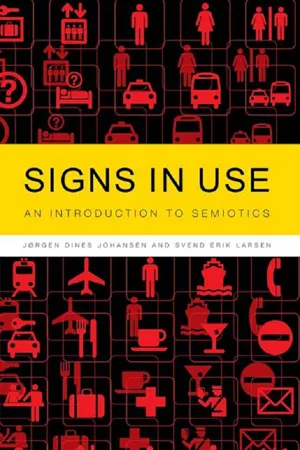
Signs in Use is an accessible introduction to the study of semiotics.
All organisms, from bees to computer networks, create signs, communicate, and exchange information. The field of semiotics explores the ways in which we use these signs to make inferences about the nature of the world.
Signs in Use cuts across different semiotic schools to introduce six basic concepts which present semiotics as a theory and a set of analytical tools: code, sign, discourse, action, text, and culture. Moving from the most simple to the most complex concept, the book gradually widens the semiotic perspective to show how and why semiotics works as it does.
Each chapter covers a problem encountered in semiotics and explores the key concepts and relevant notions found in the various theories of semiotics. Chapters build gradually on knowledge gained, and can also be used as self-contained units for study when supported by the extensive glossary. The book is illustrated with numerous examples, from traffic systems to urban parks, and offers useful biographies of key twentieth-century semioticians.
- 256 pages
- English
- ePUB (mobile friendly)
- Available on iOS & Android
eBook - ePub
About this book
Information
1 Introduction
What is semiotics about?
A summer day at the beach. A boy decides to play ducks and drakes. He finds a likely stone, tests it with his fingers, looks at the water, waits for a moment – and then throws. A dog runs next to him. It stops suddenly, sniffs a clump of seaweed, stiffens and runs off. A mosquito arrives, circles above the boy’s shoulder, lands and sticks in its proboscis. Smack! Curtains!
A series of semiotic processes has taken place here. The boy, dog and mosquito have perceived certain phenomena in such a way that they refer to something else than themselves: the stone refers to impending small skips across the surface of the water; the smell of the seaweed refers to something that the dog cannot actually see; and the shoulder refers to mosquito-food for the mosquito, while an irritating itch tells the boy that a mosquito is at work. The things become signs. Some of these processes are shared by living organisms, others are specifically human. We intend to concentrate mainly on the latter in this book. But since not only humans have semiotic competence, we will always be prepared to broaden our horizon.
Let us begin by looking at what the boy does. He starts by choosing a stone. With reference to its possible flight-path it gains a particular meaning, i.e. its suitability for stone-skimming when thrown. Next, the ripples of the waves are read as indications of wind and current conditions, so they gain the meaning of being favourable for stone-skimming. Separately, the stone and the water each refer to something else (wind and current), possibly to something which is as yet not present (the game of ducks and drakes). As signs they have acquired meaning, making it possible to orient one’s behaviour as a result. The surroundings have become an environment for human activity.
The dog, too, has semiotic abilities. With its sense apparatus it has selected a clump of seaweed as being especially interesting, possibly with reference to food or to a rival marking of territory. A closer sniff, however, reveals that it has interpreted the sign incorrectly: it obviously meant potential danger, and the dog took fright. When one perceives things as being signs, there is no guarantee that one does so correctly, or that one perceives all the consequences of the sign-making process. Consider the mosquito. Its registration apparatus reads a phenomenon as a reference to food. It acts accordingly. But this causes a new sign – a painful or itching sting that refers to the mosquito itself. This is read, localized and interpreted by the boy. He identifies the mosquito as a manageable enemy and goes into action.
Even though the processes might seem identical, they do not in fact coincide. Neither the boy nor the mosquito can do what the dog does. Indeed, they would scarcely be able to register what the dog has scented. But with a special, elementary ability to change things into signs, each of them describes a circle around their life. They change their surroundings into an environment within which they can orient themselves accurately. They have to be able to perceive things as signs for food, danger, others of the same species, preferably those of the opposite gender, and they must also be able to perceive things as signs for possible movements, e.g. direction, the layout of the terrain, etc. Otherwise, they have no environment in which to live. That is the first function of semiotic competence: to change things into signs that, together, form an environment in which the organism can live. Even though the three creatures belong to each other’s environments – since they can perceive and identify each other – their environments are not identical. Their circles merely overlap.
The boy makes the stone and the water signs by making a number of inferences on the basis of selected material qualities in things. This sorting process takes place with the aid of a code he is familiar with. Using it, he rejects characteristics that are unimportant in this particular context (e.g. the colour of the stone), linking others (e.g. the weight of the stone, the movement of the water) to a meaning that has to do with stone-skimming. He undertakes an interpretation. In principle, the dog and the mosquito do the same within their universes, and with the codes they are familiar with.
Because of this, the stone, water and boy cease to be isolated phenomena. In the act of interpretation they are bound to each other in such a way that they are integrated in a number of realizations and actions which are repeatable. The sign starts a regular activity, an inference; it is thus that the stone as a sign through its meaning, its suitability for stone-skimming, refers to a future action that can be carried out precisely because the code indicates that here we can use the rules established via previous experience. The single instance acquires a general, rule-directed nature, and thereby a collective nature. That is the second basic function of semiotic competence: it ensures that phenomena can be repeated, remembered and stored in habits, so that we can use the signs to make inferences about the nature of the world. Semiotics is about our engagement in this basic process as living organisms and as humans, and its consequences for our attempts to make the world around us our world.
In the next two chapters of the book, we deal with these fundamental semiotic functions: in the second chapter we outline the codes by means of which phenomena are structured in such a way that we can interpret them as signs. In the third chapter we give a presentation of how signs occur and are kept apart from each other as different types of signs which act together in complex sign-wholes. The remaining chapters deal with the consequences.
In its broadest sense, semiotics comprises all forms of formation and exchange of meaning on the basis of phenomena which have been coded as signs. Whether this information belongs to the entire biosphere from cells to dinosaurs or only in the world of humans, or whether information is formed and exchanged in machines, robots, etc. as electronic signals, in organic or inorganic materials, whether it belongs to a novel or a down-to-earth everyday conversation, is a matter of indifference to such a broad interpretation. We intend, however, to narrow the definition, emphasizing that semiotic competence is bound to sign-linked intention-determined actions, conscious or subconscious. For us, semiotics belongs to the living world. Sign-processes in machines, etc. are only of semiotic interest when they are integrated in sign-processes in an environment where intentions are possible. Sign-processes in such a context are referred to as discourses. This is the subject-matter of Chapter 4.
This narrowing of the semiotic perspective does not necessarily mean that human use of signs is something that enjoys special status – although the truth of the matter is that it does. Let us see what happens when the boy has returned home from the beach. He is alone in the house and potters about for a while before going to bed. Later, he wakes up with a stomach-ache. He calls out. His father arrives on the scene, frantically consults Spock’s guide to parenthood, has a quick look at The Home Doctor and happens to look into a biscuit tin that shows a catastrophic, illicit loss of its contents. He is faced with a composite phenomenon that has to be read as signs. The father must arrive at the correct conclusion about what object the sign – expression of pain, calling out and cramped lower stomach – refers to. Is it appendicitis, which means calling for an emergency service doctor immediately? Is it merely stomach-ache after excessive, illicit consumption of biscuits that are reserved for adults after the child’s bedtime? In both instances the father has to carry out the same semiotic process as the boy did down on the beach. But now he furthermore has to be able to isolate a valid context for the sign, while making his own inferences about what it refers to. He has to anchor these in a situation which is not only given, but which he has to define. Otherwise all inferences will lack a conclusion and validity.
The type of sign we are dealing with in both interpretations is a signal, i.e. a sign which via an inference is linked to a cause, independent of any human intention. If the sign is a signal for constipation, we have to broaden the interpretative framework so that we can include intention-determined actions to understand the coming into existence of the sign: the boy’s urge to eat biscuits. Not if it is appendicitis: the biology of infection is indifferent to intentions. But it could also be that the boy’s stomach-ache is a message to the father. Perhaps the child intends – conscious or subconsciously – to tell his father that he has been too busy creating his own semiotic environment, so that the boy’s sign of pain refers to a sense of lack. In that case, the sign is no longer just a signal with information about a causally determined relation to an object; it is also an act of communication – a subconscious nervous pain, possibly based on compulsive eating. But, on the other hand, it can also be the result of more direct human ingenuity: what if the boy, sneaky fox, only pretends to have a stomach-ache because he knows the sign always works? The father rushes to the scene, maybe egged on by a touch of bad conscience. The sense of lack is just as real in both cases. So there are many possibilities for anchoring the sign in a situation.
People have a number of ways, however, to get themselves out of this multiple-meaning jam. The mosquito senses food, creates a new sign which refers to itself, but is unable in time to register the sign for the possible smack. The dog goes straight to the clump of seaweed and discovers its mistake, so to speak, experimentally. The father, on the other hand, can construct a narrative as an imagined framework around the sign-process: he imagines that the boy has come home, has been alone, has cried a bit, taken biscuits from the tin and got a stomach-ache. And he can ask the boy, who can confirm the story, or take evasive action and tell a new story. The construction of narration or narrative structures is a way of placing signs in a context, so that it becomes possible to interpret signs as determined by intentions and to link intentions and action with certain subjects who may have carried them out. Interaction and narration is the subject of Chapter 5.
However, the father can call the emergency service doctor who, with the aid of various implements, can confirm whether there are signs of impending appendicitis, or whether a cup of camomile tea or a laxative tablet will do the trick – or whether one can completely exclude the sign being a signal that refers to physical pain. It may be simply the child’s imagination, a narration of suffering, pain and lack that the boy tells with his body and the nocturnal dramatization, with the father as co-actor. The father, and then the boy, can then narrate further. The semiotic competence of humans gives us a greater liberty than animals to construct an environment and to orient ourselves – but it also makes this environment more unstable and open to interpretation.
Signs not only share the context of other signs; but the meaning of the sign, its credibility and validity, rests on a number of often indirect assumptions concerning the actual context between signs. This means that signs are constituted in texts. This is the subject of Chapter 6.
It would seem to be a fundamental trait that humans equipped with semiotic abilities are not only able – like the dog and the mosquito – to adapt to nature-given surroundings and convert them into an environment they can survive in. We can to a great extent also modify the given surroundings and, in a number of instances, widen the boundaries of this environment. Not all, of course; there are biological and mental conditions which define our species, parts of the material surroundings we are not able to change. But via an ongoing modification process our environment is changed and becomes historical. Such a historicized dynamic universe is what we call culture. To the extent that the cultural process is linked to semiotic processes it is the subject of cultural semiotics as presented in Chapter 7.
What is this book about?
The aim of this book is threefold:
1 to introduce the reader to an understanding of how humans create and exchange meanings through signs;
2 to introduce concepts to do with this process which will aid the analysis of texts from different media and sign systems; and
3 to reveal semiotics as a specific theory and practice in our understanding of human culture.
In accordance with a well-established method in ‘structuralism’ and semiotics – proceeding through ‘differentiation’ – it may prove useful both to underline what we set out to do in this book in order to reach our goals and what the readers can not find in this book.
We do not claim that semiotics today is a tabula rasa where introductions have to start from point zero. There are plenty of books that introduce separately the specific schools of structuralism, of European semiotics, of American semiotics and of post-structuralism, and open specific fields of investigation such as film, literature, architecture, mass communication, computer studies, biology, philosophy, linguistics etc. in a theoretical and analytical perspective, some of them more preoccupied with the limits of semiotics than its potentials. Many of these books date from the 1960s and 1970s and are still valid in their fields. They have continued to foster new discussions up to the present day. This book is one such discussion. Fortunately, their achievements have to a large extent been included in a series of available and important dictionaries and encyclopedias, of which we list the following:
Greimas, Algirdas Julien and Joseph Courtés (1979 and 1985). Sémiotique. Dictionnaire raisonné de la théorie du langage. 2 vols. Paris: Larousse. 1st vol. Semiotics and Language: An Analytical Dictionary. Bloomington: Indiana University Press, 1982.
Colapietro, Vincent (1993). Glossary of Semiotics. New York: Paragon House.
Sebeok, Thomas (gen. ed.) (1994). Encyclopedic Dictionary of Semiotics (2nd edn). 3 vols. New York/Berlin: Mouton de Gruyter.
Posner, Roland (gen. ed.) (1997–). Semiotik/Semiotics. AHandbook on the Sign-Theoretic Foundation of Nature and Culture. 3 vols (2 have appeared). Berlin: Mouton de Gruyter.
Bouissac, Paul (ed.) (1998). Encyclopedia of Semiotics. Oxford: Oxford University Press.
Mey, Jacob (ed.) (1998). Concise Encyclopedia of Pragmatics. Oxford: Elsevier.
Nöth, Winfried (2000). Handbuch der Semiotik (2nd edn). Stuttgart: Metzler. Handbook of Semiotics. Bloomington: Indiana University Press, 1990.
Danesi...
Table of contents
- Cover
- Half Title
- Full Title
- Copyright
- Contents
- List of figures
- List of tables
- Acknowledgements
- 1 Introduction
- 2 Code and structure: from difference to meaning
- 3 Signs: from tracks to words
- 4 Discourse analysis: sign, action, intention
- 5 Action: interaction becomes narration
- 6 Text: from element-structure to dialogue-structure
- 7 Nature and culture: from object to sign
- Glossary
- Biographies
- Bibliography
- Index
Trusted by 375,005 students
Access to over 1.5 million titles for a fair monthly price.
Study more efficiently using our study tools.
Frequently asked questions
Yes, you can cancel anytime from the Subscription tab in your account settings on the Perlego website. Your subscription will stay active until the end of your current billing period. Learn how to cancel your subscription
No, books cannot be downloaded as external files, such as PDFs, for use outside of Perlego. However, you can download books within the Perlego app for offline reading on mobile or tablet. Learn how to download books offline
Perlego offers two plans: Essential and Complete
- Essential is ideal for learners and professionals who enjoy exploring a wide range of subjects. Access the Essential Library with 800,000+ trusted titles and best-sellers across business, personal growth, and the humanities. Includes unlimited reading time and Standard Read Aloud voice.
- Complete: Perfect for advanced learners and researchers needing full, unrestricted access. Unlock 1.5M+ books across hundreds of subjects, including academic and specialized titles. The Complete Plan also includes advanced features like Premium Read Aloud and Research Assistant.
We are an online textbook subscription service, where you can get access to an entire online library for less than the price of a single book per month. With over 1.5 million books across 990+ topics, we’ve got you covered! Learn about our mission
Look out for the read-aloud symbol on your next book to see if you can listen to it. The read-aloud tool reads text aloud for you, highlighting the text as it is being read. You can pause it, speed it up and slow it down. Learn more about Read Aloud
Yes! You can use the Perlego app on both iOS and Android devices to read anytime, anywhere — even offline. Perfect for commutes or when you’re on the go.
Please note we cannot support devices running on iOS 13 and Android 7 or earlier. Learn more about using the app
Please note we cannot support devices running on iOS 13 and Android 7 or earlier. Learn more about using the app
Yes, you can access Signs in Use by Jørgen Dines Johansen,Svend Erik Larsen in PDF and/or ePUB format, as well as other popular books in Philosophy & Communication Studies. We have over 1.5 million books available in our catalogue for you to explore.