- 200 pages
- English
- ePUB (mobile friendly)
- Available on iOS & Android
eBook - ePub
Understanding Broadband over Power Line
About this book
Understanding Broadband over Power Line explores all aspects of the emerging technology that enables electric utilities to provide support for high-speed data communications via their power infrastructure. This book examines the two methods used to connect consumers and businesses to the Internet through the utility infrastructure: the existing ele
Information
Publisher
Auerbach PublicationsYear
2016Print ISBN
9780367453619
9780849398469
Edition
1eBook ISBN
9781000654387
Chapter 1
Understanding Broadband over Power Lines
Similar to the first chapter in any technical-oriented book, the purpose of this chapter is to acquaint the reader with the topic of the book. In this chapter we will turn our attention to obtaining an appreciation for how data communications can occur over power lines installed to transport electricity. In addition, we will examine the potential use of broadband over power lines (BPL) as a mechanism for providing Internet access to both homes and offices. Because there are several methods that can be used to obtain Internet access, we will also review the competition to broadband communications over power line technology. This information will then be used as a mechanism to better understand the rationale for obtaining another method of high-speed communications, which is the focus of this book. Because new technology cannot be expected to be problem free, we will also discuss problems associated with the transmission of data over circuits originally intended to convey electricity.
1.1 Overview
Broadband over power lines, which is the title of this book, represents an emerging technology that can provide high-speed Internet access to the home or office through the use of an electrical outlet. Referred to as BPL, broadband over power lines theoretically has the ability to enable data to be transmitted over power lines into homes and offices at data rates between 500 kbps and 3 Mbps, which is equivalent to most Digital Subscriber Line (DSL) and cable modem transmission rates. Thus, BPL provides an emerging alternative to conventional methods of obtaining high-speed Internet access.
The key reason for the excitement concerning BPL technology is the fact that virtually every home and office is connected to a power grid and contains electrical wiring. Thus, any mechanism that provides the potential to transmit high-speed data over existing electrical wiring has the potential to provide a truly ubiquitous method to access the Internet. That said, let’s turn our attention to how this technology evolved.
Evolution
Although most readers may think of BPL as a relatively recent technology, in actuality it dates back approximately 25 years to the development of the personal computer. At that time local area networks (LANs) were still in their infancy and the most common method used to share what were then costly printers and plotters was through the use of parallel and serial mechanical switches.
Mechanical Switches
The use of serial and parallel interface switches enabled two or three computers to be connected to a printer or plotter, although obviously only one computer could access the printer or plotter at any point in time. In addition, manual intervention was required to change the setting on a switch to enable a different computer to access the shared plotter or printer.
Electric Wiring
Recognizing the need for an automatic method to share peripheral devices in the home or small office over extended distances, several vendors introduced communications products during the late 1970s and early 1980s that used existing electric wiring as a transport mechanism. Such devices consisted of a plug that was connected to the serial port of a computer and inserted into an electrical outlet. The oversized plug contained a digital-to-radio frequency modulator and demodulator. Through the use of radio frequency (RF) communications, digital data transmitted via the computer’s serial port was modulated and transmitted over the power line to another plug-type device. That device was connected to a printer or plotter in the same or a different room, in effect providing a home networking capability over existing electrical wiring.
The initial series of products developed during the late 1970s and early 1980s to enable data transmission over home power lines never achieved any significant degree of success. The reasons varied by product, but can probably be summed up in two areas: a lack of miniaturization, which resulted in rather bulky adapters, and the relatively slow data rate provided by the use of a connection to the serial port of a computer.
The HomePlug Standard
The low data rate reflected limits on the serial port of computers during the 1970s and 1980s, which limited the transfer rate to, at best, 19,200 bps during the 1970s and 115,000 bps during the 1980s, with the higher transfer rate resulting from the introduction of buffered universal asynchronous receiver-transmitters (UARTs).
Since the introduction of BPL adapters, advances in microelectronics and the development of the USB port have resulted in a renewed interest in home networks over the electrical circuits in the home and small office. USB ports provide a data transfer capability ranging from ten to a hundred times greater than the most capable UART. Concerning advances in microelectronics, instead of the bulky adapters used during the 1970s and 1980s, more modern adapters for use in the home and small office are relatively small and simple to insert into a standard electrical outlet. The combination of microelectronics and the ability to connect to the higher speed USB port now standard on desktop and laptop computers resulted in several vendors forming the Home-Plug Powerline Alliance, which released its specification for high-speed power line networking products that enable Ethernet-class operations over standard home electrical wiring.
Broadband Over Power Lines
Although the HomePlug standard represents an important step for the future of transmission over electrical circuits, home networking represents a different technology from BPL where the existing power grid infrastructure is used to provide high-speed broadband Internet access to homes and businesses. As we will note later in this book, transformers are used to raise the voltage on power lines routed from power generation plants. As high voltages are transmitted over long distances, transformers are also located where branch lines carrying lower voltages are routed to geographic locations containing clusters of homes and offices. At those locations, additional transformers are employed to reduce voltage to 120 volts, which is then routed into homes and offices.
Due to high-voltage lines and transformer coupling presenting a different environment from the home or office, a different technology emerged to solve the problem associated with moving data over power lines. Although many principles associated with transmitting data over power lines outside the home and electrical circuits within the home are similar, equipment used on power lines differs from equipment used within the home. One of the most obvious differences concerns the fabrication of equipment to withstand the elements. When designed for outdoor use, equipment requires shielding from the elements to include fabrication that makes the devices waterproof. When used indoors, similar performing equipment does not require the ability to withstand rain, snow, fog, and other weather conditions. Another obvious difference concerns the transport mechanism. In a home or office, data will be modulated to flow over a specific type of electrical wiring. In comparison, when data is modulated to flow over power lines, the type of modulation used will vary based on the transport facility. As we will note later in this chapter as well as later in this book, electric utilities have installed tens of thousands of miles of optical fiber along their high-voltage power lines. Originally used exclusively for power line monitoring and internal communications, those optical fiber facilities can also be used to provide a data transport facility for customers by increasing the capacity of the fiber through the use of wavelength division multiplexing (WDM) and dense wavelength division multiplexing (DWDM). Because optical fiber is usually not available on electrical branches where medium- and low-voltage lines are distributed toward residential and commercial customers, electric utilities will convert optical transmission into electrical transmission via RF modulation over their power lines routed to homes and offices. Thus, BPL technology represents multiple modulation methods, whereas internal home or office use of electrical wiring represents a single modulation method.
During the 1990s, several European utilities conducted trials involving the transmission of data over power lines. Although the initial trials produced mixed results, advances in technology resulted in additional trials occurring during the turn of the new century. In the United States the momentum associated with transmission of data over utility power lines significantly increased as the use of the Internet increased. Unfortunately, many large utility operators expanded their operations into the so-called merchant energy field during the years of the so-called Western energy crisis. When the energy crisis abated, many utility operators were left owing billions of dollars for power plants that were not economical to operate, which resulted in an electrical utility financial crisis. Between 2000 and 2004 several power plant operators went belly-up, declaring bankruptcy, and large utility operators who expanded their power plant portfolios had significant liquidity problems, forcing them to curtail their investments in noncore operations. Fortunately, as the recession of 2001 receded and demand for power increased, utilities in the United States and other locations once again examined the use of their infrastructure for the transmission of data. As we will note later in this book, utility operators initiated a number of field trials as the economy rebounded, and some organizations now offer Internet access in competition with cable and telephone companies.
As we build on our knowledge as we move from one chapter to the next in this book, we will become aware of the similarities and differences between the home networking and power line environments. That said, let’s turn our attention to the basic technology that enables data to be transmitted over power lines.
1.2 Fundamental Concepts
The ability to transmit data over power lines in many ways is based on the concept by which telephone companies observed that the standard wire pair routed into homes and offices could be used to transmit data at rates up to and beyond 1 Mbps. The telephone companies recognized the fact that the twisted-pair telephone line routed into homes and offices was capable of supporting a frequency range up to approximately 1 MHz. Because a telephone conversation uses only approximately 3 kHz of bandwidth, it becomes possible to transmit data by modulation occurring at frequencies beyond those used to convey voice. This technique, with which voice is transported at one set of frequencies while data is transported by modulation occurring at a different set of frequencies, is referred to as frequency division multiplexing (FDM) and serves as the foundation for the development of DSL and cable modem technologies. When we discuss BPL modulation methods in some detail in Chapter 3, we will note the similarity of the technology to DSL technology with respect to the use of FDM to separate data transmission from the primary use of the line, which is for voice when a DSL is used and for power when a BPL system is employed. For now, let’s turn our attention to how DSL technology operates.
Digital Subscriber Lines
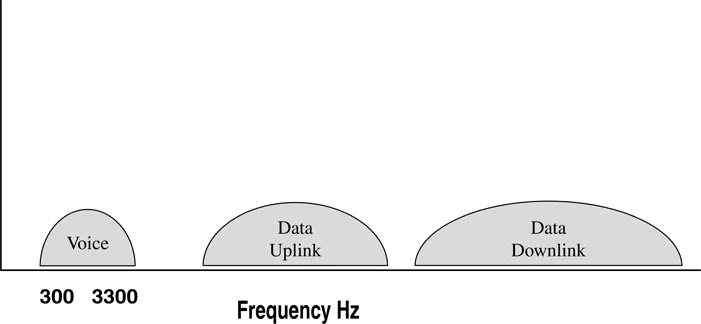
During the late 1980s, telephone companies’ suppliers introduced a series of DSL products. Each product took advantage of the fact that the telephone company local loop used only the frequencies between 300 and 3300 Hz for a voice conversation. By splitting the remaining frequency into two bands, one for the uplink and the other for the downlink, it became possible to transmit high-speed data over a standard local loop even while a telephone conversation was taking place.
Figure 1.1 illustrates how the frequency of a telephone company local loop is employed when DSL transmission occurs on the line. Note that the larger frequency band (referred to as the downlink band) is used to support data transmission from the telephone company to the subscriber. Because most DSL usage is for Internet access, vendors realized that Web pages would flow downstream toward the subscriber. In comparison, because relatively short page requests in the form of URLs flow toward the Internet, the uplink band uses less frequency than the downlink band. Because the data rate is proportional to available bandwidth, the downlink band supports a higher data transfer rate than the uplink frequency band. At the subscriber’s home or office, a DSL modem is used to modulate and demodulate data transmitted over the two frequency bands. Because the two bands are not symmetrical, this technology is referred to as an Asymmetrical Digital Subscriber Line (ADSL). Note that the three frequency bands shown in Figure 1.1 represent an FDM system occurring over a twisted-wire circuit routed from a telephone company office to a subscriber.
Power Line Operation
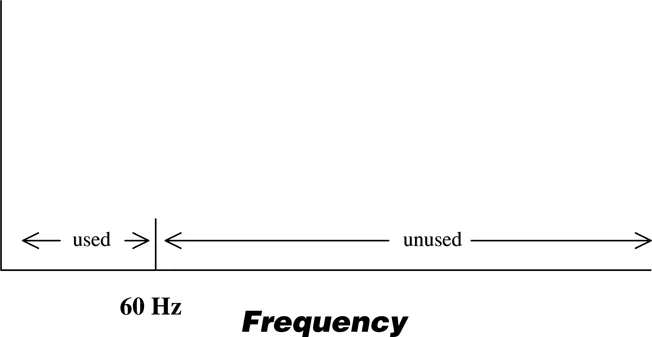
Using the telephone line as a familiar point of reference, let’s turn our attention to power line operations and the manner by which data can be transmitted concurrent with electricity. Standard alternating current (AC) is transmitted at a frequency of 60 Hz in North America and at 50 Hz in Europe and many other locations throughout the world. This means that, similar to a telephone company local loop, electrical lines have almost all of their frequency available for utilization for other purposes, to include data transmission. Consider Figure 1.2, which illustrates the frequency use of a power line. Assuming the power line is used in North America, frequencies beyond 60 Hz are unused. Thus, the evolution of data transmission over the unused frequencies of power lines is based on the same concepts that enable DSL to provide millions of subscribers with high-speed Internet access.
Overcoming High Voltages
Unlike the telephone local loop, which has a limited transmission distance, power lines allow for data transmission over extended distances. However, this results in the degradation of analog signals used to modulate data. This problem can be further exacerbated when power lines transport high voltages. To overcome the problem associated with high-voltage lines, many electric utilities are using fiber-optic cables running in parallel with those lines. Originally, the fiber-optic lines were installed for power monitoring and control purposes. Although most utilities use only a small fraction of the capacity of their fiber, it is relatively simple to expand the capacity of existing fiber by many orders of magnitude through the use of WDM equipment. Because the data is transmitted in the form of light pulses, it is ...
Table of contents
- Cover
- Half Title
- Title Page
- Copyright Page
- Dedication
- Table of Contents
- Acknowledgments
- Preface
- 1 Understanding Broadband over Power Lines
- 2 Power Line Operations
- 3 Data over Power Line Operations
- 4 Interference and FCC Action
- 5 BPL in the Home and Office
- 6 Equipment Vendors and Field Trials
- 7 Evolving Standards and Organizing Bodies
- 8 The Future of BPL
- Index
Trusted by 375,005 students
Access to over 1.5 million titles for a fair monthly price.
Study more efficiently using our study tools.
Frequently asked questions
Yes, you can cancel anytime from the Subscription tab in your account settings on the Perlego website. Your subscription will stay active until the end of your current billing period. Learn how to cancel your subscription
No, books cannot be downloaded as external files, such as PDFs, for use outside of Perlego. However, you can download books within the Perlego app for offline reading on mobile or tablet. Learn how to download books offline
Perlego offers two plans: Essential and Complete
- Essential is ideal for learners and professionals who enjoy exploring a wide range of subjects. Access the Essential Library with 800,000+ trusted titles and best-sellers across business, personal growth, and the humanities. Includes unlimited reading time and Standard Read Aloud voice.
- Complete: Perfect for advanced learners and researchers needing full, unrestricted access. Unlock 1.5M+ books across hundreds of subjects, including academic and specialized titles. The Complete Plan also includes advanced features like Premium Read Aloud and Research Assistant.
We are an online textbook subscription service, where you can get access to an entire online library for less than the price of a single book per month. With over 1.5 million books across 990+ topics, we’ve got you covered! Learn about our mission
Look out for the read-aloud symbol on your next book to see if you can listen to it. The read-aloud tool reads text aloud for you, highlighting the text as it is being read. You can pause it, speed it up and slow it down. Learn more about Read Aloud
Yes! You can use the Perlego app on both iOS and Android devices to read anytime, anywhere — even offline. Perfect for commutes or when you’re on the go.
Please note we cannot support devices running on iOS 13 and Android 7 or earlier. Learn more about using the app
Please note we cannot support devices running on iOS 13 and Android 7 or earlier. Learn more about using the app
Yes, you can access Understanding Broadband over Power Line by Gilbert Held in PDF and/or ePUB format, as well as other popular books in Technology & Engineering & Information Technology. We have over 1.5 million books available in our catalogue for you to explore.