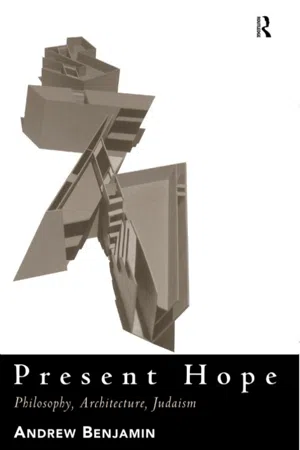
An understanding of what we mean by the present is one of the key issues in literature, philosophy, and culture today, but also one of the most neglected and misunderstood. Present Hope develops a fascinating philosophical understanding of the present, approaching this question via discussions of the nature of historical time, the philosophy of history, memory, and the role of tragedy.
Andrew Benjamin shows how we misleadingly view the present as simply a product of chronological time, ignoring the role of history and memory. Accordingly, discussion of what is meant by the present disappears from philosophical concern. To draw attention to this absence, Andrew Benjamin introduces the notion of hope and asks what this concept can tell us about the present.
At the heart of the outstanding work is an emphasis on the relation between hope and the Jewish tradition. Through discussions of philosophical responses to the Holocaust, the work of Walter Benjamin, Daniel Libeskind's Jewish Museum, and the poetry of Paul Celan, Present Hope shows how we must look beyond the purely philosophical horizon to understand the present we live in.
- 192 pages
- English
- ePUB (mobile friendly)
- Available on iOS & Android
eBook - ePub
About this book
Information
1
HOPE AT THE PRESENT
OPENING
Opening this project—Present Hope—involves establishing the positions that will continue to be developed and related in the writing to come. That they form a relation without end needs to be interpreted as symptomatic of the type of questioning they stage. Moreover, the force of this project will hold to hope as a structural condition of the present rather than as the promise of a future, the continual promise of a future that will always have to have been better.
The first of these positions concerns the way in which the present comes to be thought philosophically. As a point of departure it will have to be recognised that the present is already thought within differing philosophical positions. Instances of the differing ways in which the present works within philosophy will, in this instance, centre around the writings of Martin Heidegger and Walter Benjamin. In addition to philosophy, poetry, architecture and Judaism will also figure as an integral part of the argument to come. In more general terms, however, the presence of conflict at the present, conflict concerning the nature of the present, entails that, in the end, philosophy will have to allow for the possibility of antinomies that are not purely phenomenal. Allowing for this possibility will entail a reconsideration of the philosophical. What comes to be reworked is the relationship between the phenomenal and the essential and, therefore, the particular and the universal. Reworking is not destruction. Philosophy is constituted by an act of engagement with its own history. Engagement can take many forms. Here, and in contrast to a simple repetition of the Same, it is present as the process of reworking.
Philosophy has always attempted to justify itself in terms of universality. Even though, for example, the Cartesian project of absolute knowledge differs fundamentally from the Hegelian, their insistence on absolute inclusivity provides a fundamental point of contact.l Within Descartes and Hegel’s own terms the limit of philosophy becomes the limit of the possible or the limit of the real. Philosophy will have always been linked to the project of completion and thus to the necessity for a temporal as well as an ontological finality. This set up gives rise to questions which, despite their simplicity, harbour a necessary and insistent complexity. Is it possible to continue with philosophy if the projects of completion and finality have been rendered redundant for reasons as much philosophical as political? If philosophy is linked to the necessary identification of thought and being, and of the real and the ideal, can philosophy continue if what is taken as central, with the abeyance of these forms of finality, is the incomplete?
Responding to these questions can take at least two specific forms. The first laments the impossibility of philosophy’s project, and thus condemns itself to a ceaseless preoccupation with impossibility, the aporetic and a thoughtful melancholia. The second involves a complex re-reading of philosophy’s history in which what comes to be affirmed is the identification of the productive presence of the incomplete as always having formed part of the philosophical project. Part of that undertaking will have to involve a sustained engagement with the ontology and the temporality of the incomplete.2 Assuming the effective presence of ontology and time will allow the work of the incomplete to be traced in different sites which thereby lend themselves to a philosophical engagement. Philosophy is able to continue once continuity is understood as involving a series of complex repetitions in which repeating needs to be understood as a continual reworking. It is the second of these options that provides the basis of the chapters to come.
At work within this set up, therefore, is the necessity to rethink and thus to rework the philosophical project in terms of an affirmation of the incomplete and thus to develop further an ontology and temporality of the incomplete. Rather than writing an abstract philosophical treatise—a project that has already been rendered otiose by the nature of the philosophy in question—the insistence of the present and its possible interarticulation with hope will be taken as providing the continual point of departure. (As will emerge, this defers the possibility of abstraction because the present will always be a particular that is no longer held within the relation of dependency demanded by the interconnection of universal and particular. Abstraction will be limited to that relation.) What is at stake, therefore, is the possibility of thinking philosophically about the present. Once again, this is not intended to be a question devoid of specificity, but one in which the problem of what type of thinking and what particular formulation of the present is involved will already be implicated in the specific form of philosophical activity undertaken. Furthermore, rather than being a spurious attempt to apply philosophy, an integral part of the project here will involve questioning philosophy’s relation to architecture and to poetry once the site of engagement is taken to be the present —or, more precisely, the interrelationship between modernity and the present.
The position at work within this project therefore involves the complex set up that emerges when it becomes essential to address that which marks out modernity: i.e. modernity’s own specificity. (The problem of the relationship between the present and modernity can be put to one side at this stage.) Here, there is a three-part formulation. The first part is that modernity is delimited by a founding dislocation.3 An instance of this fundamental moment is the impossibility of identifying either a possible coextensivity or continuity between sign and thing or between signifier and signified. (There are many moments that mark out this divide. Perhaps one of the most emphatic is the Freudian formulation of the unconscious.4) Second, there is the continual attempt to efface the presence of this founding moment by the formulation of differing conceptions of continuity and totality: e.g. human nature, eternal values, myths of origin, the naturalisation of chronological time. Third, these attempts to establish or reestablish continuity generate their own version of particularity, or perhaps in a more limited sense, of the fragmentary. What makes this more difficult is that such a set up generates a conception of the particular that has three defining characteristics. Their potentially exclusive characteristics delimit how particularity is to be understood once it is viewed as having been generated by an enforcing continuity, and thus when it only exists in relation to that continuity. Particularity, now robbed of either generality or the simple assumption of existence, is here defined in relation to continuity, the continuity generating these differing conceptions of the particular. What this leaves open, of course, is the possibility of another sense of particularity.
The first characteristic is that, as particulars, they will be able to be absorbed into the whole, perhaps, for some positions, re-absorbed into the whole. The second is that a consequence of being absorbed is that, despite the presence of particulars, particularity, taken as that which may exist in itself, cannot be thought. Particulars will have been no more than mere predicates of a universal. The third characteristic is the melancholic. It is marked by a preoccupation with particularity in which the particular is haunted by either the loss of an unspecifiable whole or the fall from totality. Here particularity presupposes a founding plenitude and envisages either redemption or, more straightforwardly, the future, thought in terms of completion and thus of recovery.
What this means is that since modernity is to be understood as a dislocation that comes to be effaced, thinking that dislocation cannot involve mere attention to particulars or fragments, as though they existed in themselves. Here, in contrast, there has to be that act, that moment of work, which allows for the presence of dislocation. It should also be clear that there are different thinkers, and thus thinkings, of modernity, different ways of arguing for the founding presence of dislocation. The reality that some of these positions are, in the end, irreducible will only reinforce the fact that what marks out the present site of philosophical activity is the presence of a founding conflict concerning the nature of modernity. (Indeed it will be in precisely these terms that it will become possible to stage the encounter between Heidegger and Benjamin.) Finally, it must be noted that the differing arguments denying the particularity of modernity only become further symptoms of its ineliminable presence.
The third and final position marking out this project arises once it becomes essential to link modernity to the present. Here, it will be assumed that what yields this link is the Shoah.5 In sum, what marks this founding moment—the Holocaust within thinking—is the impossibility of maintaining simple continuity.6 However, rather than abandoning the All in the face of the Shoah, the emergent question must concern how to continue. That the tradition of European culture could not have prevented what occurred means that instead of either allowing that tradition to be repeated unchecked on the one hand, or of abandoning key elements within it and thereby employing a dangerously destructive logic on the other, the central question, one which will figure as much in the visual arts as it will in philosophy and literature, will concern how it is that what is given is able to be repeated. In what way can repetition work without the hold of either complicity or nihilism? While demanding a more precise description, complicity can initially be understood as allowing for the unchecked repetition of tradition; nihilism is the name given to the varying forms taken by what in more general terms could be described as a metaphysics of destruction.
And yet, because the Shoah can always be incorporated within the gestures of universal history or redescribed such that it forms part of a general history of racism or, even more specifically, a general history of anti-semitism, what allows it to be granted this status within this particular project? (The fact that this question still needs to be acknowledged is itself one of the motifs that marks out the current state of thinking.) There are at least two ways of addressing this question. The first would be to invoke a form of precedent. It would involve recognising that thinkers, writers and artists—including Adorno, Lyotard, Celan, Beuys and Kiefer—have not just noted the presence of a problem, but that the question of how to continue after the Shoah dominates their specific undertakings.7 This is not to argue that their projects are reducible to dwelling, straightforwardly, on questions arising from the Shoah. Rather, their projects can be situated within the more nuanced position in which there is the recognition that any work seeking to confront and thus engage with the present cannot avoid the Shoah’s insistence. The second response to this question almost defeats the description of its being an argument. It is tempting to resort to the claim that the Shoah is an occurrence for which there could be no universal, as though that were an argument complete in itself. This would have the consequence that any attempt to establish such a universal/particular relation would only trivialise the enormity of what took place. While this position has a great deal of cogency—indeed it will be necessary to deploy elements of it at a later stage—the problem of privilege remains precisely because it is a position which needs to be contested. Allowing for the ineliminable presence of such a contest means that questions of proof and certainty are no longer apposite. (Again, it may be that this is the consequence of the position being described.) At this stage, therefore, all that can be done is to acknowledge a certain privileging of the Shoah as the occurrence that, within the visual arts, literature and philosophy, brings modernity and the present into conjunction. What this involves is, of course, a move that cannot be justified if justification becomes a prescription for all. In what follows this privileging is assumed. The viability of that assumption will be shown in the work that it sustains. The problem of the lack of explicit justification should be taken as one of the enduring problems governing contemporary thought.
The major difficulty to be addressed in this opening concerns the relationship between, in the first place, a general philosophical thinking of the present—a generality that will have many specific forms; in the second, modernity understood as dislocation; and finally, the present as given by the Shoah. There is a generalised thinking of the present within philosophy. It occurs as much in Kant and Hegel as it does in Benjamin and Heidegger.8 This thinking of the present has a generality which will be addressed in terms of the reciprocity between time and task. Time, and that means the way in which the present is understood, will determine the nature and with it the direction of philosophical activity. The latter is the task. The formulation of the present arising out of a thinking of the reciprocity between time and task will be identified henceforth as the epochal present; as such, it can be held apart from the chronological present. (It will be necessary to return to the details of this conception of the present.) Nonetheless, it remains the case that once the Shoah is introduced, another element enters into consideration.
It has already been suggested that not only is modernity given by founding dislocations, but that these dislocations are able to be effaced by the reintroduction of forms of totality. Particularity will always be able to be incorporated. Part of the challenge, therefore, will be to maintain the particularity of modernity. Related to this are the differing ways in which philosophy conceives of the present. Some will be connected to modernity, others will not. However, once the Shoah is attributed the status of allowing for an interconnection between modernity and the present, then that has to be understood as claiming that modernity as dislocation will have a specific engagement with the Shoah, given that the Shoah is taken within that formulation of philosophical activity which allows it to have a determining effect on thinking. This will be the site in which the effective interconnection of time and task is to be situated. And yet despite that, there is here the absence of a generalised, and indeed generalisable, necessity. What this means is that not only is there the inescapable possibility of the Shoah’s absorption, but that this possibility defines the particularity of this project. In other words, resisting assimilation means having to grant that what is being staged here is a particular enactment of the relationship between time and task. There is no way of justifying this as a general or universal claim. As such what it provides is the point of dispute between this project and that thinking of modernity which presumes itself to be addressing the present even though the Shoah is completely absent as a determining occurrence. Moreover, in providing the site of conflict, it reinforces the necessity for judgement. It is only the presence of conflict that demands judgement. Once antinomies are taken to be anoriginally present—and here they must be, insofar as what is at stake are ways of thinking the present that cannot be reduced to each other—judgement becomes the only apposite response. What this means is that if the antinomic or the conflictual cannot be eliminated by recourse to another level of analysis, then their copresence will demand a decision. As the decision cannot have recourse to the structure of universality—if it could then the antinomies or the conflicts would have been eliminated from the outset—the decision will necessitate another response. A way of identifying the ineliminable necessity of this form of decision making is in terms of judgement. Judgement will only arise once a particular set up, while unmasterable, still necessitates a decision.
Before taking up the concerns of this text, a warning needs to be introduced. It concerns the name Auschwitz. Indeed, it will have to touch on any use of this name after Auschwitz. Perhaps one of the most acute versions of this warning has been advanced by Jacques Derrida in ‘Canons and Metonymies’. Derrida’s contextual concern is the role this name has played in a number of contemporary philosophical studies. His questions are both explicit and uncompromising.
What is the referent of this proper name Auschwitz? If, as I suspect, one uses the name metonymically, what is the justification for doing so? And what governs this terrible rhetoric? Within such a metonymy, why this name rather than those of all the other camps and mass exterminations? Why this heedless and also troublesome restriction? As paradoxical as it may seem, respect is due equally to all singularities.9
Central to what is being suggested in this passage is the possibility that Auschwitz may have moved from being a simple proper name and thereby designating a specific geographical site, to its having become the name for all such sites. Why is Auschwitz evoked in this way and not Treblinka? On one level there is a pointlessness attached to this question. And yet echoing within it is the problem of how it is possible to ‘respect’—to use Derrida’s term—those who suffered elsewhere by only having used the name Auschwitz. How are they named by the name Auschwitz? Part of what is being demanded by Derrida is a grammar. It will be essential to return to the possibility of a justification for this use of language, here and initially, the justification for the use of metonymy. Derrida’s relentless questioning introduces the need for caution and thus of holding back from an immediate oscillation between pathos and polemic. In the first place, respect will be linked here to this caution. Second, however, respect will be linked to memory. Both respect and memory demand continuity. Forgetting would be the failure to respect. The problem, therefore, is beginning to understand the possibility of a conception of memory that maintains respect. What would disturb this set up is the possibility that mourning may fail to maintain a relation of distance to the object. It would have failed precisely because it would have to have been overcome. Once this occurred, what it would entail is not just the incorporation of the object, but the elimination of a certain spacing that held the object in place. Place would have demanded distance. Incorporation and the denial of distance would, as a consequence, also fail in every respect to continue. Respect may, therefore, be necessarily linked to holding to a relation of distance.
In sum, modernity and the present are interconnected here precisely because this project—Present Hope—is an attempt to think the present from within that conception of the philosophical that takes the dislocation which yields modernity as the necessary point of departure. An inherent part of that thinking takes the presence of the Shoah to be the occurrence that brings the present and modernity into connection. What is being staged here, therefore, is a particular thinking of the present. Rather than offering an account demanding what would, in the end, be no more than putative universality, insisting on this connection has the twofold consequence of yielding a thinking of the present which projects a contemporary site of philosophical activity precisely because generality—both with regard to the present and modernity taken as existing tout court—is resisted. And yet, this resistance opens a conception of particularity that cannot be readily reinserted into the universal/particular relation. This is a fundamental part of Walter Benjamin’s philosophical undertaking. The further consequences of this possibility will be developed in the following engagements.
As a final opening point, an additional consideration needs to be noted. Here it concerns the relationship between the incomplete, the differing particularities within which the present can be said to be thought, and an ontology of the present. A problem would seem to arise with the suggestion that the very necessity of having to think particularity within the abeyance of the universal/ particular relation is incompatible with the project of ontology. The assumption in the above is, of course, that ontology will have to demand that particular form of inclusivity that would, in the end, render all particulars the Same. Responding to this position does not demand the introduction of relativism. It is not as though all that is at work here are different explanatory narratives. There is a more fundamental project which involves having to think the presence of different formulations of philosophical activity; again, this will be an activity defined in terms of the relationship between time and task. The presence of these differences is another way of understanding the presence of the incomplete. The challenge involves the further recognition that the only adequate philosophical account of this set up involves a reformulation of the project of ontology in terms of an ontology of the incomplete. Once this is taken up as a real possibility then it would, in its very realisation, provide an ontology of the present. Part of this project therefore involves precisely that undertaking. What will emerge is that the interrelationship between the incomplete and the present allows a similarity of thinking. What this means is that both articulate the same ontologico-temporal set up. Here, the ontological will have a productive or generative quality. Moving to the effective or the actative is the mark of already having moved from considering the ontological in terms of stasis, namely the fixed and the permanent, to allowing for the ontological to be explicated as becoming or force, and thus in terms of presencing rather than the already present.10
While it remains the case that these opening formulations of the interconnections between modernity, the present and the incomplete, and the differing demands they make on thinking, stand in need of further clarification, such an undertaking cannot be done in the absence of part...
Table of contents
- Cover Page
- Title Page
- Copyright Page
- Preface
- Acknowledgements
- 1: Hope at the Present
- 2: Time and Task
- 3: Shoah, Remembrance and the Abeyance of Fate
- 4: Awakening from Tragedy
- 5: The Architecture of Hope
- 6: Continuing with Poetry
- 7: Conclusion
- Notes
Trusted by 375,005 students
Access to over 1.5 million titles for a fair monthly price.
Study more efficiently using our study tools.
Frequently asked questions
Yes, you can cancel anytime from the Subscription tab in your account settings on the Perlego website. Your subscription will stay active until the end of your current billing period. Learn how to cancel your subscription
No, books cannot be downloaded as external files, such as PDFs, for use outside of Perlego. However, you can download books within the Perlego app for offline reading on mobile or tablet. Learn how to download books offline
Perlego offers two plans: Essential and Complete
- Essential is ideal for learners and professionals who enjoy exploring a wide range of subjects. Access the Essential Library with 800,000+ trusted titles and best-sellers across business, personal growth, and the humanities. Includes unlimited reading time and Standard Read Aloud voice.
- Complete: Perfect for advanced learners and researchers needing full, unrestricted access. Unlock 1.5M+ books across hundreds of subjects, including academic and specialized titles. The Complete Plan also includes advanced features like Premium Read Aloud and Research Assistant.
We are an online textbook subscription service, where you can get access to an entire online library for less than the price of a single book per month. With over 1.5 million books across 990+ topics, we’ve got you covered! Learn about our mission
Look out for the read-aloud symbol on your next book to see if you can listen to it. The read-aloud tool reads text aloud for you, highlighting the text as it is being read. You can pause it, speed it up and slow it down. Learn more about Read Aloud
Yes! You can use the Perlego app on both iOS and Android devices to read anytime, anywhere — even offline. Perfect for commutes or when you’re on the go.
Please note we cannot support devices running on iOS 13 and Android 7 or earlier. Learn more about using the app
Please note we cannot support devices running on iOS 13 and Android 7 or earlier. Learn more about using the app
Yes, you can access Present Hope by Andrew Benjamin in PDF and/or ePUB format, as well as other popular books in Philosophy & Modern Philosophy. We have over 1.5 million books available in our catalogue for you to explore.