Music Cultures in the United States is a basic textbook for an Introduction to American Music course. Taking a new, fresh approach to the study of American music, it is divided into three parts. In the first part, historical, social, and cultural issues are discussed, including how music history is studied; issues of musical and social identity; and institutions and processes affecting music in the U.S. The heart of the book is devoted to American musical cultures: American Indian; European; African American; Latin American; and Asian American. Each cultural section has a basic introductory article, followed by case studies of specific musical cultures. Finally, global musics are addressed, including Classical Musics and Popular Musics, as they have been performed in the U.S..
Each article is written by an expert in the field, offering in-depth, knowledgeable, yet accessible writing for the student. The accompanying CD offers musical examples tied to each article. Pedagogic material includes chapter overviews, questions for study, and a chronoloogy of key musical events in American music and definitions in the margins.
- 444 pages
- English
- ePUB (mobile friendly)
- Available on iOS & Android
eBook - ePub
About this book
Information
Part I
Music in the United States: Historical, Social, and Cultural Contexts
CHAPTER 1
A Social-Historical Approach to Music in the United States
The United States of America, the fourth largest country in the world, covers over 3.5 million square miles of land. From its highest point, Mr. McKinley in Alaska, to its lowest in Death Valley, California, this enormous land area encompasses deserts, imposing mountain ranges, polar ice caps, lush woodlands, rainforests, rich prairies, five time zones, and more than 280 million people of varying ethnicities, languages, and histories.
Unity in diversity is a common phrase often used today to describe the people and social contexts of the United States. Home to people of virtually all of the world’s social, ethnic, religious, and language groups, the United States has embedded within its history, government, and national consciousness the twin ideals of democracy and equal human rights; although not always realized, these ideals have motivated much social and musical activity within its borders.
Any discussion of music in the United States must take into account the various contexts of its creation, performance, and meaning. While reading this text, ask yourself these questions:
- What part do specific geographical, historical, and cultural contexts play in music making among highly diverse social and cultural groups?
- How are various group and individual identities realized or marked through music and its performance?
- How do people and their musics interact with, merge into, or separate from one another to form distinct entities?
This book answers some of these questions by examining the musical cultures of the United States through various wide-angle lenses or windows, the first framing a picture of a shared musical culture in which similar patterns of social structure and musical identity are discussed, the second framing another picture, of distinct musical cultures in which the focus is on issues of difference. Finally, issues of social and musical interaction are addressed, in which the resulting pictures are far more fluid, where identities are contested, negotiated, and continually in flux.
Remember chat these frames are artificial constructions designed to highlight certain features of musical culture over others; life lived by real people "on the ground," so to speak, is often far more complex, interactive, and unpredictable. These large frames of discussion are to be taken more as guideposts than as true pictures, pointing the way to musical and social streams that continue to have implications for the people and musics of the United States today. The reader is urged to look more closely at specific chapters and especially at the individual Snapshots found throughout this volume.
THE LAND AND ITS PEOPLE TODAY
The contiguous United States extends east to west from the Atlantic Ocean to the Pacific and north to south from the border with Canada to the Rio Grande River, which forms the natural boundary between the United States and Mexico (see Figure 1.1). The Southeast United States is framed by the Gulf of Mexico; the Southwestern portion by the Pacific Ocean. Alaska, off the Northwestern coast of Canada and separated from the easternmost tip of Russia by rhe Bering Strait, shares far more in terms of topography, climate, and natural resources with Northwestern Canada than with the contiguous United States, while Hawai'i, forming one of the many island chains in the South Pacific, shares much with the culture of Polynesia.
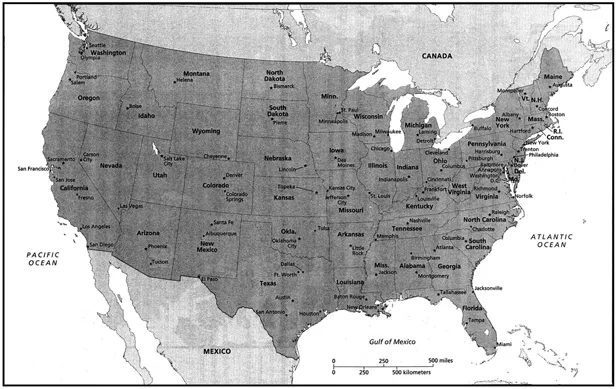
Figure 1.1 Map of the United States
The East Coast Plain, framed on the west by the Appalachian Mountains, dominates the eastern portion of the United States, while the great prairies and plains dominate the central portion. The mammoth mountain chains—the Eastern and Western Cordilleras (stretching parallel to the Pacific Ocean from Cape Horn at the tip of South America to the Aleutians in Alaska), which encompass the Sierra Nevada, Rocky, and Cascade Mountains—provide a natural north-south barrier, giving way to the lowlands and deserts of the West and Southwest coasts of the United States.
Major inland waterways include in the east the Hudson, Delaware, and Potomac rivers, which flow east into the Atlantic; the main central river system includes the Mississippi and Missouri rivers, which flow into the Gulf of Mexico; and in the west the Columbia and Colorado rivers, which flow into the Pacific. The
Great Lakes, which share their borders with both Canada and the United States, provide tremendous natural resources today as they did for these countries’ earliest inhabitants when they dominated the inland waterways system of trade and early land ownership.
In earlier times, geographical barriers—such as imposing mountain chains and the often harsh climate at both temperature extremes—made interaction between social groups difficult; thus musical and other forms of expressive cultural exchanges were fairly limited until the nineteenth century, although American Indian groups before that time had developed extensive trade networks among themselves and with the first European traders and settlers.
Today, the United States, a federal republic, is divided politically into 50 states. In addition, it also has a number of other formal dependencies, such as Puerto Rico, the Virgin Islands, and Samoa in the South Pacific. The population of the United States reflects both its political and social history as well as current demographic patterns of immigration and settlement. The following information is based on recent census data for the United States (Crystal 1999). Although the major statistics are presented here, they do not do justice to the variety of subgroups, languages, and ethnicities embedded within these categories.
The first inhabitants—American Indians, Inuit (Eskimo), and Aleut—are today a small minority of the total population (under 5%), the majority of whom live in the Southwest, Northeast, and Plains areas. Many American Indian peoples continue to live today in rural areas or on reservations, often in very depressed economic conditions, while others, especially during the latter half of the twentieth century, have migrated to large urban areas to find work.
By far the largest portion of the population (about 75% of the total) derives from Europe, predominantly from Britain. Obviously, many aspects of our federal and local governments, social and political institutions, religions, official language, economies, and musical institutions and values derive from these nations. Sizable populations of Germans, Italians, Ukrainians, Dutch, Scandinavians, Hungarians, and Greeks also live within the United States, predominantly in urban areas, although Ukrainians and Scandinavians especially played a large part in the westward expansion and rural settlement during the eighteenth and nineteenth centuries.
The remaining approximately 20% is divided among the growing African American population (about 10% of the total), originally transported primarily from West Africa during periods of slavery; people of Hispanic origin (Mexican, Caribbean, Central, and South American), the largest growing minority population, representing about 8% of the total; and the Asian communities (Chinese, Filipino, Japanese, Indian, Korean, Vietnamese, Lao) and Pacific Islanders (predominantly Hawaiians and Tongans), about 2% of the total.
About 75% of the population of the United States lives within large urban areas, such as New York, Chicago, and Los Angeles. The overwhelming majority of the population is Christian (about 80%), with Protestants comprising about 53%. Sizable Jewish and Muslim populations as well as a growing number of Buddhists, Sikhs, and Hindus have also immigrated to the United States, especially during the twentieth century.
A BRIEF SOCIAL AND MUSICAL HISTORY OF THE UNITED STATES
The Earliest Inhabitants
The original inhabitants of the United States were the ancestors of the American Indians, who are believed to have emigrated here from what is now the westernmost portion of Russia across the Bering Strait in two great waves (ca. 18,000 B.C.E. and 12,000 B.C.E.). Centuries before the Europeans arrived, American Indian peoples had developed extensive cultures based on hunting, fishing, and small-scale farming that were sustained by a traditional life infused with music and ritual activity.
Mimetic dancing
Dancing that imitates a specific activity, such as planting corn.
Specific contexts for musical performance included ceremonies surrounding the yearly cycles of spring/summer and fall/winter activities, including hunting songs (often revealed in dreams), planting (often including mimetic dancing), and harvesting (thanksgiving) songs ana dances, as well as shamanistic practices, including individual and community healing ceremonies. Among the Plains Indians, for example, song practices associated with medicine bundles and with war dances were common. In the Northwest, among the Haida, Salish, and Athapaskan, potlatches were frequently held, as well as ceremonies accompanying totem pole carving and installation. Some music, such as gambling, game, and love songs, addressed daily social and communal life, while other kinds of music commemorated historical or mythical events. Social dance songs, such as the women’s shuffle dances of the Iroquois Confederacy in the northeast United States and southeast Canada, were also performed.
Potlatch
A large feast characterized by gift giving to all participants
The traditional social structure of most American Indian communities was divided along gender and age lines, with men and women having clearly delineated and equally valued tasks and responsibilities to the group throughout their adult lives. Puberty, marriage, and death rituals were common practices ensuring safe and orderly passage into, through, and beyond life. Puberty rituals, perhaps the most extensive of the life-cycle rituals, often involved separating the young men and women from the community for a period of time, during which the elders would teach them the history and mythology of their group as well as its secret songs and ceremonies.
Many American Indian peoples, such as the Inuit (Eskimo) living in harsh northern climates, remained fairly isolated and scattered from one another, while others, such as the Plains Indians, developed by the fifteenth and sixteenth century C.E. large and powerful hunting and trading networks made up of many independent communities tied together through elaborate exchange economies. The intertribal meeting, later to develop into the powwow, became an important context for the exchange not only of food and gossip but also of songs and dances.
Although traditional American Indian song and dance were quite varied in terms of their performance contexts and meanings, musically they shared certain basic features: most of the music was vocal, monophonic or heterophonic, with frequent use of vocables.
Monophortic
One melody line
Heterophonic
One line performed in simultaneous variations
Vocables
Syllables that are phonetically related to, but have no referential meaning in, the local language
No separate instrumental traditions existed within early American Indian musical cultures, although instruments such as the drum and rattle were frequently used to accompany song. The drum, especially, had deep power and significance for early communities and became in later times a source of much contention between aboriginal peoples, Christian colonists, and other settlers, who regularly banned its use.
From Colonies to Nation; 1600-1800
Although there is some evidence for early Norse contact in Newfoundland ca. 990 C.E., the first permanent European settlements in the United States were made by the Spanish in 1565 in modern-day St. Augustine, Florida, and the British in Jamestown, now in Virginia, in 1607. The early visitors were mainly traders sent by various governments and business interests in Europe in hopes of establishing ties with the Indians, who could help them in the lucrative fur trade. By the early seventeenth century, American Indians in the East had a fully established economy based on fishing and hunting and had developed skills that proved essential to European survival. With the traders came also notions of private ownership and a money-based economy. Missionaries from Spain and France arrived soon after, bringing with them a radically different spiritual worldview based on the hierarchic p...
Table of contents
- Cover
- Half Title
- Title Page
- Copyright Page
- Dedication Page
- Contents
- Introduction
- Acknowledgments
- Part I Music in the United States: Historical and Cultural Contexts
- Part II A Sampler of Music Cultures in the United States
- Part III Global Musics in the United States
- Bibliography
- Index
Trusted by 375,005 students
Access to over 1.5 million titles for a fair monthly price.
Study more efficiently using our study tools.
Frequently asked questions
Yes, you can cancel anytime from the Subscription tab in your account settings on the Perlego website. Your subscription will stay active until the end of your current billing period. Learn how to cancel your subscription
No, books cannot be downloaded as external files, such as PDFs, for use outside of Perlego. However, you can download books within the Perlego app for offline reading on mobile or tablet. Learn how to download books offline
Perlego offers two plans: Essential and Complete
- Essential is ideal for learners and professionals who enjoy exploring a wide range of subjects. Access the Essential Library with 800,000+ trusted titles and best-sellers across business, personal growth, and the humanities. Includes unlimited reading time and Standard Read Aloud voice.
- Complete: Perfect for advanced learners and researchers needing full, unrestricted access. Unlock 1.5M+ books across hundreds of subjects, including academic and specialized titles. The Complete Plan also includes advanced features like Premium Read Aloud and Research Assistant.
We are an online textbook subscription service, where you can get access to an entire online library for less than the price of a single book per month. With over 1.5 million books across 990+ topics, we’ve got you covered! Learn about our mission
Look out for the read-aloud symbol on your next book to see if you can listen to it. The read-aloud tool reads text aloud for you, highlighting the text as it is being read. You can pause it, speed it up and slow it down. Learn more about Read Aloud
Yes! You can use the Perlego app on both iOS and Android devices to read anytime, anywhere — even offline. Perfect for commutes or when you’re on the go.
Please note we cannot support devices running on iOS 13 and Android 7 or earlier. Learn more about using the app
Please note we cannot support devices running on iOS 13 and Android 7 or earlier. Learn more about using the app
Yes, you can access Music Cultures in the United States by Ellen Koskoff in PDF and/or ePUB format, as well as other popular books in Media & Performing Arts & Ethnomusicology. We have over 1.5 million books available in our catalogue for you to explore.