eBook - ePub
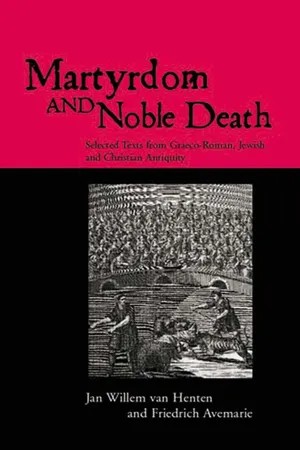
Martyrdom and Noble Death
Selected Texts from Graeco-Roman, Jewish and Christian Antiquity
- 224 pages
- English
- ePUB (mobile friendly)
- Available on iOS & Android
eBook - ePub
Martyrdom and Noble Death
Selected Texts from Graeco-Roman, Jewish and Christian Antiquity
About this book
This volume explores the fascinating phenomenon of noble death through pagan, Jewish and Christian sources. Today's society is uncomfortable with death, and willingly submitting to a violent and ostentatious death in public is seen as particularly shocking and unusual. Yet classical sources give a different view, with public self-sacrifice often being applauded. The Romans admired a heroic end in the battlefield or the arena, suicide in the tradition of Socrates was something laudable, and Christians and Jews alike faithfully commemorated their heroes who died during religious persecutions. The cross-cultural approach and wide chronological range of this study make it valuable for students and scholars of ancient history, religion and literature.
Information
1
PAGAN TRADITIONS OF NOBLE DEATH
This chapter offers brief introductions to and translations of a selection of passages on the theme of noble death, coming from the non-Jewish and non-Christian ancient world. The oldest tradition incorporated, about Ahiqar the sage, dates from the eighth or seventh century BCE and is of Aramaean origin. The other passages concern Greeks and Romans and date from the fifth century BCE to the third century CE. The general introduction at the beginning of the chapter discusses the various images of noble death presented in these texts as well as their contexts.
General Introduction
The story of Ahiqar
Ahiqar the sage was falsely accused before the Assyrian king, convicted, sentenced to death, rescued in a wonderful way, and finally rehabilitated. Ahiqar did not really die a noble death, but his story has been enormously influential. The many versions of Ahiqar in the languages of ancient and medieval Christianity, like Armenian and Old Slavonic, as well as the references in rabbinic and Muslim literature show the popularity of the traditions about this sage in Late Antiquity. Ahiqar's story and sayings have been copied as an appendix to A Thousand and One Nights.
Ahiqar's story runs as follows. Ahiqar acts as councillor and keeper of the royal signet ring during the reigns of the Assyrian kings Sennacherib (704–681 BCE) and Esarhaddon (680–669). As prophesied by an astrologer he could not have children, despite his sixty wives. He therefore adopts his nephew Nadin (Nadan in later versions) and prepares him to succeed him as a courtier. After being installed as councillor at the court, Nadin conspires against his uncle and benefactor and convinces King Esarhaddon that Ahiqar was committing treason. Esarhaddon orders the officer Nabusumiskun to execute Ahiqar. Two other men have to control and report his execution. Ahiqar persuades Nabusumiskun, whom he had rescued earlier, to hide him in his house and to execute somebody else instead of him. The two men back Nabusumiskun up and report Ahiqar's death to the king. Here, the Aramaic story breaks off. Later versions tell, however, that the Egyptian king heard about Ahiqar's death and sent a letter to Esarhaddon in which he offered three years of Egypt's revenues to a sage who could solve difficult riddles and build a castle between earth and heaven, something only Ahiqar would be able to do. King Esarhaddon starts to regret having Ahiqar executed and the officer decides that the time has come to reveal the truth to the king. Ahiqar is, of course, welcomed back and sent off to Egypt. After his successful trip he refuses a reward and instead asks permission to discipline Nadin. He tortures his nephew and addresses a long series of reproaches to him in most versions, after which Nadin swells up like a bag and dies.
The story's pattern of a downfall and later vindication of a sage reoccurs in several biblical tales (Gen. 37–50, Esther, Susannah, Dan. 3 and 6) and is also found in Jewish and Christian passages about noble death. The Ahiqar story is basically a legend about a court intrigue. The stories about Daniel and his companions (Dan. 3 and 6) correspond in interesting ways to Ahiqar's story. In both cases it concerns a sage holding a high position at a foreign court as well as a king, who, despite his absolute power, lets himself be influenced by the false accusation by another sage — in Ahiqar's case his own nephew.1 The sage is supposed to be executed on the basis of the false accusation, but is miraculously saved at the end. In the martyr stories this rescue is transposed after death, for example as a resurrection (see chapter 2–4).
Noble death of philosophers
An important tradition in ancient culture, this time closely linked to the theme of noble death from the beginning onward, concerns the death of philosophers. Ancient philosophers valued sacrifice on behalf of others or for important causes. Some of them put this ideal into practice themselves. They functioned as model figures, because they showed how important goals could be reached even under extremely difficult circumstances. Indeed, Aristotle characterises a virtuous person as somebody who is prepared to sacrifice himself for one's friends and one's homeland and, if necessary, to die for it. He also holds that it would be better to live one year nobly than many years in an ordinary way (Aristotle, Eth. Nic. 1169a). Many other philosophers from the classical period into the imperial age expressed a similar view.
Philosophers articulated this choice in various ways. Philostratus' Life of Apollonius (second or third century CE) describes a discussion between Apollonius of Tyana, a philosopher and miracle worker from the first century CE, and his pupils Demetrius and Damis. The question that triggers the discussion is whether Apollonius should submit to the Emperor Domitian's accusation of instigating a conspiracy and go to Rome for his trial. One of the pupils, Demetrius, considers death for the liberation of a polis or for the benefit of family members or friends appropriate but nevertheless advises Apollonius to flee. Damis, on the other hand, thinks that one ought to die for the sake of philosophy, as one had to do for one's temples, one's city walls and one's sepulchres. Nevertheless, he hesitated when faced with the terrible consequences. Apollonius' death would bring about the ruin of philosophy. Apollonius decisively states that any person should choose to sacrifice himself for freedom, kinsfolk, or friends and his loved ones, since the law prescribes this. Further, wise persons should even be willing to die for interests that were not laid upon them by law and not planted by nature (Vita Apol. 7.12–14). Thus, Apollonius decides to travel to Rome.
The figure of the famous conqueror and king Alexander the Great was the source of many traditions about conversations between philosophers and himself that also show this theme. According to several sources, Alexander asked nine of the Gymnosophists (‘The Naked Philosophers’) tough questions about nature, humankind and the divine. An incorrect answer would bring execution; the tenth evaluated the answers.2 Sources tell us that the Indian philosopher Kalanus accompanied Alexander during his campaign against the Persians.3 He forced Onesicritus to listen to him while he was sitting naked upon stones, in line with the tradition of the Gymnosophists. Kalanus' ostentatious suicide in order to show his self-determination has become famous in antiquity. After becoming ill, he decided to organise his own ceremonial self-cremation in Alexander's presence.4
The various traditions about philosophers' deaths belong to the ‘cultural baggage’ of intellectuals in the Hellenistic and Roman periods. A special case of these traditions not discussed so far concerns a dialogue scene between philosopher and tyrant leading to the philosopher's execution. The frequently cited deaths of two philosophers, Zeno of Elea and Anaxarchus of Abdera, are very interesting in this connection. Both philosophers are said to have openly opposed a tyrant, at the cost of their own life. Both deaths show not only ultimate contempt for the tyrant, but also a heroic attitude towards physical suffering. Diogenes Laertius reports both deaths in his collection of the Lives of the Philosophers (third century CE). This is the only extant ancient work about the lives and famous statements of philosophers from the beginning of Greek philosophy. Sometimes Diogenes concludes his reports of philosophers' lives with a description of their noble death. His Lives show that contempt of suffering or death is commonplace in traditions about famous philosophers like Socrates, Zeno of Elea and Anaxarchus of Abdera. Severe suffering or execution did not shake their convictions.
Socrates
Socrates' death was a special case for Greeks and Romans. The Romans collected and spread Greek traditions about famous persons who exemplified the most important virtues, and exp...
Table of contents
- Cover
- Half Title
- Full Title
- Copyright
- Dedication
- CONTENTS
- Preface
- Acknowledgements
- List of abbreviations
- Introduction
- 1 Pagan traditions of noble death
- 2 Noble Death in Early Jewish Sources
- 3 Christian martyrs from the first to the third century CE
- 4 Martyrdom and noble death in the rabbinic tradition
- Bibliography
- Index
Trusted by 375,005 students
Access to over 1.5 million titles for a fair monthly price.
Study more efficiently using our study tools.
Frequently asked questions
Yes, you can cancel anytime from the Subscription tab in your account settings on the Perlego website. Your subscription will stay active until the end of your current billing period. Learn how to cancel your subscription
No, books cannot be downloaded as external files, such as PDFs, for use outside of Perlego. However, you can download books within the Perlego app for offline reading on mobile or tablet. Learn how to download books offline
Perlego offers two plans: Essential and Complete
- Essential is ideal for learners and professionals who enjoy exploring a wide range of subjects. Access the Essential Library with 800,000+ trusted titles and best-sellers across business, personal growth, and the humanities. Includes unlimited reading time and Standard Read Aloud voice.
- Complete: Perfect for advanced learners and researchers needing full, unrestricted access. Unlock 1.5M+ books across hundreds of subjects, including academic and specialized titles. The Complete Plan also includes advanced features like Premium Read Aloud and Research Assistant.
We are an online textbook subscription service, where you can get access to an entire online library for less than the price of a single book per month. With over 1.5 million books across 990+ topics, we’ve got you covered! Learn about our mission
Look out for the read-aloud symbol on your next book to see if you can listen to it. The read-aloud tool reads text aloud for you, highlighting the text as it is being read. You can pause it, speed it up and slow it down. Learn more about Read Aloud
Yes! You can use the Perlego app on both iOS and Android devices to read anytime, anywhere — even offline. Perfect for commutes or when you’re on the go.
Please note we cannot support devices running on iOS 13 and Android 7 or earlier. Learn more about using the app
Please note we cannot support devices running on iOS 13 and Android 7 or earlier. Learn more about using the app
Yes, you can access Martyrdom and Noble Death by Friedrich Avemarie,Jan Willem van Henten in PDF and/or ePUB format, as well as other popular books in Theology & Religion & Ancient History. We have over 1.5 million books available in our catalogue for you to explore.