- 272 pages
- English
- ePUB (mobile friendly)
- Available on iOS & Android
eBook - ePub
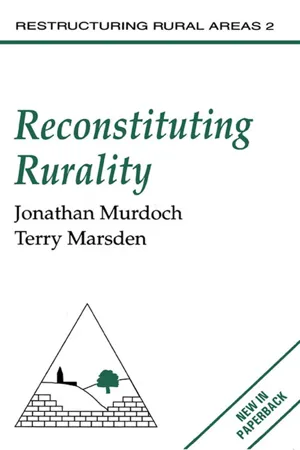
Reconstituting Rurality
About this book
The second in the "Restructuring Rural Areas" series, this work presents an examination of the way in which the rural, and the concept of rurality is being reconstructed within urban regions.; It argues that the rural is not a fixed category but the outcome of political, economic and socio- cultural pressures. These pressures are exacerbated in southeast England - an area dominated by London and the patterns of growth associated with that city. Through close analysis of key land development processes and a series of village studies, the authors give a forceful demonstration of the way in which certain social groups are becoming increasingly influential in determining the material and social shape of rural areas in the United Kingdom. The formation of class identity, it is argued, is closely bound up with the formation of certain local spaces; class and space must be considered as combined elements in the development of rural locales. To illustrate this the authors document in detail the means by which dominant groups represent themselves within the development process and show how the exclusion of certain kinds of development leads to the exclusion of certain social groups.
CHAPTER 1
Class action and the reconstitution of rural space
Introduction
In selecting Aylesbury Vale as our geographical area of study, we consciously followed much recent research which has demonstrated that the outer South East of England can be conceptualized as a “middle-class space”. We are conscious of our debt to this earlier work and we begin this chapter by reviewing some of the recent literature on class analysis, particularly in relation to the middle class. We then go on to show how rural sociology has traditionally focused on the issue of class. We adopt a perspective that focuses on class formation and this leads us to consider class action and, in particular, how the planning system has become a key arena in which much of this action in the rural domain is played out. The account of class formation we present here provides the starting point for our analysis of the land-development process in later chapters. We wish to demonstrate that classes are not fully formed entities determining everything that comes within their ambit; rather they are continually “made” and reproduced in a variety of different arenas through processes of struggle, conflict, persuasion and enrolment. Furthermore, such processes are place-specific; that is, class formation is, at one and the same time, place formation. In the following chapters we provide evidence from a variety of sources and perspectives to show just how complex the processes of formation and reproduction can be.
However, we begin by considering why class analysis has seemingly fallen out of favour in rural studies in the UK. Ostensibly, the aversion to notions of class in rural studies may reflect rural ideology which Cloke & Thrift believe “traditionally presents the countryside as an essentially classless society even if an unequal and hierarchical one” (1990: 165). This ideology has in turn been bolstered by the “invisibility” of rural issues in mainstream sociological debates about class (Hamilton 1990: 229). Despite the influence of these views, there is a recognition, amongst at least some practitioners of rural studies, that class has been unduly neglected: Paul Cloke, in a review of rural geography in Britain, has argued that “changing class structures, particularly the infiltration of different fractions of the middle class . . . [are one] of the major issues requiring serious attention” (Cloke 1989: 191; see also Cloke & Moseley 1990). As yet class analysis still seems to be of secondary concern to many sociologists and geographers working in rural studies (although see Cloke & Thrift 1987, 1990). In one sense this is surprising given the interest in such topics as restructuring, gentrification, deprivation, regulation, etc., which depend, at least in part, on conceptions of class for their explanatory value. Yet, for some reason, class analysis per se is absent. In part, the neglect of class in rural studies can be traced to problems associated with the concept in mainstream sociology where, at the very least, considerable confusion surrounds the term. In the first section, a short review of contemporary debates within sociology shows how class analysis might usefully be reconstituted in the rural domain. The bulk of this discussion is taken up with a summary of a recent book by Savage et al. (1992) which provides an account of middle-class formation in contemporary Britain. In the second section we illustrate how class analysis can be used to reinterpret many of the most influential trends in rural research, using the middle class as a focal point. We then turn to consider what we believe to be one of the key arenas in which processes of class formation are played out in the rural domain: planning.
Conceptualizing class and class formation
While the notion of class is used by many different people both to explain and describe social phenomena (despite recent attempts to herald the arrival of a “classless society”), for sociologists there seems any amount of difficulty associated with the use of the term. These difficulties include problems of definition, such as where does one class begin and another end (the boundary problem), who should be included and who should not, and, even more vexingly perhaps, whether classes can in any sense be seen as coherent and conscious social actors. Through a brief survey of some contemporary debates surrounding the concept of class, we can begin to understand how these difficulties have arisen and how they might be overcome.
In a useful summary of class analysis, Crompton (1993) identifies two main approaches which have tended to diverge in recent years. First, class analysis can be used to describe levels of social and material inequality. Here classes “summarize the outcome, in material terms, of the competition for resources in capitalist market economies” (10). A long tradition of empirical investigation into class structure has thus developed, using large data sets derived from social survey work or using aggregates of employment and occupations (most notable here would be the work of Goldthorpe and colleagues, e.g. Goldthorpe et al. 1980, Goldthorpe & Payne 1986). On the other hand, there is a tradition that sees classes as corresponding to the structures and power relations which have produced these inequalities. Here the emphasis is placed on the processes of occupational and class structuring which cannot be adequately analyzed through aggregates of occupations. Classes must be treated as social collectivities investigated in particular social contexts; they must “be studied in relation to the institutions and organizations which articulate their claims – trade unions, political parties, and so on” (Crompton 1993: 113). The preferred mode of analysis is some form of case study. The most notable example here is E. P. Thompson’s Making of the English working class, an historical study of class formation.
Resting upon these differences, Crompton discerns a further set of distinctions, the most important of which is that between structure and action. Those undertaking work on class structure (such as Goldthorpe and Wright) tend towards an analytical separation between structure and action, while those incorporating action treat structure and action as some kind of unity. This distinction has resulted in heated debate over the status of the two approaches, casting a shadow over the conduct of class analysis itself. As Savage et al. (1992: 220) note, the quantitative tradition of mapping class structure through survey data has become dominant in the past ten years, yet a growing band of critics argue that simply identifying the existence of classes goes no way to explaining how they came into existence or how class categories help in analyzing any form of social action (Hindess 1987, Lockwood 1981).
Pahl (1989) crystallizes the problem of examining class action, which he claims can be summed up by the “mantra” of “structure–consciousness–action” (SCA). The SCA chain refers to the relationship between the social and economic circumstances in which actors are embedded (i.e. structure), consciousness of those circumstances, and the resulting action, which (may) seek to transform those circumstances. Pahl argues that the “links in the chain are rarely seen as problematic” (711) but they cannot be considered by simply allocating individuals to class categories via survey data. This type of work remains transfixed by structure and provides little understanding of how consciousness and action come into being. He says “scholars have behaved as if the links in the SCA chain were self-evident. Once it is understood that such links have yet to be discovered an important programme of research designed to advance theoretical understanding can be opened up” (719). The task of class analysis is to discern the links in the chain. In response, Goldthorpe & Marshall (1992: 385) have argued that there is no reason why individuals sharing similar positions in the class structure will “automatically” develop a shared consciousness and act in concert. Pahl (1993) believes this demonstrates that class analysis has conceded too much theoretical ground and simply cannot explain why consciousness and action do come into being.
Another participant in this debate believes that empirical class analysis using longitudinal survey data is not well suited to understanding the processes of economic and social transformation. Mullins (1991) argues that sociologists have consistently neglected development and thus have little understanding of the dynamics of social structures or the impact of social forces. In his view, this neglect is tied to the discipline’s static methodology which only allows “snapshots” of the social structure. However:
An understanding of development . . . is predicated on an understanding of the social forces involved in this development; forces like class relations and consumption relations. This is because development results from the combined impact these forces have on social structures and for this reason, class analysis and consumption analysis are of value only if – in the end – they show whether class and consumption contribute to these transformations. (Mullins 1991: 119)
Leaving the question of consumption to one side, the form of class analysis being proposed here is dynamic, and it seeks to emphasize the way in which consciousness and action come to be implicated in processes of transformation. As we move away from some overdetermining class structure, issues of collective action and class formation come to the fore.
Commentators such as Barnes (1990) believe sociological theory is increasingly coming to recognize that not only the transformation but the maintenance of any given social order results from collective action, yet the study of such action has been relatively neglected. While sociological analysis is using “class structure” as an explanation, little attention tends to be paid to how such a structure is “made”; the task is simply that of mapping the empirical data in a form that accords with the structural parameters. Once we shift our focus to see how this structure arises from social action, then we need to consider the variety of forms in which actors come together and act collectively. In Pahl’s view one consequence of studying collective action in all its forms might be a more sophisticated understanding of the relationship between class action and class structure:
From informal social networks through families, kinship links and the whole range of formal and informal associations of civil society people are engaging in voluntary solidaristic and collective activity for a variety of goals . . . . Overwhelmingly these social groups are issue-oriented and territorially based . . . . whether these informal associations are the stuff out of which the links in the chain [SCA] can be forged is hard to say. At present work on such associations, locality-based groups and networks is not directly focused to the theoretical lacunae in the SCA model. However, there is no reason why this should not be done. (Pahl 1989: 719)
Likewise, Savage et al. (1992: Appendix 1) examine the contemporary debates surrounding class and conclude that the most useful way forward is to adopt an approach which sees social classes as collectivities and which seeks to demonstrate whether they have an impact on processes of historical change. The authors note that it is “difficult to integrate a theory of class based on a synchronic examination of class positions into an account of diachronic historical change” (p. 227), but the “key point” is that the separation of synchrony and diachrony may actually prevent any adequate analysis of the historical dynamics of class formation being developed. As soon as attention is focused on historical processes, it becomes impossible to specify distinct class positions. As society changes, absolute measures of class and class position also change; thus, “attention is necessarily refocused away from the positions themselves to the processes that structure these class positions” (p. 228). Savage et al. prefer an approach (derived from Przeworski 1977) that sees the process of class formation as the continual (re)organization of class positions. So the latter (those elements which are captured through quantitative analysis) can be conceptualized as the outcome of the processes of formation.
Social classes are collectivities, that is groups with shared levels of income, life-styles, cultures, and political orientations. These collectivities, in order to qualify as classes, must have their “roots” in processes of exploitation. The concept of exploitation specifies a relationship between classes, i.e. how one social class distinguishes itself from another and how it maintains that distinction. If we seek to understand the maintenance of such difference, our attention shifts to the ways that classes and other collectivities “store” their advantages. Any gains made by a collectivity must be stored if it is to remain stable over time. Furthermore, these gains must be transmitted to other members (e.g. offspring) to perpetuate advantages. Such gains and advantages are considered as forms of capital, and two such forms are usually identified: economic and cultural. The first has traditionally been regarded as the main axis of class formation and exploitation (in both Weberian and Marxist accounts), and it derives from relationships in the productive or market spheres. The second is theorized by Bourdieu (1984), and utilized by Savage et al., as a crucial component of class formation. Cultural capital has to be created and legitimated and is used to distinguish groups or classes from one another. It takes the form of “intellectual capital”, which is transmitted via educational standards, and “embodied capital”, which is transmitted to offspring through standards of health care, patterns of adornment, fashion, bearing, etc. These components of cultural capital can also be used to acquire professional credentials and skills that may lead to the acquisition of capital in the economic sphere. The latter entails the deployment of cultural capital in particular organizational contexts in order to allow material rewards – high income, job security, etc. – to be gained.
Savage et al. argue that capital is rendered into assets and that these can be utilized to aid class formation in certain contexts. They identify three types: cultural assets, property assets and organizational assets. These assets relate to one another in complex ways and should not be regarded as symmetrical; they vary in part according to the social circumstances in which they are employed. In actual fact, the authors argue, cultural assets and property assets are becoming increasingly important to patterns of middle-class formation while organizational assets, which have always been problematic for storing advantage (they tend to be tied to specific organizational contexts), are becoming less useful. A shift in the dominant organizational form of the advanced capitalist economies from large bureaucratic (“Fordist”) hierarchies to decentralized (“post-Fordist”) networks is reducing the provenance of organizational careers via internal labour markets and increasing the rôle of self-employed or professional specialists. As a result, “the pyramidical organizational hierarchy is disrupted, and the power of organization assets alone to convey reward is severely questioned. Firms increasingly look to those with specific skills to perform particular jobs, rather than relying automatically on bureaucratic procedures” (p. 66). The authors argue that cultural assets become encoded in expert knowledge; this knowledge is internalized in its individual practitioners while organizational knowledge becomes tied to particular organizational forms and contexts. The former is therefore mobile; the latter is relatively fixed.
Savage et al. go on to consider a particularly distinctive feature of social change in post-war Britain – the rise in owner-occupied housing. They point to an increase in the proportion of the population owning their homes, from 10% in 1914 to 70% in 1990 (pp. 80–82), so that by the end of this period virtually the whole of the middle class had purchased their dwellings. Moreover, the significance of owner-occupation and its rôle in middle-class formation is heightened by associated factors, such as house price inflation which has been endemic: since 1943 house prices have risen five-fold (p. 85), with middle-class occupiers achieving amongst the highest capital gains (see Forrest & Murie 1990). Property assets, which have hitherto been of relatively marginal importance outside the ranks of the petty bourgeoisie, are becoming more integrally tied to processes of middle-class formation. Savage et al. suggest that “increasing numbers of the middle class can draw upon both property and cultural assets” (p. 59).
Class formation, they point out, “does not take place on the head of a pin” (p. 33); it takes place in specific spatial contexts. These contexts are partly shaped by changes in the employment structure which are both caused by, and are a response to, middle-class spatial formation. Spatial mobility is a key feature of the middle-class lifestyle and this has the consequence of allowing middle-class households gradually to acquire more prestigious properties in the course of housing careers. Thus, “those areas with the highest proportion of professionals and managers tended to have the highest house prices in 1985” (p. 88). Property assets, in the form of owner-occupied housing, become central to class formation. But more than this there is a “trend towards the investment of cultural assets in housing . . . so that the aesthetics of the middle-class residence plays a major part in the exhibition of specific cultural tastes and values” (p. 94). Developers, moreover, have responded to these new demands by catering for specific middle-class housing tastes. Cultural assets are not simply enshrined in the house but also in the surrounding area: thus “specific housing areas are taking on particular rôles, geared to differing household types” (97), often described as “gentrification” in reference to the way in which middle-class “colonizers” or “incomers” convert residential properties to their own tastes. At the neighbourhood level this process changes both the social and material complexion of an area, marking it off from working-class areas. The South East of England is identified by Savage et al. as the region in which the economic and cultural formation of the middle class is most advanced. It is expressed culturally in patterns of consumption and types of neighbourhoods.
Finally, Savage et al. examine middle-class politics. The main focus here is voting patterns, but they do make some comments about other forms of middle-class political action most notably associated with “conservation groups”. They draw upon work by Short et al. (1986) in Berkshire on the rôle of middle-class owner-occupiers in preventing unwanted developments in the county, which they characterize as a “defensive politics designed to preserve their privileged position” (Savage et al. 1992: 209; this is discussed in more detail in the next section).
Given the sophistication adopted by the Savage et al. theoretical approach, it is a pity that their analysis of middle-class formation is not carried more fully into the portrayal of culture and politics. This may be because they lack the empirical work necessary for an examination of the “micro-processes” of class formation in particular places at particular times; their empirical evidence is largely drawn from survey-based material. However, the account presented in Property, bureaucracy and culture demonstrates the multifaceted nature of class formation. Once we begin to move away from a conception of class which sees it as “grounded” in the sphere of production then we can begin to appreciate that classes become defined in multiple arenas simultaneously. One of the problems with Property, bureaucracy and culture is that little evidence is presented of middle-class formation in the workplace apart from some general comments on industrial and organizational restructuring. However, the value of the work lies in the way it illustrates...
Table of contents
- Cover
- Title page
- Copyright page
- Contents
- Preface
- Introduction
- 1 Class action and the reconstitution of rural space
- 2 Regional development and social change
- 3 Constructing exclusivity
- 4 Developing places: new villages for old
- 5 Agriculture and beyond
- 6 From production to consumption
- 7 Minerals development in a hostile environment
- 8 Land to waste
- 9 Industrial development and the limits to growth
- 10 A reconstituted rurality?
- Appendix: methodological considerations
- Bibliography
- Index
Trusted by 375,005 students
Access to over 1.5 million titles for a fair monthly price.
Study more efficiently using our study tools.
Frequently asked questions
Yes, you can cancel anytime from the Subscription tab in your account settings on the Perlego website. Your subscription will stay active until the end of your current billing period. Learn how to cancel your subscription
No, books cannot be downloaded as external files, such as PDFs, for use outside of Perlego. However, you can download books within the Perlego app for offline reading on mobile or tablet. Learn how to download books offline
Perlego offers two plans: Essential and Complete
- Essential is ideal for learners and professionals who enjoy exploring a wide range of subjects. Access the Essential Library with 800,000+ trusted titles and best-sellers across business, personal growth, and the humanities. Includes unlimited reading time and Standard Read Aloud voice.
- Complete: Perfect for advanced learners and researchers needing full, unrestricted access. Unlock 1.5M+ books across hundreds of subjects, including academic and specialized titles. The Complete Plan also includes advanced features like Premium Read Aloud and Research Assistant.
We are an online textbook subscription service, where you can get access to an entire online library for less than the price of a single book per month. With over 1.5 million books across 990+ topics, we’ve got you covered! Learn about our mission
Look out for the read-aloud symbol on your next book to see if you can listen to it. The read-aloud tool reads text aloud for you, highlighting the text as it is being read. You can pause it, speed it up and slow it down. Learn more about Read Aloud
Yes! You can use the Perlego app on both iOS and Android devices to read anytime, anywhere — even offline. Perfect for commutes or when you’re on the go.
Please note we cannot support devices running on iOS 13 and Android 7 or earlier. Learn more about using the app
Please note we cannot support devices running on iOS 13 and Android 7 or earlier. Learn more about using the app
Yes, you can access Reconstituting Rurality by Jonathan Murdoch,Terry Marsden in PDF and/or ePUB format, as well as other popular books in Physical Sciences & Geography. We have over 1.5 million books available in our catalogue for you to explore.