- 260 pages
- English
- ePUB (mobile friendly)
- Available on iOS & Android
eBook - ePub
About this book
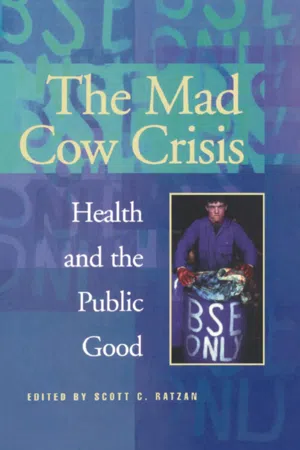
The announcement that BOSER might cause a fatal human disease "Creutzfeldt- Jacob disease CJD" triggered enormous media attention, public alarm and government wrangling that threatened the future of European integration.; As Scott Ratzan argues: "It is my belief that the [BOSER crisis] represents a quintessential case that will go down in history as the Exxon Valdez Union Carbide's Bhopal accident, and other such cases of interdisciplinary study".; This book offers lessons learned from the crisis, with contributions from experts with different viewpoints - veterinarians, Eurocrats, public relations experts, politicians, policy- makers, journalists and representatives of the beef industry.; It also offers a compilation of the key reports from governmental bodies. as a case-study in policy-making, scientific/health discovery and dissemination of information, as well as looking at the issues from the perspective of psychology and media studies.
Tools to learn more effectively

Saving Books

Keyword Search

Annotating Text

Listen to it instead
Information
Topic
MedicineSubtopic
Social WorkPart I
Scientific/Historical Perspectives
Chapter 1
BSE: A Veterinary History
Lester M.Crawford
In December 1988 while appearing before a European Community (EC) parliamentary hearing in Strasbourg, France, the author received a rather earnest call from the US Embassy in London. It seemed that the Chief Veterinary Officer of the United Kingdom, Dr Keith Meldrum, was desirous of lunching at the Embassy for the purpose of discussing a matter of some urgency. Of course Meldrum was a respected member of the world veterinary and regulatory communities and had never abused his colleagueship. Dropping back by London was a bit of an imposition, but fatigue and frustration over the hormone dispute1 in Strasbourg led to an acceptance of Dr Meldrum’s offer largely because it amounted to a convenient excuse to get home a few days early. The original itinerary called for visits to several European capitals in an effort to shore up support for the US hormone position. The UK already supported the US, but perhaps the luncheon could be labeled an exercise in consolidating British support. This lame excuse perhaps prevented a later flight on Pan Am 103 (stand-by basis) five days later from London to Washington Dulles—the day of the crash over Lockerbie, Scotland.
Meldrum surprisingly brought along two colleagues to a lunch of a roast grill featuring lamb chops and beef tenderloin amongst assorted unidentifiable meats. The kitchen of the Court of St James had seen better days. The year-dated cabernet sauvignon from Ernst and Julio helped to ease the pain at least until Meldrum launched into the unappetizing subject of mad cow disease.
Following the usual battery of veterinary jokes, Keith chillingly recounted what was known about the alarming and heretofore undiagnosed disease that was sweeping through England’s dairy herds.
“It’s a transmissible spongiform encephalopathy, Lester,” he said with uncharacteristic intensity.
“We are calling it bovine spongiform encephalopathy or BSE,” whispered one of Dr Meldrum’s colleagues.
“Viral, is it?” said I fighting fatigue with sharply angled phrasing. Veterinary pharmacologists, like the author, generally are bored with virology because drugs usually are ineffectual against viruses and it is the immunologist that usually solves the problem with a vaccine while pharmacologists are exhausting the research budget to no avail.
He responded, “Probably not viral in the usual sense of the word.” This of course begged a further sophomoric question from the idiot American but I refrained from according my famously pompous colleagues the opening their frustrated souls longed for.
“A new disease I take it?”
Six eyes lowered like in a painting by Holbein the Younger, “Yes.”
“Transmissible to humans?”
Meldrum turned the color of weathered soap stone, “Jesus, man, how can you even utter such a thing?”
“Just wondering if we should embargo British products,” murmured I with a smile. No smile was returned.
The next time I saw Keith was at the World Turkey Congress in Harrogate five years later when I had left the government. He was standing beneath a giant papier mâché turkey head. After remarking about the familial resemblance, I complimented him on a job well done.
The British had indeed inherited the whirlwind. The first cases of BSE in 1986 looked every bit like rabies. But the British Isles are free of rabies, and the brains of affected cattle did not contain the negri bodies found in animals dead of rabies.
Affected cows exhibited anxiety, nervousness, and initial hyperactivity followed by lethargy. Most characteristic of the syndrome was, and is, “headshyness”. Affected animals would not allow veterinarians and others to touch their heads. Attempts to examine the horns or horn sockets or the ears were met with pronounced avoidance and obvious pain.
Post-mortem examination was unremarkable except for the consistent presence of vacuoles and astrocytic infiltration in the brain. The medulla oblongata area was spongy to the touch and microscopic examination revealed spongiform lesions or “holes” in the medullary region. The medulla contains areas that control gait, co-ordination and involuntary movements such as breathing.
These cows were suffering terribly and dying within a few days. None of them were recovering regardless of the treatment initiated. Most were older dairy cows and most were from the south of England. The British Government wasted no time in marshaling the proper expertise to analyze the situation.
Although not previously diagnosed in cattle, strikingly similar diseases had occurred in other species. Lumped under the collective term of transmissible spongiform encephalopathies (TSE), these diseases included scrapie in sheep, transmissible mink encephalopathy, and chronic wasting disease of mule deer and elk.
In humans a trio of incurable diseases—Creutzfeldt-Jakob disease (CJD), Gerstmann-Straussler-Scheinker disease and kuru—present syndromes almost too horrific to contemplate, but which nonetheless are consistent with the TSES of the animal kingdom. The initial symptoms in people are self-neglect such as failure to groom, bathe or eat properly. This rapidly progresses to profound apathy or irritability. Sleep disorders, disorientation and tiredness may then supervene. Serious intellectual deterioration such as the inability to speak, to recognize objects, or to read and write then develop. Muscle spasms, palsies and rigid paralysis usually occur together with bizarre visual disturbances. There is no treatment. Patients usually die within one year. Most are in their late 50s at onset.
The diseases are quite rare and the incubation period can be very long—20 years or more in humans. The shorter the natural longevity of a species, the lesser the incubation period for TSES—cattle can be expected to develop the disease in four-and-a-half to five years, sheep somewhat less, and laboratory mice less than a year (wild mice strains which live longer may not develop the disease for two years). In humans it is of course not possible to perform experimental work, but the incubation period has been deduced from a number of cases where people were exposed to contaminated brain electrodes or contaminated pituitary extracts from cadavers only to develop CJD many years later.
Kuru presents a more astonishing story. Natives of New Guinea that engaged in a peculiar form of cannibalism, which involved eating the brains of their victims, perpetuated kuru—a typical TSE—for many years. Cessation of cannibalistic practices has abolished the disease, but not until 30 years after the last brain was eaten.
The causation of TSES is an enigma within a mystery, and what little is known is so complex as to elude the comprehension of most people.
Early theories were that this class of diseases might be due to bacteria, viruses, or “slow viruses”, an observational classification. Theorists of this persuasion were eventually disabused of these notions when it became known that normal sterilization techniques were valueless in dealing with whatever was causing this dread class of diseases. Temperatures of about 300°F sustained for an hour are required to kill the causative agent thought to be a subviral unit of some kind. It has been dubbed a “prion”, a shortened form of “proteinaceaous infectious particle”. Many of the hypotheses for the mode of action of the prion seem like science fiction, but most center around the prion being a glycoprotein that interacts with natural, internal brain prions to form clumps of proteinaceous material that results in the degeneration of the brain.
The British authorities could have wasted a great deal of valuable time worrying about the arcane causes of the disease. Wisely, they conducted a “down and dirty” survey to delineate what was common to the affected herds. Quickly they discovered a common link—those herds in which BSE (bovine spongiform encephalopathy) occurred had been fed offal2 containing nervous tissues, especially spinal cords. Although not a new practice, the development of new rendering3 procedure that used a different sterilization technique was new.
The British authorities quickly learned that those areas in England where the less intensive rendering procedure had been introduced were virtually identical to the areas where BSE was occurring. A rough hypotheses stated: the source of the infection is animal feed; therefore BSE is transmitted orally; so what we have to do is prevent the feeding of the most likely tissues, i.e. brain, spinal cord and sheep offal to cattle. These prohibitions and others were the subject of the UK’s so-called “specified offal ban of 1990”. The gradual decline in cases of BSE which began five years later is thought to be largely attributable to the specified offal ban.
Initially it seemed only reasonable to assume that sheep were the source of BSE since sheep had a long history of a similar disease (scrapie) and since their numbers in the UK had swelled to 44 million head because of farming subsidies. This may have been faulty reasoning; cattle cannot be infected with scrapie except by intracranial inoculation, but about 17 per cent of sheep exposed to BSE through feed contract BSE.
It is possible that BSE has existed in cattle in the UK for many years at very low levels, perhaps as low as the one new case per year per million head of cattle that would approximate the incidence of CJD in people. Indeed a case of “scrapie in an ox” was reported in 1913. The number of English cattle living long enough to manifest the disease around that time would have been approximately 1 million; one new case a year of an obscure neurological disease could have been missed.
Granted the tenuous assumption of an infinitesimal incidence, what could have happened to magnify that incidence to the 12.5 per cent experienced by 1991? Two possible factors stand out: the feeding of animal by-products (including cattle) to cattle which began slowly after the Second World War, and significant changes in the rendering process in the early 1980s. The changes were twofold: the change from batch to continuous rendering, and the elimination of solvent extraction. The first change is an unlikely suspect because the temperatures and exposure times are not dissimilar. Solvent extraction, however, is a leading suspect. Solvents such as hexane were applied to aid in the separation of the fat from the proteinaceous fractions. This also added a second high temperature step because once the fat had been separated, the solvent had to be removed by a process called steam stripping. Solvent extraction was apparently abandoned because the process produced inedible tallow that was used for candles, cosmetics, etc. Leaving the fat in the animal feed added energy to the ration, and the economics of the early 1980s augured for the shift. In the border country of northern England and in Scotland the solvent extraction process was not abandoned, and there have been very few cases of BSE.
By now, BSE has become a bovine scourge almost without parallel for a single country. Over a third of British dairy herds have been affected and the number of animals that have died number almost 200,000. New cases are still being reported because of the long incubation period.
The prohibition against using certain tissues in the production of cattle feed will, most experts agree, eventually eliminate the disease. Troublesome questions, nonetheless, remain. What is the extent of maternal transmission?4 Is there a carrier state which could serve as a reservoir of infection? Can sheep infect cattle through other means? And, most frightening of all, can people contract the disease by drinking milk or eating beef?
This last question is presently of great concern to the British public and to other European nations, especially Germany. Sales of beef have declined by more than 20 per cent in England in the last few months of 1995 and have not fully recovered. What tipped the scales from serious interest to concern bordering on panic was the discovery in 1995 of two cases of CJD in teenagers in England, a phenomenon believed to have occurred fewer than five times in world history. The probability of finding two teenage cases in a country the size of England was infinitely small and completely unexpected and inexplicable. The rareness of the events is made the more concerning when one considers the factors that may affect the incubation period—dose, route of inoculation, inoculum strain and genetics. These young people had a shortened onset time perhaps due to an enormous exposure or to a unique mode of exposure or exposure to an unusually virulent strain.
As if to further inflame public concern, a public official opined that perhaps one of the victims had been exposed whilst inhaling feed dust containing the causative prion, a comment meant to assure all that the disease did not come from cattle or beef. To a thinking nation, as Britain certainly is, this was the worst statement that could have been made. For if the selfsame agent that is infectious to cattle is also infectious to people then beef and dairy products are by extension infectious to people.
Nineteen more human cases of a suspicious new form of CJD, by now known as V-CJD (variant-CJD) have been diagnosed. Several characteristics of the new form have convinced Britain’s Spongiform Encephalopathy Advisory Committee that V-CJD is in fact a new entity probably related to BSE. All of the patients are less than 42 years old, the electroencephalogram patterns are dissimilar to that commonly seen with CJD, and the brain lesions are atypical. Even though there has not been an outpouring of new V-CJD cases, medical epidemiologists are not reassured. The worse case scenario predicts up to 85,000 British deaths.
A number of countries, including Canada, have imported English cattle that subsequently developed BSE. Much more serious is the situation in Portugal and Switzerland where BSE has become endemic; spontaneous cases are occurring in native cattle unrelated to infected UK animals or to infectious material from there. BSE now exists in Germany and France, but the source may be British cattle and/or British feedstuffs.
There have been no cases confirmed in the US, even though the US Government has had a very thorough surveillance program. Scrapie is present in US sheep and still another TSE—transmissible mink encephalopathy—is likewise. present. A suspicious disease in cattle called downer cow syndrome has been investigated but appears to have no relationship to BSE. Also worrying is so-called chronic wasting disease of mule deer and elk, a TSE that has existed in the US for many years.
Much, much more research needs to be done on BSE and TSES. But for now it appears that the British BSE epizootic is coming to an end. Transmissibility of BSE to humans remains an open question.
The great lesson of the BSE event is that the world of bacteria, viruses and prions are in a fiendish conspiracy to decimate or even extinguish higher life forms. Moreover, there is contained in the ever-evolving pool of genetic tricks available to that unseen world, the capacity to cause heretofore uncontemplated havoc to each other, to humans and to any number of non-human life forms. Thus there must be a great compunction to learn all we can from the BSE episode. The intriguing natural history of BSE might well provide a window on mechanisms of disease that may yield critical science essential to the survival of one or more species currently not at risk.
Notes
1 Between 1980 and 1989, the European Community (EC) and the US argued about the safety of meat from animals treated with certain hormones. This culminated in the EC banning US beef in 1989. The ban was lifted in 1997.
2 Although not pleasant to some, the by-products of slaughtered and dead animals are incorporated into animal feed as a convenient and cheap source of nutrition. Since such material may be an inadvertent source of infection, some experts feel safer using material from other species, like sheep by-product, for use in cattle feed.
3 Rendering is the decontamination of animal by-products by cooking at high temperatures for long periods of tim...
Table of contents
- Cover Page
- Title Page
- Copyright Page
- Preface
- Acknowledgments
- Introduction
- Part I: Scientific/Historical Perspectives
- Part II: Politics as Health
- Part III: Understanding the Crisis
- Part IV: Lessons and Possibilities
- Appendix 1
- Appendix 2
- Appendix 3
- Appendix 4
- Appendix 5
- Afterword
- Notes on Contributors
Frequently asked questions
Yes, you can cancel anytime from the Subscription tab in your account settings on the Perlego website. Your subscription will stay active until the end of your current billing period. Learn how to cancel your subscription
No, books cannot be downloaded as external files, such as PDFs, for use outside of Perlego. However, you can download books within the Perlego app for offline reading on mobile or tablet. Learn how to download books offline
Perlego offers two plans: Essential and Complete
- Essential is ideal for learners and professionals who enjoy exploring a wide range of subjects. Access the Essential Library with 800,000+ trusted titles and best-sellers across business, personal growth, and the humanities. Includes unlimited reading time and Standard Read Aloud voice.
- Complete: Perfect for advanced learners and researchers needing full, unrestricted access. Unlock 1.4M+ books across hundreds of subjects, including academic and specialized titles. The Complete Plan also includes advanced features like Premium Read Aloud and Research Assistant.
We are an online textbook subscription service, where you can get access to an entire online library for less than the price of a single book per month. With over 1 million books across 990+ topics, we’ve got you covered! Learn about our mission
Look out for the read-aloud symbol on your next book to see if you can listen to it. The read-aloud tool reads text aloud for you, highlighting the text as it is being read. You can pause it, speed it up and slow it down. Learn more about Read Aloud
Yes! You can use the Perlego app on both iOS and Android devices to read anytime, anywhere — even offline. Perfect for commutes or when you’re on the go.
Please note we cannot support devices running on iOS 13 and Android 7 or earlier. Learn more about using the app
Please note we cannot support devices running on iOS 13 and Android 7 or earlier. Learn more about using the app
Yes, you can access Mad Cow Crisis by Scott Ratzan in PDF and/or ePUB format, as well as other popular books in Medicine & Social Work. We have over one million books available in our catalogue for you to explore.