eBook - ePub
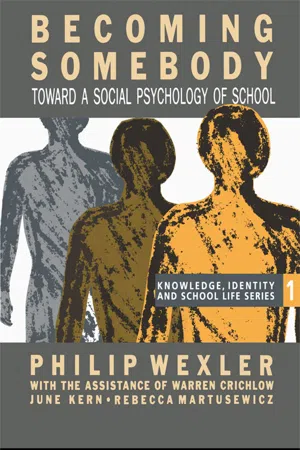
Becoming Somebody
Toward A Social Psychology Of School
- 172 pages
- English
- ePUB (mobile friendly)
- Available on iOS & Android
eBook - ePub
Becoming Somebody
Toward A Social Psychology Of School
About this book
Offers a social psychological account of social life in three high schools, combining theoretical analysis with reflective methodology. The emphasis of the book is on how social relations have varying effects on the feeling of self in young people from different socioeconomic environments.
Information
Chapter 1
Horizon
Composition
In the long run, the reassertion of industrial capitalism and its culture may erase an emerging postmodern awareness in the postindustrial era. But, for now, there are deep cracks in the iron culture.
Recognizing the newer society of informationalism means rejecting the earlier industrial logic of mechanism and mirroring. In science, the backlash of an industrial culture has not yet succeded in submerging the newer claims to describe what we know as being an artifact of human representation rather than an object espied through a non-refractory lens. To dismiss the information society's constructed way of knowing with the label of ‘relativism’ is an historically misplaced rejection of a movement that is post-structural and post-modern. It does not require taking leave of our senses and standards to acknowledge that in this culture, the old science of the social is finished in theory, if not in practice.
An interpretive, hermeneutic understanding of social reality does not mean abandoning the possibility of a real story, a comprehensible narrative, where there is care and attention not only to the form of telling, but also to the facts and to the characters of the story. But it does mean a deflation of pretenses, a modesty that leads to accepting the tenuousness of recognizable events and characters, and having a critical sympathy for the narrator's ineluctable involvement in her/his social humanity. Accounts of social life are composed during a time in history, in the life of the composer, and in a particular social world of resources and values. Perhaps great social analytic compositions transcend such contextual definition to offer timeless and placeless truths. On the other side of the coin, work that is entirely a reflection on the conditions and attitudes of social composition is not a satisfactory substitute for the composition itself. As Richard Bernstein (1983) put it, we want to go ‘beyond objectivism and relativism’. Postmodern desire is ambivalent; we bask and glow in the light of our rejection of enlightened choices among certain alternatives. We love the out of bounds choice: neither/nor.
What that means here and now is that I offer my understanding of social life in three high schools as a structured narrative. The participants speak and I record and selectively re-present their voices. But to pretend that this is simply a dialogical construction of the facts of the case would be arrogant, exploitative and deceptive. I hear their voices in my ears, and I speak my words, conditioned by my place in historical social movement and by the language and analytical resources available to me.
Hopefully, I compose my account with an open mind and a revisionary attitude, abetted by a good set of records and transcripts and a well-tuned memory. But I ‘take license’. I select, condense, juxtapose, underline, and, worst of all, I recontextualize lived worlds into an analytical social language. Still, I am not the cold-blooded instrument of an error-free objective knowledge-machine that mirrors social reality; but, an historical, social analytic composer, and what follows is neither Truth nor Fiction, but a composition.
Analytical Fields
I undertook a study of high schools as a retake of my first empirical effort, which was a participant observation study of a secondary residential school in Israel. In the time that elapsed between that research and this, field research or ‘ethnography’ of schools became popular among academic workers in education and later, in sociology of education (Anderson, 1989).
This ‘new’ sociology of education research was very tightly framed within prevailing models of social reproduction and resistance. Liberal faith in the reformative power of schooling, while partly displaced into a revived ‘critical pedagogy’, was generally eclipsed. The new sociology idea was that schools had the effect of more or less successfully replicating a stratified social order; notwithstanding instances of student cultural resistance against the socially reproductive structure of education.
I began these high school studies at that time in the early 1980s when there was incipient dissent from the reproduction/ resistance model among the educationists and sociologists who comprised new sociology of education. The dissent, however, was in very much of an abstract and often polemical register. I was a dissenter, arguing for a social movement and symbolic interest rather than for the emphasis on the correspondence of school and workplace or on social and cultural reproduction and student resistance that was popular among the new sociologists of education. It was not until the end of the decade, in the field research of Lesko (1988), Weis (1990) and Crichlow (1991), that the dissenting view was expressed in case studies.
These high school studies express a mixture of the search for a less ‘mechanical’ and more symbolic view of social relations and for a more dynamic, movement rather than reproductive orientation to society. Yet, the connection between work and school that Bowles and Gintis (1976) had so powerfully and influentially expressed and the ideas of reproduction and resistance popularized by Apple, (1982), Giroux (1983) and Willis (1977) are also carried along in the way that I frame these accounts of social life in high school. The ghosts of Lukacs' (1971) structured totality and Althusser's (1969) relatively autonomous apparatuses vie with Touraine's (1981) societal self-production and Levi-Strauss' (1963) deep symbolic structure as stage setting beneath the limited and provincial abstract arguments and debates among a small group of new sociologists. But, I did undertake, perform and write the studies within and against the analytical field of the new sociology of education.
I rebounded from the academic purges of the late seventies in a private university in a corporate town. It was a good time for corporatism generally and, later, especially for corporatism in education. My research on high schools was first written for the Office of Naval Research, and funded as grant number N0014–83- K-0032. Like Bowles and Gintis (1976), military and corporate investigators were interested in the correspondence between schooling and working. The ‘Best Years’ research project was formally titled, ‘Learning Commitment and Disaffection in Educational Organizations’ and promised to explain the social relations of educational disaffection as the organizational socialization prologue to disaffection in the workplace.
While I was no less critical of corporatism than of new sociology of education, the high school studies were conceived with a military and corporate consumer in mind. The research was supported by a military-corporate-university establishment that was at least as serious as new sociology in its desire to explain education as a social process. The critics argued that schools succeeded too well and the establishment complained that schools were failing to perform their socially-allocated functional responsibilities. I brought both views into the field research, a social class cultural ‘carrier’, in Weber's (1963) sense, for the skeptical wing of the corporate professional new middle class.
New sociology in academic theory and corporatism in educational practice are immediate contexts for the conception, performance and writing of this field research. The wider social, cultural and intellectual atmospheric circles are no less various and contradictory. The thinking and writing of social research in education takes place not at some clear intersection of historical social trajectories. More accurately, our work is now pervaded with interlacing synthetic strands of language and meaning that belong to different formations that vary not only in their basic directions and interests, but also in the times of their origin and moments of vitality. ‘Archaeology’ is not an accidental term for the layered formations of intellectual work during these times. Nor is ‘postmodernism’ an esoteric description of architecture or dance or even literature that occurs far from the scene of doing academic social science.
Postmodern images of eclecticism and pastiche that denote mixtures and combinations of style and intent also characterize expressions that are much closer to the legitimate and sustaining core of the culture. But legitimation demands a better front, and so we write social and cultural studies as if there were a clear analytical bridge between an unambigous object of vision and a mechanical procedurally correct or purely conceptually ideal seer. The discomforting alternative is to recognize that the multiplicity and simultaneity of channels, media and messages characterizing postmodern culture is also the condition of social research.
The older rhetorical forms of univocal competing hypotheses can still be invoked, but can be maintained only through shutting down a few broadcasting networks or turning up the sound/image volume so high that simultaneous messages are denied. Polyvocality is not a theory for precious literary analyses; it is the historical condition of our work. Only systematic suppression and denial saves us from confronting the fact that we live now not only beyond objectivism and relativism, but also beyond subject and object.
At the same time that the wider ambient social formation moved deeper into global corporatism, there was a mini-renaissance of academic social theory. The corporatist tendency, even when considered separately, has been complex. At the cultural level, free market beliefs and restorationist organicism coexist as the New Right agenda of the Reagan-Bush era. Institutionally, the corporatist social structure which melds state, corporation, and labor elites into horizontal ruling groups across sectors, solidifies beneath the cover of an asocial, individualist ideology of nonintervention.
Education was an excellent example of this synchronic cultural-institutional movement. Choice, voluntarism, and professionalism were spoken while horizontal integration of state school management, teacher union labor leadership, and private corporation executives openly pressed for a common program of educational ‘restructuring’. This corporatism is the emergent institutional infrastructure that goes beyond the reassertion of capital and polarizing immiseration of labor to create a new society to manage the technology of informationalism. It is a reorganization of the economy, the polity, and the practices within which the postmodern culture of fractionated image, electronic icon, and technology-as-science is produced.
The academic mini-renaissance of social theory seemed to occur ideationally, as if there were no social organization of cultural creation, no polity, no economy. Self-centeredness was the explicit theme of this ‘renaissance’ as well as its unconscious practice. The auto-referentiality of language or irreducibility of the text were the cultural complements of self-centered meditations on the decentering and disappearance of the self. Social deracination permitted, however, attention to internal structures of symbolic meaning and to the signifier as independent of a strict representational correspondence to objects and persons. Foregrounding the symbolic domain took the wind out of the sails of simple realism and empiricism. A new holism, even though it prophesied dispersion, appeared in descriptions of discursive ‘epistemes.’ Philosophical anti-foundationalism still raised foundational questions about knowledge and social theory. The articulation of postmodern culture in university specializations created a common academic language of literary, symbolic, rhetorical and interpretive interests. Even sociology admitted postmodern theory along with hermeneutics and semiotics (Turner, 1990).
Such is the contradictory field of events, practices and analytics in which the composition occurs: new sociology and corporatism; symbolic theory and correspondence between school and work; social class polarization and the horizontal integration of different sectors. Geertz (1980) began the decade with the announcement that the style of discourse in social studies was becoming one of ‘blurred genres’.
I think it is less a matter of blurring than of a synthetic interweaving of social and cultural history into the language of social analysis. The refraction of our lens is an historical translation of structures, formations and events into languages of frames, orientations and theories. Social history is recounted by a creative intervention that can only be made from culturally accessible materials. Ethnography is neither an objective realist nor subjective imaginative account. Rather, it is an historical artifact that is mediated by elaborated distancing of culturally embedded and internally contradictory (but seemingly independent and coherent) concepts that take on a life of their own as ‘theory’. So, this is not ‘news from nowhere’, but a theoretically structured story where both the story and its structure are part of my times, and perhaps also of yours.
Theory
A truly postmodern story is simultaneously an exposition and a deconstruction of itself. The theoretical structure of this field research did not formally and expressly precede the research; nor did it emerge as a fitting conclusion to the data collection. Rather, the observations and the interviews nourished some preconceptions and let others atrophy. The theory is really a ‘fusion of horizons’ between the elements of the analytical fields as I blended them and what the subjects of the study said and did. I let the subjects lead me to the language and understandings that could only be found on the field of perception for which I had prepared.
That field is social interaction. The public preoccupation with school dropouts and the more esoteric critical theory inquiry into the motivational deficits of individuals as an aspect of the historic societal crisis of legitimation are expressions of a long-standing sociological interest: to understand the individual-society relation generally and, particularly to explain how and why people give their loyalty and energy to a social regime. The terms commitment and disaffection could be replaced by others like solidarity and alienation or integration and differentiation. On the surface, the question comes from Durkheim, but also from Marx, Weber, Nietzsche, Sartre and beyond.
The new sociology formulation of reproduction and resistance was, despite its Marxist trappings, too Durkheimian, too cultural, and finally, even too cognitivist for my interest. The social interactionist tradition of the American Pragmatists answers the individual-society relational question by showing how the individual is socially constituted, how society is in the individual. The structuralist critique, whether Marxist or Durkheimian (classical or modern linguistic and symbolic versions) is that the interactionists’ view of society is diffusely organicist and does not represent the determined, organized, structured charac ter of the societal pattern. I came prepared with a strong structuralist predisposition, but also the sense that historical events (and not simply theoretical discoveries and debates) had made it impossible to think of social structures or forms of culture as solid and stable entities.
The effect of a structuralism that is wary of solidity and reification in theories as much as in everyday life is to find the patterns of movement that are internal to and constituent of, any object, concept or system and then to reconstruct them. When I tried to encapsulate what students were doing in these high schools, their words summed it up best: becoming somebody. They were not struggling to become nobody, some high postmodernist definition of a decentered self. They wanted to be somebody, a real and presentable self, and one anchored in the verifying eyes of the friends whom they came to school to meet. The ideology of individualism that had such a successful comeback in North America during the first, Reagan phase of corporatism, and the anti-self self-centeredness of postmodern criticism oddly combined to underline again for me sociology's long-standing quest to subvert the bourgeois individualism of modern culture. Subcultural explanations only displaced the internal social dynamics of the self to a higher realm of ‘culture.’ Becoming somebody was an organizationally patterned process of production that used cultural resources deeply ingrained in more pervasive societal structures of inequality and difference.
The familiar language of social control was no more a clue to dynamic processes of movement internal to the organizations than was the term subculture for understanding patterned individual differences. Instead, the organization set the terms for a system of interchanges in which the ‘somebody’, self or identity was the valued product. I came to see a person's self or identity in these settings as a subjective value. This value was not entirely the product of the organizational field, because kids came to school with histories of value and with different repertoires of social and cultural resources that they could use to create the value of the subject, self or identity. But, within the intense social life of the school organization, some personal resources were ignored, while others were seized upon, used and affirmed as collectively valuable —building up in the process their possessors' image of identity. Identity was the pay-off for deposit of organizationally usable interactional resources. The flow of these resources, their transformation and use was not in a chaotic field, but was structured by the collective self-image of the organization and its distribution of values. In each school, I found an organizational economy of identity, that refuted both the restorationist ideology of individualisin and the postmodern ideology of self-dissolution.
The organizational economy of identity was not an autonomous self-regulating system of social interactional resource interchanges. I chose the schools because I saw differences among public schools as aspects of differences among social segments more generally. I set out to see how the dynamics of commitment and disaffection might be different in socially disparate schools. This can be called a ‘class’ orientation in the sense that I do not take the superficial term ‘school’ or even ‘public school’ as an erasure of the very deep differences and inequalities that make this a highly stratified society; ideologies of individualism notwithstanding. I was not prepared, however, to discover how deeply the differences of class run in the lives of high school students. There are other differences that powerfully organize different experiences of everyday life, notably gender differences, but also age, racial, ethnic and regional differences.
I argue that class difference is the overriding organizing code of social life that sets one school apart from another. Against the background of a seemingly shared mass youth culture, what students struggle for in becoming somebody and how they engage that interactional life project during high school—the ‘best years’ of their lives—is different depending on where their school is located in the larger societal pattern of organized social differences and inequalities. The ideal and the route to becoming somebody in the suburban white working class is not the same as becoming somebody in a high school in a professional middle class suburb. Both are as different from urban under class among youths, as it is for their parents. Differences of achievement scores across schools are as well documented as differences in income among ecologically segregated communities of adults. What I underline is how much the experience and the meaning of everyday life— perhaps both cause and effect of achievement and income inequalities—are different. It is not simply a question of deficits or deprivations and advantages, but of different lifeworlds and of the dynamic organizational economies that generate and sustain diverse understandings and aspirations.
In portraying each school, I don't want to provide a snapshot of subcultures, under the sign of esotericism and voyeurism in which field research ordinarily flourishes. Rather, I aim to show an organized production process of subjective value. The ‘product’ of this process is identity, selfhood, the ‘somebody’ which the students work to attain through their interactions in school. The process is the organized shaping of a distribution of images of identity. These images may not capture the full reflexive biographical psychodynamics of a person's self, but they make a difference for how the student defines herself and is reciprocally defined by and defining of friends, teachers and parents. These images of self are stereotypes, relatively unrefined, almost caricatured types of social identities. But, students and teachers work with them and produce them in the course of their interactions.
The social process in the organization is the way that single behaviors, words, or other kinds of signs become representative of the self. There is a structure of social or identity ‘tracks’ in the schools, and while there are cross-overs and some people who are neither within one imagic, tracked world nor another, for most the identity image production process consists of amplification, distortion, condensation, representation and diffusion of partial signs that denote full identities. Smoking does not make you a ‘drugger’ or a ‘radical’, but smoking in the druggers hall or ‘on the rock’ might well put you on a track that goes through an official set of identity confirming organizational practices.
These practices are highly structured, dividing within class and gender into identity types which are the ‘somebody’ that you have become. This self-realization is not of course ordinarily a cas...
Table of contents
- Cover Page
- Title Page
- Copyright Page
- Acknowledgments
- Chapter 1: Horizon
- Chapter 2: Working Class: Nobody Cares
- Chapter 3: Professional Middle Class: Success
- Chapter 4: The Urban Under-Class: I AM Somebody
- Chapter 5: Society in Reverse: Microdynamics of Social Destruction
- Chapter 6: Becoming Somebody: The Class Self
- Chapter 7: Horizon
- Chapter 8: No Note on Method
- Bibliography
Trusted by 375,005 students
Access to over 1.5 million titles for a fair monthly price.
Study more efficiently using our study tools.
Frequently asked questions
Yes, you can cancel anytime from the Subscription tab in your account settings on the Perlego website. Your subscription will stay active until the end of your current billing period. Learn how to cancel your subscription
No, books cannot be downloaded as external files, such as PDFs, for use outside of Perlego. However, you can download books within the Perlego app for offline reading on mobile or tablet. Learn how to download books offline
Perlego offers two plans: Essential and Complete
- Essential is ideal for learners and professionals who enjoy exploring a wide range of subjects. Access the Essential Library with 800,000+ trusted titles and best-sellers across business, personal growth, and the humanities. Includes unlimited reading time and Standard Read Aloud voice.
- Complete: Perfect for advanced learners and researchers needing full, unrestricted access. Unlock 1.5M+ books across hundreds of subjects, including academic and specialized titles. The Complete Plan also includes advanced features like Premium Read Aloud and Research Assistant.
We are an online textbook subscription service, where you can get access to an entire online library for less than the price of a single book per month. With over 1.5 million books across 990+ topics, we’ve got you covered! Learn about our mission
Look out for the read-aloud symbol on your next book to see if you can listen to it. The read-aloud tool reads text aloud for you, highlighting the text as it is being read. You can pause it, speed it up and slow it down. Learn more about Read Aloud
Yes! You can use the Perlego app on both iOS and Android devices to read anytime, anywhere — even offline. Perfect for commutes or when you’re on the go.
Please note we cannot support devices running on iOS 13 and Android 7 or earlier. Learn more about using the app
Please note we cannot support devices running on iOS 13 and Android 7 or earlier. Learn more about using the app
Yes, you can access Becoming Somebody by Philip Wexler,Warren Crichlow,June Kern,Rebecca Matusewicz in PDF and/or ePUB format, as well as other popular books in Education & Education General. We have over 1.5 million books available in our catalogue for you to explore.