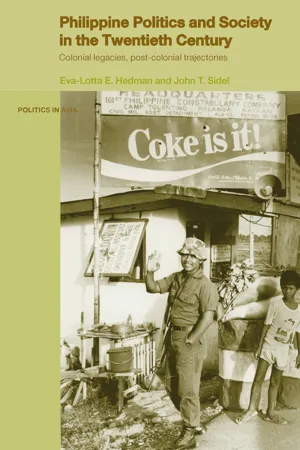
eBook - ePub
Philippine Politics and Society in the Twentieth Century
Colonial Legacies, Post-Colonial Trajectories
- 224 pages
- English
- ePUB (mobile friendly)
- Available on iOS & Android
eBook - ePub
Philippine Politics and Society in the Twentieth Century
Colonial Legacies, Post-Colonial Trajectories
About this book
The only book length study to cover the Philippines after Marco's downfall, this key title thematically explores issues affecting this fascinating country, throughout the last century. Appealing to both the academic and non academic reader, topics covered include:
national level electoral politics
economic growth
the Philippine Chinese
law and order
opposition
the Left
local and ethnic politics.
Information
1 Introduction
In the mid-1980s, at the height of the Reagan era and the last decade of the Cold War, the Philippines became the focus of considerable international media attention, and news stories tended if not to romanticise the archipelago then at least to imbue it with special geo-political significance. Long-time president Ferdinand Marcos, after twenty years in power, seemed to follow in the footsteps of other brutal and rapacious ‘Third World’ dictators like Batista, Somoza, and Shah Reza Pahlevi. Newspaper exposés revealed in great detail the extent of the ‘ill-gotten wealth’ which he and his wife Imelda had accumulated and the extravagance of their lifestyle. Meanwhile, conditions of poverty and social inequality in the Philippines were among the most dramatic in Southeast Asia, as vividly – and repeatedly – described by journalists who visited Manila’s vast slum area, Tondo, and interviewed ‘scavengers’ who earned a livelihood in the infamous garbage dump-site known as Smoky Mountain. Moreover, given the history of American colonial rule in the Philippines, the presence in the archipelago of the two largest US overseas military installations (Subic Naval Base and Clark Air Field) in the world, and Washington’s strong support for Marcos, such conditions amply illustrated the harsh injustices of the Cold War, the Reagan Administration’s policies in ‘The Third World’, and US global hegemony in general.
Against this backdrop of dictatorship, destitution, and US imperial design, the Philippines was also the site of well-publicised and somewhat romanticised political struggles at the time. By the mid-1980s, the Communist Party of the Philippines (CPP) had emerged at the forefront of the most potent revolutionary movement in Southeast Asia. With its New People’s Army (NPA) guerrillas reportedly present in roughly one-fifth of the villages in the archipelago and church, student, labour and urban poor groups affiliated with the party increasingly active in the seminaries, campuses, factory belts and streets of Manila and other major Philippine cities. Local and foreign journalists alike reported frequently on the growing strength and popularity of the CPP/NPA, celebrated the guerrillas variously as ‘Nice People Around’ or ‘the New Khmers Rouges’, and predicted the implosion of the Marcos regime and the victory of revolutionary forces in just a few years’ time. Only the candidacy of the ‘modest housewife’ Corazon C. Aquino, widow of the slain opposition leader Benigno S. Aquino, Jr, in the February 1986 ‘snap’ presidential election brought the foreign correspondents down from the rebels’ mountain and jungle hideaways and dramatically concluded the ‘Revolution’ story with a ‘Democratic’ dénouement. With US senators and major television network anchors on hand in Manila for the occasion, Marcos proceeded to engineer his own electoral victory on February 7, 1986 through massive fraud, intimidation, and violence, but was ousted a few weeks later by a military rebellion and the mobilisation of more than one million Filipinos in the streets. The success of so-called ‘People Power’ in Manila provided not only a happy ending of sorts for scores of book-length parachute journalists’ accounts,1 but also a precedent that local democracy activists – and international media commentators – would cite and to some extent follow a few years later, whether in the streets of Prague or, less successfully, Beijing’s Tienanmen Square.
By the post-Cold War 1990s, however, the Philippines no longer held special geo-political significance in the gaze of the international media panopticon. In the place of the high drama of the mid-1980s, the Philippines of the 1990s offered only the occasional spectacle of volcanic eruptions, political buffoonery, and seemingly random and rampant violence and criminality. One survey of the Sydney Morning Herald’s 1993 coverage of the Philippines, for example, noted the prevalence of stories about natural disasters, ‘terrorism’, Imelda Marcos, and ‘vice and sexual crimes’.2 Readers of British or American broadsheets in 1999 likewise encountered little more than occasional articles on paedophiles, kidnappings, landslides, Imelda Marcos’ notorious shoe collection, and the unseemly antics of the Philippines’ new president, popular action-film star Joseph ‘Erap’ Estrada. If in the 1980s the Philippines produced the signifying chain of Dictatorship, Revolution, and Democracy, today its only claim to international fame seems to be alleged parentage of El Niño, the global meteorological phenomenon ushered in by the 1991 eruption of Mt Pinatubo: if not an entirely empty signifier then certainly one devoid of any discernible political meaning.
In recent years, this tragi-comic image of the Philippines in the media has been echoed and elaborated in lurid detail in fiction, film, and other realms of the global culture industry. Most noteworthy in this regard is probably the Hong Kong-based writer Timothy Mo, whose novels depict a Philippines populated solely by teenage prostitutes, gangsters, and society ladies, who are uniformly duplicitous, grasping, and laughably incompetent and incoherent in their crude pidgin English.3 Alex Garland’s The Tesseract also belongs to this genre, as the blurb on the back of the book jacket suggests:
The sun is setting over Manila. In an abandoned hotel on the wrong side of town, Sean prepares for the arrival of Don Pepe, the mestizo gangster who runs the shipping lanes of the South China Seas. As he kills time, Sean discovers that his bed-sheets are stained with blood, the phone lines to his room are dead, and somebody has screwed a steel plate over the spyhole in his door …
Elsewhere in the city, Rosa, a doctor, waits for her husband to come home. As she puts her children to bed she remembers the coastal village in which she was raised, and the boy who would meet her on the way to school. Meanwhile, thirteen-year-old Vincente begs from the stream of airconditioned cars on Roxas Boulevard, keeping an eye out for the strange man who lives in the city’s most expensive apartment block, and who pays money for street kids’ dreams …4
But similarly leering, lecherous portrayals of Filipinos crop up elsewhere as well. The Australian cult movie, Priscilla,Queen of the Desert, for example, features a brief scene with a highly flirtatious and scantily clad young Filipina mail-order-bride turned ‘entertainer’, who performs sexual gymnastics before a rowdy barroom crowd and her obese, aging Australian husband. Even the otherwise sympathetic heroine of Peter Hoeg’s best-selling novel, Miss Smilla’s Feeling For Snow, betrays a similarly casual form of racism:
In Greenland they say that Filipinos are a nation of lazy little pimps, who are only allowed on ships because they don’t ask for more than a dollar an hour, but you have to keep on feeding them vast amounts of steamed rice if you don’t want a knife in your back.5
Recent trends in scholarship
Meanwhile, the late 1980s and 1990s witnessed a wave of foreign scholarship on Philippine politics and society researched and written in what might be described as an exposé mode. This scholarship was the work of academics writing in large part for a Filipino audience and in self-conscious support of the causes of democratisation, human rights, and social justice in the Philippines. The exemplary figure in this regard is the accomplished historian Alfred W. McCoy, who in the 1970s exposed the links between the US Central Intelligence Agency and the heroin trade in Southeast Asia6 and who, in late January 1986, on the eve of the ‘snap’ presidential elections in the Philippines, revealed his discovery of documents which discredited Ferdinand Marcos’ claims of anti-Japanese guerrilla leadership and heroism during the Pacific War.7 In the late 1980s, McCoy did much to draw attention to the glaring social inequalities and injustices in the sugar plantation belt of Negros Occidental and also to document the involvement of the much lionised military ‘reformists’ (and putschists) in cases of torture and other human rights violations.8 In the 1990s, moreover, he brought together scholars working on Philippine local history and politics in a collection of essays which underlined the endurance of large landowning families, mafia-style machine politicians and their persistent rent-seeking and criminal activities despite the restoration of formal democracy in the archipelago.9
Younger scholars finishing their doctoral research during the Aquino (1986–92) and Ramos (1992–98) administrations likewise tended to write in this exposé mode, combining careful research with a line of inquiry and argumentation designed to debunk the myths of ‘People Power’ and ‘Democratisation’ during this period. Political scientists like Mark Thompson and James Putzel, for example, meticulously documented how the opposition politicians who were swept in with Aquino had been utterly opportunistic in their quest for power in the 1980s, and how Aquino and other policy-makers (in Manila and Washington, DC) had systematically blocked efforts to formulate and implement an agrarian reform programme in the late 1980s, thus preserving an extremely high concentration of land and wealth in the hands of a narrow élite.10 In his careful study of Philippine banking, moreover, political economist Paul Hutchcroft chronicled the political entrenchment of a ‘predatory’ oligarchy and a history of cronyism and rent-seeking activity which long preceded Marcos and impeded capitalist development in the archipelago.11 Meanwhile, still other scholars traced the pattern of organisational weakness, ideological myopia, and tactical error which underpinned the decline and division of the Philippine Left in the late 1980s and early 1990s.12 The authors of the collection of essays in this volume also contributed, however modestly, to this early post-Marcos wave of foreign scholarship on the Philippines, in revisionist studies of the much celebrated mobilisation of ‘civil society’ for ‘free and fair elections’ and of the supposedly ‘clientelist’ basis of local politics in the archipelago.13
The foreign Philippinists of this period, it should be noted, wrote with a Filipino audience in mind and in the hope that their work would shed light on the political forces and dynamics which had stolen the promise of ‘People Power’ and ‘Democratisation’ in the early post-Marcos period. Yet in tone and substance, these studies sometimes inadvertently echoed the moralising, muckraking accounts that American colonial authors had offered many decades earlier.14 Compromised by patrimonialism, provincialism, and personalism, Philippine democracy was not fully Democratic, these authors seemed to suggest; Philippine capitalism was not really Capitalist, and even Philippine communism was not properly Marxist or Leninist. Indeed, it is easy to understand how readers critical and suspicious of Orientalism and essentialism might see in these writings a picture not only of the Philippines but also of Filipinos which shared some of the unflattering features of the lurid journalistic and fictional accounts cited above. After all, if the studies of ‘patron-client’ relations in the Philippines of the quiescent late 1950s and early 1960s depicted Filipinos as essentially deferential and obliging family and community members,15 and subsequent work in the turbulent 1970s and early 1980s cast Filipinos as courageous rebels and subversives,16 then much early post-Marcos scholarship tended to portray Filipinos as cynical wheeler-dealers, crass opportunists, and cunning seekers of power and wealth.
Against this prevailing tendency towards disenchantment, debunking, and derogation, another set of contemporary scholars, both Filipino and foreign, has offered an alternative vision of the Philippines and its inhabitants, one much more attentive to the self-understandings and shared aspirations of ordinary Filipinos rather than the country’s ‘predatory oligarchy’ and other oppressors. One direction pursued in this spirit has been historical, with Filipino scholars such as Reynaldo Ileto revisiting the Philippine Revolution of the late nineteenth century, exploring the lives and works of peasant rebels like Apolinario dela Cruz and nationalist intellectuals like José Rizal, and tracing the metaphors and memories of the past in contemporary popular discourse. These scholars’ interest in ‘subaltern studies’ and ‘history from below’ has worked against the recent efforts of ‘official nationalists’ to domesticate and defang remembrances and representations of the Revolution in centenniary celebrations, conferences, and coffee-table books.17 Another line of investigation and inquiry has been ethnographic in nature, concerned with the efforts of ordinary Filipinos to craft identities and lead lives of dignity in the face of considerable material deprivation, exploitative social relations, and political disenfranchisement. Political scientists like Benedict Kerkvliet and Kit Collier,18 and anthropologists like Fenella Cannell, Thomas Gibson, Mark Johnson, Thomas McKenna, and Michael Pinches were among the pioneers in this wave of ethnographic research on the lived experience of rural and urban poverty in the contemporary Philippines, and contributed nuanced accounts of everyday Filipino life to broader scholarly debates about subaltern consciousness and resistance, the hegemony of dominant ideologies, and the construction of ‘culture’ and identity.19 The works of these scholars have helped to rescue Filipinos from both ‘the enormous condescension of posterity’20 and the neglect of contemporary political scientists, whose writings tended to suggest the seamlessness of bossism, patrimonialism, and cacique democracy, on the one hand, and the passivity and powerlessness of the broad mass of the population, on the other.
The book
This volume, by contrast, offers a counterpoint to recent scholarship on the Philippines, not through ‘history from below’ or ethnography, but through the optic of what might be described as comparative historical sociology. The authors of this book, after all, are neither historians nor anthropologists, and the chapters to follow draw at least as much on the vast secondary literature on Philippine history, politics, and society as on primary documents examined in the archives and personal experiences during many months living and travelling in the Philippines in the late 1980s and 1990s. This collection of essays offers less an effort to restore a sense of historical or cultural depth to our understanding of popular consciousness in the Philippines today, than an attempt to sketch the broad contours of those underlying structures – economic, institutional, social, and geo-political – which have shaped the course of twentieth-century Philippine his...
Table of contents
- Front Cover
- Title Page
- Copyright
- Dedication
- Contents
- Series editor’s preface
- Acknowledgements
- List of abbreviations
- 1 Introduction
- 2 Trasformismo and Philippine democracy
- 3 Morbid symptoms and political violence in the Philippines
- 4 ‘Forget it, Jake, it’s Chinatown’
- 5 The Last Hurrah revisited
- 6 Malling Manila: images of a city, fragments of a century
- 7 From Pugad Lawin to Pugad Baboy: the making of the ‘new native’
- 8 The Sulu zone revisited: the Philippines in Southeast Asia
- Bibliography
- Index
Trusted by 375,005 students
Access to over 1.5 million titles for a fair monthly price.
Study more efficiently using our study tools.
Frequently asked questions
Yes, you can cancel anytime from the Subscription tab in your account settings on the Perlego website. Your subscription will stay active until the end of your current billing period. Learn how to cancel your subscription
No, books cannot be downloaded as external files, such as PDFs, for use outside of Perlego. However, you can download books within the Perlego app for offline reading on mobile or tablet. Learn how to download books offline
Perlego offers two plans: Essential and Complete
- Essential is ideal for learners and professionals who enjoy exploring a wide range of subjects. Access the Essential Library with 800,000+ trusted titles and best-sellers across business, personal growth, and the humanities. Includes unlimited reading time and Standard Read Aloud voice.
- Complete: Perfect for advanced learners and researchers needing full, unrestricted access. Unlock 1.5M+ books across hundreds of subjects, including academic and specialized titles. The Complete Plan also includes advanced features like Premium Read Aloud and Research Assistant.
We are an online textbook subscription service, where you can get access to an entire online library for less than the price of a single book per month. With over 1.5 million books across 990+ topics, we’ve got you covered! Learn about our mission
Look out for the read-aloud symbol on your next book to see if you can listen to it. The read-aloud tool reads text aloud for you, highlighting the text as it is being read. You can pause it, speed it up and slow it down. Learn more about Read Aloud
Yes! You can use the Perlego app on both iOS and Android devices to read anytime, anywhere — even offline. Perfect for commutes or when you’re on the go.
Please note we cannot support devices running on iOS 13 and Android 7 or earlier. Learn more about using the app
Please note we cannot support devices running on iOS 13 and Android 7 or earlier. Learn more about using the app
Yes, you can access Philippine Politics and Society in the Twentieth Century by Eva-Lotta Hedman,John Sidel in PDF and/or ePUB format, as well as other popular books in Politics & International Relations & Asian History. We have over 1.5 million books available in our catalogue for you to explore.