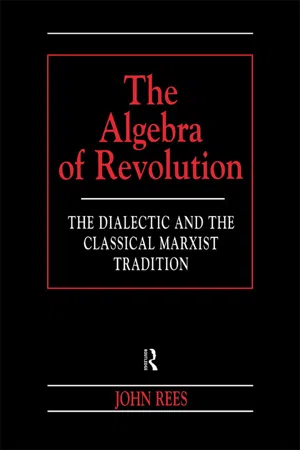
The Algebra of Revolution is the first book to study Marxist method as it has been developed by the main representatives of the classical Marxist tradition, namely Marx and Engels, Luxembourg, Lenin, Lukacs, Gramsci and Trotsky. This book provides the only single volume study of major Marxist thinkers' views on the crucial question of the dialectic, connecting them with pressing contemporary, political and theoretical questions. John Rees's The Algebra of Revolution is vital reading for anyone interested in gaining a new and fresh perspective on Marxist thought and on the notion of the dialectic.
- 320 pages
- English
- ePUB (mobile friendly)
- Available on iOS & Android
eBook - ePub
About this book
Trusted by 375,005 students
Access to over 1.5 million titles for a fair monthly price.
Study more efficiently using our study tools.
Information
1: Hegel’s Algebra of Revolution
Hegel's name has often come to the lips of marxists during great crises in history or at crucial turning points in the development of marxism. When Marx and Engels first laid the foundations of historical materialism in the 1840s, they did so by developing a critique of Hegel's thought. As Marx labored on Capital, he found Hegel's Logic “of great service to me.”1
When confronted with an unprecedented imperialist war and the collapse of the Second International, Lenin looked to Hegel to help refurbish his understanding of marxism. He concluded: “It is impossible completely to understand Marx's Capital…without having thoroughly studied and understood the whole of Hegel's Logic. Consequently, half a century later none of the Marxists understood Marx!!”2
Again, in the great revolutionary crisis that shook Europe between 1919 and 1923, George Lukacs made his way to marxism through a study of Hegel. The result, History and Class Consciousness, was the greatest work of Marxist philosophy since Marx himself. Between the invasion of Hungary in 1956 and the events of 1968, the Stalinist monolith began to crack, and a new generation of activists looked for the authentic voice of revolutionary marxism. They looked to the works in which the young Marx had engaged with Hegelianism, and they looked to the work of George Lukacs.
By contrast, Hegel's name has been missing from those periods when the fortunes of a genuine revolutionary marxism have been in decline. During the long night that stretched from the defeat of the 1848 revolutions to the Paris Commune, Marx himself noted how “ill humoured, arrogant and mediocre epigones…began to take pleasure in treating Hegel…as a ‘dead dog.’”3 Similarly, as the Second International slid into bureaucratic reformist practice and a vulgar materialist theory, it had little time for Hegel. Even where it mentioned Hegel, it focused on the dead formalism of his system, not the living dialectic at its core. Plekhanov was one of the best theoreticians of the Second International, yet Lenin noted, albeit with slight exaggeration, “Dialectics is the theory of knowledge of [Hegel and] Marxism…to which Plekhanov, not to speak of other Marxists, paid no attention.”4 When the revolutionary storms of the 1920s had passed and Stalinism's dead hand lay over the movement, a similar deliberate neglect set in. Stalin's economic reductionism deliberately removed the negation of the negation from theory— and with it went any notion of how a radical break with the present can emerge from current conditions.
Hegel's philosophy has had such resonance in periods of crisis and revolution precisely because it was born of one such crisis—the French revolution. Hidden in its core is the last great attempt by a bourgeois philosopher to understand the dynamics of social change and social revolution. Hegel lived through the revolution and into the era of reaction that followed. He saw the death of the old society and looked fearfully at the shape of the new. This unique vantage point gave his philosophy the enduring value that Marx and Engels, Luxemburg, Lenin, Lukacs, and Trotsky all recognized. Marx and Engels founded historical materialism in opposition to Hegel's philosophy, but they never ceased to pay tribute to “the colossal old chap.” Likewise, in renewing the marxist critique of Hegel, we must also avow ourselves the pupils of that mighty thinker.5
THE ENLIGHTENMENT
Before we can understand Hegel, we must understand his world. Hegel was deeply imbued with the values of the Enlightenment, the intellectual tradition of his times. He was one of its last great inheritors and, until Marx, its greatest critic. The Enlightenment was a broad intellectual movement that championed religious toleration against the tyranny of church and state, science against mysticism, education against ignorance, and favored humanism over superstition.
The origins of the Enlightenment lie in the scientific revolution of the seventeenth century, which, in turn, resulted from the growth, particularly in England, of trade and craft manufacture, accelerated by technological improvements in surveying, navigation, metallurgy, and dyestuffs. The increasing use of the compass in the West had already fostered exploration and trade. The development of the cannon promoted the study of ballistics and metallurgy. The earlier invention of printing allowed these new discoveries wider dissemination. This revolution in science both contributed to the intellectual environment that accompanied the English Revolution and received new impulse from the battles of the revolution and the settlement that followed. Such an atmosphere encouraged the empirical study of nature and the search for causal laws, rather than blind obedience to the dictates of the church.
We can usefully examine the intellectual and social background to Hegel's philosophy and the changes in the intellectual atmosphere that took place during the Enlightenment itself by briefly examining the work of some of the great scientific and philosophical figures of the epoch. The achievements of Francis Bacon (1561–1627), Isaac Newton (1642–1727), John Locke (1632– 1704), David Hume (1711–76) and Jean-Jacques Rousseau (1712–78) will serve to give an impression of the age.
The work of Francis Bacon, lord chancellor under James I, was largely ignored by his own generation, but it became important for the civil war generation that followed him. His biography of Henry VII insisted on a causal explanation of history rather than a divine one. He claimed, “Men have been kept back…from progress in the sciences by reverence for antiquity, by the authority of men accounted great in philosophy, and then by general consent.” His call for a new science was based on the belief that traditional learning, tied to Christian theology and the writings of the ancient Greeks, was “a wicked effort to curtail human power over nature and to produce a deliberate artificial despair. This despair…confounds the promptings of hope, cuts the springs and sinews of industry, and makes men unwilling to put anything to the hazard of trial.”6 This faith in human reason, scientific experiment, and progress made Bacon a true precursor of the Enlightenment.
Isaac Newton's theory of gravity was the high point of the scientific revolution. It bound together all movement of matter in the heavens and on the earth in one single mathematical law. It provided startling proof of Bacon's faith that human reason could, by careful observation and experiment, explain the workings of the natural world. Newton's own ideas, inevitably, were a mixture of the old world and the new. He believed in alchemy and insisted that although the universe operated according to mechanical laws, like the workings of a clock, God must first have set the clock running.7 Newton's universe retained a role for God, but later Newtonians drew the logical conclusion and banished God to some distant original cause. In the here and now science triumphed. Pope caught the impact graphically:
Nature and Nature's laws lay hid in night, God said “Let Newton be!” and all was light.
Newton's Principia was greeted by his colleague Halley with an ode that concluded:
In reason's light, the clouds of ignorance Dispelled at last by science.8
These social, technical, and intellectual developments resulted in one very important philosophical foundation of the Enlightenment: mechanical materialism. Thomas Hobbes (1588–1679) was one of the most radical of the materialists. He saw society as an unremitting “war of all against all” in which self-preservation was the only guiding thread, the basis of ethics. In this picture, religion was mostly eliminated. This dark view found little echo in the first, more optimistic phase of the Enlightenment. It wasn't until the mood began to change in the latter half of the eighteenth century that Hobbes's influence began to grow.
In the meantime, it was John Locke who stood at the nexus of some key political and intellectual developments. He was involved in the Glorious Revolution of 1688 which, in overthrowing James II, finally ended claims for the
Divine Right of Kings in England. His Treatise on Civil Government (1690) was a theoretical justification of the bourgeois settlement of 1688, arguing that the monarchy was simply a limited and revocable contract between ruler and ruled in which authority finally rested with “the will and determination of the majority.” Marx summarized the conditions that gave Hobbes and Locke such an unparalleled intellectual sweep:
Hobbes and Locke had before their eyes both the earlier development of the Dutch bourgeoisie (both of them had lived for some time in Holland) and the first political actions by which the English bourgeoisie emerged from local and provincial limitations, as well as the comparatively highly developed stage of manufacture, overseas trade and colonisation. This particularly applies to Locke, who wrote during the first period of English economy, the Bank of England and England's mastery of the seas. In their case, and particularly in that of Locke, the theory of exploitation was still directly connected with economic content.9
Locke's major philosophical work, the Essay Concerning Human Understanding, extended what he took to be the empirical method of the scientific revolution into the realm of human affairs. Locke's friendship with both Isaac Newton and the chemist Robert Boyle was based in part on a common, empirical, observational approach to science.
Locke rejected the idea, advanced by Descartes, that ideas were innate. Locke argued that our mind at birth is a “white paper” and that all our ideas are derived from experience. Our more complex ideas may be the result of reflection on the images that we gain from experience, but, nevertheless, all the raw material for knowledge is gained from the senses. Locke thus tied together an empirical approach to the origins of knowledge with a crucial role for human reasoning. Real knowledge is a product of reason working out the connections between the varied ideas we receive from experience.
In some cases, Locke believed, knowledge arose from comparing our ideas with the real things that they were meant to represent. The closer the correspondence, the nearer we were to the truth. This is the most empirical aspect of this thought.
But there are other ideas, according to Locke, whose truth depended solely on their internal consistency. Here reason was its own judge and did not depend on experience. Geometry, for instance, was a rational construction whose laws (for instance, that every equilateral triangle has three sides of equal length) were not given to us by experience. Morality was, likewise, not innate, nor given to us by experience, but the product of rational deliberation.
Locke, like Newton, kept within a Christian frame of reference, but the impact of his ideas led to secular, rationalist, and materialist social attitudes which underpinned much Enlightenment thought. Locke's argument against innate ideas, for instance, was taken as a blow against religion.
More generally, materialist arguments could be used to defend toleration of different beliefs, because these were the product of differing environments, not of heresy or demonic possession. The equality of man was at least a possibility, because social inequality was the product of environment, not of heredity and lineage. Rationality, education, and social reform were the key to progress. The stage was set for the spread of such ideas throughout Europe, for Diderot, Voltaire, and Rousseau.
During the eighteenth century such ideas came to dominate the thinking of many Europeans—at least those who had the time, leisure, and ability to read. If one project can summarize such a long and complex movement, it must be the Encyclopedia. This was the great collaborative dictionary compiled under the eye of Diderot to which nearly every major French thinker, including Voltaire, Montesquieu, and Rousseau, contributed. Charged with the belief that society should be organized along lines dictated by human reason, instead of the hierarchy of caste and privilege that marked aristocratic absolutism, the Encyclopedia set out to popularize the sum of human knowledge.
Such rationalist ideas invoked the authority not of God but of human reason verified by empirical science, even when the language in which they were expressed was designed to avoid the attention of the censor. Inevitably, they were a challenge to authority. As Diderot wrote elsewhere, using the form of a dialogue between father and son,
“The point is, father, that in the last resort the wise man is subject to no law…”
“Don't speak so loudly.”
“Since all laws are subject to exceptions, the wise man must judge for himself when to submit and when to free himself from them.”
“I should not be too worried if there were one or two people like you in town, but if they all thought that way I should go and live somewhere else.”10
That such ideas could spread in Europe was proof that some of the same forces that had given them such a vigorous life in England were also at work in other countries. If we exclude England and certain Dutch cities, France was the most economically developed part of Europe. In the forty years before the revolution, the value of French trade quadrupled. France's cities were the largest on the continent. Factory-based production had small but impressive footholds.11 Some provinces, encouraged by entrepreneurial aristocrats, the new school of Physiocrats (or economists), and the government's own Department of Agriculture (established in 1761) were also beginning to employ new scientific agricultural techniques.12 The materialist ideas that were part of the intellectual armor of the rising bourgeoisie in England and that received their fullest expression after the old order had been broken by the revolution of the 1640s now took strongest root in France.
But it wasn't just emulation and common circumstances that encouraged the educated classes in France to adopt materialist ideas. England and France were not intellectual partners but commercial rivals. Where England led, others must follow. “Enlightened” monarchs throughout Europe were willing to promote mild reform, encourage their own bourgeoisie, and give cautious backing to the new science so long as the process did not go beyond their control. The French, and other monarchies, balanced between the old order, on which their whole political prestige depended, and the rising bourgeoisie, on which they increasingly depended financially. Such h...
Table of contents
- Cover Page
- Title Page
- Copyright Page
- Acknowledgments
- Introduction: Contradictions of Contemporary Capitalism
- 1: Hegel’s Algebra of Revolution
- 2: The Dialectic in Marx and Engels
- 3: The First Crisis of Marxism
- 4: Lenin and Philosophy
- 5: The Legacy of Lukacs
- 6: Trotsky and the Dialectic of History
- Conclusion: Contradictions of Contemporary Theory
Frequently asked questions
Yes, you can cancel anytime from the Subscription tab in your account settings on the Perlego website. Your subscription will stay active until the end of your current billing period. Learn how to cancel your subscription
No, books cannot be downloaded as external files, such as PDFs, for use outside of Perlego. However, you can download books within the Perlego app for offline reading on mobile or tablet. Learn how to download books offline
Perlego offers two plans: Essential and Complete
- Essential is ideal for learners and professionals who enjoy exploring a wide range of subjects. Access the Essential Library with 800,000+ trusted titles and best-sellers across business, personal growth, and the humanities. Includes unlimited reading time and Standard Read Aloud voice.
- Complete: Perfect for advanced learners and researchers needing full, unrestricted access. Unlock 1.5M+ books across hundreds of subjects, including academic and specialized titles. The Complete Plan also includes advanced features like Premium Read Aloud and Research Assistant.
We are an online textbook subscription service, where you can get access to an entire online library for less than the price of a single book per month. With over 1.5 million books across 990+ topics, we’ve got you covered! Learn about our mission
Look out for the read-aloud symbol on your next book to see if you can listen to it. The read-aloud tool reads text aloud for you, highlighting the text as it is being read. You can pause it, speed it up and slow it down. Learn more about Read Aloud
Yes! You can use the Perlego app on both iOS and Android devices to read anytime, anywhere — even offline. Perfect for commutes or when you’re on the go.
Please note we cannot support devices running on iOS 13 and Android 7 or earlier. Learn more about using the app
Please note we cannot support devices running on iOS 13 and Android 7 or earlier. Learn more about using the app
Yes, you can access The Algebra of Revolution by John Rees in PDF and/or ePUB format, as well as other popular books in Politics & International Relations & Philosophy History & Theory. We have over 1.5 million books available in our catalogue for you to explore.