Can you learn without knowing it? This controversial and much debated question forms the basis of this collection of essays as the authors discuss whether the measurable changes in behaviour that result from learning can ever remain entirely unconscious. Three issues central to the topic of implicit learning are raised. Firstly, the extent to which learning can be unconscious, and therefore implicit, is considered. Secondly, theories are developed regarding the nature of knowledge acquired in implicit learning situations. Finally, the idea that there are two separable independent processing systems in the brain, for implicit and explicit learning, is considered.
Implicit Learning and Consciousness challenges conventional wisdom and presents the most up-to-date studies to define, quantify and test the predictions of the main models of implicit learning. The chapters include a variety of research from computer modelling, experimental psychology and neural imaging to the clinical data resulting from work with amnesics. The result is a topical book that provides an overview of the debate on implicit learning, and the various philosophical, psychological and neurological frameworks in which it can be placed. It will be of interest to undergraduates, postgraduates and the philosophical, psychological and modeling research community.
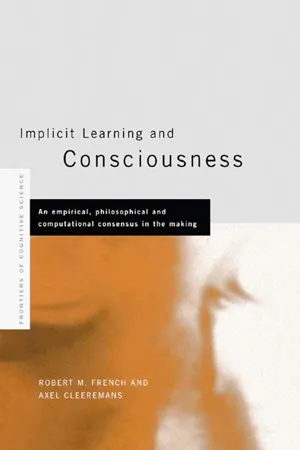
eBook - ePub
Implicit Learning and Consciousness
An Empirical, Philosophical and Computational Consensus in the Making
- 200 pages
- English
- ePUB (mobile friendly)
- Available on iOS & Android
eBook - ePub
Implicit Learning and Consciousness
An Empirical, Philosophical and Computational Consensus in the Making
About this book
Information
Publisher
Psychology PressYear
2013Print ISBN
9781138877412
9781841692012
Edition
1eBook ISBN
9781135431495
CHAPTER ONE
Implicit learning and consciousness: A graded, dynamic perspective
Cognitive Science Research Unit, Université Libre de Bruxelles, Belgium
Facultad de Psicologia, Universidad de Santiago, Spain
INTRODUCTION
Although the study of implicit learning is nothing new, the field as a whole has come to embody—over the last decade or so—ongoing questioning about three of the most fundamental debates in the cognitive sciences: (1) the nature of consciousness; (2) the nature of mental representation (in particular the difficult issue of abstraction); and (3) the role of experience in shaping the cognitive system. Our main goal in this chapter is to offer a framework that attempts to integrate current thinking about these three issues in a way that specifically links consciousness with adaptation and learning. Our assumptions about this relationship are rooted in further assumptions about the nature of processing and of representation in cognitive systems. When considered together, we believe that these assumptions offer a new perspective on the relationships between conscious and unconscious processing and on the function of consciousness in cognitive systems.
To begin in a way that reflects the goals of this volume, we can ask the question: “What is implicit learning for?” In asking this question, one presupposes that implicit learning is a special process that can be distinguished from, say, explicit learning or, even more pointedly, from learning tout court. The most salient feature attributed to implicit learning is, of course, that it is implicit, by which most researchers in the area actually mean unconscious. Hence the question “What is implicit learning for?” is in fact a way of asking about the function of consciousness in learning that specifically assumes that conscious and unconscious learning have different functions. The central idea that we will develop in this chapter is that conscious and unconscious learning are actually two different expressions of a single set of constantly operating graded, dynamic processes of adaptation. Although this position emphasises that conscious and unconscious processing differ only in degree rather than in kind, it is nevertheless not incompatible with the notion that consciousness has specific functions in the cognitive economy.
Indeed, our main conclusion will be that the function of consciousness is to offer flexible adaptive control over behaviour. By adaptive, here, we do not mean simply the possibility for an agent to select one course of action among several possibilities. This, as dozens of computer programs routinely demonstrate, can be achieved without consciousness. Instead, we assume that genuine flexibility necessarily involves phenomenal consciousness (subjective experience), to the extent that successful adaptation in cognitive systems seems to make it mandatory that behavioural changes be based on the rewarding or punishing qualia they are associated with. There would be no point, for instance, in avoiding dangerous behaviour were it not associated with feelings of danger. Learning is thus necessarily rooted, we believe, in the existence of at least some primitive ability for cognitive agents to experience the consequences of their behaviour and to recreate these experiences independently of action. These primitive experiences can then, through more elaborate learning and developmental processes, become integrated into increasingly complex structures that include representations of the self, that is, into a set of representations and processes that enable an agent to entertain a third-person perspective on itself, or, in other words, to look upon itself as though it were another agent. We surmise that any information-processing system that is sufficiently complex to make such processes possible should be characterised as conscious—albeit we might never find out unless this system exhibits the only sort of consciousness that we know of first-hand, that is, human consciousness. We will not discuss this important epistemic debate any further short of noting: (1) that it actually is what the Turing Test is about (see French, 2000, for further discussion of the Turing Test); and (2) that it is perfectly possible to develop simulations of some behaviour that successfully mimics adaptation without requiring qualia, but then, presumably, only at a level of description that would fail to pass more elaborate testing.
Our primary goal in this chapter will thus be to outline a novel framework with which to think about the relationships between learning and consciousness. In the next section, “Adaptation, adaptive changes, and learning”, we propose to define learning as “a set of philogenetically advanced adaptation processes that critically depend on an evolved sensitivity to subjective experience so as to enable agents to afford flexible control over their actions in complex, unpredictable environments”. We continue by discussing the implications of such a definition of learning on current debates about: (1) the nature of phenomenal experience (in the third section, “Consciousness”); and (2) the functions of consciousness in cognitive systems (in the fourth section, “The function of consciousness”). In the next section, “The framework”, we turn to an overview of our own proposal. We continue by briefly illustrating how our framework can be used to understand diverse phenomena in domains such as priming, implicit learning, automaticity and skill acquisition, or development (“Implications”). We conclude the chapter, in which we consider issues that the framework does not address. We should add that this chapter is by no means intended to offer a complete overview of all relevant phenomena and theories, but rather to convey the flavour of what we believe to be an alternative framework in which to consider some of the central issues in the domain of implicit learning.
ADAPTATION, ADAPTIVE CHANGES, AND LEARNING
Mounting evidence suggests not only that the brain is far more plastic than previously thought, but also that the effects of learning can be tracked all the way down to the organisation of local connectivity. To wit: Expert string players exhibit larger-than-normal areas of the somatosensory cortex dedicated to representing input from the fingering digits (Elbert, Pantey, Wienbruch, Rockstroh, & Taub, 1995). Likewise, not only is posterior hippocampus—a region of the brain involved in episodic and spatial memory—enlarged in experienced taxi drivers compared to subjects who do not have extensive experience in memorising complex maps, but the observed size differences further depend on the amount of driving experience (Maguire et al., 2000). There is also considerable evidence that the brain can recover in various flexible ways after trauma, and even suggestions that the very organisation of the somatosensory cortex (the famous Penfied homunculus) depends on prenatal sensory experience (Farah, 1998). More recently, suggestive evidence for neurogenesis was also found in humans (Eriksson et al., 1998), a finding that overturned decades of unquestioned—but, as it turns out, erroneous—assumptions about the lack of regenerative cellular processes in the adult brain. These often spectacular findings all reassert that adaptation plays a fundamental role in cognition, and that its effects can be traced all the way down to the manner in which specific neural circuits are organised.
Given this plethora of new findings hinting that the brain adapts constantly to the environment that it is immersed in, what can we say about the relationships between learning and consciousness? Should we consider processes of adaptation in general to be distinct from processes of learning? Is it the case, as some authors contend (see Chapter 2 and also Shanks & St John, 1994) that learning is always accompanied by conscious awareness? One can ask the question in another way: Why should behaviour always be available to conscious control? It might seem particularly adaptive for complex organisms to be capable of behaviour that does not require conscious control, for instance because behaviour that does not require monitoring of any kind can be executed faster or more efficiently than behaviour that does require such control. Reflexes such as withdrawing one's hand from a fire are good instances of behaviours that have presumably evolved to the point that they have been incorporated in the functional architecture of an organism's central nervous system and cannot be controlled any longer (or perhaps, only with extensive training on self-control techniques).
The relative accessibility of different actions to conscious awareness suggests that an important distinction between adaptation in general and learning is, precisely, the extent to which consciousness accompanies each. Learning, according to many standard definitions (e.g. Anderson, 1995; Klein, 1991; Tarpy, 1997), constitutes a subset of philogenetically advanced adaptation processes that are characteristic of so-called “cognitive systems”, and through which relatively permanent and generally adaptive changes in the behaviour or dispositions of the organism arise as the result of their previous “experiences” with the environment in which they are immersed. From such a definition, it follows that the distinction between learning phenomena and the superordinate class of adaptation phenomena to which they belong depends on the “cognitive” status of the systems in which such learning occurs, and on the ability of these systems to enjoy a particular kind of sensitivity—”experience”. Thus, however many reasons there might be to consider adaptation and learning as fundamentally rooted in the same mechanisms, we do not think that learning can simply be equated with adaptation. Adaptation, indeed, is a very broad concept. When taken to its limit, it might be used to refer to any dynamic relationship between an object and its environment through which: (1) the object changes its states and dispositions; (2) the object does this as a result of its prior sensitivity to the environment; and (3) the object does it in a way that continuously modifies this sensitivity. It should be clear that, by this definition, even inanimate objects such as rocks, thermostats, or computer programs all exhibit patterns of adaptation. Indeed, erosion in rocks, the switch of a relay in a thermostat, or the occurrence of specific digital states in computers, can all be characterised as adaptive “responses” to changing environmental conditions, to the extent that they modify the systems' future sensitivity to the re-occurrence of the same environmental conditions. In living systems, these processes of adaptation are further subject to continuous evolution on a species basis through the laws of natural selection.
Is it reasonable to consider such processes as processes of learning? Consider again standard definitions of learning. What, exactly, in these definitions, does “experience” refer to? Should our “experiences” as human beings be considered as similar to those of stones and amoebas? Certainly not. However, the literature about learning is in general conspicuously prone to conflate the term “experience” with any other kind of phenomenally neutral sensitivity that produces relatively permanent and adaptive changes in the responses of a system. For instance, even though neither machines nor neurovegetative systems are generally considered to be endowed with subjective experience, there is at least one journal that is entirely devoted to “Machine Learning”. It is also relatively easy to find articles in psychological journals in which the changes produced in our neurovegetative systems in response to their environment are analysed as examples of learning (Ader & Cohen, 1985).
While this conflation between “experience” and “mere sensitivity” has had the merit of emphasising that there is a continuity between the processes of change that occur in different natural or artificial systems, it also blurs the distinction between learning and adaptation phenomena in general. In so doing, it has also further contributed to doing away with the distinction between cognitive and non-cognitive systems. Dennett (1996), in particular, has made this conflation completely explicit by assuming that the differences between cognitive and non-cognitive systems (e.g. between most animals and plants) might be only in the eye of the beholder. Indeed, according to Dennett, the main difference between animals and plants is that we tend to adopt an intentional stance when analysing animals' behaviour but do not do so when it comes to understand the dynamics of plant adaptation. As he boldly puts it, there is no reason to dispute the claims that plants should be considered as extremely slow animals whose “experiences” are overlooked because of our “temporal scale” chauvinism (Dennett, 1996) and that libraries should be viewed as cognitive systems that use researchers as tools to reproduce themselves (Dennett, 1991).
While this conclusion strikes many of us as bluntly absurd, perhaps its absurdity should be taken as an indication that we need to revisit the notion of “experience” and, in so doing, attempt to carefully delineate what it entails. Indeed, if learning is a fundamental element of what it takes for a system to be “cognitive” (Dretske, 1988), it might also be the case that the nature of the phenomenal states upon which learning operates is essential to distinguish it from other processes of adaptation. This analysis thus forces us to look into the nature of phenomenal experience in some detail. That is what we attempt to do in the next section.
CONSCIOUSNESS
What is consciousness? While it would be foolish even to attempt to answer this question in this chapter, it might nevertheless be useful to offer guidelines about the sorts of explanations we are looking for, and about which of these are relevant to the study of implicit learning. In the following, we briefly discuss three aspects of consciousness that often tend to be overlooked in discussions of implicit learning: (1) the fact that consciousness is not a unitary phenomenon; (2) the fact that consciousness is graded; and (3) the fact that consciousness is dynamic.
Consciousness is not a unitary phenomenon
Consciousness is not a unitary concept but instead includes different dimensions. Block (1995), for instance, distinguishes between access consciousness, phenomenal consciousness, monitoring consciousness, and self consciousness. Everybody agrees that the most problematic aspect of consciousness is phenomenal consciousness, or subjective experience, that is, the fact that information processing is accompanied by qualia-^lements of conscious imagery, feelings, or thoughts that together appear in our mind to form a coherent impression of the current state of affairs.
In the specific context of research about implicit learning, the central question is thus: Can changes in behaviour occur without correlated changes in subjective experience, and are these changes best characterised as mere adaptation or as learning? This, at it turns out, is also one of the central questions in the ongoing “search for the neural correlates of consciousness” (Crick & Koch, 1990) that has been the focus of so much recent empirical research about consciousness in the cognitive neurosciences. In an excellent overview, Frith, Perry, and Lumer (1999) have suggested organising paradigms through which to study the “neural correlates of consciousness” in nine groups resulting from crossing two dimensions: (1) three classes of psychological process involving, res...
Table of contents
- Cover
- Half Title
- Full Title
- Copyright
- Contents
- List of contributors
- List of figures and tables
- Foreword
- Introduction
- 1 Implicit learning and consciousness: A graded, dynamic perspective
- 2 The Self-organising Consciousness: A framework for implicit learning
- 3 A theory of the implicit nature of implicit learning
- 4 Modularity and artificial grammar learning
- 5 Knowledge representation and transfer in artificial grammar learning (AGL)
- 6 Artificial grammar learning in amnesia
- Author index
- Subject index
Trusted by 375,005 students
Access to over 1.5 million titles for a fair monthly price.
Study more efficiently using our study tools.
Frequently asked questions
Yes, you can cancel anytime from the Subscription tab in your account settings on the Perlego website. Your subscription will stay active until the end of your current billing period. Learn how to cancel your subscription
No, books cannot be downloaded as external files, such as PDFs, for use outside of Perlego. However, you can download books within the Perlego app for offline reading on mobile or tablet. Learn how to download books offline
Perlego offers two plans: Essential and Complete
- Essential is ideal for learners and professionals who enjoy exploring a wide range of subjects. Access the Essential Library with 800,000+ trusted titles and best-sellers across business, personal growth, and the humanities. Includes unlimited reading time and Standard Read Aloud voice.
- Complete: Perfect for advanced learners and researchers needing full, unrestricted access. Unlock 1.5M+ books across hundreds of subjects, including academic and specialized titles. The Complete Plan also includes advanced features like Premium Read Aloud and Research Assistant.
We are an online textbook subscription service, where you can get access to an entire online library for less than the price of a single book per month. With over 1.5 million books across 990+ topics, we’ve got you covered! Learn about our mission
Look out for the read-aloud symbol on your next book to see if you can listen to it. The read-aloud tool reads text aloud for you, highlighting the text as it is being read. You can pause it, speed it up and slow it down. Learn more about Read Aloud
Yes! You can use the Perlego app on both iOS and Android devices to read anytime, anywhere — even offline. Perfect for commutes or when you’re on the go.
Please note we cannot support devices running on iOS 13 and Android 7 or earlier. Learn more about using the app
Please note we cannot support devices running on iOS 13 and Android 7 or earlier. Learn more about using the app
Yes, you can access Implicit Learning and Consciousness by Axel Cleeremans,Robert French in PDF and/or ePUB format, as well as other popular books in Psychology & Cognitive Psychology & Cognition. We have over 1.5 million books available in our catalogue for you to explore.