- 376 pages
- English
- ePUB (mobile friendly)
- Available on iOS & Android
eBook - ePub
About this book
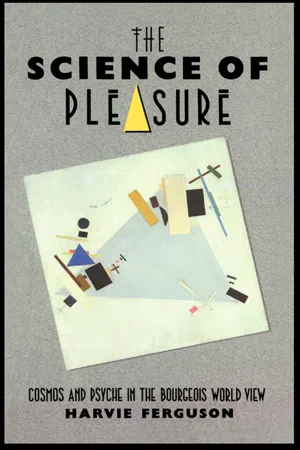
In this rich and original work, the author argues that science is the highest expression of bourgeois thought and whilst it may have liberated mankind, it has also devised new forms of repression, discipline and control.
Trusted by 375,005 students
Access to over 1.5 million titles for a fair monthly price.
Study more efficiently using our study tools.
Information
Subtopic
Social PsychologyIndex
Social SciencesPart One
FUN
The tragedy of our age is reason.
Søren Kierkegaard
In every man there is a world, a universe.
Giordano Bruno
Chapter One
THE DREAD OF CHAOS
Life in bourgeois society is contained within a series of inescapable contradictions.
No description of the human reality of capitalism can resist, nor any history of its culture avoid, the brutalizing exclusiveness engendered by almost 400 years of inconclusive struggle. Its loving polarities, subject/object, mind/matter, theory/fact, form/content, being/nothingness, exchange/use, are so many ways of rendering experience coherent by dividing it against itself. In its world all possible phenomena are categorized through the successive invocation of a universal Either/Or. In this, of course, bourgeois society is not unique. ‘Dual organization’ is the central organizing principle of many cultures.1 And the bourgeois world cannot be defined, therefore, solely in terms of such formalisms; it must be described by reference to the entire range of social meanings embedded in the antagonistic differences specific to its ideal order.
A direct analysis of these meanings, however, tends to reproduce rather than to interpret the very categories we wish to investigate. A cautious, elliptical approach has to be adopted. Before looking more closely into the favourite antitheses of bourgeois culture, the larger implicit distinction between the possibility of any such ideally ordered existence (reason) and its apparently inconceivable negation (unreason), must be examined.
Bourgeois cosmology includes, that is to say, not only the familiar, rational ordering of nature and human experience, but also and simultaneously a kind of negative image of itself. It is thus something more than that self-conscious ‘world view’ that generations of ‘theorists’ have tried to make safe for reason by assiduously excluding from it everything chaotic or frivolous. It was a process of purification that never quite succeeded. Fun could not be completely excluded from the rational cosmos. It persisted in the diminishing but never-eliminated residue of ‘unexplained’ phenomena. Its awkward presence was felt more generally, within the literary tradition at least, as an uncomfortable intuition of cosmic disorder.2 And it challenged, with growing confidence, a century of metaphysical radicalism with a number of rather obvious ‘facts’ of experience.
If bourgeois society was the realization of universal order, then human nature must be, in itself, the embodiment of reason. The evidence of history told against such a view, but for the philosophe, secure in the new cosmopolitan world of commerce and letters, history could be viewed (with some difficulty, it is true) as a perverse story of ignorance and error. Those obstacles removed, reason, nature, and society could be linked together in mutually reinforcing enlightenment.3
More recalcitrant than the broad sweep of narrative history, the spectacle of children, savages, and lunatics posed special difficulties for any comfortable theory of human self-improvement. Human, yet by no means reasonable, each existed alarmingly within self-enclosed worlds of their own. They did not share, it seemed, in the universe illuminated by Newton and Locke. A brief sketch of the philosophers response to defiant irrationality reveals the extent to which they failed to exclude from the realm of enlightenment all that was dangerously incoherent
Simplifying a good deal, we can say that throughout the eighteenth century, especially in Scotland and France, men of letters gave themselves to the task of self-examination. As rational individuals they could, in following an introspective method, recover a universal human nature. This ambition is as evident in the magisterial coolness of Hume’s Treatise on Human Natures it is in the flamboyant emotionalism of Rousseau’s Confessions. Both in fact sought to expose, systematically and unreservedly (one might almost say carelessly) the elements of a shared humanity. In this project reason came to play a dual role. It served to designate both the common criteria of the human as a species, and the method by which such an enquiry should be conducted.4 Without reason we could not be human, and in the absence of reason we could not begin to describe the special character of humanity bestowed upon us by its possession.
In other words, during the period of confident capitalist expansion, reason was not simply a logical or intellectual faculty. It was that certainly, but it was also more than that. Reason was the synthetic unity of human nature itself, and not just one of its ‘powers’. It must therefore be the common property of mankind, and could not, by being made dependent upon a technical function, become a monopoly enjoyed exclusively by the educated. Reason propelling before it a spirit of democracy must constitute the very ‘frame of man’.
The divisions proper to reason (the components of human nature) underwent continuous modification throughout the eighteenth century. The simplicity of those abstract dualisms which had their origin in Descartes’ project of pure thought, gave way before the claims of moral and aesthetic sensibilities.5 Terminology varied, but some such set of distinctions, comparable to that of intellect, emotion, and will, was general. Hume’s Treatise, for example, was divided into three books, ‘Of the Understanding’, ‘Of the Passions’, and ‘Of Morals’, corresponding in an approximate fashion to such a three-fold classification. The point of such schemes was to define the absolutely irreducible and ‘simple’ processes common to human nature; those internal ‘mechanisms’ which transformed the contents of a sensory manifold into perceptions of the world.
Human nature could be defined, therefore, as an internally ordered system of relations among intellect, emotion, and will. The Enlightenment might then be characterized as the choice of intellect, as the medium of humanity’s synthetic unity. Reason progressively came to stand both for the irresistible expansion of knowledge and understanding, and for the mechanism of coherence unique to human nature.6 It ought perhaps to be noted that there was no necessity in such a view. In principle, either emotion or will (or some more remote ‘transcendental’ faculty) might have furnished such a mechanism, as indeed they were subsequently held to do. Bourgeois culture, however, even at a later date when in full possession of Schopenhauer’s and Freud’s alternative reconstructions of the human subject (the first from ‘will’, the second from ‘emotion’), remained remarkably faithful to its first choice; to Man as Reason, and to Reason as Thought.7
Socially, these internal divisions can be related to the major spheres of collective life; to circulation, to production, and to consumption. Such a connection can, for the moment, only be suggested intuitively.8 Production and the will ‘belong together’ as the energy of all humanly creative processes. Consumption and emotion, dissolving into an access of pleasure or grief, are linked as the termini of processes of exchange. And circulation, especially during the eighteenth century, evidently shares with the intellect a realm of ideal freedom. Neither in ‘thought’ nor in the circulation of commodities can anything be created or destroyed. Both are perfectly conserved worlds filled with objects of terrifying abstraction.9 The epoch of merchant capital is not accidentally also the era of enlightenment.10 Deserting systematic metaphysics, however, the philosophe cultivated a form of literature (varied, self-possessed, humane) that exemplified the virtues of synthetic reason rather than those of ‘cold logic’.11
These parallel divisions allow us to grasp more securely the significance of children, lunatics, and savages as prototypically disordered lives. There was more than academic issues at stake here. It was not just a game about the limits of conceivability. It was a matter of conduct. Reason, it seemed, could be negated and the human world inverted. Children, lunatics, and savages were human and yet they were not rational. They were living paradoxes whose existence undermined every certainty. Each, in addition, was non-rational in a particular way, so that together they formed a strangely logical sequence; an organized multiplicity in the forms of chaos; an underground system to mock the careful elaborations of the orthodox cosmologist.12
Unreasonableness might be approached, then, in two rather different ways: as a ‘normal’ human synthesis of one or more ‘inadequate’ faculties, or as an inadequate synthesis of normally functioning faculties. In practice, of course, both interpretive techniques were employed in the effort to shed light on these difficult subjects.
CAPRICE
‘We know nothing of childhood,’ Rousseau flatly declares, setting out to exploit his own ignorance.13 Childhood for him, as for his contemporaries, had become a cultural enigma, and children held for them all the fascination of an alien species. However exaggerated or oversimplified the claims of a generation of sociologists directly linking the ‘emergence’ of the modern nuclear family with the rise of the bourgeoisie may be, there seems little doubt that the image of childhood has undergone significant changes during the development of capitalism. It was specifically in bourgeois society that an association between age and dependence was established. Aristocratic youngsters of the sixteenth and seventeenth centuries could lead lives as liberated and independent as those of their parents, while during the same period economically unfree peasants, unable to marry or to establish households of their own, were held to exhibit well into their thirties those intellectual and moral characteristics that the bourgeois age came to regard as ‘childish’.14 Liberated from the necessity of labour yet excluded from the adult social world, childhood became an increasingly puzzling phenomenon. Its sequestration was justified on the grounds of children’s ‘immaturity’ and ‘helplessness’, on their evident need to be ‘looked after’. Yet, as a general type, childhood could not be understood solely in terms of a ‘developmental’ process. The non-rationality of the child was not simply the absence of ‘adult’ qualities which would, in due course, make their appearance. Were they, for example, completely bereft of intellect? If so, then from what source did logical faculties subsequently spring? And what of the will? In some ways children seemed possessed of a will more highly ‘developed’ than that of the typical adult Clearly there was not just a change in scale here but an internal re-ordering of the basic elements of human nature.
The key to the different ‘structure’ of childhood subjectivity was found in the special character of the childish ‘will’. This follows directly from the fact of their exclusion from the process of production, which is the social form best adapted to the expression of the will. The child’s will, in being wholly ‘liberated’ from the necessity of labour, appears perverse, violent, unpredictable, transparent, and insincere. As a critic of bourgeois domestic indulgence as well as aristocratic indifference, therefore, Rousseau complains that ‘If we did not spoil our children’s wills by our blunders, their desires would be free from caprices’.15 And he notes elsewhere that, more properly speaking, children cannot be said to have desires at all. They want nothing in particular, and in expressing their wishes they are subject to nothing more substantial than a whim. Children altogether lack that settled self-identity which is the precondition and consequence of the will. They can only wish; a free and lively mobility of feeling that is directed towards nothing but the growth of their own faculties (if they are left alone), or the borrowed vanity and presumption of their elders (if they are not).
Children’s actions are remote from their ‘real’ needs which depend for their satisfaction upon the indulgence of adults. Wishing therefore, which is the subjective corollary to a dependent relationship, is held to be typical of their ‘inner’ life.16 The ‘natural’ activity of children thus came to be defined as play. Locke’s letters to Edward Clarke are an early recognition of this fundamental proposition. Children ‘must play and have playthings’, he insists—a view echoed from a different perspective by Rousseau and every child psychologist since.17
Play supposes a world of Utopian abundance. As they are ignorant of the practical necessity of labour, there is no material reality to resist children’s tyrannical caprice. In play all things become possible—or rather, nothing has yet become impossible. The ‘object world’, variously differentiated as the toys effortlessly conjured into being by the momentary exigencies of a game, is dissolved and re-formed without limit Play treats the ‘objective’ characteristics of the world as the paraphernalia of fun. And, since its endless metamorphoses are purely subjective, the ‘laws of nature’ can be ignored or contradicted. Who has not at some time swooped effortlessly over distant countryside, enraptured by the liberty of unaided flight?
The play world completely absorbs the child. Within it nothing is difficult. Rousseau noticed that, while playing, children frequently ‘endure without complaint, hardships they would not submit to otherwise without floods of tears’.18 Fatigue is alien to its spirit of continuous originality. Even a simple repetitive game is never tedious; the hundredth bounce and catch of a ball is as fresh and lively as the first The child thus engaged is unaware of our world surrounding and threatening his own.
This subjective freedom is neither private nor egoistic. It cannot be ‘planned’ or deliberately invoked. It has merely to be granted its own possibility to ‘happen’. And if it does not ‘come off’, children complain of ‘boredom’ and ask in bewilderment, ‘What shall we play?’19
Such a world is sensed rather than conceptualized. The child’s first mental experiences are purely affective, she or he is only aware of pleasure and pain’, claims...
Table of contents
- COVER PAGE
- TITLE PAGE
- COPYRIGHT PAGE
- ACKNOWLEDGEMENTS
- INTRODUCTION
- PART ONE: FUN
- PART TWO: HAPPINESS
- PART THREE: PLEASURE
- PART FOUR: EXCITEMENT
- CONCLUSION: INTIMATE COSMOLOGY
- NOTES
- BIBLIOGRAPHY
Frequently asked questions
Yes, you can cancel anytime from the Subscription tab in your account settings on the Perlego website. Your subscription will stay active until the end of your current billing period. Learn how to cancel your subscription
No, books cannot be downloaded as external files, such as PDFs, for use outside of Perlego. However, you can download books within the Perlego app for offline reading on mobile or tablet. Learn how to download books offline
Perlego offers two plans: Essential and Complete
- Essential is ideal for learners and professionals who enjoy exploring a wide range of subjects. Access the Essential Library with 800,000+ trusted titles and best-sellers across business, personal growth, and the humanities. Includes unlimited reading time and Standard Read Aloud voice.
- Complete: Perfect for advanced learners and researchers needing full, unrestricted access. Unlock 1.5M+ books across hundreds of subjects, including academic and specialized titles. The Complete Plan also includes advanced features like Premium Read Aloud and Research Assistant.
We are an online textbook subscription service, where you can get access to an entire online library for less than the price of a single book per month. With over 1.5 million books across 990+ topics, we’ve got you covered! Learn about our mission
Look out for the read-aloud symbol on your next book to see if you can listen to it. The read-aloud tool reads text aloud for you, highlighting the text as it is being read. You can pause it, speed it up and slow it down. Learn more about Read Aloud
Yes! You can use the Perlego app on both iOS and Android devices to read anytime, anywhere — even offline. Perfect for commutes or when you’re on the go.
Please note we cannot support devices running on iOS 13 and Android 7 or earlier. Learn more about using the app
Please note we cannot support devices running on iOS 13 and Android 7 or earlier. Learn more about using the app
Yes, you can access The Science of Pleasure by Harvie Ferguson in PDF and/or ePUB format, as well as other popular books in Social Sciences & Social Psychology. We have over 1.5 million books available in our catalogue for you to explore.